Showing posts with label Ted Levine. Show all posts

Wednesday, July 5, 2023

American Gangster

Written at the time of the film's release...

"That's What's Wrong with America. You can't Find the Heart of Anything to Stick the Knife In"

American Gangster tells the story of Frank Lucas, who, for a time in the 60's and 70's, ran the most successful narcotics operation in Harlem. The film is based on a "New York" magazine article from an interview with the real-life Lucas, so it must be based on fact, right?*

Ridley Scott's played fast and loose with facts before (1492, Black Hawk Down), so one should take the credit "Based on a True Story" with a kilo of salt (or a pound of cocaine). 
 
But, that aside, how is the movie?
It tells the parallel stories of Lucas' rise in power on the Harlem streets by "cutting out the middle-man" smuggling in raw opium from Thailand, and manufacturing a concoction called "Blue Magic" that had twice the potency, but at half the cost, with the story of the cop who eventually busted him, a down on his luck detective named
Richie Roberts who's too honest to be trusted by the New York Police. 
While Lucas starts to make his version of the American Dream, Roberts continually has his legs knocked out from under him--his wife leaves him, takes his kid, he struggles with classes to better himself (public speaking, law), his partner turns junkie, and implicates him in a murder. The movie drips with irony at every turn, constantly showing the easy path of Crime and the tough road of Law Enforcement, that recalls that epitome of the thesis—"
The French Connection."
**
In a montage of Thanksgiving, Lucas is shown with his entire family at a stereotypical Thanksgiving spread (and in one of the more heavy-handed of Scott's directorial choices frames it like
Norman Rockwell's "Freedom from Want" painting, while Roberts, makes a cold sandwich of canned turkey-spread and potato chips over the kitchen sink. But then the director re-ups it by showing junkies shooting up between their toes in grimy bathrooms, and a mother passed out in bed, while her child is screaming in the room. Whatever glamour Lucas may enjoy, Scott is particular about showing the cost in human misery. No one gets off "Scott"-free.
Washington takes aim at a rival...
...and it's Idris Elba!
Sometimes the tables are turned. Lucas occasionally has troubles in the operation, and however much he may espouse core-values of honesty and integrity, the very nature of his business starts to rot his dreams for his family. And the more Roberts investigates, the closer he comes to his target, the more his team of "Untouchables" gel, and his investigation and life begin to come into focus.
Ridley Scott misses as much as he hits. For every good film (The Duellists, Alien, Black Hawk Down, Thelma and Louise), there is a terrible one (Legend, 1492, Someone To Watch Over Me, G.I. Jane, Hannibal, A Good Year), and some that have just enough quality in them (Blade Runner, Gladiator, Matchstick Men) that his directorial brio can compensate for weaknesses and messy scripts. But here, he has a cracker-jack script by Steve Zaillian, no worries about creating "a world" out of whole cloth, and a stunning cast that includes Clarence Williams III (uncredited), Joe Morton, Armand Assante, Josh Brolin, Cuba Gooding, Jr., the magnificent Ruby Dee, Ted Levine, Roger Bart, Carla Gugino, Chiwetel Ejiofor, and top-lined by Russell Crowe, but especially Denzel Washington. When these two heavy-weights get together, their scenes crackle with invention. Everybody does incredibly lived-in work.
And nobody less than the director. This is Ridley Scott's best film in ages. At times the details get a bit murky, but Scott does so to keep a multi-faceted story moving at a brisk pace. And he pulls off some amazing little camera tricks that stun, and some of the most unpretentious action-sequences put to film. Those action sequences are rough stuff--the film begins with the immolation and point-blank gun-down of a mob rival--and the junkie sequences are harrowing, so one should be warned. But missing it would be missing a great film.
* Merely a casual glance at the internet will disprove a lot of myth from fact. Lucas did not work for crime boss "Bumpy" Johnson for 15 years, but five (he's been in prison before), he was not with him when he died, did not marry "Miss Puerto Rico," or own "Small's" nightclub. And that's just the start for Lucas. The real Roberts is a bit miffed that to attract Crowe, they beefed up his part by making him more of a loser. Lucas admits that the film is "about 20% true."
 
** The names "Eddie Egan" and "Sonny Grosso" are invoked early on, and Crowe's Roberts employs a foot-chase under the "El" that figured so prominently in the movie.

Thursday, March 14, 2019

Jurassic World: Fallen Kingdom

Jurassic World: Fallen Kingdom (J.A. Bayona, 2018) I didn't go see the latest installment of the "Jurassic Park" series when it was in theaters because its predecessor Jurassic World didn't do anything new, but merely switched out new characters for the old (with the exception of Jeff Goldblum), and continued with the idea that, despite the mayhem from three previous movies, someone—or some conglomerate—would still think it was a good idea to create a theme park around living, breathing, carnivorous, and entirely untrainable giant lizards. Then, they went with the crazy idea that someone—especially Chris Pratt's Owen Grady—could train veloci-raptors and—because science fiction reality isn't enough—that one could create NEW dinosaur types by tinkering with their DNA. There is just so much evidence that this is a Capital B-Capital I-Bad Idea on so many levels, but the movie had to track away from the original's "naivete of visionaries" theme to the naivete and craven greed of corporate interests. You can always count on corporations to do the wrong thing when a buck is concerned. So, the initial under-pinning of "just because you CAN do something, doesn't mean you should" gets lost in a message so obvious and ever-present, any novel new idea gets swamped by it.
Well, along comes Jurassic World: Fallen Kingdom, and it recycles Spielberg's (rare) sequel film The Lost World: Jurassic Park, like so much re-captured DNA, with only a few changes to people, places, and things.
In that, the ne'er-do-well nephew of park creator John Hammond decided that, despite the disasters evident in the first film, he would ship a bunch of the dino's over to the U.S. (that wasn't in Crichton's follow-up novel, but Spielberg really wanted to have rampaging T-Rex's tromping through city-streets before some hack did it) for profit—because it worked so well having them on Isla Nublar.
Again, very bad idea. But, it's the exact same premise of Fallen Kingdom. This very bad idea is predicated on the issue that the volcano on Isla Nublar has decided to go super-nova, and so a mission is undertaken—by Hammond's business partner Benjamin Lockwood (James Cromwell) to save as many different dino-types as possible and put them on a new island—don't most large  islands have volcano's?—where they'll be safe to wander around without trampling any tourists (and, evidently, there are dino-preservationists who, since we've already messed with the natural order of things, think we should protect dinosaurs because they're so warm and cuddly, fit right into our eco-system, and besides "what could go worng? This is how Claire Dearing (Bryce Dallas Howard) gets roped into the thing and this movie.
And if she's onboard, she'll get Pratt's raptor-trainer to coax "Blue" the remaining raptor from the last movie to get into a cage, or even sit on his lap, for the long flight to the new paleological digs.
This would be all fine-and-dandy (if a Bad Idea), if the intent was to actually re-locate the dinosaurs. But, no, it's a ruse by those shadowy corporate interests to auction off species for their potential uses of weapons of mass-stomping (they probably didn't show King Kong as the in-flight movie). Again, Bad Thing to do, but, then, a sequel was a bad thing to do, as well—so, one can imagine that such a thing might be possible.
The movie does have one nice little wrinkle to it that might be considered an interesting idea, and that is how they employ the standard "spunky little kid" into the scenario, which does utilize the "just because you CAN do it, doesn't mean you should" theme to its maximum and logical conclusion. It is the one interesting idea in this sorry mess.
It is a sad thing to see, especially considering the director. J. A. Bayona has made a couple of really good, if not especially profitable films—A Monster Calls and The Impossible. Both of them are miles apart in genre and subject matter—one based on a popular children's book and the other on a true incident that occurred during the catastrophic tsunami in Thailand in 2004. It must have been tempting to take this talented director and try and goose his box-office appeal with a franchise-piece. But, it might have better served the director (and movies in general) to have allowed him to merely go with his muse and develop a project of his own leanings to create something truly unique as has been seen in his work in the past.
That might have been a GOOD idea.


Wednesday, August 17, 2016

The Assassination of Jesse James by the Coward Robert Ford

Written at the time of the film's release with a 2016 post-script

The Assassination of Jesse James by the Coward Robert Ford  (Andrew Dominik, 2007)

Poor Jesse had a wife to mourn for his life,
Three children, they were brave;
But the dirty little coward
that shot Mr. Howard*
Has laid Jesse James in his grave

That's from the old song "The Ballad of Jesse James" which I remember from my youth, forever enshrining James and the "dirty little coward" Robert Ford in my memory. It was written by one Billy Gashade (who took pains to include himself in the lyrics, naturally) soon after the outlaw's death. As with so much in the Jesse James business, it is reflective of the myth of Jesse James rather than the reality. 

For instance (as the Ford character points out in the movie) Jesse only had two kids. 
The fact behind the myth was that Jesse James was a vicious little punk—racist, paranoid, just as capable of killing friends as enemies, and women and children in the bargain. And while it's true he did rob from the rich—his target was banks and trains (or Union veterans)—the legend that he gave to the poor only extended to himself and members of his gang. 
Besides, you rob from the rich because that's where the money is.

No one who sees Jesse James as a folk-hero, or seeks to profit from that image, mentions the mutilations he would perform on his victims. It kinda gets in the way of the "fun." Yet, folks in Missouri still talk of the history of Jesse James (I once stayed in a hotel that advertised he slept there), and there's even a feud going on about whether Jesse really did die, and there are folks who want to dig him up to check DNA evidence to claim family affiliation. The myth rolls on. The lies that were sold in the pulp-magazines during his life are still at work, and as the line from The Man Who Shot Liberty Valance goes: "This is the West, sir. If the Legend becomes Fact, print the Legend." Even if it is a god-damned lie and the guy was a scum-bag.
It is the yin and yang of truth and fiction that suffuses The Assassination of Jesse James by the Coward Robert Ford, but then it did in reality, too. The conceit of the film (and the book by Ron Hansen on which it is based) is that Robert Ford was a product of a pulp-western inspired hero-worship, that Jesse had his eye on the stories, too, and their mutual attraction and loathing of the truth behind it was the music to the dance of death they engaged in. Robert Ford was a nobody, and, in the film's words "Jesse James stood as tall as a tree." And that set up a love-hate relationship with the unstable hoodlum. "I can't figger it out," says Brad Pitt's Jesse to Casey Affleck's Bob Ford. "Do you wanna be like me, or do you wanne be me?" 
In the film, Ford doesn't know himself and the answer changes depending on his fortunes...and his fears. But as the cliche goes there's only room for one of them, and if there's no doubt that the strong will prevail, there is some question which one that would be. Maybe it will merely be a case of who is the least weak. Ironically, both will go on to greater fame and infamy.
Andrew Dominick's film meanders between an informative narration** spoken over landscapes beneath time-lapsed speeding clouds, as if Nature is careening to a foregone conclusion, while the figures take their own sweet time getting there. Dominick has a formalism going with those fleeting clouds and shots that are framed by a time-distancing diffusion. But it's very inconsistent, and rendered meaningless--no doubt due to post-production cutting by Producer Ridley Scott and star Pitt to punch up the pace. 
If it's not all Dominick wanted it to be, at least there remains some terrific performances all-around. Pitt is at his enigmatic best here, an unreadable half-smile on his face in all occasions. Sam Rockwell as Ford's older brother and fellow gang member gives another off-kilter performance that is spot-on. Along the way there are terrific cameos by Sam Shepard, Michael Parks and Ted Levine (and one distracting one by James Carville), but the stand-out is Casey Affleck. Affleck is every insecure, withdrawn kid who talks big, with a defensive smile on his face, and eyes that roll protectively up into his head when challenged. He's a train-wreck waiting to happen. And Jesse James specialized at trains.
If you're of a patient frame of mind, and have a taste for an unromantic West with heavy-handed irony then The Assassination of Jesse James is for you. But if not, it's a rental.
Narration: He was growing into middle age, and was living then in a bungalow on Woodland Avenue. He installed himself in a rocking chair and smoked a cigar down in the evenings as his wife wiped her pink hands on an apron and reported happily on their two children. His children knew his legs, the sting of his mustache against their cheeks. They didn't know how their father made his living, or why they so often moved. They didn't even know their father's name. He was listed in the city directory as Thomas Howard. And he went everywhere unrecognized and lunched with Kansas City shopkeepers and merchants, calling himself a cattleman or a commodities investor, someone rich and leisured who had the common touch. He had two incompletely healed bullet holes in his chest and another in his thigh. He was missing the nub of his left middle finger and was cautious, lest that mutilation be seen. He also had a condition that was referred to as "granulated eyelids" and it caused him to blink more than usual as if he found creation slightly more than he could accept. Rooms seemed hotter when he was in them. Rains fell straighter. Clocks slowed. Sounds were amplified. He considered himself a Southern loyalist and guerrilla in a Civil War that never ended. He regretted neither his robberies, nor the seventeen murders that he laid claim to. He had seen another summer under in Kansas City, Missouri and on September 5th in the year 1881, he was thirty-four-years-old.


The view from 2016: 

I was writing less and faster when I did this and there are some things that are remiss. In hindsight, I should mention it's an early film, not only of Sam Rockwell, but a pre-fame Jeremy Renner, the wonderful Paul Schneider, and Garret Dillahunt, as well as brief cameos by Nick Cave and Zooey Deschanel.
But, I think the biggest sin here is there isn't even a mention of Roger Deakins, who did the cinematography. One thing that DOES stand out about The Assassination of Jesse James, besides its rather astringent presentation—narration over tableau/scene/narration over tableau—is the beautiful imagery Deakins pulls out of his camera, to the point where it's almost trying to create myth in its own manner, by the sheer beauty and care of the images, some even diffused at the edges to give it a "magic camera" feel. 
Deakins, the go-to cameraman for the Coen Brothers, Sam Mendes, and so many others, knows that the images will become as communicative as the narration in those tableaux and he has a great ally in Dominick (who is also a cinematographer, working with Terrence Malick on The New World) in achieving amazing images throughout the film, but none more so than when the world is still and actors are not having to hit marks.
Narratively, the film is still a bit of a mess, but a second look recently struck me how beautiful the thing looks. It truly one of the best examples of Deakins' work in a storied career.

* "Thomas Howard" was the alias Jesse James was using at the time of his death.

** The narration has its own problems. One is not too sure of its reliability. For instance, in describing Jesse it states that he had "granulated eye-lids" which caused him to blink excessively, though part of Brad Pitt's performance is a protracted concentration, where he stares but does not blink. Then, the narration goes all flowery on the subject "...caused him to blink as if the world was too big to take in for too long." The film has its own problems with truth and myth.

Thursday, October 23, 2014

The Silence of the Lambs

The Silence of the Lambs  (Jonathan Demme, 1994) "I will NOT go see a movie like THAT!"

My client was adamant. I knew what he meant. I was repulsed by the idea, myself. After all, it was based on a novel by
Thomas Harris, the most ghoulish and cruelest of thriller writers. I'd read "Black Sunday" and it had an image I wish I could sand-paper out of my mind. I'd read "Red Dragon" (and seen it's Michael Mann movie adaptation, Manhunter), but I hadn't read "The Silence of the Lambs." After "Red Dragon" I swore off his novels. Harris went places I just didn't want to go...ever...not even in a pulp entertainment.

But the "buzz" about
The Silence of the Lambs was so good, I had to go. My wife didn't want to see it ("UH-uh"). But a female colleague heard I was going (and her husband was "in no way" going to see it), so we agreed to meet up at the theater—almost like a dare—and satisfy our morbid personalities.

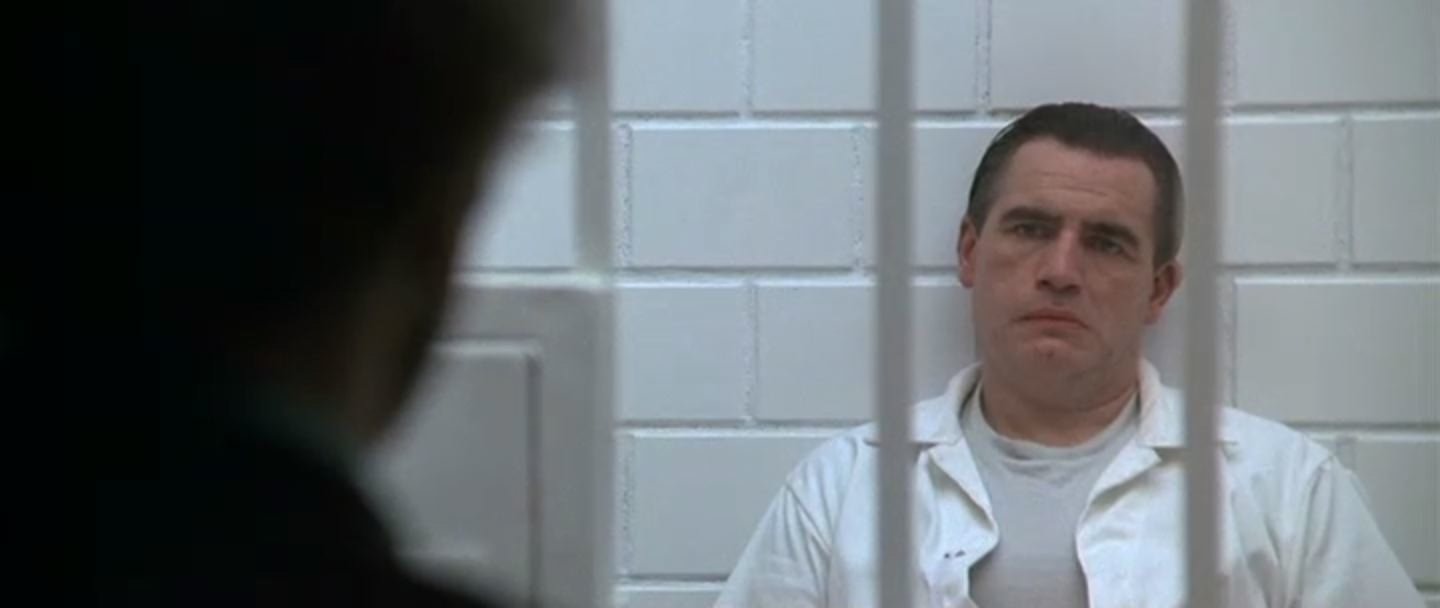
See, I'd seen Manhunter (starring pre-"CSI" William Petersen and Joan Allen), and the most intriguing thing about it was the introduction of a character named Dr. Hannibal Lecter* (played in Manhunter by Brian Cox). Lecter was an über-villain, like Dr. Mabuse. An insane genius psychiatrist, far more twisted than his clients, and he seemed unstoppable and uncontainable. Indeed, he was portrayed as a criminal so dangerous, he was kept in an impenetrable transparent cage of perspex. Cox played him agitated, and as a cannibal, he perpetually chewed gum, as if to satisfy a craving (or to keep his jaw strong).
 
A study in contrasts: Brian Cox (above) and Anthony Hopkins (right) as their respective Lecters.
 
Anthony Hopkins famously played him in The Silence of the Lambs as an unblinking, supremely confident being of stillness. When we first see him (after an extended build-up talking about how dangerous he is), the camera slides him into view—and he's already waiting for us. That's a bravura move (done in silence, purely visually, pure cinema) in collaboration between Hopkins and director Jonathan Demme (who has never been so "to-the-bone" instinctual in his set-ups). Our first sight of Hopkins is a shock; he's not doing anything. Nor does he have to. In a dungeon-cage with a transparent front (not bars, as they're too penetrable, but more like a zoo for observation), he still is in control of the situation and knows it, and his "laser-like intellect" has already begun profiling his prey, FBI Agent Clarice Starling (a bird's name, indicative of small, tremulous life), played by a subtly vibrating Jodie Foster (who's brilliant).
This is a horror movie. And the best horror movies don't just scare us. They touch a nerve, grab on tight and slither up into our brains and take root, never leaving us. They know what scares us, right down to the DNA in our collective alligator brains, and individually to our unbidden (but specially created) nightmares. And like Jaws, The Silence of the Lambs serves up one of the special horrors to our conqueror species: fear of being eaten...consumed. It's not just the dying and the reduction to meat, but it's taking away ourselves, our "souls," our specialness and uniqueness (like Gene Hackman's Sheriff in Unforgiven blurting down the echoing cave of a gun-barrel: "I was building a HOUSE!"). "Deserves got nothing to do with it."

And that's a horror.  A true horror. A viscerally twisting fear of humankind, that we don't matter, everything that we are, that we do, can't hold off Death. Any Death. Every "snuff" makes us just dust in the wind. And everything we are amounts to nothing. "Tell her to paint an inch thick.  To this favour, she must come."

"Make her laugh at that."

Sure, it's a horror movie. But becoming carrion is one thing. This is about skin-suits. Bad enough to be turned into a meal, yes. But apparel? 

Yeee-EEE-eee!

So, that's the reason so many people might NOT want to go see The Silence of the Lambs. What is there, of such value, to see it? To face your fears and walk into the darkened theater to face these horrors?
There is a subtle sub-text in the film and a not-so-subtle-visual one. One of the travails of Agent Starling is to go through her rigorous FBI training, the obstacles, the paths, includes making her way through a traditional world (and institution) of men. She is often under-estimated (except by, of all people, Lecter, who is intrigued and challenged by her: "People will say we're in love" is his witty reversal on it) and must point out to the officious males she's dealing with (and it is dealing) that they are treating her in a subordinate manner ("You know, we get a lot of detectives here, but I must say I can't ever remember one as attractive."), even though she calls everyone—her superior Jack Crawford (Scott Glenn), Lecter, even the serial killer she's seeking (the terrific Ted Levine, whose brave work in this film should never be unacknowledged in any review) "sir." 
Foster's Starling is a victim, too, although she won't succumb to victimization. She fights it. And she fights the battle for the women whose lives have been lost through the pathological extension of that subjugation, and, with her work, might be saved. Reduction of the human being is the tough theme that runs through The Silence of the Lambs, and it is perpetrated by serial killers and officials alike, anyone who assumes more authority than they are due. Or more superiority than they deserve. We all covet that to some degree. Look in the mirror.

What looks back?
"The eyes are the window to the Soul" they say (although it's difficult to trace who originally said it). And director Demme makes sure we see them, both eyes and souls. Frequently, even in conversations, he will photograph the actors looking straight on, their eyes on a direct axis with the center of the camera lens (and thus, the audience). A lot of directors do that (Spike Lee and Woody Allen, for instances), but more often than not, those uses are to have the characters speak directly to the audience, breaking the fourth wall between player and played. Not Demme (and this is what makes Silence unique). Whole conversations happen, with the actors looking out at us, as if we are the ones having the conversation—we connect with them, those flickering phantoms on the screen, making them more than casual phantoms, the ones we merely observe as if they were any passer-by on the street. We look into those windows, see the Souls (even those of the Soulless) and immediately those beings have value and worth, not just victims of our gaze, but true intimates, more than the mere shells that envelop their spirits.

And this is what separates The Silence of the Lambs from the many serial-killer/slasher movies that stalk through the genre—separates it a full 180° from the other films, in fact. So many of those use the POV subjective shot of the killer observing and hunting its prey (and Demme uses it, too, in the nerve-jangling final confrontation between Starling and "Buffalo" Bill). So many used it, in fact, that it became a cliché of the type, putting us in the uncomfortable position of seeing the world through the victimizer's vision, rather than the victim's—the hunter's, rather than the hunted's—accompanied by the rasping inhuman breath of the coveting, rather than the pleadings of the coveted. The Silence of the Lambs breathes new life into the form, elevating the victim, the genre...and us. It gives value to the human being, and in so doing, raises itself up, as well.
---------------------------------------------------

"So," the client began tentatively. "I went to go see Silence of the Lambs... 

"And?" I offered. "Wha'd ya think?"

He blurted. "Ya know, that was a REALLY GOOD movie."

Yes, it is. Still is. Repulsive, still, certainly. But a great movie.


And it still has the distinction of being the only horror movie to win the Best Picture Oscar, and, even rarer, to win the Big Five categories (Best Picture, Director, Actor, Actress, Screenplay), all deservedly so.


* In Mann's film, he's Hannibal Lecktor, a more oral-associated mad scientist name.