Showing posts with label Carla Gugino. Show all posts

Tuesday, April 15, 2025

The Friend (2024)

White Ghost/Sad Pony
or
"What's Going To Happen To The Dog?"

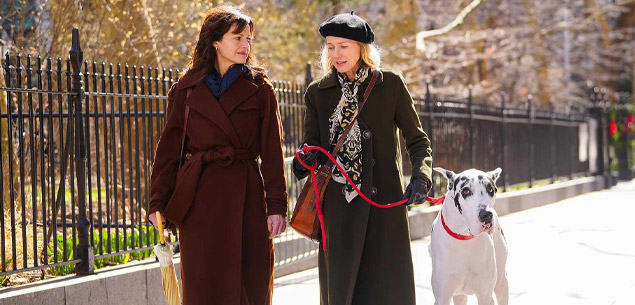
As soon as it's over, you want to watch The Friend again. It's that good, with a literate script, masterful performances (from everybody, not just Naomi Watts and Bill Murray...or the dog, Bing), New York as a background, an intricately selected soundtrack, and the least anthropomorphic animal performance I've seen in a long time.

And, it's a "dog" movie.

I hate "dog" movies, usually. You know why. The dog always seems to die at the end, usually in the dramatic interest of teaching the film's protagonist a life-lesson of great import. Like "life is a gift" or "appreciate what you've got when you've got it." Blah-de-blah-de-blah. I'm cynical of the form because I hate to cry in theaters and beating me with a dead dog turns me into a blubbering wreck and I hate to throw away all the soggy popcorn. The one time I didn't was when John Wick's dog was murdered and that it inspired him to come out of assassination retirement (which I giggled at, finding it perversely ludicrous).
But, this one I rushed to see because, well, 
Naomi Watts and Bill Murray are in it and their taste in parts alone should sell it, some laudatory words online were mentioned, and it's based on a Booker prize-winning novel by Sigrid Nunez. All indications were for some good breeding of a project that was low-key and mildly amusing. I wasn't prepared for a great movie, but I got it in spades.
It starts with a moment of inspiration, which we're not privy to: successful author-teacher Walter Mitchell (Murray) is out on his morning "Two Bridges" jog when he sees something that delights him, but we cut away before we see what has animated him so. We see him at a dinner party where he is holding court, volubly telling the story of his discovery. By the next scene, he is dead—by his own hand, they say*—and the survivors are left wondering how such a thing could happen. What would the world be without Walter? There were so many projects in the air, so many things left undone, and he'd just met his grown daughter whom he—or any of his wives, past or present—never knew existed.

But, hardest hit seems to be Iris (Watts), ostensibly his best friend. Walter was her mentor (currently she's working on a book of his correspondence) and she, in turn, is mentoring his new/old daughter, collaborating on the book. Progress on it has been slow but, now, work on it—like Walter—has come to a screeching halt.
Walter's widow (Noma Dumezweni) has asked Iris to come see her and she has a request. Well, more of a bequest—Walter had asked that if anything happened to him that Iris should take care of his dog, Apollo, the creature that he encountered on that morning run.
"Apollo" is a 150 lb. Great Dane and Iris weighs quite a bit less and is only half-again taller. Plus, Iris' apartment is, what they call in New York, a "studio" but it could be a "prewar", but anywhere else it would be called "cramped" and if you were selling it you'd mention "simplicity" and "ease of maintenance". In no way would it be considered a kennel, and—besides—it's in a "No Pets Allowed" building. Iris is not keen on the idea and her "go-to" is to avoid the Super as long as she can and find a place to "re-home" Apollo. But, in the meantime, she picks up the dog at its temporary kennel to take to what she hopes is its temporary home in her apartment only to find that the brute jumps on her bed and spreads out, despite her protests. His forlorn look prompts Iris' neighbor to remark "There's a PONY on your bed! A SAD pony!"
A sad pony to be sure, but also the elephant in the room. Apollo is just too big to fit into her apartment without obstructing Iris' every movement. She capitulated by pulling an air mattress out of her closet and sleeping on the floor, Apollo's sad eyes never leaving her through the night. But, the two are bonded, despite the separate bed-places in that they're both grieving—she for her mentor, he for his master. One's a human, one's a dog; she's a loner, he's a pack animal, so they're both approaching each other from separate corners. And with all the inconvenience this big white ghost causes in her life, some accommodation needs to be reached, some compromise between these two living beings who've been left behind.
And, ultimately, value.
The Friend, unlike so many "dog movies", is what the AARP magazine likes to call 
"Movies for Grownups". The emotions are complicated and recognizable, and maybe over some folks' heads. But, a New Yorker will recognize the panic of possibly losing a rent-controlled apartment; an older person will recognize the paralysis of grief; a real dog-owner will understand the inconvenience of pet-ownership** ...beyond the dog-movie-cliché antics of four-legged tornado-damage to the feng shui. There are no easy-laugh slobber jokes. This one is about loss, responsibility, and mutual need. And a bit about survivor's guilt. And the usual "taking care of others is more fulfilling than taking care of yourself." And Watts and Murray are brilliant in this.
It's so good and funny and wise that you immediately want to see it again. Or, better yet, read the book to get all the good stuff they couldn't make room for. Sometimes, that's the best part.

* I suppose with the mention of it, I should give the number of the Suicide and Crisis Hotline—If you or a loved one are having emotional distress or thoughts of suicide, call 988 to connect with a lifeline specialist for support.—but DOGE only knows if it still exists. From what I've been able to access online, it does. 
 
** The other day something popped up in my news-feed that still makes me laugh: "Nobody has ever said 'What this house needs is a box-full of shit. Let's get a cat!'"

Saturday, July 13, 2024

Righteous Kill

Saturday is traditionally "Take Out the Trash" Day...
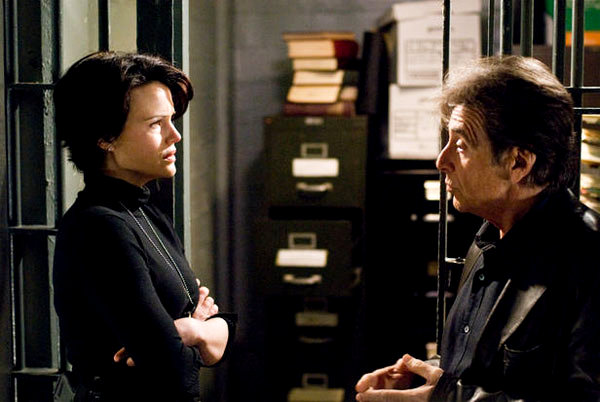
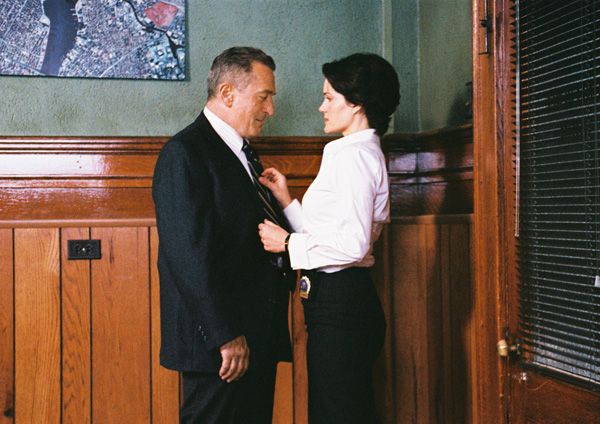
Righteous Kill (Jon Avnet, 2008) Someone is killing "Scott Free's"—those scum-bags that you just know are guilty but have some smooth-talking fancy-pants lawyer or some milque-toast judge who lets 'em walk, sneering, to prey on Society again...until they show up with a bullet-hole in the middle of their forehead. Two buddy cops, Turk (Robert De Niro) and Rooster (Al Pacino) start to add things up when one of the perps they arrested shows up deader than a Keanu Reeves performance. Looks like it's murder "and somebody's responsible." A vigilante? Certainly. But, if its revenge they're after, why are so many of these guys showing up dead? It's then that they think that the killer may be a cop.

But who?

Complicating matters is that most of the cops, including De Niro, Pacino, plus Carla Gugino, John Leguizamo, plus Donnie Wahlberg-o are creeps, so it could be any of 'em, except for the Captain of the squad (Brian Dennehy) but only because you couldn't believe Dennehy could sneak up on anybody but a bed-ridden quadriplegic.

So the question is: which of the crazy actors is playing the crazy character killing all these people?
The answer:
who cares? With a movie this terrible, and victims painted so sneeringly evil they're cartoons it's hard to work up much sympathy or even interest in finding their killer.
That's the problem of the writer. But director Avnet is so ham-fisted, he can't seem to hold a shot or light a set without sabotaging the drama of a scene. He's so busy "nuancing" things that you have trouble following the plot. He's not even talented enough to get out of the way of De Niro and Pacino (or, God forbid, rein them in) to make a scene play.
And, let's face it, having
those two legends on the screen should be a treat: they didn't work together in The Godfather: Part II (obviously), but their scenes in Michael Mann's Heat were tantalizingly short. Here, they're in almost every scene together (although Avnet can't seem to find the wherewithal to keep them in the same shot), and you realize they're like oil and water, or Mumbles and Loudmouth—they're two actors who've known each other for years, but their characters don't seem to. Or else the movie would be over in five minutes. But no, the suspicions and subsequent doubts must be fully explored, the red herrings must stink up the joint, and the script-writer must throw in a couple of feints that make no sense once the movie is over—they're there just to con the audience.*
What a waste. The big mystery is given this script, how could it attract two of the most iconic, respected and (when paired) legendary actors? Sounds like the biggest con was going on behind the scenes. Righteous Kill is the last thing you would expect a film starring De Niro and Pacino would be—a very pedestrian run-of-the-mill movie.

2024 Update: The story goes that at the premiere of this film, De Niro approached Pacino and said that they should never do another movie like this again, that they should find properties they could be proud of appearing in together.
 
As a result, the two actors didn't appear in another film until Martin Scorsese's The Irishman (I Hear You Paint Houses).

* Now, movies are by nature, the manipulation of reality—and the audience—to tell a story.  But, there's doing it well, and there's doing it the Righteous Kill way. 

Wednesday, July 5, 2023

American Gangster

Written at the time of the film's release...

"That's What's Wrong with America. You can't Find the Heart of Anything to Stick the Knife In"

American Gangster tells the story of Frank Lucas, who, for a time in the 60's and 70's, ran the most successful narcotics operation in Harlem. The film is based on a "New York" magazine article from an interview with the real-life Lucas, so it must be based on fact, right?*

Ridley Scott's played fast and loose with facts before (1492, Black Hawk Down), so one should take the credit "Based on a True Story" with a kilo of salt (or a pound of cocaine). 
 
But, that aside, how is the movie?
It tells the parallel stories of Lucas' rise in power on the Harlem streets by "cutting out the middle-man" smuggling in raw opium from Thailand, and manufacturing a concoction called "Blue Magic" that had twice the potency, but at half the cost, with the story of the cop who eventually busted him, a down on his luck detective named
Richie Roberts who's too honest to be trusted by the New York Police. 
While Lucas starts to make his version of the American Dream, Roberts continually has his legs knocked out from under him--his wife leaves him, takes his kid, he struggles with classes to better himself (public speaking, law), his partner turns junkie, and implicates him in a murder. The movie drips with irony at every turn, constantly showing the easy path of Crime and the tough road of Law Enforcement, that recalls that epitome of the thesis—"
The French Connection."
**
In a montage of Thanksgiving, Lucas is shown with his entire family at a stereotypical Thanksgiving spread (and in one of the more heavy-handed of Scott's directorial choices frames it like
Norman Rockwell's "Freedom from Want" painting, while Roberts, makes a cold sandwich of canned turkey-spread and potato chips over the kitchen sink. But then the director re-ups it by showing junkies shooting up between their toes in grimy bathrooms, and a mother passed out in bed, while her child is screaming in the room. Whatever glamour Lucas may enjoy, Scott is particular about showing the cost in human misery. No one gets off "Scott"-free.
Washington takes aim at a rival...
...and it's Idris Elba!
Sometimes the tables are turned. Lucas occasionally has troubles in the operation, and however much he may espouse core-values of honesty and integrity, the very nature of his business starts to rot his dreams for his family. And the more Roberts investigates, the closer he comes to his target, the more his team of "Untouchables" gel, and his investigation and life begin to come into focus.
Ridley Scott misses as much as he hits. For every good film (The Duellists, Alien, Black Hawk Down, Thelma and Louise), there is a terrible one (Legend, 1492, Someone To Watch Over Me, G.I. Jane, Hannibal, A Good Year), and some that have just enough quality in them (Blade Runner, Gladiator, Matchstick Men) that his directorial brio can compensate for weaknesses and messy scripts. But here, he has a cracker-jack script by Steve Zaillian, no worries about creating "a world" out of whole cloth, and a stunning cast that includes Clarence Williams III (uncredited), Joe Morton, Armand Assante, Josh Brolin, Cuba Gooding, Jr., the magnificent Ruby Dee, Ted Levine, Roger Bart, Carla Gugino, Chiwetel Ejiofor, and top-lined by Russell Crowe, but especially Denzel Washington. When these two heavy-weights get together, their scenes crackle with invention. Everybody does incredibly lived-in work.
And nobody less than the director. This is Ridley Scott's best film in ages. At times the details get a bit murky, but Scott does so to keep a multi-faceted story moving at a brisk pace. And he pulls off some amazing little camera tricks that stun, and some of the most unpretentious action-sequences put to film. Those action sequences are rough stuff--the film begins with the immolation and point-blank gun-down of a mob rival--and the junkie sequences are harrowing, so one should be warned. But missing it would be missing a great film.
* Merely a casual glance at the internet will disprove a lot of myth from fact. Lucas did not work for crime boss "Bumpy" Johnson for 15 years, but five (he's been in prison before), he was not with him when he died, did not marry "Miss Puerto Rico," or own "Small's" nightclub. And that's just the start for Lucas. The real Roberts is a bit miffed that to attract Crowe, they beefed up his part by making him more of a loser. Lucas admits that the film is "about 20% true."
 
** The names "Eddie Egan" and "Sonny Grosso" are invoked early on, and Crowe's Roberts employs a foot-chase under the "El" that figured so prominently in the movie.

Thursday, March 4, 2021

The Lookout

Written at the time of the film's release...there's a bit of an up-date at the end...

The Lookout (Scott Frank, 2007) When one samples a lot of movies, one notices trends. Sometimes, they're small things like the string of copy-cat movies that ride the financial coat-tails of a box office smash. Maybe it's a theme, like "pregnant woman" movies, or "kids who have sex meet a grisly death."

Or superhero movies, be they
light, grim, or attitude-of-the-month.

Maybe I don't get out much, but it seems odd that a lot of the teen "thrillers" I've seen lately begin with a spectacular and traumatic car-crash. Is that part of the teen-zeitgeist that the acquisition of the freedom that "wheels" represent also is uppermost on their minds as the most ironic of deaths--
especially at a time when they're feeling most invulnerable. They can't imagine a "Dead Man's Curve" that could turn them into "teen angels" when they've seen themselves as an immortal "Leader of the Pack." There's something emblematically horrific about the symbol of your freedom turning against you.
And so, teen thrillers have the air of a driver's education blood-bath film about them.
The Final Destination films had a spectacular highway smash-up. Disturbia opened with one that traumatized the hero.
So, too, does The Lookout, screenwriter Scott Frank's directorial debut. Frank's made a reputation for tough-guy neo-noirs along the lines of
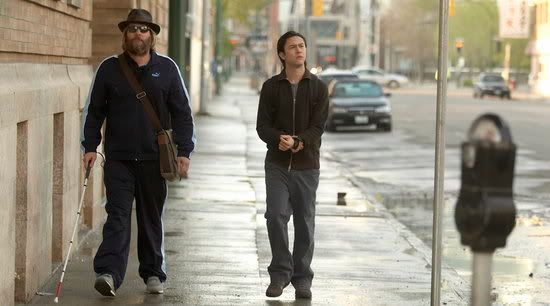
Get Shorty, Minority Report, Out of Sight,—he has inexplicably written the screenplay for Marley & Me—and The Lookout is in the same vein. Chris Pratt (Joseph Gordon-Levitt) was a promising high-school athlete who, due to a stupid driving accident, has a variation of short-term memory loss and a crippling case of "Survivor's Guilt." For one, he has to make lists to keep him task-focused, and for the other he lives with his blind room-mate, Lewis (Jeff Daniels--fine, understated work). Cognitively, he's so "in the moment" that the only job he can reasonably function at is as clean-up crew at a local bank. That puts him under the watchful eye of a skanky team of heisters who blackmail Chris into being their entree into the facility.
One wishes that with a screenwriter of Frank's freshness that The Lookout would keep you guessing, but it does not—playing out as one might expect a movie with this particular character arc, would. This is no
Memento that would turn the complications and moral implications of a brain condition like this on its medulla oblongata. Here, Scott treats it as a deficiency that needs to be overcome for the world to work right for the young Mr. Pratt. And there are enough complications that affect him personally that he is compelled to pull himself out of his funk, and get his head on straight. Sounds a bit rote--a bit Hollywood-convenient--when boiled down to those essentials. But there are compensations with the likes of actors like Daniels, and Bruce McGill, and Carla Gugino lending supporting roles.
One hopes for better things from the talented Frank, but considering he's in line to helm the next attempt to jump-start a "Planet of the Apes" franchise for 20th Century Fox, they might be empty hopes.
Note from 2021: Yeah, that :Planet of the Apes: thing didn't happen (well, it happened and happened well, but Frank wasn't credited on it. He turned to television platforms—when he wasn't writing for Marvel's "Wolverine" character—and had, it would seem a bit more freedom, and creative control. There, he made the TV series "Godless" and "The Queen's Gambit" which burned up Netflix for quite a time (and I'm watching it now...move by deliberate move).

Wednesday, June 24, 2015

San Andreas

Whose Fault Is It, Anyway?
or
"...And Upon This Rock I'll Build My Search."

San Andreas, like Titanic, hits the disaster movie formula just right—have a catastrophic event, but concentrate on just a handful of people. Oh, there are a lot of people in San Andreas. it's just that their roles amount to only a few seconds before we don't care about them anymore. They're basically innocent by-standers caught in the shaking.

Nope the action is extraordinarily focused: it's just Dwayne Johnson's extended-family-by-divorce (Carla Gugino, Ioan Gruffud, Kylie Minogue, Alexandra Daddario), the love interest for Ms. Daddano (Hugo Johnstone-Burt) and his brother—who fulfills the role of "kid in jeopardy"(Art Parkinson), the folks at CalTech (Paul Giamatti, the handy reporter-expositioner played by Archie Panjabi, and some student-players).


And that's it.*

No, really. That's it. It ain't an all-star cast in line to fall through the cracks, it's basically that clutch of actors doing their best to be interesting...and the rest who get minimal screen time, who are lucky if they last past an edit. If you're going to have a big disaster, best to keep it intimate, I guess.
It's just another day for LAFD Chief Rescue Pilot Raymond Gaines (Johnson**): a blonde in a tank top and tight jeans (Morgan Griffin) has just careened off the freeway (damn kids, texting and driving) and her car is suspended on a tree-limb in a deep and tight gully and it takes some kind of helicopter wizard to get deep enough in the trench to winch her out. Ray's your man. One of the young turks on-board decides she's cute enough to rescue himself but gets himself pinned in the attempt. And (uh-oh) they're running out of gas. So, even though he's the Chief Pilot, Ray does the job himself, grabbing the girl, freeing the turk and whisking them both up to the chopper. Radiant smiles all around.  
"They" say that this is a shot from San Andreas on the Interwebs,
but it's actually from Fast and Furious 6..because 1) that's Gina Carano
(not Carla Gugino, but one can see the confusion..???) next to The Rock and
2) he's not wearing his LAFD helmet (which is why they're using the pic)
Hey, we're just getting started. Witty banter post rescue turns into domestic drama/skin shot as Ray cell-talks to daughter Blake (Daddario) sunning herself poolside in a bikini. I have completely forgotten what they talked about. I think it was a bicycle. Now, one could grouse about this (if this male writer weren't so grateful), but there is a general obsession with pulchritude in San Andreas. Now, it is both of the female and male variety, which is damned fair of them. And one would be suspicious of that if the women in this film weren't as capable (and frequently more so) than the men involved (when they are not completely incapacitated, like stuck in the back-seat of a vehicle being crushed by a crumbling garage, for instance). No, Carla Gugino runs like Captain America across calving roof-tops rarely missing a step; Daddario can find emergency supplies at the drop of fire-truck and doesn't even break a sweat when pulling a big shard of glass out of a femoral muscle, and when she runs...whatever else is in the frame becomes irrelevant. And forgotten.
Oh. The bicycle. Back to that. She needs it for going to school in San Francisco, which Ray will be driving her to. Well, that plan collapses when he drives over to his estranged wife's house and finds that boyfriend Daniel (who's moving in) will be doing that. Oops. Somebody forgot to mention that. Poor Ray. His family is starting to split apart.

He thinks HE has problems.

Now, if somebody is taking this too far in any film-scholarly direction, one could say that this is a character set-up of magnification/identification.  As his word starts to shatter, Gaea does the same in sympathy. Well, if so, she's overdoing it. Over at CalTech, seismologist Lawrence Hayes (Giamatti), who, after giving an alarming lecture in his Earthquake 101 class, is excited to hear that a bunch of "magnetic pulse rates" are "spiking" in Nevada.  Road trip!  So, he and a research assistant (Will Yun Lee) go to the oh-so-safe location of Hoover Dam to do "spike readings" (to quote any Republican taking money from coal interests or big-oil: "I'm not a scientist, so I really can't say...") with Giamatti safely on top of the dam and the disposable minority actor deep in some dam bowel of the thing. Things get spiky, then shaky, and ...oh no!
This might be from Superman, the Movie, come to think of it...
Giamatti runs back to CalTech (because that's what you do when you've been in a disaster that has probably closed roads including the one on Hoover Dam that doesn't exist anymore. And he has time enough to speculate to the handy TV reporter (who just happens to be filming there) that "The Big One" is coming, without once recalling Fred Sanford.
"So...WHEN did you say it was going to happen again?"
Back to the San Francisco trip, Ray, who had planned to take Blake, finds out creepy Daniel is taking her, instead. Ray furrows his brow and takes it like a 260 pound man. It turns out he's flying that day, anyway—what, he didn't know he was working?  Good thing, too, because he's the only one with his feet not on the ground when "The Big One" hits. Ray's ex is caught having a high-rise lunch with her future sister-in-law (Minogue), while Blake is cooling her heels in one of Daniel's San-Fran high-rises, passing time with a nervous job interviewee (Johnstone-Burt) and his buttinski little brother (Parkinson). And before you can say "spiking magnetic pulse rates" things start shaking.

And falling over.
Yowtch. These are the scenes we came to see—wholesale CGI destruction on a city-wide scale along with the resulting tsunami's, flooding and sinking buildings. And to insure the thing gets a PG-13 rating, we don't see that many people getting hurt. You know, they run out the exit door and the person following them sees that (woopsy) the next step is 40 floors down. Buildings calve on-camera.  People die off-camera. Just like real life. The scenes are spectacular, sure. But, they are also soulless to anyone without an Edifice Complex.
"Think Blake's in there?" "Hope not."
The rest of the movie is spent trying to put together what Nature and family history has rent asunder—Ray and ex try to get from smashed-up Los Angeles to crushed San Francisco to try and find Blake to be re-united as one big happy family...who have to live in a tent for the next twenty years. What do you think happens?
The "Hollywood" sign collapses for the umpteenth time in movies.
In the meantime, there are set-pieces and falling pieces of sets. There are enough practical effects with water that probably are the sole reason for California's drought and anything and everything citified gets smashed, crashed and dashed. Meanwhile, the problems of the Gaines family is all the movie cares about—one gets the impression that the "pitch" says "Family splits apart. Earth splits apart. Family gets back together." "Family Values Movie of the Summer." And California? Well, let's say we can start re-developing. The rental prices have finally bottomed out.
An extreme way to handle Norovirus...
The whole Gaines family story-line would have made a mere sub-plot in the old disaster movies of old—the The Hurricane's, the San Francisco's, even The Towering Inferno's. Those movies usually handled the entire of San Andreas' entire plot in a couple of shots—you see a distinctive couple early on and then several story-lines  and a whole lot of destruction later, you can pick them out re-united in a pan shot. But, it takes all of San Andreas to do that. Yes, the shots of earthquackery in both Los Angeles and San Francisco are spectacularly and even (perversely) lovingly rendered in their detail, and that's where the most care went into the film. Other than that, there's not much there, as the basis of it is pretty weak. But isn't that the lesson of every earthquake movie (or, for that matter, earthquake)? That you need to have a better foundation? 
"And I bought this place for the view..."
* Um, but if you look at IMDB, you'd think every actor in Hollywood worked on this thing. Yeah, maybe a couple hours.  It makes me wonder how many people on IMDB pad their resumes with this thing.

** An odd thought struck me in this particular performance: Johnson could be the love-child of Barack Obama and Arnold Schwarzenegger (With Schwarzenegger, you never know...)
Well, this'll solve California's water shortage