Thinking Outside the Cell-Block or "It Doesn't Matter What We Believe"
Director Paul Haggis, you either love or you hate. The haters find him manipulative and obvious (I'll buy the second charge, but movies, even documentaries, are—du-uh!—manipulative by their very nature) and will never forgive him for making Crash, which beat outBrokeback Mountain for the Best Picture Oscar.*The lovers, well, there aren't too many of them outside the movie industry—but Clint Eastwood and the Bond producers love him, and that's good enough for me.
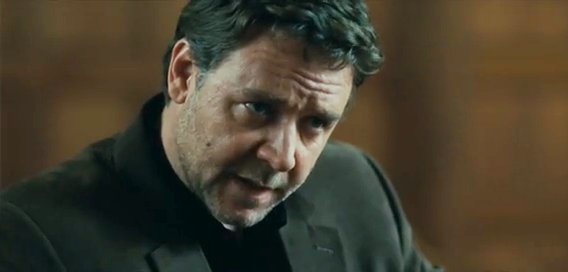
His third film,The Next Three Days, which he wrote and directed,** tells the story of a couple (with child) who are separated, when she (Elizabeth Banks) is arrested, tried and convicted for murder. Her husband (Russell Crowe), a school teacher, exhausts their finances—selling two homes—and all legal recourse, trying to prove her innocence. After three years of incarceration, her child doesn't even acknowledge her (having lived half his life without her), and after her last appeal is turned down, she attempts suicide.
Time to think outside the box...the legal system, and the penal system. The civilized courses have failed...as a matter of course. It's time to take action, and matters...into one's own hands.
In a way, this is the same movie Haggis has been making all along, his thesis converted into an action plot device more positive in its usage than negative in its omission. Both Crash and In the Valley of Elah feature protagonists trying to do more than the expected by-the-book (or society) response, to subvert the easy knee-jerk "comfortable" reaction, and (I dunno) think a little deeper. He seeks the help of a multi-prison escapee (Liam Neeson, in a too-short cameo), who gives him a broad picture of the strategies of going over the wall, and more importantly, staying out. One of the first things he says may be what's written on the first page of Haggis' screenwriting notebook, as it informs so much of his work: "You have to do a lot of lookin'—things that disrupt the day-to-day routine." That semi-somnambulent day-to-day routine has been the loam Haggis has toiled in over the years, and in this film, he finds a protagonist who tries to take advantage of it, rather than subvert it.***
It's a heist film, basically, with human valuables. It is also, for a brief time, an "incredible mess" movie as Crowe's John Brennan must—painfully—learnthe ropes of the outlaw life (and occasionally be beaten with them). This pays off later in the film—well, nearly everything pays off later in the film—as the "anything that could go wrong" scenarios start piling upin the film'snerve-rattling desperate finale, and one remembers how those early efforts only served to make matters worse.
The barriers that Brennan must overcome are represented by a filming scheme that places so much of the film behind screens and windows of various opacities—a traditional trope of prison films (it just doesn't happen so much out in the so-called open, as it does in here—Haggis wants us to know there are traps inside and outside prison).
Great cast. Crowe is nicely casual initially, then gradually turns into the ragged obsessive/compulsive he needs to be, Banks does drama as well as she does comedy (very), and, beyond Neeson, there are nice cameos by Daniel Stern, Olivia Wilde (as a divorcee...really?)...and particularly, Brian Dennehy, who, with the least amount of dialogue, makes the most of his scenes.
There will, no doubt, be an increase in interest in "bump"-keys, and breaking into vehicles with tennis-balls, and Haggis even throws a bone to his critics by purposely leaving a plot-thread frustratingly unresolved. It's a good film, professionally done, and with enough twists and turns to keep one engaged, while still taking the time—one of the critical elements the film focusses on—to keep things realistic, and not turning the down-to-earth perps into clairvoyant superheroes.
* A decision I've always agreed with: I think Crash was reaching for something to say—especially about the 7-10 split of a city that is Los Angeles, and the casualness of racism as the easy way out. Brokeback Mountain, although I admired its photography and I thought Heath Ledger had the best cowboy voice in movie history (great work, that—Jake Gyllenhaal, not so much) felt too much like a Joan Crawford movie in reverse-drag. Mellerdrama at its sawdustiest. ** After Crash and In the Valley of Elah, The Next Three Days is not original—it is based on the French film Pour Elle (Anything for Her, 2008)
*** Even a late-minute extreme act by one of the protagonists is an expression of trying to break out of the routine, to think outside the box (or in this case, the van) and break the lock-step the other is in.
Saturday is traditionally "Take Out the Trash" Day...
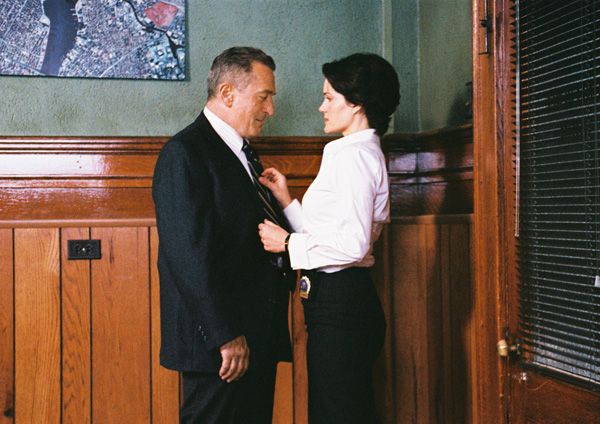
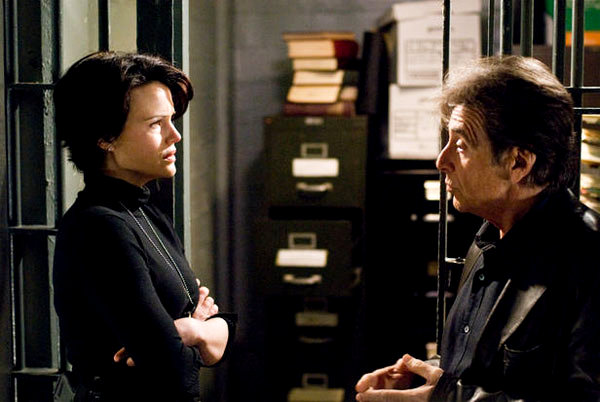
Righteous Kill(Jon Avnet, 2008) Someone is killing "Scott Free's"—those scum-bags that you just know are guilty but have some smooth-talking fancy-pants lawyer or some milque-toast judge who lets 'em walk, sneering, to prey on Society again...until they show up with a bullet-hole in the middle of their forehead. Two buddy cops, Turk (Robert De Niro) and Rooster (Al Pacino) start to add things up when one of the perps they arrested shows up deader than a Keanu Reeves performance. Looks like it's murder "and somebody's responsible." A vigilante? Certainly. But, if its revenge they're after, why are so many of these guys showing up dead? It's then that they think that the killer may be a cop.
But who? Complicating matters is that most of the cops, including De Niro, Pacino, plus Carla Gugino, John Leguizamo, plus Donnie Wahlberg-o are creeps, so it could be any of 'em, except for the Captain of the squad (Brian Dennehy) but only because you couldn't believe Dennehy could sneak up on anybody but a bed-ridden quadriplegic. So the question is: which of the crazy actors is playing the crazy character killing all these people?
The answer: who cares? With a movie this terrible, and victims painted so sneeringly evil they're cartoons it's hard to work up much sympathy or even interest in finding their killer.That's the problem of the writer. But director Avnet is so ham-fisted, he can't seem to hold a shot or light a set without sabotaging the drama of a scene. He's so busy "nuancing" things that you have trouble following the plot. He's not even talented enough to get out of the way of De Niro and Pacino (or, God forbid, rein them in) to make a scene play.
And, let's face it, having those two legends on the screen should be a treat: they didn't work together in The Godfather: Part II (obviously), but their scenes in Michael Mann's Heat were tantalizingly short. Here, they're in almost every scene together (although Avnet can't seem to find the wherewithal to keep them in the same shot), and you realize they're like oil and water, or Mumbles and Loudmouth—they're two actors who've known each other for years, but their characters don't seem to. Or else the movie would be over in five minutes. But no, the suspicions and subsequent doubts must be fully explored, the red herrings must stink up the joint, and the script-writer must throw in a couple of feints that make no sense once the movie is over—they're there just to con the audience.*
What a waste. The big mystery is given this script, how could it attract two of the most iconic, respected and (when paired) legendary actors? Sounds like the biggest con was going on behind the scenes. Righteous Kill is the last thing you would expect a film starring De Niro and Pacino would be—a very pedestrian run-of-the-mill movie.
2024 Update:The story goes that at the premiere of this film, De Niro approached Pacino and said that they should never do another movie like this again, that they should find properties they could be proud of appearing in together.
* Now, movies are by nature, the manipulation of reality—and the audience—to tell a story. But, there's doing it well, and there's doing it the Righteous Kill way.
Silverado(Lawrence Kasdan, 1985) Director Lawrence Kasdan took his big box office successes with Body Heat and The Big Chill and parlayed them into a Big Gamble to revive the western genre with this "all-in" tale (co-written by himself and his brother Mark) of four travelling pilgrims who happen to collide and find enough common ground in skill sets and back-story that they end up resolving each others' business. Why they happen to find each other in all the empty space of the West is a bit of a mystery, but I have a feeling it would have been inevitable as the four of them seem to follow the directions of their own individual moral compasses. Despite their differences, they're going to end up in the same place. Just like the country. Even though it starts out in the dry wilderness of the West, everything seems to be moving to civilizing and taming the wild, except that things aren't exactly going to plan. "Nothing wrong with the land. It's just the people," says one of the settlers of Silverado. That settler's brother gets an example of that at the very start of the film: Emmett (Scott Glenn) is asleep in a shack—at least it has a wood-stove—when the door burst opens and guns start firing. A reach for a holster and one guy is dead, but bullet-holes start blasting through the walls, and the roof explodes from rifle-fire. Emmett fires sight-unseen, anticipating the movements and when he finally exits into the sunlight, three men are dead, two horses are on the loose, but one has stayed. That horse will come in handy twice in the movie: once as transport and once as a clue to why someone would want Emmett dead.
Title sequence. While Bruce Broughton's classic score*starts with the first tremulous chords as Emmett exits the shack (in a move not to dissimilar from the opening shot of The Searchers) to reveal a dawn landscape and the music blossoms into full-throated Americana with a chime announcing the title of the movie, Broughton's main theme is presented over shots of Emmett's character travelling with the two horses across various picturesque landscapes, finally reaching a desert, where he spies a prone figure baking in the sun....wearing nothing but long-johns, his legs nonchalantly crossed as if he'd fallen from the sky that way. Emmett takes out his canteen and tentatively offers the sun-roasted character some water. He croaks something unintelligible. Emmett leans closer and we hear the first words from Paden (Kevin Kline): "Pleased to meet you."
They're also the first words spoken in Silverado, and already it sets the pattern for the dialogue that acts as series of laconic, well-chosen ironic words that make up the bulk of the film's banter ranging from austere sentiments that can have hidden depths of meaning and lines that are clever for their brevity and what's left unsaid. Kasdan has written many impressive original scripts and adaptations over his career, since his first optioned script (for The Bodyguard, sold in 1980 but not filmed until 1992), but none is as rich as this collaboration between the two Kasdan brothers. Over nighttime coffee—Emmett always seems to have coffee—the two men share some history—how Paden got into that predicament (robbed of everything and left for dead by some fellow travelers) and his first summation of his experiences with luck, and Emmett's shack shoot-out ("Aw, I had to get up, anyway" is Emmett's comment). Emmett, it seems, has just been sprung from Leavenworth ("Never been there," says Paden) and he's going to meet up with his brother to reunion with his sister's family. He asks Paden where he's going, and Paden's reply is practically undecided: "Where's the pinto going?"
To the nearest outpost, apparently. The two make an odd pair, riding into the fort—the dusty cowboy and the guy in his skivvies. Emmett flips Paden a coin to buy some clothes to make himself presentable "I'm good for it," he says, and absent-mindedly tips the memory of a hat at a shocked mother and daughter. He may not be needing that coin. Across the way, he recognizes his horse...and his pants...and his shirt...boots...gun-belt and guns. The guys getting ready to mount up, so Paden runs into a general store, grabs a gun, but is stopped by the proprietor—that gun doesn't equal that coin. "Well, what can I get for this?" says Paden in a hurry.
Not much. The gun he gets is falling apart, the cylinder falling out of it, plus a box of cartridges more destined for dirt than defense, given his firearm. He has just enough time to hastily assemble the pistol, load a couple of shots, while the guy who's second hand Paden is riding down on him, shooting from horseback—one shot takes out the business-end of his long-johns and he takes a studied aim and fires the guy right off his (Paden's) mount.
You don't shoot a guy in the middle of the street without attracting attention and the local constabulary has questions and they're not buying a bum's story about getting robbed "Can't you see this horse loves me?" The Cavalry Sergeant (Sheb Wooley, he of The Wilhelm Scream) isn't impressed. "I had a gal do that to me, didn't make her my wife..." But, Paden's name is on the inside of the saddle he says and when he's asked for clarification, a voice in the crowd speaks up "P-A-D-E-N" That's what the saddle says, all right, just like the man says. The man is Cobb (Brian Dennehy) and he and Paden have history. "Where's the dog?" is practically the first thing he asks him. It goes unanswered. In Silverado, some things are best left unsaid, but you will find out about them...eventually, and if you're not in too much a hurry.
Despite the shared past and Paden's recent change of fortunes (or maybe because of them) Cobb offers him a job working with him again. "I've given that up..." Paden says evasively. "So have I," replies Cobb. "I have a legitimate job now." The two commiserate just long enough for one of the men that Cobb HAS hired to be released from the stockade. It's Tyree (Jeff Fahey), who also knows Paden...only too well. "Where's the dog?" he sneers as he rides past him.
Emmett and Paden (with his clothes hanging back on him, again, but still missing his hat) make their way to the town of Turley: Emmett's going to "meet a guy on the way to Silverado." Paden rides along once he finds out there's a saloon and women there. And breakfast. They're on their way to eat when they're mistaken for a couple of trail-hands supposed to lead a wagon-train to the town of Silverado. When the two actually show up, they eye the hands suspiciously when they actually don't count their pre-job half of their wages. Odd.
At breakfast, a tall, dark, dusty stranger named Mal (Danny Glover) walks in and asks for a drink of whiskey and a bed (he's been without either for ten days). He's served, but the place's owner comes out and gets ugly and demands the stranger leave, which he doesn't. That's when three rough types decide to interfere and the stranger makes quick work of them and is only interrupted by the Turley Sheriff Langston (John Cleese) with a Pynton-esque "What's all this, then?" Langston advises Mal that he is not welcome in Turley, as it is his job to keep the peace. "That ain't right," says Mal, but his only defiance is to take a long pull from his whiskey, satisfied.
Langston, charged with keeping the Turley peace, sits down with the other two strangers, Emmett and Paden, and asks their business ("We'd like to stay," says Paden meekly). Emmett inquires about the man he's looking for—"about my size, full of juice, wears a fancy two-gun rig." "I know where that gentleman is..." says Langston.
Next stop: jail, where Emmett's brother, Jake (Kevin Costner) is delighted to see him. But, there's an issue—Jake is in jail for, in his view, "kissing a girl." But that act resulted in unpleasantness escalating to Jake killing a man...for which he is scheduled to be hung the following dawn. Emmett opines that this will certainly disappoint their sister, and he and Paden leave the jail. On their way to the local saloon, Emmett says regretfully he'll have to spring Jake, and Paden tells him he can't be any part of that.
He's spoken too soon. Upon entering the saloon, he recognizes a familiar sight—his hat, on a particularly surly gambler, who, when challenged, briefly stands to draw and quickly sits down again, dead from a shot by Paden. He does get his hat, but also a night in the pokey, at the very least. "It was self-defense!" he says lamely as the door swings shut and locks with a clang. "That what I said!" says his new cell-mate, Jake.
True to form, there is a jail-break made, despite previous protestations, an inside job between the men sharing the cell, and Emmett who has created a distraction by burning down Jake's intended gallows and been standing by the now-three horses to make their escape. They are pursued by a hurriedly pulled-together posse led by Sheriff Langston, but they are stopped in their tracks by some welcome interference from the banished Mal and his Henry rifle.
"Now, I don't want to kill you, and you don't want to be dead..."
And as, the four have mutual interests in the direction of the town of Silverado, they ride together and director Kasdan and composer Broughton make a big show of their side-by-side cantering as a unit, galloping across a magic-houred vista. It's mean to be a "Moment," showing solidarity and unification of purpose as four strangers become one, for a moment, galumphing to a common destination, even though, in their minds, anyway, heading for different destinies.
But, I've always found it amusing—one of those moments where Silverado invokes the overblown melodrama of the "horse-opera" days of the western, edging up to the fence of "camp," but not quite crossing over. The four guys are just too precise of marksmen, always have that "just-so" reply, despite some flecks of shadow seem to be compelled to be on the side of virtue...as when they come across that wagon train again, and volunteer to help recover the party's "stake" after it's been stolen by those very trusting trail-hands they'd encountered earlier. All four are all too willing to risk life and limb in a well-coordinated intervention for a bunch of strangers. Of course, they're the good guys.
That moment of equine synchronicity is always a matter of amusement to me—but not derisively, mind you—not only because it's a bit overblown, accompanied as it is with Broughton's tripletting trumpets, but also because it's just amusing for me to see these four New York Method trained actors riding four abreast like natural cowboys. They carry it off, but it still brings a smile to my face every time.
"After a while, I won't be so pretty. But, this land will be."
It's emblematic of a generally quirky, but nonetheless scrupulous casting that also includes Dennehy's Cobb, Cleese's Sheriff "not from these parts", Jeff Goldblum's snaky gambler (named "Slick"), Roseanna Arquette's prairie flower love-interest, and especially the character of Stella, as portrayed by 4' 9" Linda Hunt ("The world is what you make of it, friend. If it don't fit, you make alterations.")—none would be found at the top of the 8x10 stack as obvious choices for their characters, but there's something about their heft—or lack of it—that immediately communicates a contrast in their interactions that allows the realization of their principled places in the universe to an audience far beyond what the sometimes circumspect dialogue insinuates.
"Welcome to Heaven..."
That goes for The Big Four, too. As the story progresses, fortunes rise and fall, loyalties are tested—sometimes to their limits—but that shot of the four riding astride stays in the mind throughout the movie. You can't imagine these four hombre's of differing, but no less expert skills, going against each other, despite how each one handles (or man-handles) a conflict. But, you can imagine that they make a formidable team, each acting separately, but with similar intentions, choosing their battles and and taking care of them the best way they know how.
Take, for example, the big ending action-piece in the town of Silverado, where, once and for all, personal goals having been met, they take on the last remaining bad guys who have insinuated themselves into the affairs of the town, in a four-fronted military action, each to their own fashion (familiar ones to those folks who have seen a lot of Westerns): Jake goes in loud and flashy;
Mal goes personal with some close-order street-fighting.
Emmett goes street to street, using the whole town as a back-drop, a defense and a weapon;
and Paden—he gets the old-fashioned mano-a-mano gun-down.
Despite their different methods, personalities, and their personal battles, they are still bonded together as a unit as they approach the town of Silverado, where their stories and challenges center on family, loyalty, and their repercussions.
No matter what movie associated with Kasdan I've seen—and I've seen just about everything including the recent standalone Solo (written by Kasdan and his son and directed by Ron Howard)—the strongest, most fully realized, and least dog-eared movie he's made is Silverado (Body Heat comes in a close second). It's almost too perfect, with the dialogue pointed and full of call-backs and reflections ("Didn't have much choice," "Bad luck" "That ain't right..." "Sounds good...") and a sureness of direction that's direct, not too fancy, but does take advantage of the film's widescreen field.
And it is just fun, with nice touches of malice to raise the stakes and make it a bit less larky—to spoil the mood and make you root for the good guys to win. It's an entertainment machine, with heroes who are too competent to fail and rarely miss their mark, with either bullets or words, and all the actors—all of them—are enjoying the ride, and that's infectious.
Oh, Lucky Man! (Rinse and Repeat) or "Likes: Long Walks on the Beach"
"On the positive side, the Knight of Cups is a sensitive soul. He is a poet - a lover of all things romantic and refined. He uses his imagination in wondrous ways and taps the deepest levels of emotion. He knows how to create beauty and share it with others.
On the negative side, this Knight is prone to flights of fancy and illusion. His melodramatic moods are legendary, and his emotions often get the better of him. He's too temperamental and takes offense easily. He can't stand unpleasantness and will always let others deal with it."
We may have reached the end of the inventiveness in Terrence Malick's career and begun the phase of annoying self-indulgence and obtuseness (if we haven't already gone past it). There has always been a danger of that in Malick's work, but he has always worked with a non-traditional approach to narrative drive and story structure that oftentimes has been thrilling. Even after coming out of what seemed a self-imposed eighteen year exile after Days of Heaven, there was still a thread of story in The Thin Red Line and in, especially, The New World. He went far afield of traditional narrative in The Tree of Life, but there was still a through-line of feeling and history, despite star Sean Penn grousing that "this wasn't the movie I read."
To the Wonder was more problematic—taking the same roundabout "Tree of Life" approach with the film about relationships gone sour despite the spark of the new, the film dragged, felt more than improvisational, and felt slap-dash and pointless, but benefited from some nice performances, even if they were mostly mimed.
Knight of Cups(which spent very little time in theaters) has more problems than just a sense of randomness. It drifts, following a callow, non-committal screenwriter/script doctor as he roams the country, starting relationships with women, and ending them, sometimes selfishly, and always from that one man's perspective. Unlike To the Wonder, you never see the women's side of things.
There was no script (Christian Bale, who spends the most amount of time on-screen, supposedly was cribbing character notes from his co-stars' instructions to see if there was something about him in them). One suspects there was no story. At which point, one is left with merely "attitude." That's not enough, especially in a film that has enough reach to employ so many actors and leave them with little or nothing to do than merely be photographed prettily.
But, if one wants a synopsis, here's my best at one: the film begins with a prologue-story, one that was read to our screen-writer when he was a boy by his father (Brian Dennehy). It tells the story of an Egyptian prince who is sent by his father into the city to find a precious pearl. But, once he gets there, he is set upon and given a drink that puts him into a deep sleep and when he wakens, he's forgotten he's a prince, forgotten about the pearl, and lives a life of normalcy, while his father sends out messengers, once his son has gone missing, to find him and bring him home.
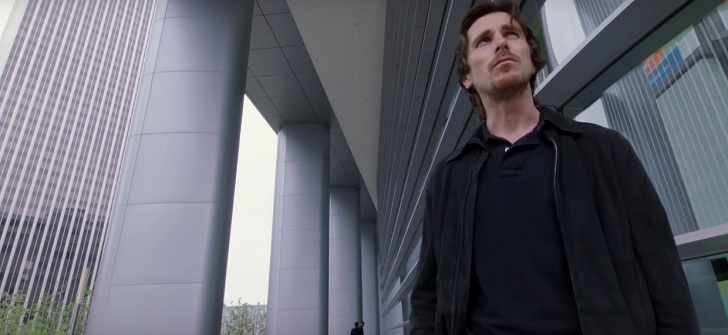
The movie's synopsis from its web-page reads like this: "Knight of Cups follows writer Rick (Christian Bale, The Fighter,American Hustle) on an odyssey through the playgrounds of Los Angeles and Las Vegas as he undertakes a search for love and self. Even as he moves through a desire-laden landscape of mansions, resorts, beaches and clubs, Rick grapples over complicated relationships with his brother (Wes Bentley) and father (Brian Dennehy). His quest to break the spell of his disenchantment takes him on a series of adventures with six alluring women: rebellious Della (Imogen Poots); his physician ex-wife, Nancy (Cate Blanchett); a serene model Helen (Freida Pinto); a woman he wronged in the past Elizabeth (Natalie Portman); a spirited, playful stripper Karen (Teresa Palmer); and an innocent Isabel (Isabel Lucas), who helps him see a way forward."
"Rick moves in a daze through a strange and overwhelming dreamscape -- but can he wake up to the beauty, humanity and rhythms of life around him? The deeper he searches, the more the journey becomes his destination. The 7th film from director Terrence Malick (The Thin Red Line, Tree of Life), Knight of Cups (the title refers to the Tarot card depicting a romantic adventurer guided by his emotions) offers both a vision of modern life and an intensely personal experience of memory, family, and love."
...and (it might add) a lot of walks on the beach.
Memory and reverie have been the dream-stomping ground for Malick for the last few films, and one can do an awful lot with that, structurally, leading the audience through the memory-maze, which, itself, is a journey. But, there should be markers along the way or you'll get lost in thought, making that journey pointless. The film imposes a structure of chapters into the film (named, except for the last, on cards in the tarot deck), but if one is looking for that to help you find your way, you should ask for a re-shuffle—the cards and their distinct meanings have little to do with the incidents that follow them. Tarot cards are no help when the film resembles a game of "52 pick-up."
Instead, we are given randomness as Rick deals with the death of his brother, his estrangement with his father and brother, his various dealings with studio-folk, parties, happenings, road-trips, and an earthquake. But, mostly women (those being Imogen Poots, Cate Blanchett, Freida Pinto, Isabel Lucas, Theresa Palmer, and Natalie Portman, all drastically under-utliized, which is something of a first for Malick, who are usually the strongest characters in his films). Perhaps we're seeing a cinematic equivalent of depression where Rick is endlessly re-visiting past relationships, looking for a way out of the well. But, it's an endless rumination as he keeps banging his head against a mirror when what he should be looking for is a door-handle. Pin-balling inside your own skull rarely provides the perspective needed to pull oneself out of one's rut; if anything, the circular thoughts such self-examination presents generally cork-screws you even deeper into the abyss.
Hollywood navel-gazing is hardly a new subject for the movies. But, they rarely present a universal truth seeing as how the dream-factory surrounds itself with fantasy and un-reality. Most of us "real" folks have to deal with delusion rather than illusion, and as reality not as art. Yes, we can relate to the phoniness of Hollywood, to the dark-side of the dream-factory, of buying into the fantasy as if it were reality and the way that can mess you up. That orange-grove has been thoroughly tilled to the point where it's been asphalted over and turned into a parking lot.
But, despite the trope, one shouldn't think of Hollywood's version of tragedy as real tragedy. Sure, one can be depressed in Hollywood, but that's only if one has the idle time to waste. Most of us don't have the luxury to sit back and wonder if they're wasting their lives. We're in the constant struggle not to, and to find worth in something more than the week-end's box-office take. It is hard (and practically impossible) to take Knight of Cups seriously when the person we're supposed to wring our hands about is well-off, handsome, and white, and living a life most people would dream of. "What in the hell does he have to be depressed about?" is the question that kept going on in my mind, competing with Bale's voice-over. On top of that, one shouldn't even consider that Rick is luckier than most—he makes a living as a script-writer—how many would-be writers are out there who've never gotten that chance. Boo-hoo. This is me playing the smallest violin in the world. Are we really meant to sympathize with somebody who has every reason not to be depressed?
Perhaps that's why we're treated to so many images of our poor little screen-writer walking the beach; he's attracted to it because it's so damned shallow. One sincerely wishes that Malick made this to finance a few more shots of his IMAX project (expected this year), hood-winking the financiers into bank-rolling a few more shots that he needs to fill it out. Other than that, hopefully, this is an anomaly and Malick can return to an actual narrative, rather than these random acts of montage. The world needs more story-tellers like him, when he gets around to telling a story.

 Time to think outside the box...the legal system, and the penal system. The civilized courses have failed...as a matter of course. It's time to take action, and matters...into one's own hands.