Showing posts with label Freida Pinto. Show all posts

Wednesday, March 3, 2021

Rise of the Planet of the Apes

I was about to run a past review for another film when I realized I hadn't re-run the review of the first film of the "Planet of the Apes" re-boot. Great Caesar's Ghost, how could I have missed that? 

Herewith, written at the time of the film's release.

"Running the Serkis from the Monkey Cage"

or
"Well...That was Fun..."

Conquest of the Planet of the Apes was always the controversial one in the "Apes" series. Test audiences were so upset at the carnage—rioting apes bludgeoning government officials with rifle-butts—that a drastic re-write and edit was demanded by 20th Century Fox (it's why, when you watch Caesar—Roddy McDowall—delivering his "let's be merciful" speech at the end, you only see his eyes to avoid any lip...er...mask-sync problems).

Tonally, it's jarring...as well as being a load of bananas. Conquest could have been good...in the disquieting way that the "Apes" movies could be. But, instead, the studio ham-strung it's simian rights leader.

It's different times now.  The cities aren't burning down, only our 401K's.  So, along comes Rise of the Planet of the Apes—as unnecessary and pointless as any movie could be in this dull Summer Season for movies—after all, it's not a "tent-pole" franchise and arriving rather late in August. The "Apes" series had already run dry in its first go-'round, and in 2001, Tim Burton put out a "re-imagining" of the original that only proved that a "re-imagining" with better FX and make-up doesn't improve on something that depended on some good ideas first and the rest second. This new one seemed like a too late after-thought, and although the trailers looked intriguing, the ad campaigns and posters were uninspiring—there were no "character" posters, no tie-in cups at the 7-11, no "franchise" buzz—just another "Apes" movie long past its relevancy.
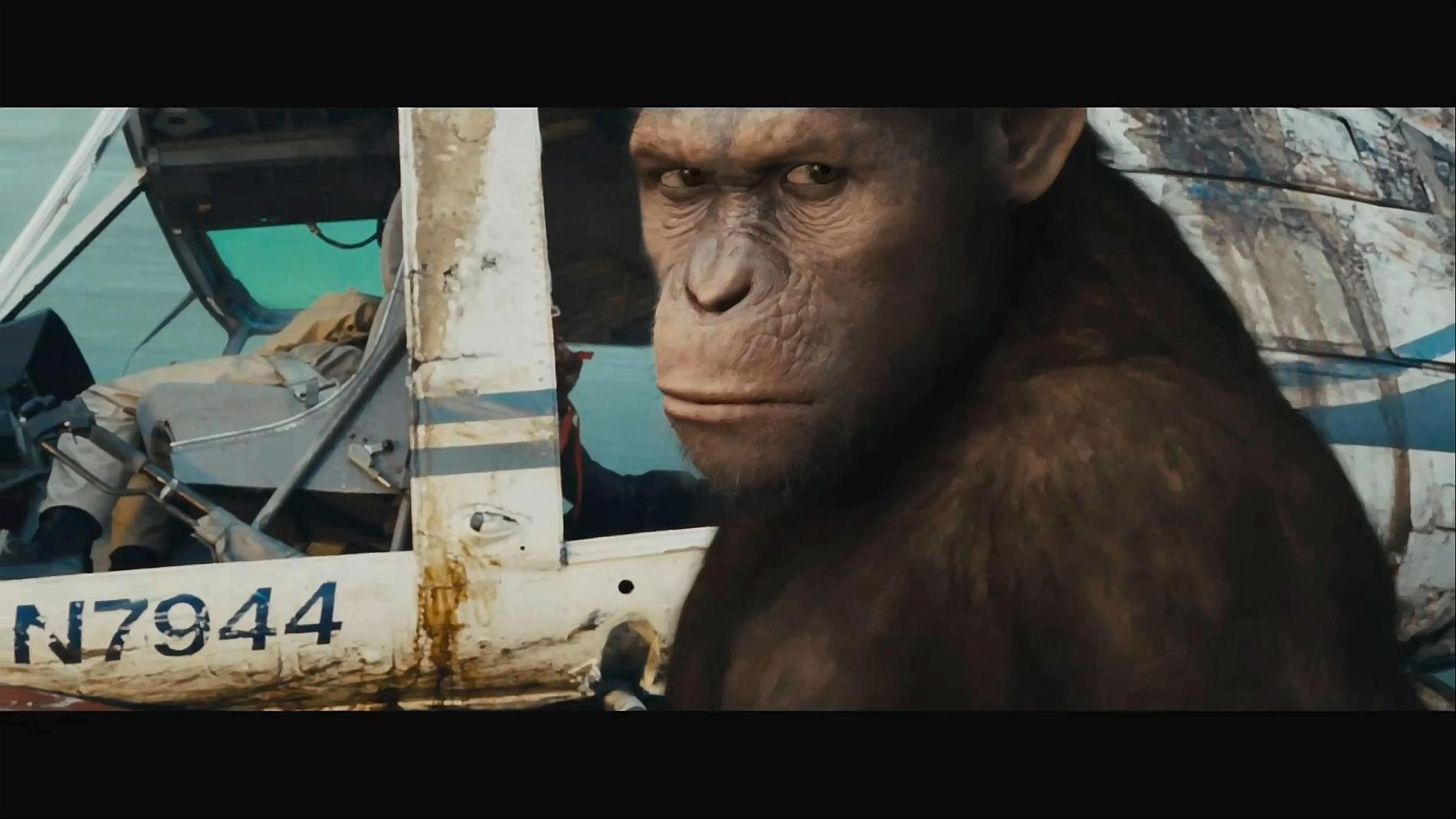
Except it has one thing going for it—good ideas. And when I say "good ideas," I don't mean the lines are clever (they aren't—Caesar gets the best lines, and
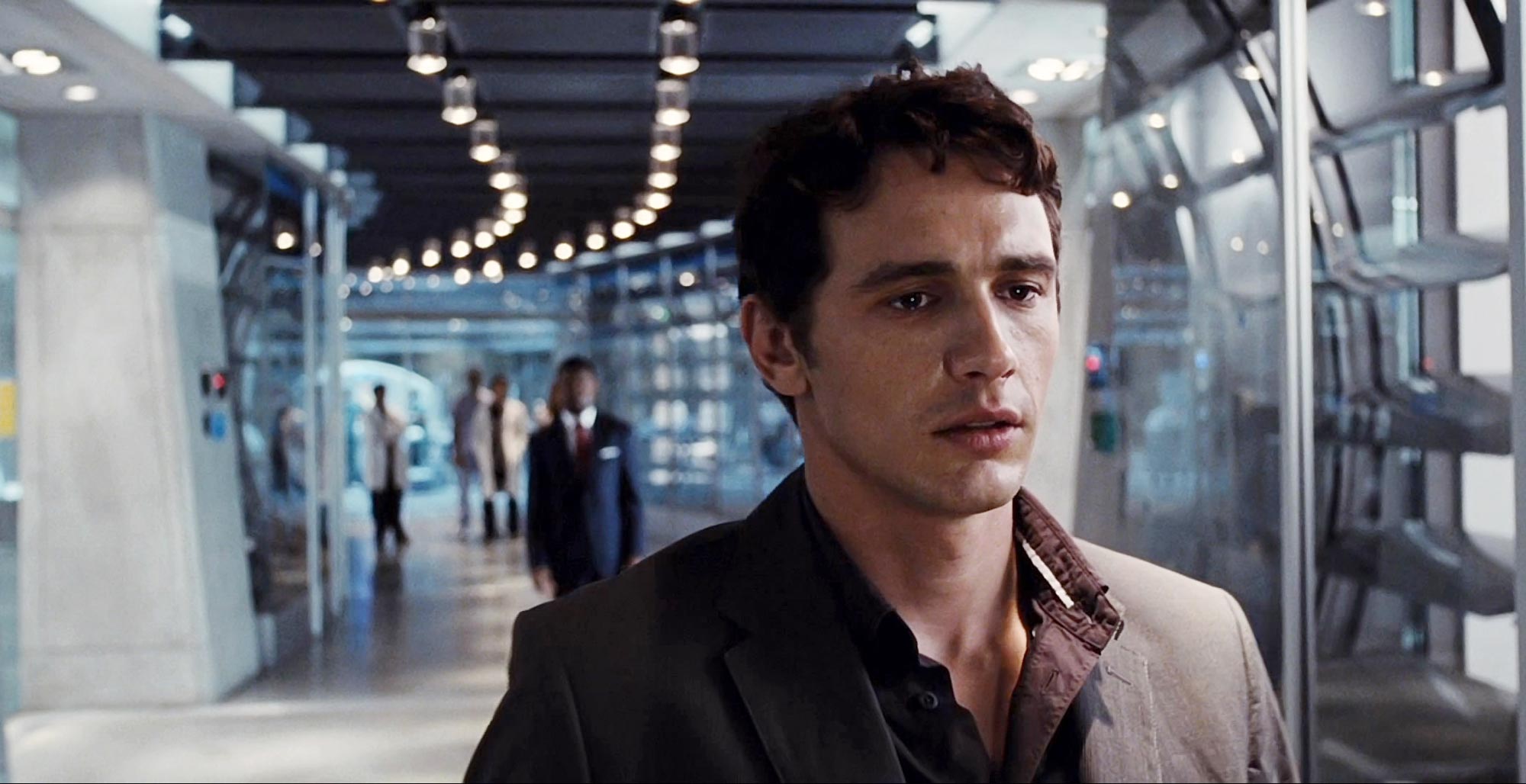
the most effective scenes are played without dialogue) or the acting is anything that will get James Franco another Oscar nomination (he plays it absolutely straight—he has to, and given what surely were bizarre circumstances on the set, that is quite the accomplishment and there's no "hip" attempt to distance himself from the subject). But, at the basic story-telling level of Rise, there are good ideas that play out and lead the audience along, incrementally ramping up the circumstances until you can accept the anarchic and truly mind-blowing with a straight face. Where Burton's Planet billed itself as a "re-imagining," Rise truly is one, turning the circumstances of the first film on its ear, as the circumstances of the Charlton Heston classic turned the evolutionary relations of man and monkey on theirs.
The film starts with a sequence cleverly patterned after "The Hunt" sequence from the 1968 film, and follows its hero's journey through the cruel circumstances of living in Man's World, after having a fairly free existence for most of its growing life,* paralleling Astronaut Taylor's cynically-smug attitude (and subsequent come-down) from the first film. That it goes into different territory, quickly and strategically, is where this film strikes out on equally sure footing.
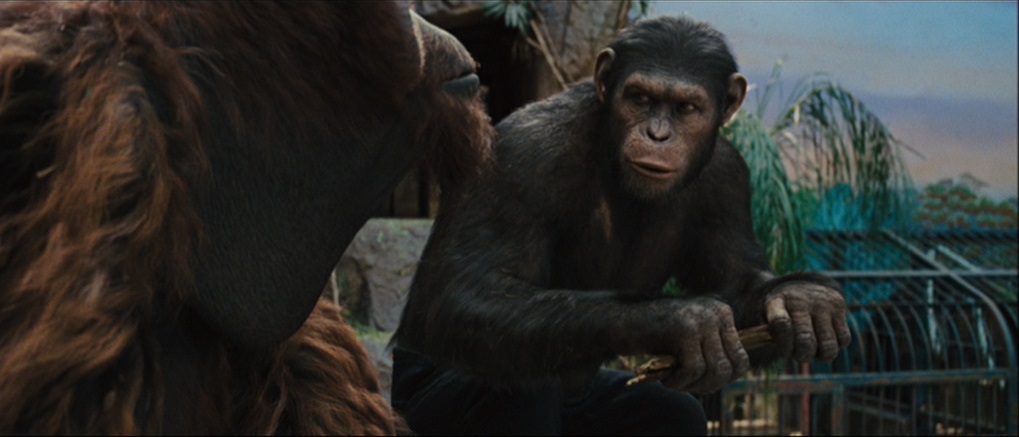
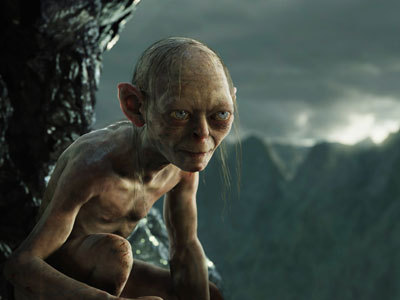
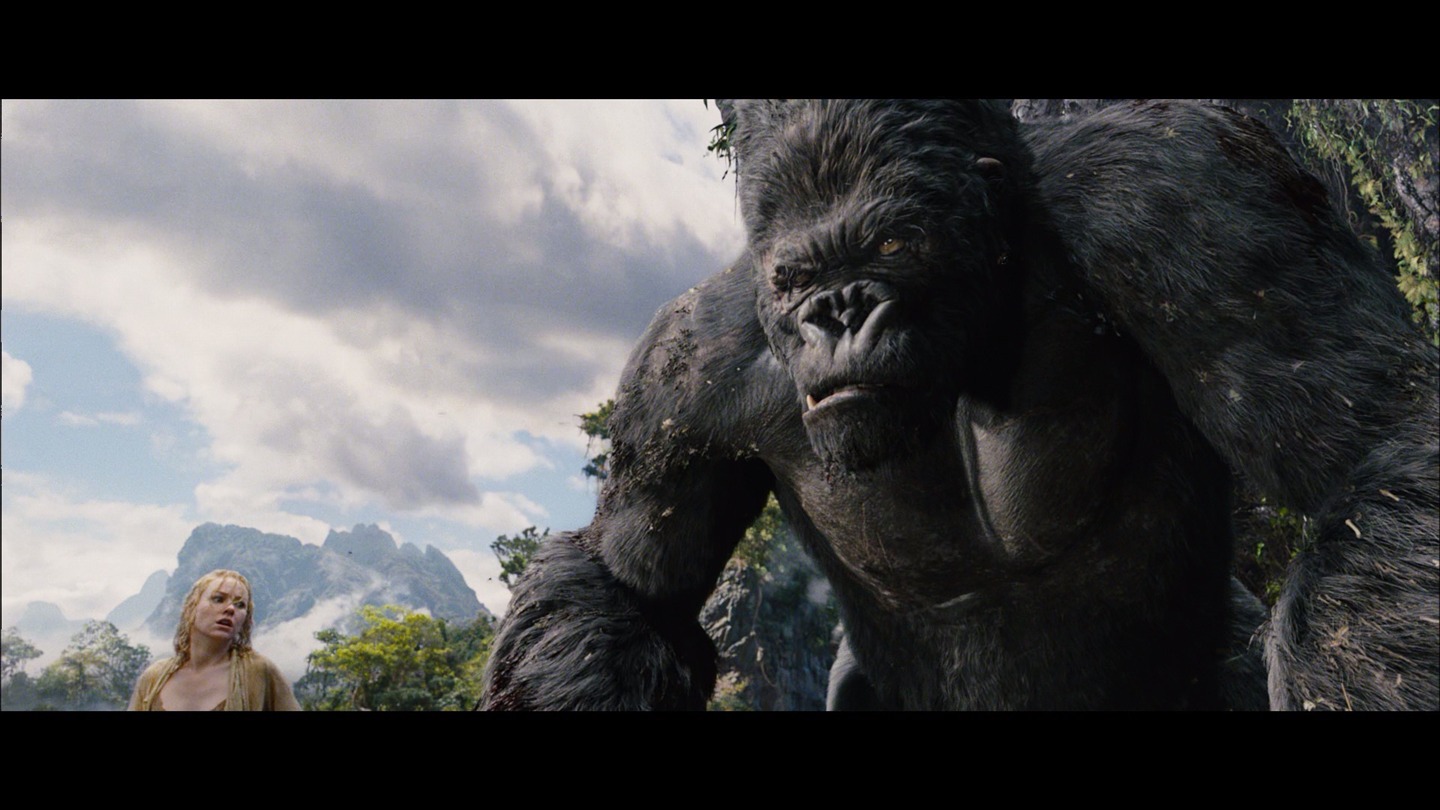
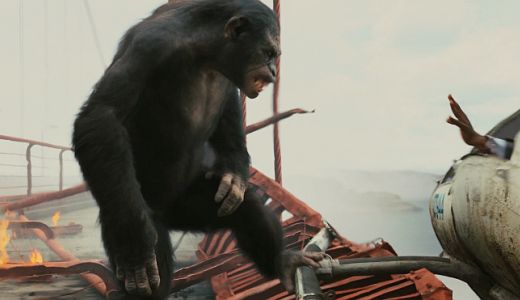
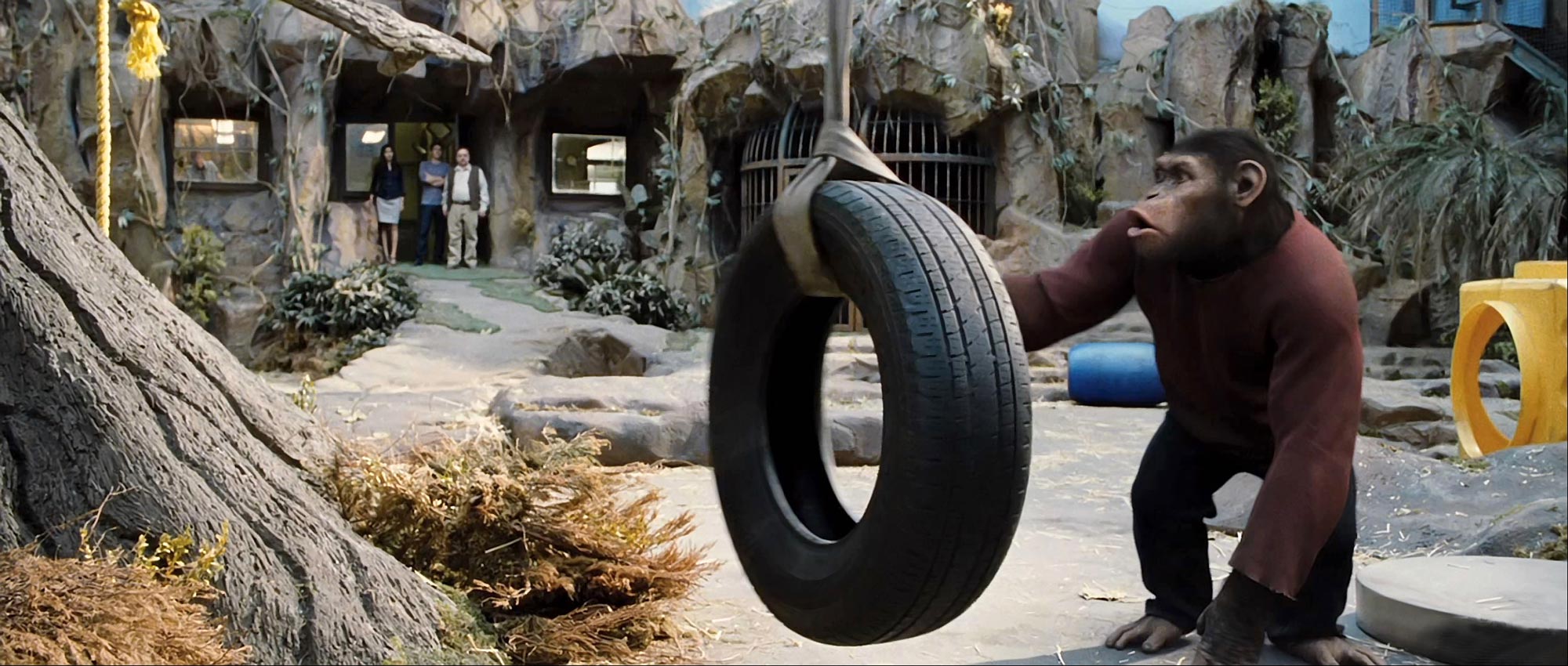
It couldn't have come at a better time, really, when motion capture technology allows abandoning the use of the monkey make-up that has gone before to achieve its animal effects—as well as having Andy Serkis (he was "Gollum" in the Lord of the Rings trilogy and played "Kong" in Peter Jackson's version of King Kong) mime-playing the lead Ape, Caesar,** which elevates the film, and pays off in strange (and surprisingly subtle) ways one couldn't imagine before. Also, that a lot of it hinges on basic silent movie techniques raises this one considerably in my eyes. Kudos to director Rupert Wyatt (only his second feature) for his good, strong story-telling and to writers Rick Jaffa and Amanda Silver for cracking this "Planet" wide open.***
One appreciates the big picture (man's technological hubris is again his downfall as in the first film) and the small (Caesar's symbol for freedom is nicely arced through the film, and it's not coincidence that the lab where Franco's Alzheimer's cure is developed and the primate facility at the Animal Control compound are structurally the same) that neatly draws parallels within itself and the franchise, taking what was good in concept, expanding on it and breaking out from it. The result is a rip-roaring film that stands on its own, yet makes one anticipate, even beg for, a continuation if it can be done as well as this one.
"...paying off in strange (and surprisingly subtle) ways."

Dawn of the Planet of the Apes

* There may be a little too much of that, actually. The structure of the film so complements the first film—to a point—that it seems unnecessary to "gild the lily" with so many call-backs from the original—we didn't need a word for word utterance of the first film's iconic line...and do you think the dullards at the Animal Control facility would REALLY be watching The Agony and the Ecstacy? (They'd be better advised to watch Spartacus, although it isn't owned by 20th Century Fox, nor does it star the appropriate actor). Now, Agony/Ecstacy would work...if the one guard was particularly religious...which could inspire in Caesar the whole concept of "The Lawgiver" that was presented in the original series. But, I digress (fan-boyishly)...

** The same motion-capture process that was employed with Serkis for Gollum and Kong was used here by WETA, Peter Jackson's New Zealand FX company. Some of the early scenes are a bit dicey, but once things start galloping along...the FX work becomes truly amazing. Now, with motion-capture, it's become a unique combination of the mime-work done to portray the pre-human apes in 2001 and John Chambers' enhanced theatrical make-up (Arthur C. Clarke ruefully noted that Chambers won a special Oscar that year for his POTA work, rather than 2001: A Space Odyssey, as the Academy "didn't realize our apes were actors."). And back to the point of Franco's job here (and frankly, everybody's), he had to play it completely disciplined in his scenes with Serkis, even though the latter was surrounded by one of the those crazy "motion-capture" suits, while on location (rather than a green-screen stage), which is a movie first.

*** Glenn Kenney, who writes for MSN Movies, fairly nailed it in the expansion of his review. Kenney's no slouch, but called the film "very nearly close to completely awesome" in the review, and noted that the film had four "Holy Shit!" moments, where something so unexpected happens that you wonder what could happen next (at the packed showing I attended, there were audible gasps at one particular happenstance—even though it parallels something that happens in the first film—followed by very nervous laughter). I counted six (but I have a low threshold for "Holy Shit!" moments), where most of the movies this year have had precisely zero.

Tuesday, April 30, 2019

Slumdog Millionaire

Oh, don't worry. There's a review of "it" very soon. In the meantime...

Written at the time of the film's release and it's winning Best Picture at the 2009 Oscars.

"Is That Your Final Answer?"
or
"My karma ran over your dogma"


There's a backlash against Slumdog Millionaire. There had to be. Showing up at the end of the year with such a positive critical reputation and so many glowing reviews, a few noses-out-of-joint had to be lifted in the air to pronounce that it couldn't be "that good."

But it is.

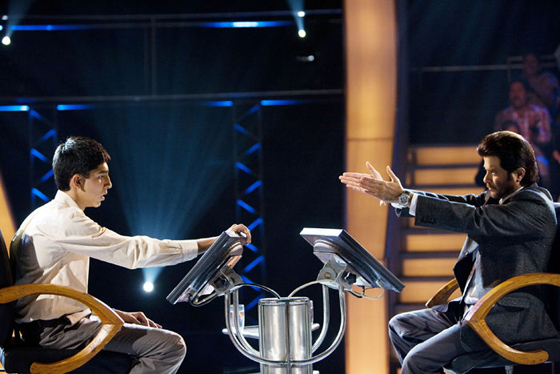
The irony is that these clowns' dismissal roughly parallels the story of director Danny Boyle's (and co-director Loveleen Tandan's) energetic film where it is assumed that a seemingly humble chai-wallah for a cell-service call center could not possibly know the answers to go (as the pompous host intones) "from rags to raja'" on the Hindi version of "Who Wants to Be a Millionaire."
*


When we first meet Jamal (Dev Patel), he is one question away from winning it all...and losing his life. Strung up like a piece of meat, he is being tortured by the local authorities*** to find out how he's cheating—he must be as so many others (of more worth) haven't done as well on the game-show as he has. Sounds like the "feel-good" movie of the year ala Forrest Gump, or as Time Magazine blurbles: "A Poignant Hymn to Life." **
Obviously, it's more complex than either view.

The movie even begins with its own "Millionaire" question for how he manages to do it: A. He cheated; B. He's lucky; C. He's a genius; D. It is written.

Is that your final answer? Really? (feigned look of concern)
You'll do a lot better with the movie if you don't pick just one, or pigeon-hole it into being this type or that, for the answers have too many facets, too many colors and shadings, and offer up the extremes of life—the ebullient and the tragic. In the end, it's a little bit of all of them.
This movie would seem like an odd tangent for Danny Boyle if every step of his career weren't punctuated by abrupt changes of pace. Especially lately after splitting from his writing partner John Hodge. To go from the zombie epic 28 Days Later... to the sublime kid's parable Millions, then to the sci-fi allegory Sunshine to this are as stunning turn-arounds as the dervish-like camera moves he is constantly spinning in Slumdog Millionaire. Boyle lived in India for five years, and so his camera-eye goes right to the colors and exoticism of Indian street-life.
In a dizzying chase sequence early in the film, a five year old Jamal and his older brother Salim are running from the police through the back-alleys of a shanty-town on the outskirts of Bombay. Boyle (and his Indian co-director Loveleen Tandan) films a wide variety of shots in different styles and speeds, sometimes step-editing the shot, twirling the camera, changing perspective, while out of the corner of your eye you see odd little details of street life going on (at one point, he cuts away to a close shave at a barber's, while in the alley behind the shop the kids streak by). But one never loses perspective on the chase, despite the wildly disparate angles and frenetic pace—something sadly lacking from the Bond-movie chase masters in Quantum of Solace****—and the result is exciting and masterful.
We follow the two boys as they become orphaned in a religious attack on their Muslim slum, live lives of begging and thievery on the street and the garbage dumps with their "third musketeer," a street-girl named Latika, then get picked up by gangsters who organize rings of street-beggars, blinding the best ones because they'll bring in double. The boys escape, but Latika is left behind, and that becomes an obsession for Jamal who is determined to find her again, while Salim follows his instincts into the Mombai underworld.
Sound like fun? Some critics seem to think so. Even without the beatings and torture that start the film. But Slumdog Millionaire follows its own karmic path to a pre-determined destiny in tune with the mixture of sweet and rancid of Indian life. And what these jaded writers don't get is the dharma of it all: when things are good, you better recognize it and enjoy it while it lasts.

Because it won't.

Doyle manages to capture the sense of India—an acid-trip without the acid (or so I've been told)—and communicate it on-screen—the colors, the desperation, the joys that crash through the crust of grinding poverty—to a delirious ending that would please Ganesh. Stay through the closing credits.

Enjoy it while it lasts.


* Although it no longer dominates the American air-waves, I've seen it in Spain ("Who Wants to be a Mult-multi-Millionaire?" and Austria. No matter where you go in the world, "Who Wants to be a Millionaire?" plays just the same.


** Although did I ever tell you about the time my Mother and her sisters went to see Martin Scorsese's Casino because they thought it was a musical? Fuggedabaht Joe Pesci being bludgeoned to death, or the guy with his head crushed in a vice--there's a sex scene between Pesci and Sharon Stone! Eyeeeww!

*** The Inspector in charge of the interrogation is played by Irffan Khan—memorable in The Namesake  and The Darjeeling Limited , but absolutely essential to the effect of A Mighty Heart. His unstated power and ability to internalize conflicting emotions across his face makes him fascinating to watch.


**** Funny that I made this comment: Boyle up until the end of last year was the working director of what is currently called "Bond 25" until disagreement with the producing Broccoli kids lad the director and his script-writer John Hodge to leave the project. Quite a few screenwriters have revised the script and American Cary Joji Fukunaga began filming this week in Jamaica.

Wednesday, November 30, 2016

Knight of Cups

Oh, Lucky Man! (Rinse and Repeat)
or
"Likes: Long Walks on the Beach"
"On the positive side, the Knight of Cups is a sensitive soul. He is a poet - a lover of all things romantic and refined. He uses his imagination in wondrous ways and taps the deepest levels of emotion. He knows how to create beauty and share it with others.
On the negative side, this Knight is prone to flights of fancy and illusion. His melodramatic moods are legendary, and his emotions often get the better of him. He's too temperamental and takes offense easily. He can't stand unpleasantness and will always let others deal with it."
We may have reached the end of the inventiveness in Terrence Malick's career and begun the phase of annoying self-indulgence and obtuseness (if we haven't already gone past it). There has always been a danger of that in Malick's work, but he has always worked with a non-traditional approach to narrative drive and story structure that oftentimes has been thrilling. Even after coming out of what seemed a self-imposed eighteen year exile after Days of Heaven, there was still a thread of story in The Thin Red Line and in, especially, The New World. He went far afield of traditional narrative in The Tree of Life, but there was still a through-line of feeling and history, despite star Sean Penn grousing that "this wasn't the movie I read." 
To the Wonder was more problematic—taking the same roundabout "Tree of Life" approach with the film about relationships gone sour despite the spark of the new, the film dragged, felt more than improvisational, and felt slap-dash and pointless, but benefited from some nice performances, even if they were mostly mimed. 
Knight of Cups (which spent very little time in theaters) has more problems than just a sense of randomness. It drifts, following a callow, non-committal screenwriter/script doctor as he roams the country, starting relationships with women, and ending them, sometimes selfishly, and always from that one man's perspective. Unlike To the Wonder, you never see the women's side of things.
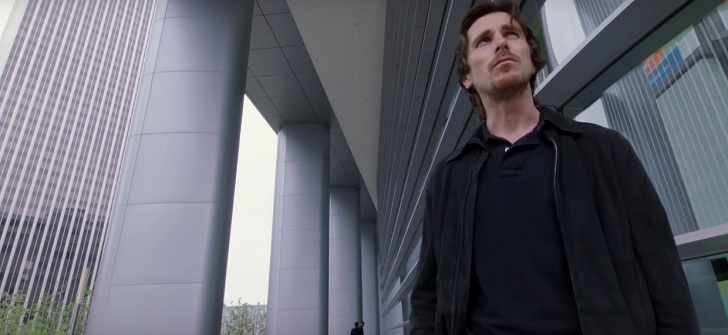
There was no script (Christian Bale, who spends the most amount of time on-screen, supposedly was cribbing character notes from his co-stars' instructions to see if there was something about him in them). One suspects there was no story. At which point, one is left with merely "attitude." That's not enough, especially in a film that has enough reach to employ so many actors and leave them with little or nothing to do than merely be photographed prettily.
But, if one wants a synopsis, here's my best at one: the film begins with a prologue-story, one that was read to our screen-writer when he was a boy by his father (Brian Dennehy). It tells the story of an Egyptian prince who is sent by his father into the city to find a precious pearl. But, once he gets there, he is set upon and given a drink that puts him into a deep sleep and when he wakens, he's forgotten he's a prince, forgotten about the pearl, and lives a life of normalcy, while his father sends out messengers, once his son has gone missing, to find him and bring him home.

The movie's synopsis from its web-page reads like this: "Knight of Cups follows writer Rick (Christian Bale, The Fighter,American Hustle) on an odyssey through the playgrounds of Los Angeles and Las Vegas as he undertakes a search for love and self. Even as he moves through a desire-laden landscape of mansions, resorts, beaches and clubs, Rick grapples over complicated relationships with his brother (Wes Bentley) and father (Brian Dennehy). His quest to break the spell of his disenchantment takes him on a series of adventures with six alluring women: rebellious Della (Imogen Poots); his physician ex-wife, Nancy (Cate Blanchett); a serene model Helen (Freida Pinto); a woman he wronged in the past Elizabeth (Natalie Portman); a spirited, playful stripper Karen (Teresa Palmer); and an innocent Isabel (Isabel Lucas), who helps him see a way forward." 
"Rick moves in a daze through a strange and overwhelming dreamscape -- but can he wake up to the beauty, humanity and rhythms of life around him? The deeper he searches, the more the journey becomes his destination. The 7th film from director Terrence Malick (The Thin Red Line, Tree of Life), Knight of Cups (the title refers to the Tarot card depicting a romantic adventurer guided by his emotions) offers both a vision of modern life and an intensely personal experience of memory, family, and love." 
...and (it might add) a lot of walks on the beach.
Memory and reverie have been the dream-stomping ground for Malick for the last few films, and one can do an awful lot with that, structurally, leading the audience through the memory-maze, which, itself, is a journey. But, there should be markers along the way or you'll get lost in thought, making that journey pointless. The film imposes a structure of chapters into the film (named, except for the last, on cards in the tarot deck), but if one is looking for that to help you find your way, you should ask for a re-shuffle—the cards and their distinct meanings have little to do with the incidents that follow them. Tarot cards are no help when the film resembles a game of "52 pick-up."
Instead, we are given randomness as Rick deals with the death of his brother, his estrangement with his father and brother, his various dealings with studio-folk, parties, happenings, road-trips, and an earthquake. But, mostly women (those being Imogen Poots, Cate Blanchett, Freida Pinto, Isabel Lucas, Theresa Palmer, and Natalie Portman, all drastically under-utliized, which is something of a first for Malick, who are usually the strongest characters in his films). Perhaps we're seeing a cinematic equivalent of depression where Rick is endlessly re-visiting past relationships, looking for a way out of the well. But, it's an endless rumination as he keeps banging his head against a mirror when what he should be looking for is a door-handle. Pin-balling inside your own skull rarely provides the perspective needed to pull oneself out of one's rut; if anything, the circular thoughts such self-examination presents generally cork-screws you even deeper into the abyss.
Hollywood navel-gazing is hardly a new subject for the movies. But, they rarely present a universal truth seeing as how the dream-factory surrounds itself with fantasy and un-reality. Most of us "real" folks have to deal with delusion rather than illusion, and as reality not as art. Yes, we can relate to the phoniness of Hollywood, to the dark-side of the dream-factory, of buying into the fantasy as if it were reality and the way that can mess you up. That orange-grove has been thoroughly tilled to the point where it's been asphalted over and turned into a parking lot. 
But, despite the trope, one shouldn't think of Hollywood's version of tragedy as real tragedy. Sure, one can be depressed in Hollywood, but that's only if one has the idle time to waste. Most of us don't have the luxury to sit back and wonder if they're wasting their lives. We're in the constant struggle not to, and to find worth in something more than the week-end's box-office take. It is hard (and practically impossible) to take Knight of Cups seriously when the person we're supposed to wring our hands about is well-off, handsome, and white, and living a life most people would dream of. "What in the hell does he have to be depressed about?" is the question that kept going on in my mind, competing with Bale's voice-over. On top of that, one shouldn't even consider that Rick is luckier than most—he makes a living as a script-writer—how many would-be writers are out there who've never gotten that chance. Boo-hoo. This is me playing the smallest violin in the world. Are we really meant to sympathize with somebody who has every reason not to be depressed?
Perhaps that's why we're treated to so many images of our poor little screen-writer walking the beach; he's attracted to it because it's so damned shallow.

One sincerely wishes that Malick made this to finance a few more shots of his IMAX project (expected this year), hood-winking the financiers into bank-rolling a few more shots that he needs to fill it out. Other than that, hopefully, this is an anomaly and Malick can return to an actual narrative, rather than these random acts of montage. The world needs more story-tellers like him, when he gets around to telling a story.