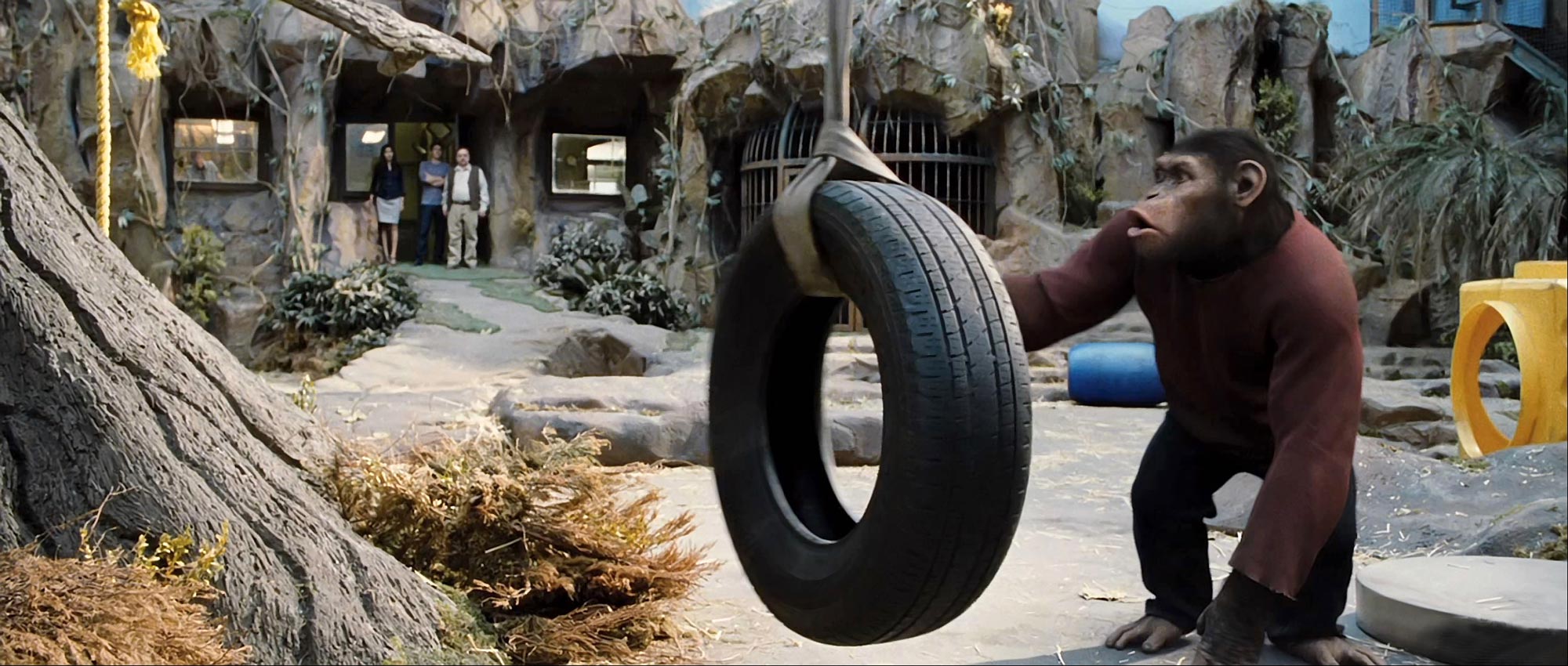
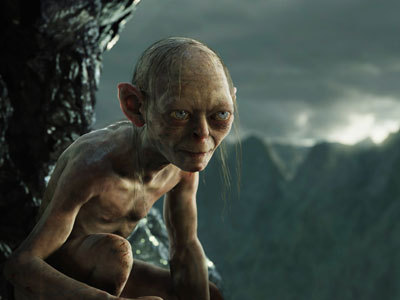
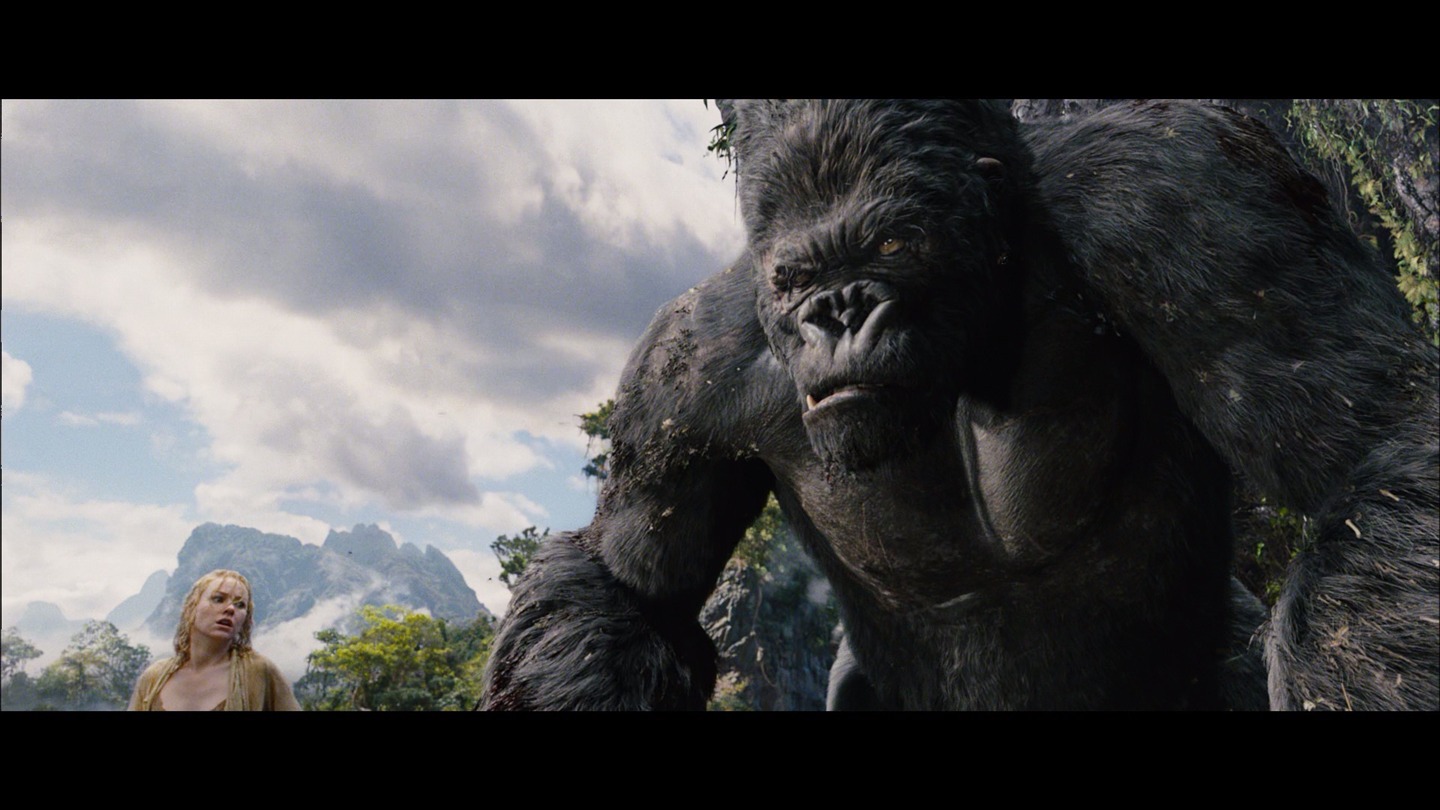
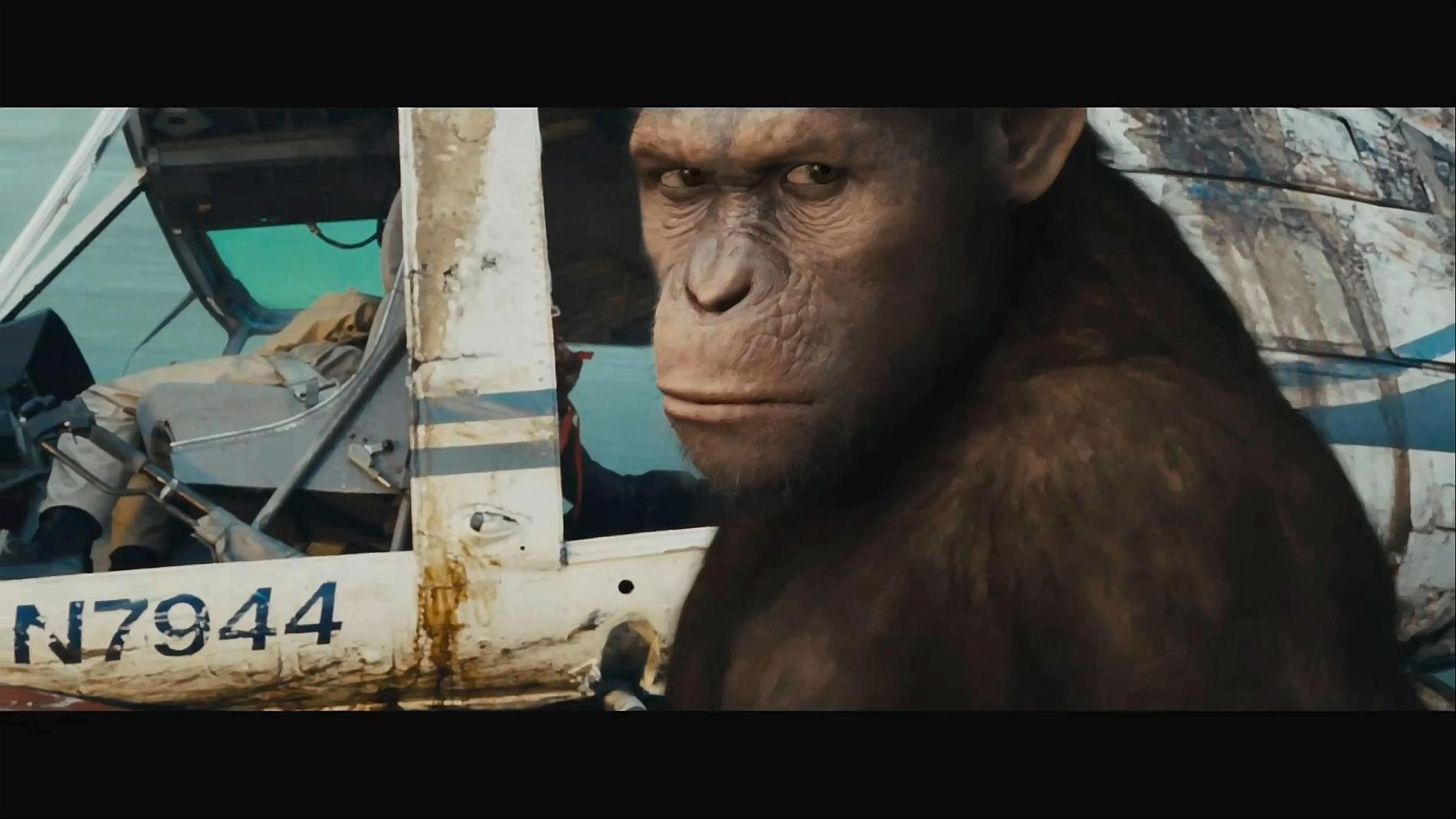
I was about to run a past review for another film when I realized I hadn't re-run the review of the first film of the "Planet of the Apes" re-boot. Great Caesar's Ghost, how could I have missed that?
Herewith, written at the time of the film's release.
"Running the Serkis from the Monkey Cage" or "Well...That was Fun..."
Tonally, it's jarring...as well as being a load of bananas. Conquest could have been good...in the disquieting way that the "Apes" movies could be. But, instead, the studio ham-strung it's simian rights leader.
It's different times now. The cities aren't burning down, only our 401K's. So, along comesRise of the Planet of the Apes—as unnecessary and pointless as any movie could be in this dull Summer Season for movies—after all, it's not a "tent-pole" franchise and arriving rather late in August. The "Apes" series had already run dry in its first go-'round, and in 2001, Tim Burton put out a "re-imagining" of the original that only proved that a "re-imagining" with better FX and make-up doesn't improve on something that depended on some good ideas first and the rest second. This new one seemed like a too late after-thought, and although the trailers looked intriguing, the ad campaigns and posters were uninspiring—there were no "character" posters, no tie-in cups at the 7-11, no "franchise" buzz—just another "Apes" movie long past its relevancy.
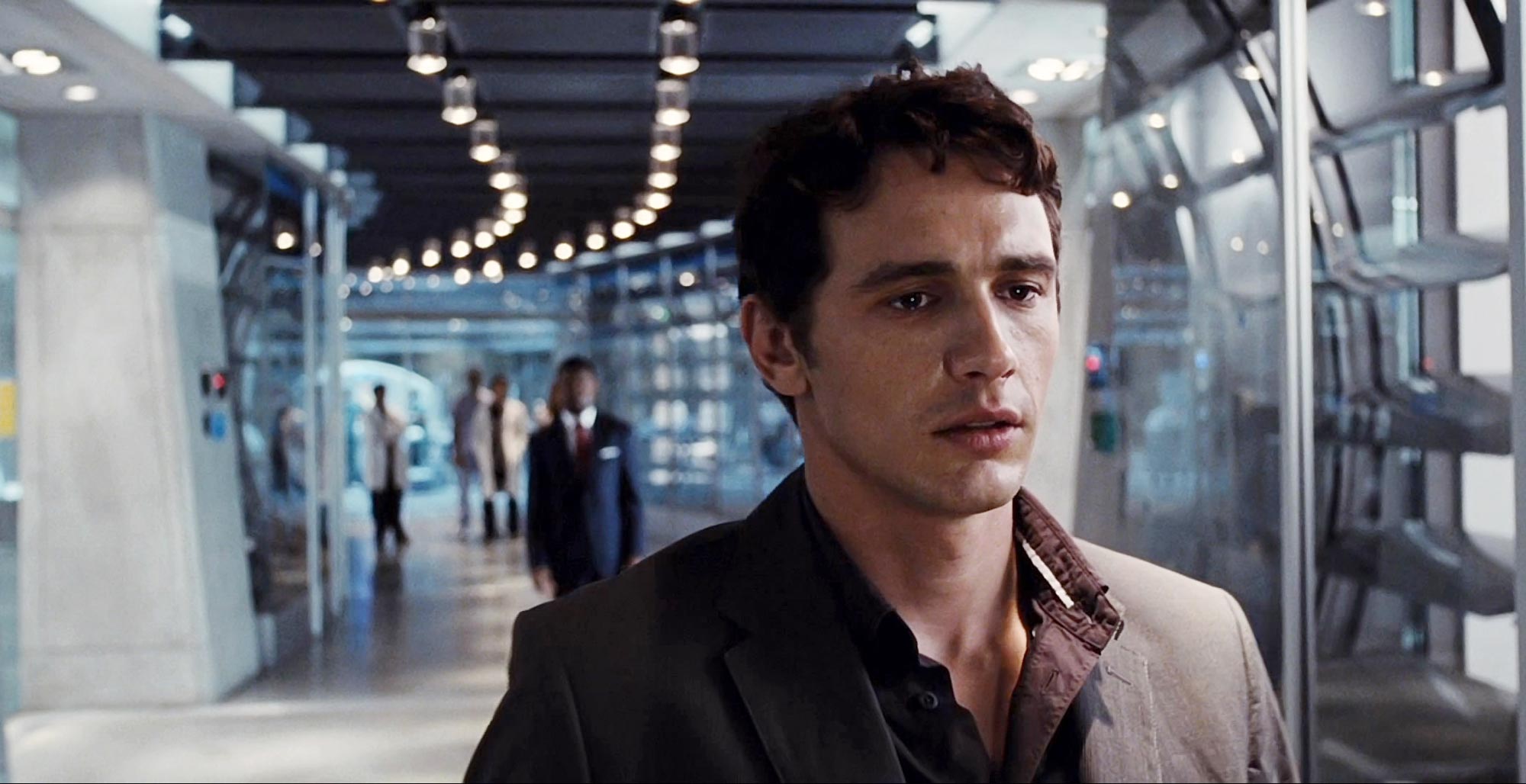
Except it has one thing going for it—good ideas. And when I say "good ideas," I don't mean the lines are clever (they aren't—Caesar gets the best lines, and the most effective scenes are played without dialogue) or the acting is anything that will get James Franco another Oscar nomination (he plays it absolutely straight—he has to, and given what surely were bizarre circumstances on the set, that is quite the accomplishment and there's no "hip" attempt to distance himself from the subject). But, at the basic story-telling level of Rise, there are good ideas that play out and lead the audience along, incrementally ramping up the circumstances until you can accept the anarchic and truly mind-blowing with a straight face. Where Burton's Planet billed itself as a "re-imagining," Rise truly is one, turning the circumstances of the first film on its ear, as the circumstances of the Charlton Heston classic turned the evolutionary relations of man and monkey on theirs.
One appreciates the big picture (man's technological hubris is again his downfall as in the first film) and the small (Caesar's symbol for freedom is nicely arced through the film, and it's not coincidence that the lab where Franco's Alzheimer's cure is developed and the primate facility at the Animal Control compound are structurally the same) that neatly draws parallels within itself and the franchise, taking what was good in concept, expanding on it and breaking out from it. The result is a rip-roaring film that stands on its own, yet makes one anticipate, even beg for, a continuation if it can be done as well as this one.
"...paying off in strange (and surprisingly subtle) ways."
* There may be a little too much of that, actually. The structure of the film so complements the first film—to a point—that it seems unnecessary to "gild the lily" with so many call-backs from the original—we didn't need a word for word utterance of the first film's iconic line...and do you think the dullards at the Animal Control facility would REALLY be watching The Agony and the Ecstacy? (They'd be better advised to watch Spartacus, although it isn't owned by 20th Century Fox, nor does it star the appropriate actor). Now, Agony/Ecstacy would work...if the one guard was particularly religious...which could inspire in Caesar the whole concept of "The Lawgiver" that was presented in the original series. But, I digress (fan-boyishly)...
** The same motion-capture process that was employed with Serkis for Gollum and Kong was used here by WETA, Peter Jackson's New Zealand FX company. Some of the early scenes are a bit dicey, but once things start galloping along...the FX work becomes truly amazing. Now, with motion-capture, it's become a unique combination of the mime-work done to portray the pre-human apes in 2001 and John Chambers' enhanced theatrical make-up (Arthur C. Clarke ruefully noted that Chambers won a special Oscar that year for his POTA work, rather than 2001: A Space Odyssey, as the Academy "didn't realize our apes were actors."). And back to the point of Franco's job here (and frankly, everybody's), he had to play it completely disciplined in his scenes with Serkis, even though the latter was surrounded by one of the those crazy "motion-capture" suits, while on location (rather than a green-screen stage), which is a movie first.
*** Glenn Kenney, who writes for MSN Movies, fairly nailed it in the expansion of his review. Kenney's no slouch, but called the film "very nearly close to completely awesome" in the review, and noted that the film had four "Holy Shit!" moments, where something so unexpected happens that you wonder what could happen next (at the packed showing I attended, there were audible gasps at one particular happenstance—even though it parallels something that happens in the first film—followed by very nervous laughter).I counted six (but I have a low threshold for "Holy Shit!" moments), where most of the movies this year have had precisely zero.
The year was 1973, and in an effort to attract crowds to the decidedly inferior fifth film in the "Planet of the Apes" series, Battle for the Planet of the Apes, the Crossroads Theatre in Bellevue—at that time a single cavernous auditorium (not the glitzy multi-plex it is now), was hosting a single day event: "Go Ape!" with the Planet of the Apes series. All five POTA movies in their Möbius-like timeline would be played in a row starting (and ending, appropriately) with the first, and best, of the films.
My buddies and I talked it over for all of ten minutes—the event was the next day—and we made plans with brown-bag lunches, gallons of pop—and plenty of bananas—to see each film in the continuing (and deteriorating) series. We made it all the way through to the last show, though we were reduced to grunts for communication by that time, proving the premise of reverse-evolution possible (and not that I'm complaining, but if they wanted to end it with a bang they should have re-run the second film as well).
Here is the twisted timeline of the Decline (and Rise) of the Planet of the Apes.
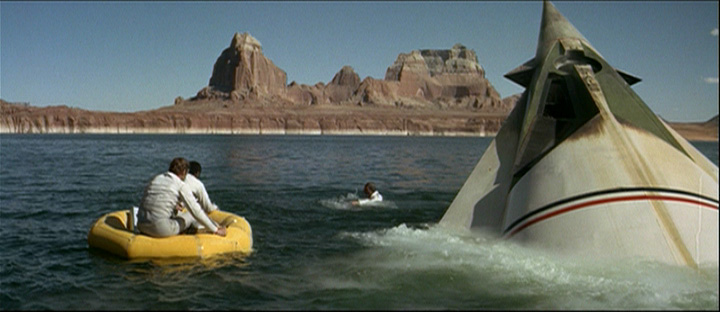
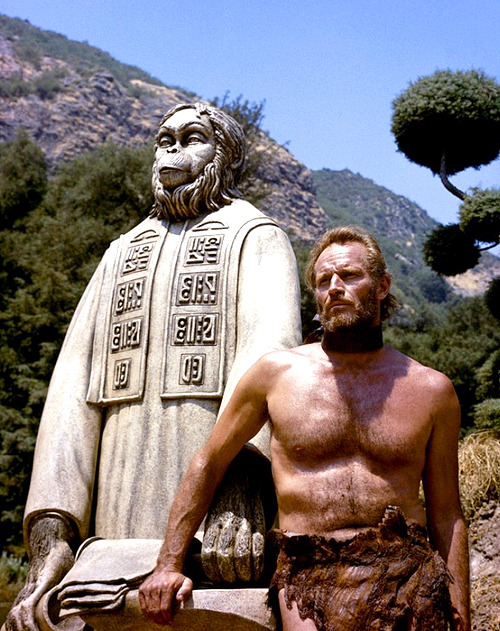
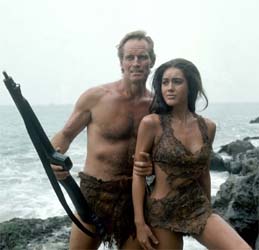
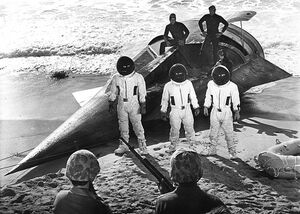
Planet of the Apes(Franklin J. Schaffner, 1968) Four space travelers led by Col. George Taylor (Charlton Heston) journey into deep space for the first time travelling faster than light—but not faster than the psychedelic light-show outside the ship's windows. While the entire crew is in suspended hibernation, the ship crash-lands (luckily, in a lake) on a primitive desert-like planet, forcing the survivors to march across the blasted landscape to find food, if any can be had.
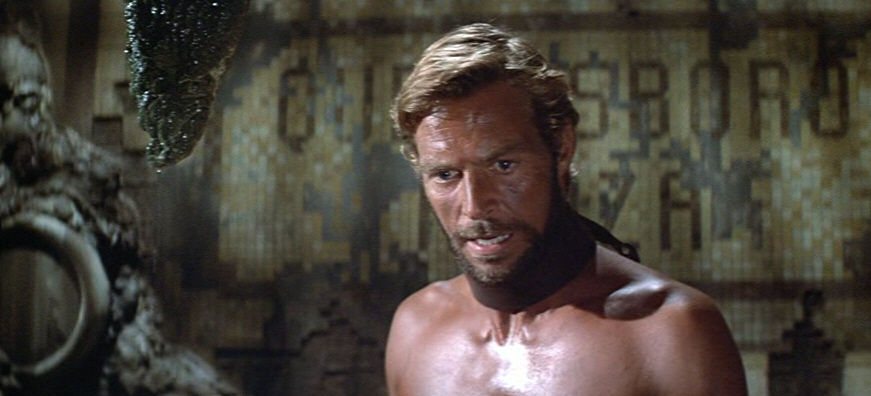
They come across a Garden of Eden of placid human-like creatures...the men ragged and bearded, the women made up, and sporting "big hair" do's...who are herded and hunted by gorillas on horseback, culling the humans to prevent them from destroying the apes' food supply. In the melee, Taylor is the only crew-member left standing, but can't speak, having been shot in the throat. He is taken to an animal infirmary where he is tended to by animal researcher Zira (the great Kim Hunter, trying gamely to emote through her elaborate make-up by scrunching up her nose) and her scientist fiancé Cornelius (Roddy McDowall, the most successful actor working with John Chambers' Oscar-winning ape make-up*). Eventually, he manages to convince the ape-intellectuals that he is intelligent and can communicate with them.This brings Taylor to the attention of the authorities: the orangutans in charge of religion and philosophy, led by Dr. Zaius (Maurice Evans, not able to handle the make-up so well, but his Shakespearean sing-song delivery—to counteract a stutter—gives his character enormous authority) who officially considers Taylor a mutant—and Zira and Cornelius heretics—to be delivered to the military arm of ape-society, the gorillas. It's already evident that the screen-writers (Rod Serling—who came up with the ending—and Michael Wilson—black-listed screenwriter who adapted "POTA" novelist Pierre Boulle's The Bridge on the River Kwai, only to see the French novelist credited with his screen-play and walk off with his Oscar) are straying from Boulle's novel. But, once the astronauts reach Ape-City, they go overboard with the satire in order to comment on human society, with human cliché's coming from the mouths of monkeys, and Taylor a hapless victim of the society's authoritarian capacity to destroy him. The message is layered onto the movie like several coats of frosting, and sweetened with much camp humor (during Taylor's trial scene, the three judges at one point cover their ears, eyes and mouths over objections). But, all this lampoonery around aspects familiar to human audiences only points to one thing—the crew did not crash on any far-flung "Planet of the Apes." Added to that is Astronaut Taylor's absolute certainty that humans must have preceded apes on this supposedly "different" planet—an idea that's weirdly illogical, on and off Darwinian theorems.
An extreme Franklin J. Schaffner wide-screen composition:
Taylor (Heston) and Cornelius (McDowall) are needlessly having a conversation
across a very large chasm overlooking a picturesque river-bed.
What? They couldn't have done this conversation standing next to each other?
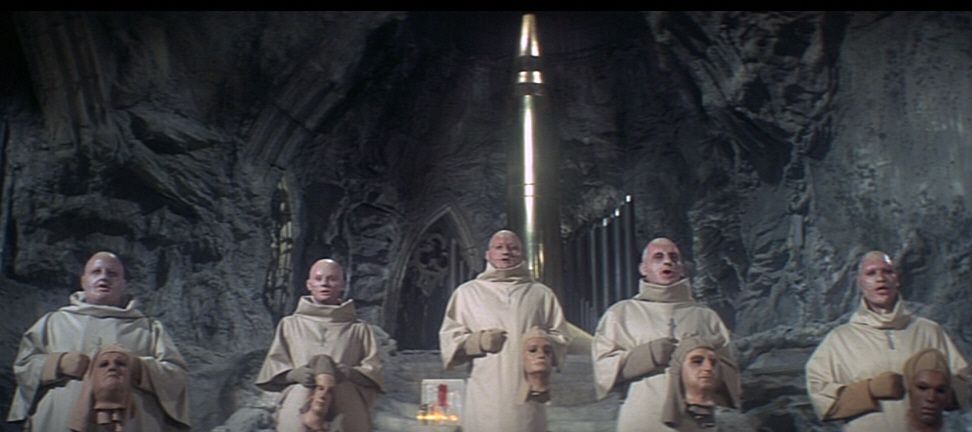
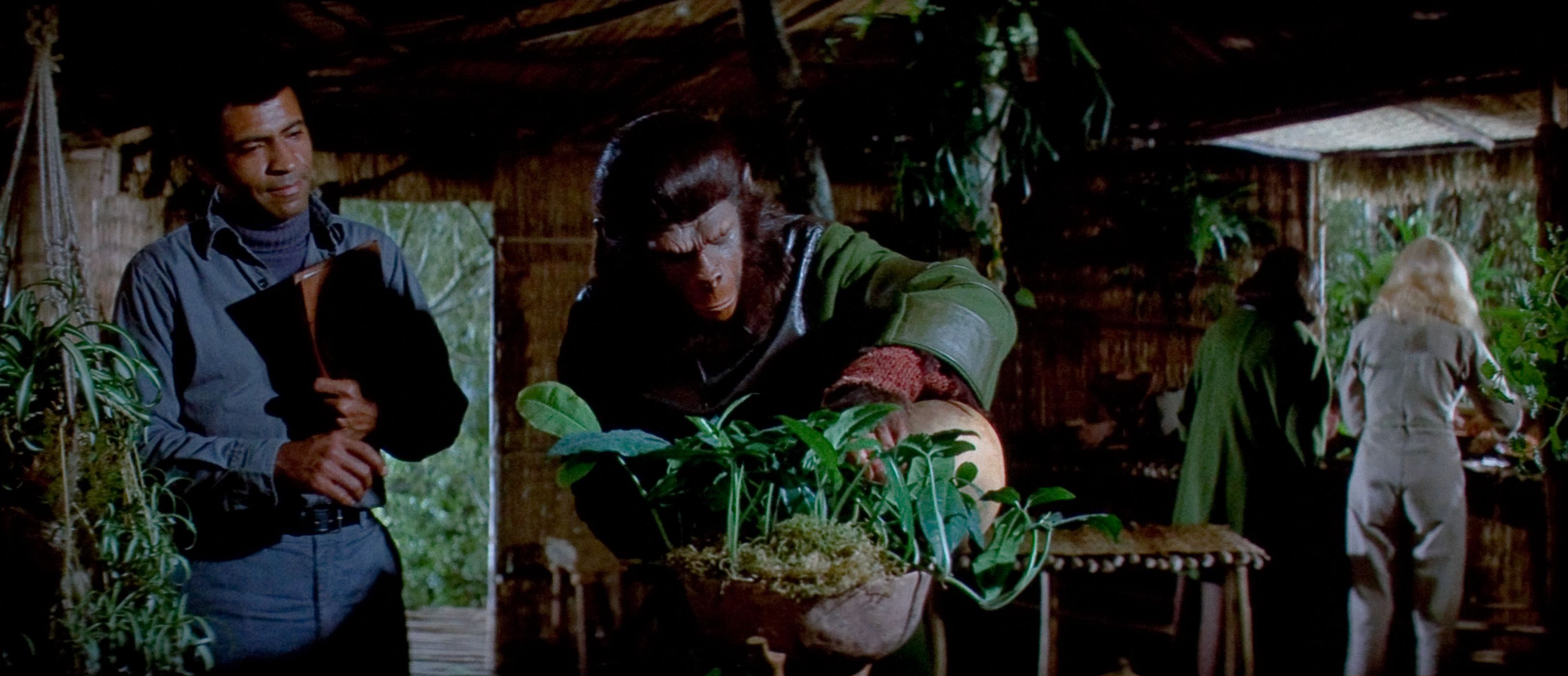
Escape from the Planet of the Apes(Don Taylor, 1971) Never underestimate a movie studio that wants to milk a film-franchise. And never ever underestimate a scriptwriter on a mission. This wicked twist on the "Apes" timeline was written by Paul Dehn, one of the more interesting men to write movies. A former spy, film reviewer, librettist, and political radical, Dehn, who adapted everything from Shakespeare to James Bond (and wrote the rather arch screenplay for Beneath the Planet of the Apes) turned the original film (and its own upside-down world) on its inside-out ear. Before the Earth explodes, chimp-scientists Cornelius (McDowall) and Zira (Hunter) and a red-shirted ape named Milo (Sal Mineo) find Taylor's original ship, re-fuel it somehow, and use it to leave the planet...for whatever reason...who knows, but their timing was perfect. Taylor must have left some cosmic bread-crumbs on his mission because the three chimponauts arrive back on 20th Century Earth, and, reflecting Charlton Heston's plight in the first film, are arrested, held on an army base and tested for intelligence. When it's determined that the apes can speak, they become something of a cause célèbre: positively, for the charmed citizenry; negatively, for a member of the President's Commission on the new immigrants, Dr. Otto Hasslein—the very same Dr. Hasslein whose "Hasslein curve" was a part of the original space mission!***
Hasslein, being a German scientist, investigates further by drugging Zira with truth serum and discovering 1) that they came from the future, 2) the apes have overrun humans in the future and 3) Earth blows up in the future, and 4) Zira is pregnant. As he's the guy who got us into this mess, he decides to put the space-time continuum back into the tooth-paste tube, and because he's a German scientist he wants to incarcerate the apes and abort the baby. He and Zaius would get along, I think. Cornelius and Zira escape, she gives birth to baby Milo, and are hidden by the owner of a conveniently travelling-by circus, Armando (Ricardo Montalban). But Hasslein (he's still a German scientist) helps track down the ape-parents and in an example of his countrymen's efficiency, manages to get Zira, the baby, Cornelius...and himself...killed. But, a visit back to Armando's reveals that he has a new baby chimpanzee in his circus—one capable of repeating one word, over and over: "Mama."****
The Lesson: "Even those who know the future are doomed to cause it." You've been warned.
Cornelius and Zira before their own tribunal
Conquest of the Planet of the Apes(J. Lee Thompson, 1972) Probably the most violent of the "Apes" movies, and, if studio cold-feet hadn't occurred, would have been the most radical. Told that it would be the last of the films, scenarist Dehn decided to connect the dots and reveal (on a limited budget, mind you) how the apes took control of the Planet from men.
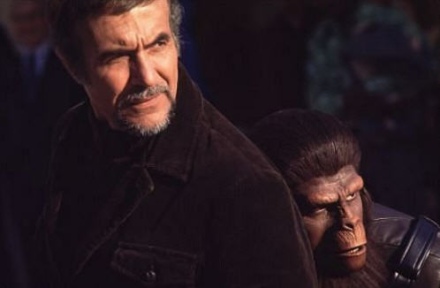
A space-plague has wiped out all of our beloved cats and dogs, and humans have replaced them in our hearts with apes. In our slave-quarters, too, as the apes and those handy opposable thumbs are doing a lot of the grunt work in the fascist-leaning city-states. They sweep the streets, wait tables, tote that barge, lift that bail, get a little drunk...and you end up in the electro-shock "re-education" center for re-inspiration. The apes need a leader, a "Spartacus," someone to bring them out of servitude. Where could one be? Baby Milo (McDowall, again) is grown-up, still hiding with Armando's circus and talking, and reasoning—which puts him at odds with his city's governor, Breck (Don Murray). Soon, he is part of the Ape Management work-force and begins to organize revolt. With the civil rights movement, the Watts riots, and student activismburning fresh in their memories, Dehn and Thompson crafted a bloody revolt by apes against men, culminating in the governor being beaten to death by gorillas with rifle-stocks. Fearing an "R" rating for violence, and negative preview reactions to the story-line's conclusion, the studio ordered the ending changed, with McDowall's chimp-leader, now named Caesar, pleading for tolerance, just when everything builds to a fever pitch and the city burns. It doesn't make any dramatic sense, but it does clear the way for one more half-step closer to "The Planet of the Apes." And a chance to wring more blood from the "Planet".
"So...uh...economic sanctions aren't going to work?"
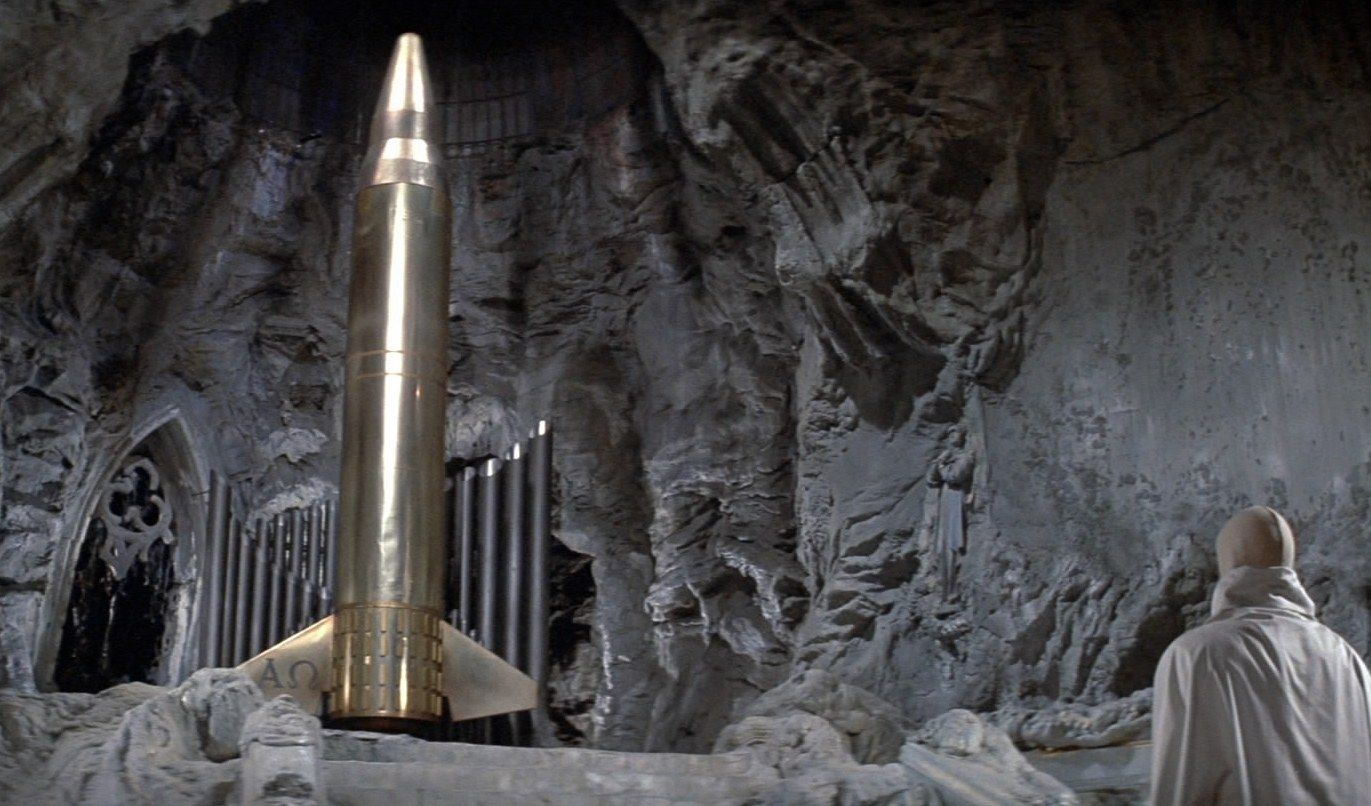
Battle for the Planet of the Apes(J. Lee Thompson, 1973) Executive producer Arthur P. Jacobs was ill during the work on Battle... and would die a month after its release. Paul Dehn had a basic outline of what should be done with the movie, but moved on. J. Lee Thompson remained, but for the paltry budget given to him (not to mention the paltry script), there was very little he could do to suggest the disintegration of the fragile peace between apes and men (that was scotch-taped onto Conquest...), especially after a nuclear war has decimated most of the planet, and a renegade band of nuclear survivors bent on destroying both (setting up the second film's conflicts) is on the attack.
The world is a mess in Battle, just like the movie.
🙈🙉🙊🙈🙉🙊🙈🙉🙊🙈🙉🙊🙈🙉🙊🙈🙉🙊🙈🙉🙊🙈🙉🙊🙈🙉🙊🙈🙉🙊🙈🙉🙊🙈🙉🙊🙈🙉🙊🙈🙉🙊🙈
We managed to survive the "Go Ape!" marathon, even staying to watch the first film again if for no other reason than to wash our minds of the dreadful Battle... We would have thrown our own poo at the screen as a comment, but it would have been a bit like "gilding the lily." The film-makers had thrown enough as it was.
But the series didn't end there: a Friday television showing of the first film on CBS recieved such high ratings that it inspired a television series, again starring Roddy McDowall as the chimp Galen, helping two earth astronauts lost in space (Ron Harper and James Naughton) in "Fugitive"-like episodes where they try to avoid capture by the gorillas and orangutans on a planet where they stick out like a sore opposable thumb. It lasted a mere half-season. Then there was a not-very-inspired Saturday morning cartoon "Return to the Planet of the Apes". One thing about the series. You could blow it to smithereens, cut its budget, and even turn it into a cartoon, but you couldn't kill the damn, dirty "Planet of the Apes."
Well, that is, until somebody tried a re-boot...
.
Planet of the Apes(Tim Burton, 2001) Smarting after creating three box-office under-achievers in a row (Ed Wood, Mars Attacks!, andSleepy Hollow*****), Burton joined with producer Richard D. Zanuckto make a new version of the "Planet of the Apes" franchise. The pair brushed aside labeling the film a "remake," insisting that it be called a "re-imagining." Image-wise, the film is phenomenal with a re-conceptualization of the ape-prosthetics by make-up wizardRick Baker, the best choice in Hollywood to do the job.******Baker's apes hew a bit closer tomonkeyandgorilla features in the face,andtheir leather-craft uniforms, including impressive mollusk-shaped helmets, andgaudy details—these apes like shiny things. Some of the make-up doesn't hold up well, though. Although allowing her greater expressiveness,Helena Bonham Carter's make-up is a bit too human-like(although Bonham-Carter does great body-work in her simian performance), andPaul Giamatti's orangutan make-up,is not all it should be, either. But, they're the exceptions. The movie has a grand look, and that extends to the gleaming space-ships that Burton imagines for the future.
But the script is a travesty—a room of monkeys with type-writers could have done better. Credited to William Broyles Jr. (who's done some good things) and the team of Lawrence Konner and Mark Rosenthal (who haven't—they were credited with Star Trek VI and wrote The Beverly Hillbillies, as well as the wretched Superman IV: The Quest for Peace) the script could have gone back to the original book for some ideas, but instead seemed to stop at the first movie for inspiration, including such gambits as a nubilesuper-modelin ragscompanion and a "twist" ending (that feels a bit desperate to be "twist-y"). Hinging on the sci-fi gambit of the "The Early Bird Changes the Time-line" (which most of us associate with Star Trek's "The City on the Edge of Forever"—by Harlan Ellison—and served as the basis for the 2009 "Trek" re-boot), the film spends more time on the visuals than in doing anything with the concepts it throws carelessly around like Samsonite Luggage, and ends with that staple of lazy script-writers, the chase across a terrainto an ambush, basically the way Battle for... ended. For all the sumptuousness that Burton prepared for the eyes, he could have taken some time to do something...anything...fun with the script, besides cameo's and confusion, to satisfy the brain.
Heston's cameo: "Damn them all to Hell"
But wait...there's more: it's a cyclical Universe, after all. Just as a star will die, it can sometimes re-ignite and start life anew like a phoenix. Out of nowhere a new Planet of the Apes movie was put in production, but (as Tim Burton's version proved) audiences just weren't going to be surprised or intrigued by the concept or by "twists." And so, writers Rick Jaffa and Amanda Silver tossed out the stranded astronauts trope and started anew and director Rupert Wyatt genuinely re-imagined the weakest aspects of the Planet of the Apes series, and made them intriguing. Imagine...rather than re-making a hit, they took the bad ones in the series...and improved on them.
What a concept.
🙈🙉🙊🙈🙉🙊🙈🙉🙊🙈🙉🙊🙈🙉🙊🙈🙉🙊🙈🙉🙊🙈🙉🙊🙈🙉🙊🙈🙉🙊🙈🙉🙊🙈🙉🙊🙈🙉🙊🙈🙉🙊🙈🙉
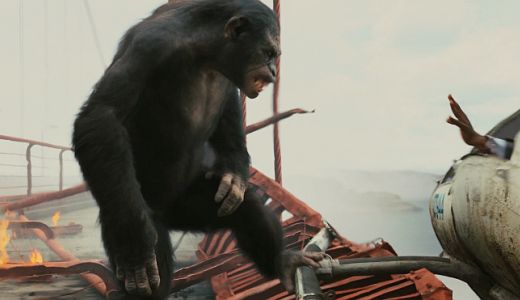
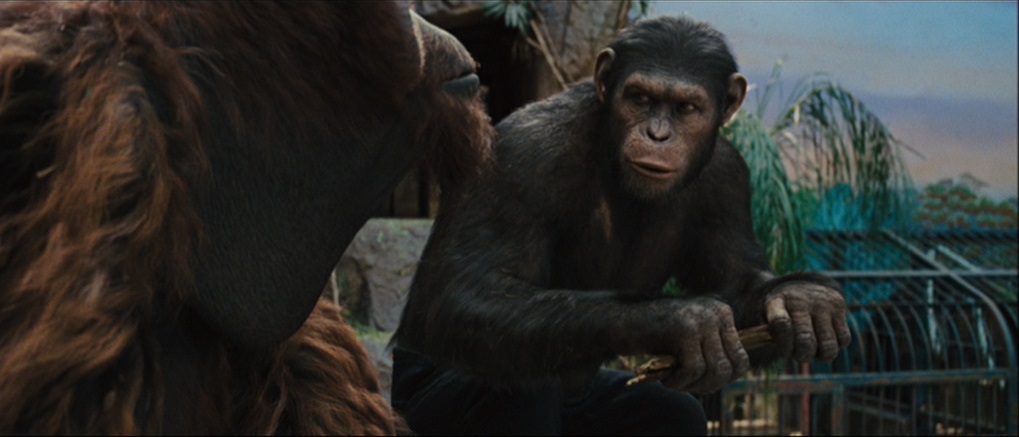
Rise of the Planet of the Apes(Rupert Wyatt, 2011) The original Planet of the Apes started at the end of the upside-down evolution of man to ape. The new series starts at the beginning, answering the question "Wha...hoppen?" to get there. And the answer is a good one: "good intentions." A pharmaceutical company is exploring drugs for coping with Alzheimer's and testing them on primates. Man is getting weaker and dying out, taking away its mental primacy. And the cure is only tipping the balance by increasing the mental acuity of the test-apes in the study, and one of them—the first subject, named Caesar (played rather brilliantly by a motion captured Andy Serkis)—is determined to raise all boats, the apian way. Forget Caesar. He's a primate Spartacus. Rise is well-acted, well-directed, and (as critic Glenn Kenney wrote in his review on his blog and at MSN movies) has a couple of genuine "'Holy Shit!' moments." Its closing moments, where the escaped ape-tribe led by Caesar having broken out of the test facility, survived a paramilitary assault on the Golden Gate Bridge and disappear into the Mt. Tamalpais forest (while the human populace is starting to be wiped out by a plague) whetted one's ape-atite for a sequel, and that hasn't happened since...well, the first one.
"Uh-oh." Andy Serkis as the motion-captured Caesar in Rise of the Planet of the Apes
Dawn of the Planet of the Apes(Matt Reeves, 2014) The first sequel of this century begins with a hunting party of apes, on horseback and decked out in war-paint, on a hunting party for venison. Things are progressing for the apes, a culture has started, more apes are communicating, most using sign language and a rudimentary schooling system has begun, including a rudimentary form of "Ape Laws." The humans aren't doing as well. The ones that have survived what is being called "The Ape Plague" (owing to a rumor that the apes infected the humans, as opposed to the destruction of the pharmaceutical plant where this all started) are holed up in the remains of San Francisco, where fuel for running the city's power on diesel is running out. Despite some bickering a team of humans (led by Jason Clarke and Keri Russell) set out to negotiate with Caesar's tribe (Andy Serkis again plays Caesar) to try and repair the generator of a hydro-electric dam in their area to restore the lights and power to the crumbling city. The sequel is not as successful as the first film, but not for want of trying. Reeves maintains a credible look of a Bay Area with a crumbling infrastructure, and Serkis and the other ape-performers are far more interesting than the human characters. But this part of the story is less about revolution than maintaining power, which is more intrigue than fireworks. Caesar even has an Iago-character in the ranks to set him up to fail. There's an extended action fight set amidst a crumbling skyscraper that goes on far too long, and ends (rather too conveniently, I thought) with the same outcome as the earlier Battle for the Planet of the Apes. But relations between the two hominids do not end well and suspicions among the groups are left unresolved, leading to the next sequel called War of the Planet of the Apes. Hopefully they've got some protection around the Statue of Liberty.
War for the Planet of the Apes (Matt Reeves, 2017)The third film in the "new" trilogy is a film of so much incident (although quite compact), that the Big Picture the film is aiming at doesn't become apparent until you're out of it. Like the apes in their California forest, you can't see them for the trees. It's because evolution has been upended, and Man has made his successor in the form of his ancestor. The apes become humanity...and that's not a good thing. We have met the enemy and "he is us." The humans have played God with evolution...and God's really pissed. Those expecting a big apocalyptic nuclear set-piece will be disappointed (although I was rather expecting it when I saw a reference to Beneath the Planet of the Apes in one of the sets). The world doesn't end with a bang, or a whimper, for that matter. The world doesn't end at all. It just hits "reset" as it occasionally does and begins again. Cosmically speaking, The Earth bases its fiscal year on dominant species. And the new King in town is the one Evolution left behind, and that Evolution's beneficiary unknowingly gave a kick-start to in its attempt to improve itself. The next species would do well if it never invents irony. War, with its emphasis on a "Human's Last Stand" (led by a Col. Kurtz-like Woody Harrelson) has action aplenty and food for thought, as well. That's in keeping with the entire series, which has always been satirical, often heavy-handedly so. This prequel series of Rise..., Dawn..., and War... has been more cunning, and far more subtle, often defiantly so. One of my favorite shots of the three films is in War... where a captured Caesar stands up for his troop in their captivity and resists, taking the whipping that one of his followers started to endure. The weakened ape is dragged to McCullough who stares at him, mutters "Jesus Christ, you are impressive" and orders him to order the apes back to work. When Caesar refuses, he takes his gun and points it Caesar's forehead...and he defiantly leans into it, staring his oppressor down. That is powerful stuff, more than explosions, more than fire-power, more than mega-tonnage.
So...how does it all end? Aptly, actually. With an ending and a beginning.
But these POTA prequels leave one thread dangling...suspended, as it were. Back in Rise... there was the hint of a mystery that was buried in background television newscasts and newspaper headlines...of the Mars Mission Icarus that was poised to enter the Martian atmosphere but became (as the headline read) "Lost in Space." Nothing of that seemingly doomed mission is mentioned in either Dawn... or War..., but it's still out there, somewhere. War for the Planet of the Apes ends (not with a bang, not with a whimper) with a shot of the former Muir-Ape-troop in their Promised Land, as the camera tilts up to the sky and lingers there for more than a moment before the final fade-out. This may not be to connotate the freeing of a spirit, but more probably to await the promise of...something...falling to the Earth. The circle in this trilogy is now complete, but with that completion of the turning, another one has begun, in the grooves of what has come before. Is it the end of The Planet of the Apes...or just the beginning?
Short of a nuclear war or a space plague (or a desperate actor wanting to get out of his contract) The Planet of the Apes will —probably—be continued...
🙈🙉🙊🙈🙉🙊🙈🙉🙊🙈🙉🙊🙈🙉🙊🙈🙉🙊🙈🙉🙊🙈🙉🙊🙈🙉🙊🙈🙉🙊🙈🙉🙊🙈🙉🙊🙈🙉🙊🙈🙉🙊🙈🙉
Kingdom of the Planet of the Apes(Wes Ball, 2024) It's "many generations" since the War and civilization has bifurcated in dominant species—apes and humans, and the humans have bifurcated to the mute and the one who still retain intelligence and speech. And the apes have developed enough societal skills to use farming and falconry for subsistence. But, they're tribal and every once in a while, some big ape wants more power and start warring on another tribe. One such skirmish kills the parents of Noa (Owen Teague) and he swears revenge by going after the Proximus Caesar (Kevin Durand), a self-styled king who can't play well with others. Along the route he picks up his own "Nova" (Freya Allan), who only pretends to be mute, but is part of a human team living in a facility minding a phalanx of radio-telescopes, while Noa has found evidence—an observatory with a still-functioning telescope That there is, indeed, something going on out there beyond the planet and their petty squabble. But, what it could possibly mean for their burgeoning civilization, he has no idea. But, the stars sure are pretty.
* McDowall, clasically trained and in movies since How Green Was My Valley, appeared in all the first round of ape movies (except Beneath) as well as the TV series. Easy to see why. McDowall's performance is something of a triumph over the make-up's adversity: scrunched down into a crouch, with an odd half-hopping gait, he could actually convey different emotions through the face-covering make-up. His apes smiled with a high cheeked crinkliness, the mouth moved most realistically than the others actor's during speaking, he'd react in chagrin by bringing the jaw back and the forehead up, and, in irritation, McDowall used the make-up's tendency to go slack into an open-mouthed look of threat. But mostly, as Olivier was fond of saying, "It's all in the eyes, really." McDowall knew how to throw it all out his eyes, and one of the best moments of the series is in the luke-warm (owing to studio cold feet) Conquest of the Planet of the Apes, when McDowall's ape is allowed to pick his name from a book. He paws through a few pages, and jabs his finger at one word: "Caesar." Don Murray's villain-governor sees the gravity of the name and gives the ape a glower and finds "Caesar" giving him a penetrating, somewhat challenging stare. The two actors keep their eyes locked for a looong period of time (and they're not even the focus of the scene at this point!). It's a funny, uneasy scene that evokes guarded laughter. McDowall was that good.
** Heston didn't want to do the sequel, but agreed to if he got to blow up the entire planet... thus eliminating any need to come back for more. He did make an amusing cameo as ape Gen. Thade's dying father in Tim Burton's "re-imagining"—one of the few joys in the dreary thing.
*** There's a reason Hasslein's name is spelled with two "s's," as he serves the same function as Dr. Zaius in the first two movies—the government representative who distrusts the illegal immigrants and takes matters into his own paws...er, hands. That he's played by the teutonic Eric Braeden (who also starred in Colossus: The Forbin Project) should alert anyone to never give the guy a grant for research of any kind! **** Ironic because it's also the word that escapes from the baby-doll when its dropped and confirms Taylor's rather chauvinist contention (in the face of all evidence) that humans first ruled the Planet of the Apes.
***** Regardless what I think of them—I happen to like Ed Wood a lot and Mars Attacks slightly less so—they under-performed at the box-office.
There is another "remake" of Planet of the Apes, however that succeeds wildly.
That is the musical version presented on "The Simpsons," entitled
"Stop the Planet of the Apes-I Want To Get Off!"!)




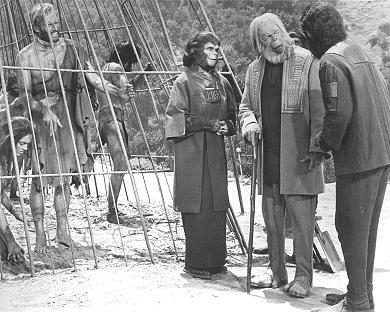 This brings Taylor to the attention of the authorities


.jpg)