The Wreck of the Mary Deare(Michael Anderson, 1959) It was intended to be an MGM production for Alfred Hitchcock—he'd liked the best-seller and he'd wanted to work with Gary Cooper since Foreign Correspondentin 1940—but screenwriter Ernest Lehman found it pretty dull with an extended, dry courtroom scene at the end, and the two decided to fulfill his real ambition—to make the "ultimate Hitchcock film"—which turned out to be North By Northwest. We are all the better for it. As it is, The Wreck of the Mary Deare is an odd picture with a great mysterious opening and a dry-as-dust finale, try as scripter Eric Ambler and director Anderson might to make a suitable action closer to it. In turbulent seas in the English Channel, a salvage tug, captained by John Sands (Charlton Heston), finds a ghost-freighter marooned and adrift, nearly colliding and destroying his ship. Pulling alongside, Sands grabs a dangling line and laboriously clambers aboard. The rusting hulk, the Mary Deare, is without power, a large gash in its side that is slowly flooding the engine room, and with no sign of life on-board...at least initially.
One man has remained—First Officer Gerald Patch (Cooper), a merchant marine eking out an existence on the ship, which was recently abandoned, and desperately trying to scuttle it before it sinks of its own accord. The reason is not because he wants it to be salvaged; he needs it for evidence, but why is being kept a closely guarded secret. With the reluctant help of Sands, Patch gets the boiler-room going, the ship under power, and the Captain-by-default's mission accomplished.
All of which is great stuff—the conflicts, the questionable sanity of Patch, Sands' greediness in wanting to claim the salvage on the ship—which would have made a great film if it ended there. Unfortunately, that's only thirty minutes of it. It would have been a great short subject, though, but the movie trundles along over the investigation and trial over who owns the boat and the conflicting testimonies between Patch and the eventually-found crew (ring-leadered by Richard Harris, who can't seem to eke out an interesting performance from the material, try as he might).
Michael Anderson is no one's idea of an innovative director—and he started his career assisting David Lean and Carol Reed! His widescreen compositions look like they're meant to be cropped for a boxy television presentation, although he was known for taking elephantine projects—Around the World in 80 Days, Logan's Run—and making them as quickly and cheaply as possible, There is the sense watching his films that a creative presentation, rather than a practical one, was thought unnecessary—keep the focus, hit the marks, and, as far as lighting, make sure the audience can see the stars' faces.
Both Cooper and Heston are good, in what seems to be dueling portrayals of earnestness. But, ultimately, the secrets that Patch is keeping just aren't very interesting, and although some attempt is made to salvage it at the end, the movie is, like its namesake, something of a drifting hulk.
Major Dundee(Sam Peckinpah, 1965) Semi-restored version of Major Dundee that's a bit closer to the idea Sam Peckinpah had in mind when producer Jerry Bresler took the film over, edited it with a meat cleaver and threw on a wildly inappropriate score (a ranch massacre with bodies littering the desert and the main house on fire until it collapses is set to a bouncy Mitch Miller tune?* Say, what? Peckinpah has been accused of bad taste in his movies, but he'd never have pulled something as egregious as that!). Peckinpah's first A-budget movie has a great story. A hard-nosed Union Major, Amos Dundee (Charlton Heston)**side-tracks a bit from the Civil War to capture or kill the marauding Apache chief who torched that outpost. To do so, he must cross the border to Mexico in a mission that doesn't officially exist. His requisitioned army of nobodies employs cut-throats and horse-thiefs, Confederate Rebels and Buffalo Soldiers. No one asks: Can't we all get along? It's just assumed that they can't, but a sense of order and hierarchy is maintained within the groups, while the groups test and prod each other en route.
And the film is full of detail (you want to see it on a big screen). There are some extraordinary screen-caps from the film below that show Peckinpah's innate ability to fuse landscape and character, not unlike John Ford, whom Peckinpah seems to emulate while presenting either a celebrational rabble or a ceremonial piety but infused with a more cynical rough-hewn presentation. I don't think John Ford would have had a soldier swatting flies away from a war wound, but I could be wrong.
Heston is a bit of an odd man out in the film, his acting rhythms are slower than Peckinpah is able to deal with in his cutting style (in fact, there's a couple places where Peckinpah cuts in the middle of Heston's reaction shots just to speed the man up a bit) and the clashes show. In an interview, R.G. Armstrong calls Heston "a poser," (which is certainly true, but also calls him "the nicest guy in Hollywood"—Heston gave up his salary to keep an embattled Peckinpah as director***), but Heston loosens up quite a bit in this film than he had in any previous one, setting a tone for his subsequent work as less heroic, more recognizably human presences.
But the movie falls apart somewhat, when the troop liberates a starving town from the French; everyone looks impoverished (even the dogs outside town are skin and bones), the exception being the widow Santiago (Senta Berger)**** whose nursing duties among the starving citizens hasn't reduced the glow in her cheeks or made her any less voluptuous. Her presence and the subsequent romance with Dundee just doesn't sit well with the grit of the rest of the movie, and so Peckinpah wounds Dundee and sets him on a rehabilitating toot that manages to negate a lot of the nobleness of the character, and undermines a couple other parts as well.
A broken arch does not connect (and thus dooms any romance) between Major Dundee and Teresa Santiago (Senta Berger)
Production began before a suitable third act was constructed, and Peckinpah was convinced that once filming had begun, the script would be hammered out. But production delays and disputes between the director, the studio and the producer ate up a lot of that valuable work-time. And Peckinpah began to drink, most days towards the end, showing up drunk on the set.
Peckinpah gives shape to Richard Harris' Captain Tyreen caught between his sense of honor and loyalty to the Confederacy.
Still, up until the romance, it's a gritty, atypical Western story with integrity and a nice mature brusque edge to it. Studio interference would hamper this film and dog Peckinpah for the rest of his career.
The remains of Dundee's command escape the French across the Rio Grande. A shot with such depth it approaches 3-D.
* The opening credits run over the shot of the house burning, and the structure collapses when the director's credit comes up. Peckinpah liked to do things like that.
** To give you a flavor of the writing by Peckinpah and Harry Julian Fink (Dirty Harry), Dundee is characterized as a "$70 red-wool, pure-quill military genius or the biggest damn fool in Northern Mexico."
*** When asked by a reporter if that would set a precedent among Hollywood actors, Heston said, "It's not even going to set a precedent with ME!" A great line.
**** Peckinpah was dissatisfied with the romance story-line imposed on the script but not the actress: Senta Berger would work with Peckinpah again (and James Coburn) in the director's fine Nazi war film Cross of Iron.
Juggernaut(Richard Lester, 1974) Made in the shock-wave of such star-culling epics as Airport, The Poseidon Adventure, Earthquake, and The Towering Inferno that had the gall to ask: "Who Will Survive?" in its posters, Juggernaut played the same game. See? All the stars are lined up like ducks in a gallery reading to be pinged, just like those other all-star slaughter fests.
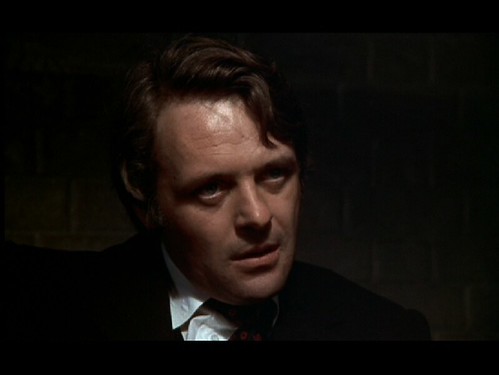
Juggernaut plays the game differently, though, while maintaining the conventions. This film is as soapish as the others in terms of interpersonal relationships. But in other disaster movies, people are collateral damage to the epic depiction of crumbling masonry. Lester's film is all about character—the "disaster" is man-made, the people at-risk are portrayed intimately, if not by stars, by strong character actors (Clifton James, Shirley Knight, Michael Hordern, Cyril Cusack, Julian Glover, Roy Kinnear—Lester's favorite buffoon is given a part to shine in this film—Ian Holm, a pre-fameAnthony Hopkins) you begin to care about.
The cast is filled with faces who would become more familiar in later roles, but the two leads are Omar Sharifat his dyspeptic best as the Captain of the threatened ship and Richard Harris, who was never better than he is in this movie.
The cruise ship SS Britannic is half-way across the Atlantic Ocean when the line's president (Holm) receives a phone call from "Juggernaut" saying there are seven barrels of high explosive rigged to go off the next day at a predetermined time. Unless a ransom is paid, the bombs will go off and the ship will sink. With the ransom, instructions to defuse the bombs will be sent. Any attempt to defuse the bombs will cause them to explode. Holm's president wants to pay the ransom quickly, but the British government threatens to pull his operating subsidy if he negotiates with terrorists. While Hopkins' Scotland Yard detective attempts to find "Juggernaut,"bomb expert Tony Fallon (Harris) and his crew are sent out to the Britannic, dropped in the ocean, and clamber onto the boat.
The focus shifts to Fallon, who sees all defusing jobs as a form of psychology—he's not trying to figure out the bomb, he's trying to figure out the man who made the bomb, and the tense scenes of Fallon examining one bomb to relay instructions to his crew are a whispered monologue of a man on the edge of death attempting to read the mind of the puzzle-maker in a battle of wills.
For director Lester, who is fond of games and puzzle solving, the film is one of his obsessions brought to life with the bomb design being particularly devious. Given its nature, one is put immediately into the Fallon mind-set that he is battling a man and not a bomb. And it is this interplay, where one man must rely on his skills and his knowledge, rather than the tides of Fate, that makes Juggernaut sail past the other films in the sub-genre.
Robin and Marian (Richard Lester, 1976)On paper, it looks perfect. The authorof The Lion In Winter jumping a few years ahead in the story to tell of the end of Richard the Lionheart's bloody Crusades, and the return of Robin Hood and the loyal Little John to Sherwood Forest, where they find a lot has changed. Directing would be Richard Lester, who had returned to A-list prominence with his extraordinary staging of The Three Musketeers/The Four Musketeers. He was becoming the "go-to" guy for period dramas, finding ways to bring a mature light-heartedness to any dreary point in history (or more appropriately, he would ignore Hollywood sound-stage pretense and show historical periods a bit more accurately--for example, his fly-filled Rome in the otherwise schtick-filled A Funny Thing Happened On the Way to the Forum). In the years since, his successes had been spotty: Juggernaut, his all-star take on the disaster film, sank at the box-office (never mind--watch it!), as did his dream-project Royal Flash bringing his "Musketeers" adapter George MacDonald Fraser's character to the big screen.
Then things started to go wrong.The script by Goldman is charming, but often relies, as did The Lion in Winter on piquant anachronisms--the kind of "Isn't that funny? They talk like we do!" approach to historical drama that can be a bit cloying. "You never wrote!" complains Maid Marian at one point in the script about Robin Hood's many years away. "I don't know how!" says Robin in perplexed reply. But there are some nice things--the over-all theme of living past your prime or need, combined with Robin's nostalgia for the old days and his childish belief that he can make things right again on all fronts.
There are some nice little cliche-bashings. I remember a couple of cut-away shots of Nicol Williamson's Little John looking pained at Robin and Marian expressing affection for each other, and thinking, "Oh Lord, they're going to make Little John gay!" which I thought was a pretty cheap way to bring in relevance to the story. But it proves to be a clever gambit. Later in the film when Marian goes to John and begs him to keep Robin out of battle, she makes the same assumption. "You've always been jealous of me! But you had him all those years!" Williamson beautifully underplays this scene "Yer Rob's lady," he mumbles. "What?" she cries. "If ye'd been mine, I'd never've left." and Williamson chucks the apple he was eating into the night where it arcs and disappears. Nice set-up. Nice turn. As is the ending, recreating the myth of Robin firing one last arrow through the window, telling John to bury Marian and he where it lands. In Lester's last shot, it never falls to earth.
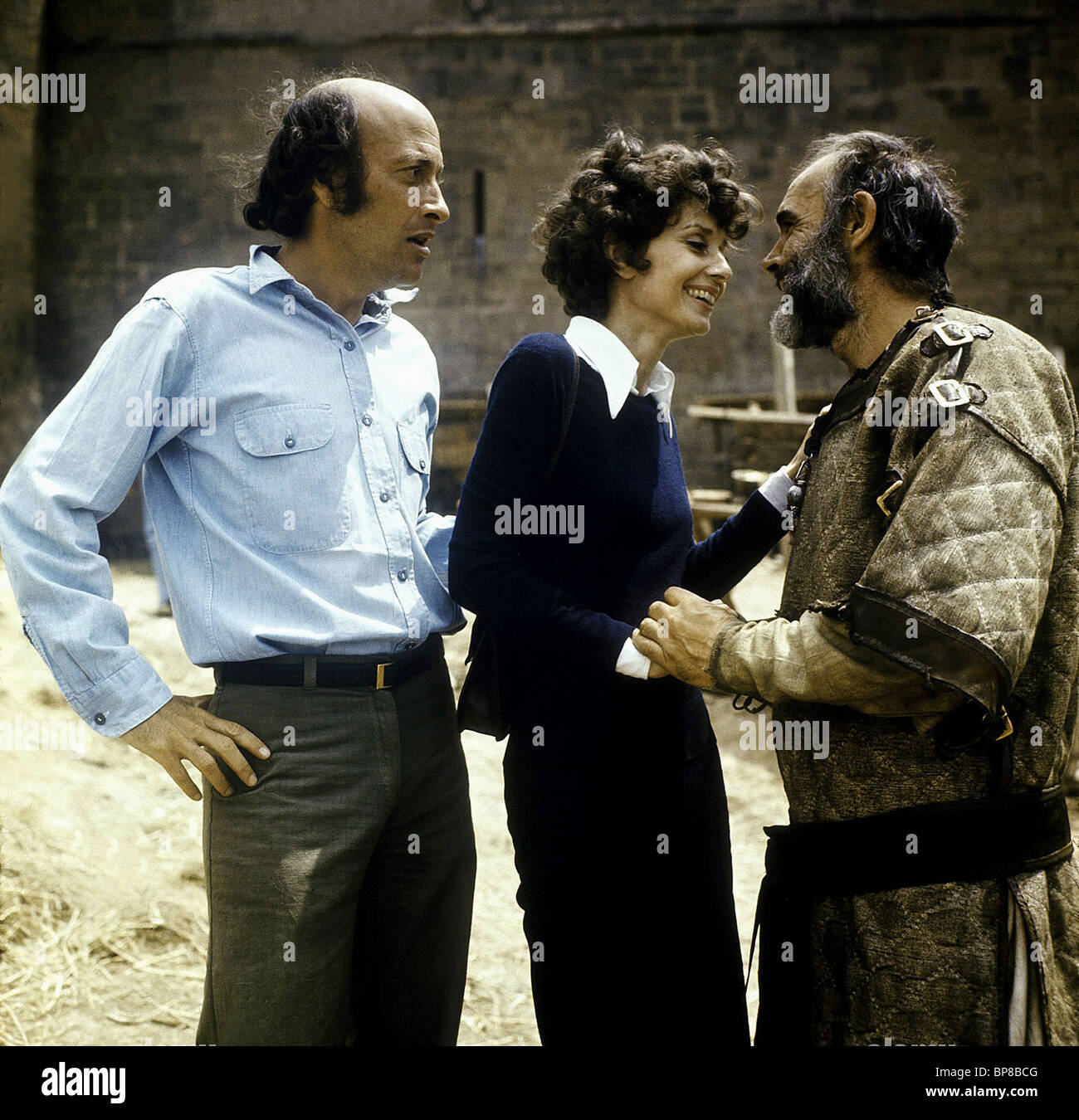
The charm of the script no doubt appealed to Hepburn--she has a speech at the end that most actresses would kill for, though, practically, it slows the film to a crawl at a very critical time. There are publicity pictures of Lester and Connery showing her around the set, but Hepburn, given Lester's directorial approach of "You act, I'll shoot" might have been a bit put off by his quick approach and lack of hand-holding.
She made complaints about some of the gristlier aspects to Lester's cut, particularly to his opening the film with a shot of ripe fruit, and ending it, with the fruit rotting in the sun. This is a brilliant way to express an aspect of the story--that Robin, and Marian too, have overstayed their usefulness. And the film is gritty. The staging of an opening scene in a burned-out desert fortress feels more like everybody's waiting for Godot rather than King Richard. And Lester keeps his own anachronisms well-chosen, for example Robin Hood's morning routine--waking up in the forest, stretching, brushing his teeth with a fir branch, and reaching for a good ball-scratch until he sees Marian waking up--Connery's hopping attempt to be nonchalant is priceless.
And the violence is rough stuff. People die very badly in the film despite the chain-mail and armor, and the wounds they suffer are played up. Lester seemed determined to counter-act any chirpiness in the film by bringing it down to Earth. Maybe this upset Hepburn.
But for whatever reason, producer Ray Starkchose to take control. Initially, Lester employed Michel Legrand, his composer for the Musketeers films, to write a period-appropriate score—Legrand opting, instead, to write something a bit more modern, more mature, which Lester wasn't entirely happy with. Stark, hearing the score, and not having control over much else, replaced it with a quickly put-together (two weeks, reportedly) score by John Barry, who'd worked with Lester before (on The Knack...And How to Get It and Petulia) and whose James Bond scores for Connery were well-known. He also won an Oscar for the music for Goldman's The Lion in Winter. Barry's a wonderful composer, but the main-stay of his score is a bucolic love theme that frequently bounces over the scenes and makes them too sweet for a film about the passing of youth and the end of days. It's sounds like it would be more appropriate for a film about frolicsome otters than Robin and Marian. Perhaps Stark thought that would be enough to soothe the blue-haired ladies going to see Audrey Hepburn's first film in a decade. Given her rather cute performance, maybe it would have been a good idea to re-cast her, too. Perhaps she took the role as a chance to get another Oscar (she won in 1954 for Roman Holiday--Katherine Hepburn won for her starring role in The Lion in Winter). She didn't get it. Nor did the blue-hairs show up. The film was not a major hit at the box office.
Having now heard the Legrand score (a bit of which is below), one hears a nice maturity to the score in marked contrast to Barry's. Although it might not be as up-beat, I find it preferable for the film that Lester ultimately made, despite producorial intentions. But we'll never know. Robin and Marian is locked in a bizarre nether-world where it's at once too sweet, but also stark and unsentimental. Lester could make mis-concieved films, but his approach to counter-point Goldman's sentimentality in a world of hardship was a good one. One would have liked to have seen that version of the film.
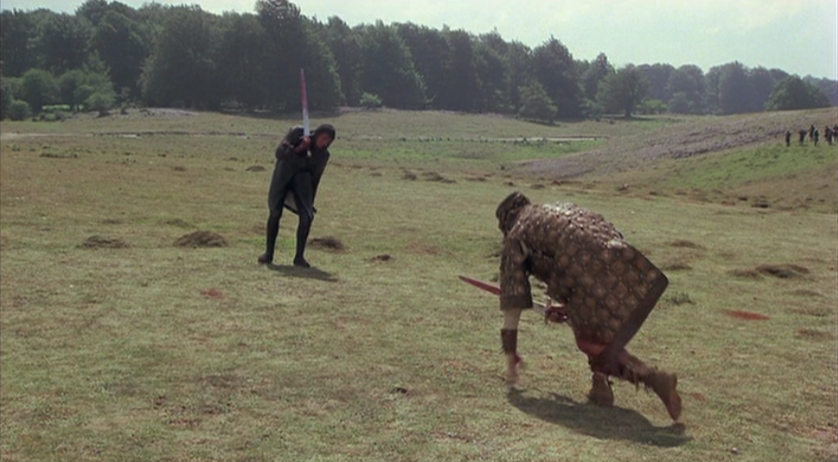
Compare and Contrast: the same section of film scored by Legrand (left) and Barry (right)




_01.jpg)