Showing posts with label Michael Shannon. Show all posts

Tuesday, June 25, 2024

The Bikeriders

The "Wisdom" of the Tribe ("Whatta Ya Got?")
or
"It'd Be Funny If It Weren't So Tragic..."
 
Look. I get it.
 
I blog about movies because I love it. So, of course, I joined a movie-loving-cluster of bloggers—The Large Association of Movie Blogs (I've participated in a podcast for them about this very movie) and there is comfort there. It's a joy to commiserate with other people—of other ages, of other backgrounds, from other countries—who share a love of movies. We all have opinions. Sometimes we don't agree, and you can ignore that or you can learn from the different perspective. It's all about the process of understanding this thing you love. There's safety there, too. Sometimes you can share something in those discussions that it would be a fool's errand to try to communicate with your family and friends. For most of them, "movies" is something to do on a date-night, or when you want to just 'veg'. The last thing they want to do is to study the film and try to find out why (or why not) it communicates its message. For others, that's like assigning yourself homework. For me, it's something I "gotta" do.
 
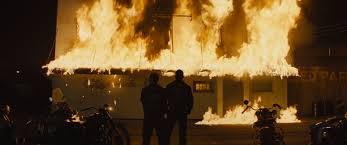
So, here's The Bikeriders, written and directed by Jeff Nichols. It's a movie about a motorcycle club—the Vandals MC —that operated (in its hey-day) between 1965 and 1973, and was immortalized by the picture book of the same name by Danny Lyons.
It's a movie about a motorcycle gang. Haven't we seen enough movies (and bad ones) about those?

Sure. But, this is Jeff Nichols, one my favorites of the "younger" crop of directors, and his subjects are interesting, and if they're not box-office sure-things, they're at least interesting in the way he presents them. He made Mud, Take Shelter, Midnight Special, and Loving, all movies I'd recommend seeing (especially Loving) because of the way he tells stories so well. All his movies are about ostracized outsiders, and The Bikeriders is no exception.
We first meet Benny (
Austin Butler) quite a ways into the story, but this is like a thesis statement for the movie. He's sitting in a bar, smoking, drinking, minding his own business. Then two beefy "townies" walk into the bar and object to the fact that Benny is wearing "colors"—his motorcycle jacket—and suggest that he take it off. Benny—as in the way of movie bikers—looks from one of the guys to the others—clenches his jaw and says "You'd have to kill me to get this fuckin' jacket off." 
So, there's a fight, seeing as there's no negotiation between the parties. It starts in the bar, then goes outside. It's starts as a fistfight, then Benny pulls out a knife and slashes one of the guys' face, then the other grabs a shovel and swings it at his head.
Just before it connects—and it IS going to connect—Nichols freeze-frames and we begin the movie proper with an interview (we're still not at the beginning of the story) and Danny (Mike Faist) is talking to Kathy (Jodie Comer) about the incident and about her relationship to Benny and of how the Vandals came to be—Johnny (Tom Hardy), a blue collar worker with a wife and two kids, saw The Wild One on TV and, like so many others, liked the freedom of the lifestyle depicted (ignoring the underlying message) and formed the club. It was about how a bunch of outsiders formed a community of like-interests, ignoring the typical organizations like churches, PTAs, and Elks. The reason? They're all outsiders who wouldn't fit in those clans, so why not form their own? "What's not to like?" (which is as much of a nothing sandwich as "Whatta ya got?").
The through-line of the movie is the passage of time and how the group changes, following Johnny's lead, which has some basic things like wearing the distressed leather jacket that serves as a uniform, and some arbitrary rules about being loyal to each other, and if there are any issues that are disagreed upon, they'll have a fight—"fists or knives" is the only specifics that need to be addressed—and whoever wins, gets their way, much in the way it worked in Black Panther (which sounded like a good system in that movie, but here smacks of "rule by minority").
While these things are going on, Johnny weighs the responsibility that being leader of such a group imposes on him, and Kathy realizes that Benny will always be conflicted whether to choose her or the club, even as that club faces challengers from a couple of fronts—the incoming Vietnam vets with chips on their shoulder and a disdain for authority and the young kids who see the power in numbers and want in on it. The "outlaw" mythology starts to get the better of the Vandals and it starts changing as time gets longer and meaner. It leaves Johnny with one of the few articulate insights in the movie: "You can give all you got to a thing" he tells Kathy at one point. "And it's always gonna do what it's gonna do" and it applies for Kathy to Benny and it applies for him to the club.
But, that's about it for depth. Things happen. Things get worse. And the vague rules of the club seem to go by the way-side as its reputation swells and new members begin to dilute its purpose and turn it into a gang. The rules don't apply to anybody anymore. And any good intentions are drowned out by bad behavior.
That's the gist of it. And as good as the performances are—although the actors' recreations of their characters' voices may produce giggles, they're based on Lyons' tapes of interviews with them—and as okay as the visuals are and as strenuously Nichols tries to recreate the books' look, it doesn't amount to much. One gets left with the impression that The Bikeriders is less about the gang than it is about Kathy's observations of them, and that's an outsiders' perspective (like, frankly, the guy who made the book). We see her struggle for the soul of Benny, but we really don't get to know him—he's a James Dean wanna-be—and the audience doesn't really get to know the Vandals—do they have jobs? how do they get the money for all that beer? They own a bar, sure, but there never seems to be anybody in it—because they're a bit of a mystery—and an antagonist—to Kathy. Like Brando's challenging non-answer of "Whaddaya got?" there's no "there" there. And the story of the Vandals is just another cautionary tale of what happens when you don't apply the brakes every once in awhile. Or check the gas-tank.
If Nichols wanted to make a film of a picture book, he accomplished it. But, it's all captions with nothing between the lines and nothing between the pictures. The Bikeriders is more of a scrapbook than a fully fleshed-out movie, with a veneer of remove as he's trying to recreate what somebody already documented—"The Golden Age of motorcycle clubs"...but that age is long gone. Thomas Wolfe said you can never go home again. Apparently you can't make a movie of it, either.
 
But, Nichols is a fine director. This time he merely took a spill. And I look forward to his next one


Friday, June 16, 2023

The Flash

The Blade of Grass is Always Greener in the Other Meta-verse
or
Whatever Happened to The Scarlet Speedster?
 
Let's start with a bit of history: when I was a kid (and older), I loved "The Flash" comic books. The character had a lot of history, and (for some reason) was usually the lynch-pin for any big comics event. They re-invented the character (in the comics, his identity was police scientist "Barry Allen") with a more scientific basis to create what was dubbed "The Silver Age" of comics. In 1961, when "The Silver Age" Flash managed to traverse dimensions and meet "The Golden Age" Flash from the 1940's comics, it ushered in DC Comics Multiple Earths, a fictional representation of the Multiverse Theory. When sales of his comic weren't (shall we say?) "up to speed" the publisher decided to kill the character off in "Crisis on Infinite Earths" (designed to eliminate the multiple Earths and simplify the comics line for new readers. 
 
Demand for the Silver Age Flash to be resurrected led to that happening, and then soon after DC decided to "re-boot" its entire line of comics (the idea was called "The New 52"), they decided the catalyst for the change would be The Silver Age Flash, who —due to the machinations of one of his villains—finds himself in an altered reality where he has no powers, there is no Superman, there is a Batman (but he's Thomas Wayne, as it was Bruce who was shot in the alley in that reality), there is a war going on between the Atlanteans and the Amazons, where Wonder Woman assassinated Aquaman, and so on. And the Flash has to fix all of it, and get it back to his reality...which of course, would be the "New 52" revamp. That all happened in a comics "event" called "Flashpoint"
Got all that? You might think that comics are stupid, but they sure can get complicated.
So, this movie, The Flash, has its origin-bones in that "Flashpoint" story but grafts it into the DC Movie Universe sticking to the one "changing history" aspect of it and going its own way. In it, Barry Allen (Ezra Miller), on the eve of a potentially losing appeal by his father (Ron Livingston now)—in prison for being falsely convicted of killing his wife, Barry's mother (Maribel Verdú*)—discovers that he can go back in time, and, in fact, pick-and-choose many time-lines, and affect what has happened in his past. Cautioned by Batman/Bruce Wayne (Ben Affleck) that he could haphazardly "destroy...everything," Barry figures out a way that he can alter events without actually being seen or interacting with that time-line in order to prevent his mother's murder.
Yeah, well, going back in time to change things is...never easy. In fact, the only thing tougher is pleasing a rabid movie/comic fan-base with singular expectations of what would make a "good" Flash movie—is it related to the TV show? ("why not?"), Michael Keaton's Batman is in it? How about Val Kilmer's? ("why not?") What about "poor" Henry Cavill?—and for every "slight" to their expectations, the "Rotten Tomatoes" meter will drop closer and closer to a green blotch (as if that mattered). No, The Flash will not meet an awful lot of people's "wish lists." It's not world-building. Quite the opposite. It's not setting up the next chapter of a franchise (like we're used to). It is a self-contained story that could conceivably not have—or need—a sequel. It's just considering the possibilities. It's what DC used to call in the Silver Age "An Imaginary Story." Writer Alan Moore ("Watchmen," "V for Vendetta," "Batman: The Killing Joke," "From Hell") had the best rejoinder: "Aren't they all?"
So, how is it? I'll use a word that hasn't been much used since comic-movie-makers have been striving to make their super-heroes "credible"—"Let's dress them in leather!" "Let's make them bad-asses!"—it's hilarious.
And hilarious in a good way! From it's opening sequence where Barry Allen (Miller) aka "The Flash" must spend an excruciating amount of time waiting for his carb-filled PB&J order and gets interrupted by a call from the Justice League (well from Wayne butler, Alfred—Jeremy Irons) to race over to Gotham City where thieves have stolen a toxin from a local hospital. Thieves being so smart they're dumb, they've managed to undermine the foundation of the hospital where it's at the brink of collapse. While Bat-fleck goes after the thieves, Barry-Flash must save the people trapped in the hospital. What ensues is a sequence straight out of Rube Goldberg by way of Buster Keaton, as The Scarlet Speedster, must save falling babies out of maternity ward by "any means necessary." And in Barry's perceived bullet-time, all those babies each have their own individual perils that he must solve in the—to him—excruciatingly long time it takes them to fall.
Director Andy Muschietti has filled the sequence with such giddy malice that one cannot take any of it too seriously, especially when he and scenarist Christina Hodson build on the sequence, complicating it with more dangers that Flash has to solve. Sure, Batman gets to use all his toys for an extended chase, that strains credulity, dragging him along Gotham highways in the sturm-and-drangy way we've become accustomed to, but The Flash sequence sets up an atmosphere that dilutes suspense in favor of a pell-mell momentum that's rather exhilarating.
We'll stop there for a synopsis over-view because to say anything more would be like spoiling the punch-line of a joke. It's not as funny—or, at its core, surprising—if you can anticipate how it all ends. There are just too many twists and turns and laterals and feints that will be telegraphed, ruining little moments and small that are intended to take you places you had no idea were coming, or even existed. If you think you know what's coming, you're just wrong, even for all the hints and speculations that leaked out in the marketing.
Key to making this work is Ezra Miller. I've always had problems seeing him as The Flash and his presentations in both versions of Justice League (but especially Joss Whedon's) where he was a manic goof-ball and grating comic relief. But, Miller comes out of his supporting-role comfort zone and proves that he can carry a big splashy movie with amazing ease. And he's a hell of a performer, playing two versions of the same character, but with two different histories and stages of development. That's a trick in itself, but Miller makes it look easy, with a gutsy level of letting himself look stupid without losing the basic integrity of the character and making the drama and emotion of the thing work. And for all the manic energy that he throws out, he still manages to have one of the best dead-pan reactions for comedy. Say what you will about him (and everybody has!), but he's just damned good in this.
What else are people talking about? Oh...cameos! Yes, there are cameos, both voluntary and not. And, yes, Keaton is great—he always is. And the "Supergirl" we're introduced to (
Sasha Calle) is terrific.
And the special effects? There's been a lot of kvetching about that, but an early sequence in what will be called the chrono-globe (or some such—maybe we should call it "The Uncanny Valley?") sets up a non-photo-realistic quality that carries out throughout the rest of those sequences (assuming that's what everybody is talking about—I have no previous experience with what constantly shifting time-lines actually look like, so I couldn't judge!) that generally smudges perceptions of what we think we should be seeing.
I could quibble with a prolonged sequence based on Man of Steel where Michael Shannon seems less than engaged, but director Muschetti has always had an observable weakness when it comes to big set-pieces. One would have thought if he could juggle a bunch of falling babies, he could handle a super-hero slug-fest on four fronts, but it falls just shy of being super. I wasn't crazy about the "never-ending battle" in Man of Steel for that matter.
But, was I entertained? Heck, yeah. As much as when I used to close the cover of a good comic-book. So much so that I didn't mind when Muschetti pulls off a final "gotcha" that was just as amusing as its meant to be, upending people's pre-concieved notions and messing with their minds. It's a story, after all. One with limitless possibilities and a perverse willingness to "go there."
 
Aren't they all?
 
Well, no. But, they should be.

* One of the many joys of The Flash is to see Verdú again, who was in Coppola's Tetro, del Toro's Pan's Labyrinth, and Y Tu Mama Tambien.

Wednesday, October 12, 2022

Amsterdam (2022)

"What Fresh Hell Is This?"
or
The Endurability of Good Intentions. ("He Followed the Right God Home...")
 
Who knows when it really, really started in the scheme of things, but it really started to get intense with the dead Senator in the box with no lid.
 
Just back from Europe by ship, he turns up dead and his daughter (Taylor Swift) wants an autopsy. So, she calls two guys from the former General's old integrated unit in WWI, Burt Berendsen (Christian Bale), a doctor of "experimental medicine," and Harold Woodman (John David Washington), Columbia University-trained lawyer, to oversee the procedure. To ensure that the procedure is done without prejudice, Dr. Irma St. Clair (Zoe Saldana) does the autopsy.
 
What the autopsy reveals is suspicious, but when Harold and Burt attend a pre-arranged meeting with the general's daughter to report their findings, they see her running away for their rendezvous, stricken. "He knew something. He saw something terrible," she says while she can.
 
Join the crowd.
Before the night is over, Burt and Harold are on the run from the police, accused of a murder they didn't commit, but sure of who committed it, not that it matters in the short run. They have to hide...and they have to find out who killed the General and who's behind all this...because...they're veterans. Their commander has died. And they owe him.
But, that's history. In that history, Burt found himself the medic for the 369th Infantry, an integrated unit in WWI France. Its commander was such a racist that he required the black infantry to wear French uniforms, rather than American ones due to white soldier complaints, but he was replaced by his commander General Bill Meekins (
Ed Begley Jr.), and to further cement fences, Berendsen made a pact with the most vocal soldier, Woodman, that they would always have each other's backs. Even during "The Argonne."
Berendsen and Woodman are severely wounded, requiring many operations to remove shrapnel by a diligent French nurse named Valerie (Margot Robbie), who repairs their wounds and forms a bond with the two men, eventually taking them to Amsterdam, ostensibly to take Burt to a company called Cambridge Glass (run by characters played by Michael Shannon and Mike Myers), manufacturers of the best quality glass eyes, but more to live together in peace and fellowship and recover from "the war to end all wars." They become "lost."
It is an idyll that can't last. "Choice matters over needs." Burt, finally becoming comfortable in his scarred skin, decides to return to America out of his devotion to his wife. Harold stays with Valerie, but sees no future in it ("We only exist in Amsterdam") and returns to America to pursue a law degree. Then, their General comes home in a box.
David O. Russell's Amsterdam is being marketed as a star-filled cream-puff of a movie, but it isn't that. Instead, it's a good-natured political screed on the dangers of fascism roosting in America, basing it on the "Business Plot", a little remembered attempt by conservative business interests, unhappy with liberal Franklin Roosevelt's election, to use veteran protests over delayed bonuses by the Hoover administration, to install an un-elected military official to essentially oust FDR as President. As a modern context, let's suppose that the MyPillow guy and the CEO of Overstock didn't like the results of the 2020 election and were taking aggressive actions to have it over-turned. Couldn't happen, right?
 
It's a curious little gremlin of a movie. There are going to be a certain number of people—on the far right, maybe fascist, certainly white supremacist side—that would never see this movie. And then there are others—people who are stuck in the post Nixon era cynical groove (which has only atrophied during the Trump years to the point where late-night comedians can barely keep up) who will look at it and pooh-pooh it as satire-lite, which is easy to do if you're viewing it with the same attitude as one would have now.
But, the folks depicted in this movie didn't live through Nixon. They lived through World War I and came home to depressions, both Great and small. They still believed in government and they still believed in the United States, no matter what tough times they'd been through. The same starry-eyed patriots who volunteered in droves during World War II. Because they believed in something bigger than themselves. That's not a popular sentiment these days.
And Russell's movie may be off-putting for those who want their messages obvious and with the tone of righteous indignation (that is also popular these days) instead of the quick-paced Wes Anderson whimsy that it evokes. Still, it doesn't shirk from portraying grievous war-wounds—praise must be heaped on the make-up department for their relentless consistency—on people who refuse to see themselves as victims.
These are people who, despite their quirks, walk the talk and aspire to good intentions despite the consequences. Burt, being Half-Jewish, Half-Catholic goes to war at the behest of his Park Avenue in-laws only to find that the means are more important than the ends, especially considering that their respect for the military doesn't extend to veterans. He is kicked out of his lofty office address and starts work in the streets and then in Harlem, to the point of moving out of the apartment he shares with his wife...he's so straight an arrow that he doesn't even think that's perverse. Woodburn is black in an early 20th century—he already knows the heartbreak of good intentions when your skin isn't the predominant color. Yet, he has found validity and valediction in another country fighting for a country that wouldn't consider giving it. And Verna is a rich girl considered a kook, but whose dedication in the operating room goes above and beyond the requirements and limitations of triage. Their actions all make sense in a society that ignores their sacrifices while reaping the rewards of the very things they fought to protect.
The cast is uniformly excellent with Bale coming up with a fully realized character taking advantage of the limitations of a back-brace and glass eye and turning it into a performance reminiscent of Peter Falk—and in moments of agitation, Martin Scorsese, while Washington is his most relaxed since BlacKKKlansman. Robbie has a little trouble with accents, but manages to make a performance that is both alluring and comedic, and it's all photographed with a slight sepia tone by
Emmanuel Lubezki, who manages to turn out top-tier work under technically challenging conditions.  
One has to admit, though, that Amsterdam is better in the after-glow than in the light of projection. Free from its manic energy in that post-viewing meditation, two aphorisms come to mind—for a movie that is full of them. One (that I've heard quoted so many times it defies origination) is "If you have a message, call Western Union", something that Amsterdam does with tenacity in its reckless abandon to obfuscate with comedy. The other I heard from legendary baseball announcer "Red" Barber on one of his weekly talks with Bob Edwards on the NPR Morning Edition. He said
"It's not the one with the most toys, wins. God doesn't count the toys. He counts the scars."
 
There are a lot of scars in Amsterdam. I like that.

Saturday, February 5, 2022

The Current War: Director's Cut

Written (really) at the time of the film's eventual release.

Saturday is traditionally "Take Out the Trash" Day...


AC/DC
or
Bringing It All to Light

The Current War was produced in 2017 and finally released—to theaters—in late 2019 (after premiering with a different cut at the Toronto International Film Festival in September, 2017). The script had been acquired by The Weinstein Company (after appearing on the legendary store-house of interesting but unproduced screenplays "The Blacklist"), and filmed, executive produced by Martin Scorsese and Steve Zaillian

Then, people finally paid attention to Harvey Weinstein's behavior, and the film, which had a lukewarm reception at the festival, was shelved and sold in the midst of TWC's implosion. Pulling strings with his final cut contract, director Alfonso Gomez-Rejon ordered re-shoots and did some trimming before the film was finally released to theaters in 2019.
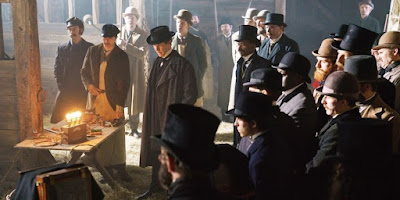
In what might be called its thesis statement, the film begins with top-hatted businessmen walking in the dark through the woods to a clearing, at which point they are blinded by a circle of light that appears magically before them, composed of many singular light bulbs piercing the darkness. From the center of the array walks Thomas Edison (Benedict Cumberbatch) who greets them with "I hope you brought your check-books." He'll need it. For Edison's plan isn't merely the use of light-bulbs, but the invention of something that no one has heard of—the electrical grid. Edison's Big Idea is to create a network of generators—that he'll own—generating direct current to cities and neighborhoods. But, given DC's limited range he's going to have to make a lot of them.
There's money to be made. And where there's money to be made, there is competition. George Westinghouse (Michael Shannon) wants to partner with Edison, but when his overtures are rebuffed, Westinghouse decides to find an alternate system. Alternating Current will travel over greater distances and given its on-again/off-again transmission could be safer and probably cheaper. The two go head-to-head trying to convince local governments to flip the switch, but they're reluctant with two systems in competition.
With the arrival of Nikola Tesla (
Nicholas Hoult) to his employ, Edison thinks he might have an inside track, but Tesla is a mercurial sort and soon bridles at Edison's single-mindedness and leaves, feeling his work is being ignored. He tries to develop his own system, but eventually joins forces with Westinghouse, who has taken his battle to the public.
As every politician knows, the best way to persuade people is with fear. Westinghouse starts a smear campaign claiming that DC is dangerous and should not be allowed in homes. Edison starts to say the same thing about AC and, to prove his point, submits a proposal for a method of execution that is far more humane—the electric chair (despite professing that he would never be a part of weapon development or something destructive to mankind).  When the first use of it sets the prisoner on fire, his reputation is damaged.
The movie sure looks interesting. The director—who's done a lot of second unit work on a lot of good movies—has a slightly cock-eyed way of framing that takes it out of the "vaunted past" look of period films and makes it a bit more surreal. But, despite a terrific cast and some sparks of nice writing, the film doesn't rise above being a more expensive version of one of those "The Inventions That Made America" episodes (but without the teasing before commercials and re-running of footage you've already seen afterwards).
And with all its talk of greatness consisting of what you leave behind, there is more than a little pissing on a live-wire when it shows the blight of a skyline cross-hatched with electrical lines. But, then I don't think the Grid is what it's celebrating: the most moving sequence is when Edison shows off a new invention—a machine that shows hundreds of individual photographs of his late wife that appears to make her move and live again. You spend two hours talking electricity, but ultimately it's about the birth of motion pictures.
 
No wonder Scorsese put his name on it.