Saturday is traditionally "Take Out the Trash" Day.
"Zombieland 2"
or"30 Brain-cells or Less"
30 Minutes or Less is the latest film from director Ruben Fleischer, who had previously been in charge of the movie Zombieland (which was fresh, funny and smart) and I think that in the current movie climate, as damp and soggy (and derivative) as it is, that we might want to re-think the auteur theory—the critical bon mot from the 1950's era Cahiers du Cinema crowd that the director is the true "author" of a film, despite it, by necessity, being a collaborative medium. You can make a case for it with some—Hitchcock, Kubrick, Welles, Hawks, Ford, Capra, Leone, Fellini, Scorsese, Kurosawa, Spielberg, Woo, Malick...Michael Bay, Lars von Trier (hmmm).
Well, for good or ill you can make the case.
Mr. Mason, your witness. "Call to the stand, Ruben Fleischer..." (and the prosecution then puts its head in its hands).
"Move to dismiss..."
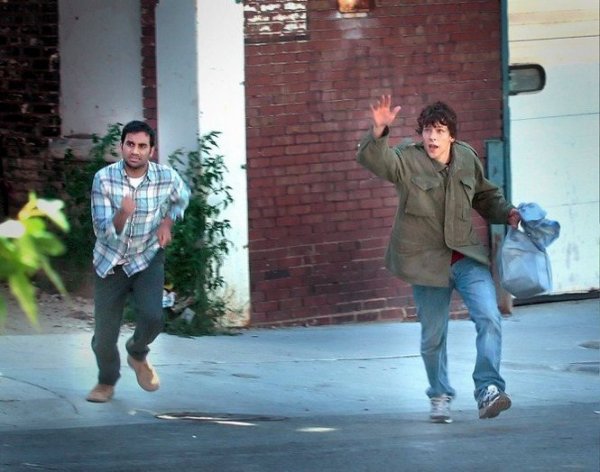
As I said, I liked Zombieland (which, although it had moments when it dragged, was a hilarious take on zombie-movie traditions). But, I despise to the core of my critical thinking 30 Minutes or Less. And it shakes my faith, because the guy who brought so much to the former brings nothing to the latter, not even the smarts to know when something's not working and, in so realizing, makes the attempt to change it. That's what direction is all about, isn't it? There are the occasional stylistic flourishes—liked the pan up from headlights of both the protagonists and antagonists linking the two, and a fire-flash of seriousness there towards the end—but, for goodness sake, scene after scene of this nightmare falls as flat as a two hours old pizza (thin crust), bereft of story sense or any humor, other than a chain-link of easy crudities and a nasty streak of hooting at the flailing of the morons on display. The plot—such as it is—involves slacker Nick (Jesse Eisenberg, looking a bit lost but doing so at 90 mph), a pizza-delivery boy, who, despite driving like a maniac, seems incapable of delivering a pizza on time. He crosses paths with two even slacker bone-heads (Danny McBride, Nick Swardson—evidently the next big star of terrible films), who claim to be entrepreneurs—although they seem to have trouble pronouncing the word—even though they have no business sense, no ideas on how to make money—other than cleaning the pool of the lottery-winner-father of the former (Fred Ward, you should be ashamed), and could be considered troglodytes if only they had a hint of hunter-gatherer skills. They decide to raise $100 grand to hire a hit-man (Michael Peña) to kill off said father—their only means of support—by robbing a bank, or rather forcing someone else to rob a bank by attaching a time-bomb to them, the not-agreed-to heist to be completed before bomb and bearer go boom. At least, their characterizations are consistent—they don't want to take responsibility for anything or for doing anything. They should probably re-think starting a tanning business and going into politics.This is where Nick comes in. He delivers a pizza to the slackers, they drug him and attach the bomb while he's "out." In a panic, he must (for once) be on time, or he's dead. He recruits his pal Chet (Aziz Ansari) to help in the robbery, but, even though they get away with the money, it's a botch-job (no doubt inspired by the making of this picture), then comes the inevitable complications over the money hand-off and a resolution of sorts...lots of explosions that we are to believe people survive, as if this were some kind of Road-Runner cartoon (except those are entertaining).
The whole thing has a slap-dash feel to it, with a lot of ad-libbing between McBride and Swarsdon that comes off as "'Off'-Night at the Improv." The thing is totally devoid of wit and is just a string of sketch comedy riffs held together by the robbery plot. It's a movie best seen drunk or stoned or sleeping. After bearing with the thing for 45 minutes, I chose the latter.
Here's the thing—a variation on this really happened: On August 28th, 2003, a bank in Erie Pennsylvania was robbed by Brian Douglas Wells, a pizza delivery man, who was abducted and a bomb placed around his neck. Wells pleaded with everyone during the bank heist that he was doing it against his will and begged to get the bomb off him. Unfortunately for Wells, the bomb squad showed up four minutes after the device exploded, killing him instantly. Now, just imagine the brainstoming session between the script-writers where someone relates this horrible crime (it was attempted a couple weeks ago in Australia, as well) and said "This would make a great comedy!" ("Laugh? I thought I'd die!")
According to Wikipedia's entry on the movie, the scriptwriters, Michael Diliberti—his first screenplay after being an assistant to producer Scott Rudin—and Matthew Sullivan claim that they were only "vaguely aware" of it. "Vaguely aware" are the perfect words, I think. It seems that was the state in which the whole movie was developed and made. It's a bad idea for a movie, badly made. And now, in a moment of justice, Fleischer, Diliberti and Sullivan have their own "bomb" tied around their necks.
And they're going to have to carry it around for a very long time.


 Kaufman takes us into the dark-hole of the jet-engine, and inside we hear echoing voices and whistles and the sound of drums, and before we can register the change, we're not in the negative space of the engine anymore, we've transitioned to another channeled tube of energy—we're traveling through a tunnel riding atop a limousine from an astronaut's perspective...
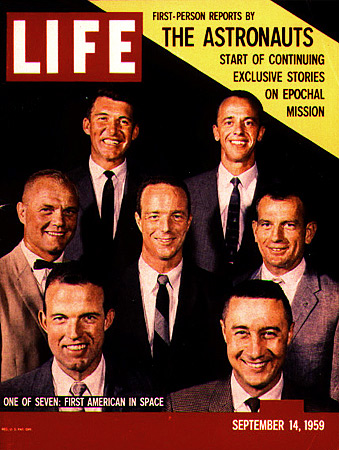
 ...as President Lyndon Johnson stands on a flag-draped stage and welcomes the seven Mercury astronauts to an out-sized barbecue in Houston--the new home for the Manned Space Center, as well as the astronauts and their families. Their homes, their furnishings are all paid for by the Houston developers who are benefiting from Johnson's earmarks. The Mercury 7 are living the good life, while the Man who Broke the Sound Barrier makes a run for space.
 Both these incidents happened and are mentioned in Wolfe's book, but they took place months apart, while Kaufman has them happening simultaneously. To what purpose will become clear later, but in the meantime, we follow Yeager (
 And in one spectacular shot, we see space bend and warp as we approach the feathery layer of a cloud-ceiling, then go through it...
 ...and the picture fades to an incident from that barbecue--an odd detail that Wolfe found funny and sad and a bit pathetic, but Kaufman turns into visual poetry. For some reason, the Houston event organizers chose as one of the entertainers stripper
  But Kaufman takes that incident and marries it with a running theme throughout the film. The Moon has been a beckoning image throughout The Right Stuff, and now, as the clouds that Yeagher is punching through become the delicate feathers of Sally Rand's fans, she dances to an orchestral version of the melancholy "
 Kaufman stays on his images of empty space and feathers and lights, then to shots of the astronauts and their wives reacting to the irrelevance and embarrassment of it all. And then, something strange happens....
 ...and Shepard's not even watching the stage-show. He's lost in thought...
 ...as is
  Glenn turns to look at
  ...who is already looking at him.
 Grissom turns and looks at his buddy,
  ...who is his usual grinning self, but he's subdued. We transition back to Sally Rand...
 ... and a blaze of kleig-lights to Yeager trying to "punch a hole in the sky."
 Yeager reaches top altitude, then his engines give out and he's given one tantalizing glimpse of the stars in space...

 ...before his fighter-jet begins to rapidly tumble back to Earth.
 Unable to bring it under control, Yeager makes a fiery ejection...
 ...and Kaufman holds on him--trailing smoke, because as we'll see his helmet is on fire--and we watch his long, long fall through space as he tumbles through the silence--a modern Icarus...


 ...who disappears into the clouds.
 The clouds fade back to the feathers of Sally Rand.
 ...and to the astronauts, who are somewhere else.

 Glenn, on edge, looks to Grissom and Cooper...
 Grissom is wary...
 Cooper, head bowed, tentatively looks up...
 as does Slayton...
 And Shepard cranes his gaze to the ceiling...
 We transition to Sally Rand, and on the soundtrack we hear a distant boom.
 With a hard cut, we're back in the California desert.
 Reverse angle to an ambulance approaching in the shimmering desert heat.
 The driver points ahead "Sir? Is that a man?"
 Amid the smoke and heat-waves, a silvery shape emerges.
 "Yeah," says Ridley (
 As the music swells, Yeager carrying his parachute, his face burned, but still chewing gum, approaches the ambulance.
 Yeah. You bet it is. It's great film-making, too. And a brilliant sequence by Kaufman that shuffles real time a little, but makes a point about the competitiveness of air-men, giving way to a brotherhood. All of the men in the sequence have competed with each other as well as Yeager to be "at the top of the ol' pyramid," going faster and higher than any person before. The astronauts were test-pilots competing with Yeager, then signed on to become astronauts, "spam in a can" in the test-pilots' jargon, achieving a fame Yeager never would...until Wolfe's book...and this movie