Showing posts with label 1979. Show all posts

Sunday, August 4, 2024

Don't Make a Scene: Manhattan (1979)

The Story: 
A meeting between bone-heads.

Here's another of those "Classic Scene" features from "Premiere Magazine"—this one from Woody Allen's Manhattan—featuring an absurdist argument that, if it were a little funnier (although there are a couple "zingers" in here) might have come from a Marx Brothers movie.

Except it isn't that funny, other than in the way of Anton Chekhov, where the the human condition of conflict between the selfish and the selfless clash unreasonably without regard, presenting an argument that has no resolution and is as useless as a current Presidential debate ("the problem isn't with me, it's with you!").

Allen's character Isaac has just found out that the woman he's been seeing—played by Diane Keaton—has decided to go back to her former lover, a uni professor who's cheating on his wife with her. Some need must be fulfilled here, but Allen—to whom this is news—stalks over to the University with his professor-friend to try and grasp what's going on and what could he and she be thinking (if they're thinking at all).

Yale, the professor, won't admit his deviousness, deflecting blame and making excuses, but couching it as if Isaac is just as much to blame for the wrong that's been done to him, but the arguments and counter-arguments fly past each other's heads, never making a mark.
 
Allen is bobbing and weaving with every new revelation, like he's in the ring with Ali, being pummeled (it was tough to take screen-grabs where he's actually in focus); Michael Murphy, on the other hand, plays it as if he doesn't even know he's in a fight, and is fairly rigid (can you imagine him in class when a student asks a question? "Because it is, okay, why are you challenging me?").
 
So we're left with Woody's Isaac striking back with every new revelation, and Murphy's Yale not accepting blame and making it seem like it's all Isaac's fault.
 
It really is a childish argument between two immature males, and probably should have been set in the school-yard and not in a classroom.

The final irony is that, although Tracy, Isaac's "high school sweetheart" is considered too young, she's the most mature one of the bunch.
 
The Set-Up: Manhattan is the favorite city of Isaac Davis (Woody Allen) but his relationship with it is...complicated. Just like every other relationship he has had. A writer by trade (currently a television writer, but he wants to write books), he is divorced from former wife Jill (Meryl Streep), who has since moved in with her lesbian lover. Isaac is best friends with university professor Yale Pollock (Michael Murphy)—who is married to Emily (Anne Byrne Hoffman) but having an affair with Mary (Diane Keaton)—while Isaac is dating a 17 year old high school student, Tracy (Mariel Hemingway). Yale and Mary are breaking up as it's causing a strain on his marriage, so he encourages Isaac to go out with her...as Tracy is awfully young. Reluctantly, Isaac agrees and their initially testy relationship ends up with them moving in together. But...it's complicated. Eventually, Yale and Mary begin seeing each other again, and Isaac, confused and angry confronts Yale at his job.
 
A...uh..Action.
 
Ike and Vale walk through the door to an empty classroom. It looks like an ordinary schoolroom, with its wooden desks and blackboard, except for the two skeletons hanging near the door; they seem to be observing the two friends as they talk. 
IKE
(Sighing) What are you telling me, that you-you're-you're gonna leave Emily—is this true?—and-and run away with the-the winner of the...
IKE
...
Zelda Fitzgerald Emotional Maturity Award? 
YALE
Look, I love her. I've always loved her. 
IKE
(Sighing) Oh, 
IKE
what kind of crazy friend are you? 
YALE
I'm a good friend! 
YALE
I introduced the two of you, remember? 
IKE
Why? What was the point? (Chuckling) I don't understand that. 
YALE
Well, I thought you liked her! 
IKE
Yeah, I do like her! Now we both like her! 
YALE
(Looking away) Yeah, well, I liked her first! 
IKE
(Reacting, incredulous) "I liked her first." 
IKE 
What're you—what're you, six years old?! 
IKE 
Jesus. 
YALE
Look ... I thought it was over. You know, I mean, would I have encouraged you to take her out if—if I still liked her? 
Ike walks closer to Yale; he now stands next to one of the skeletons. As he talks, he shares the screen with the skeleton's skull, which looks as if it has a perpetual grin. Ike, deep in conversation with Yale, ignores his long-dead scene stealer. 
IKE
So what, you liked her. Now you don't like her. Then you did like her. 
IKE
You-you-you know, um, it's still early. You can change your mind one more time before dinner! 
YALE
Don't get sarcastic about this. You think I like this?! 
IKE
How-how long were you gonna see her without saying anything to me? 
YALE
Don't turn this into one of your big moral issues. 
IKE
(Reacting, still standing next to the skeleton) You could've said—but you-you ... all you had to do was, you know, was call me and talk to me. 
IKE
You know, I'm very understanding. I'd 'a said, "No," but you'd've felt honest. 
YALE
I wanted to tell you about it. I knew it was gonna upset you. I—uh, uh . . . we had a few innocent meetings. 
IKE
A few?! She said one! 
IKE
You guys, you should get your story straight, you know. Don't-don't you rehearse? 
YALE
We met twice for coffee. 
IKE
Hey, come off it. She doesn't drink coffee. What'd you do, meet for Sanka? That's not too romantic. You know, that's a little on the geriatric side. 
YALE
Well, I'm not a saint, okay? 
IKE
(Gesturing, almost hitting the skeleton) But you—but you're too easy on yourself, don't you see that?! You know, you ... you—that's your problem, that's your whole problem. 
IKE
You-you rationalize every­thing. You're not honest with yourself. You talk about . . . 
IKE
you wanna—you wanna write a book, but—but, in the end, you'd rather buy the Porsche, you know, 
IKE
or you cheat a little bit on Emily, and you play around the truth a little with me, and—and the next thing you know, 
IKE
you're in front of a Senate committee and you're naming names! You're informing on your friends! 
YALE
(Reacting) You are so self-righteous, you know. I mean, we're just people, we're just human beings, you know. You think you're God! 
IKE
I—I gotta model myself after someone! 
YALE
Well, you just can't live the way you do, you know. It's all so perfect. 
IKE
Jesus—well, what are future generations gonna say about us? My God! 
IKE
(He points to the skeleton, acknowledging it at last) 
You know, someday we're gonna—we're gonna be like him!  
IKE
I mean, y-y-y-y-you know—well, 
IKE
he was probably one of the beautiful people. He was probably dancing and playing tennis and everything. And—and— (Pointing to the skeleton again) and now—well, this is what happens to us! 
IKE
You know, uh, it's very important to have—to have some kind of personal integrity. 
IKE
Y-you know, I'll—I'll be hanging in a class­room one day. And—and I wanna make sure when I ... thin out 
IKE
that I'm w-w-well thought off 
The camera stays focused on the skeleton, its full form shown now, as Ike leaves, then Yale.
YALE
Ike...Isaac, where're you going?
 
 
Words by Marshall Brickman and Woody Allen
 
Pictures by Gordon Willis and Woody Allen
 
Manhattan is available on DVD and Blu-Ray from M-G-M Home Entertainment.

Saturday, June 1, 2024

Meteor (1979)

Saturday is traditionally "Take Out the Trash Day"...

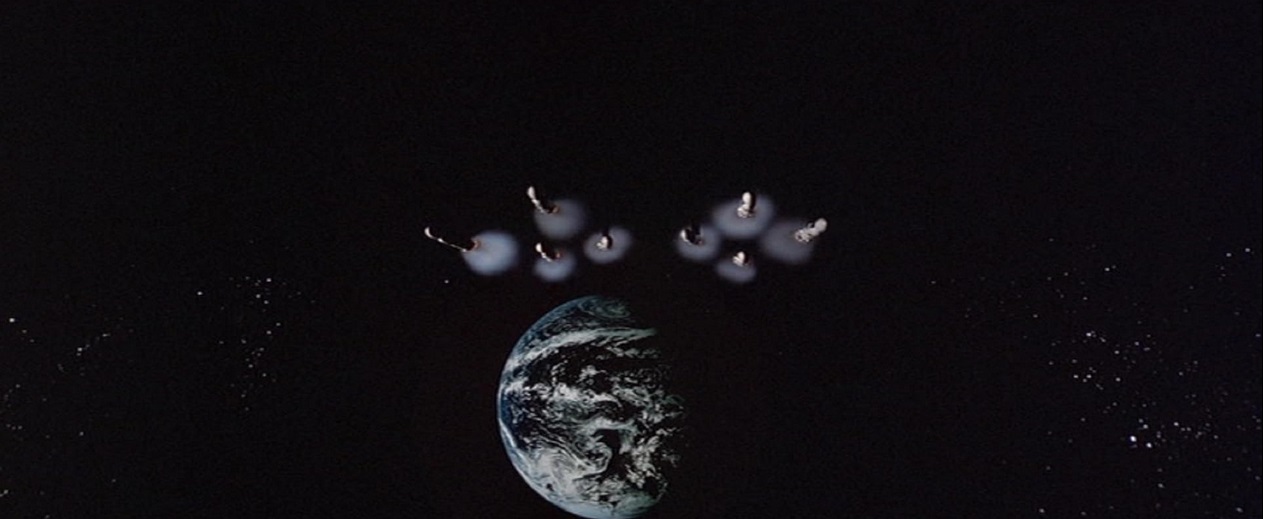
Meteor (Ronald Neame, 1979) A co-production between Shaw Bothers Studios, Warner Brothers, Nippon Herald Films and American International Pictures, featuring a script by Edmund H. North (who wrote The Day the Earth Stood Still and co-wrote Patton) and Stanley Mann (who wrote a couple of Sean Connery's early films) and featuring a cast that probably ate up most of the movie-budget—ConneryNatalie WoodBrian KeithKarl MaldenHenry Fonda, Martin Landau, and Trevor Howard all under the direction of Ronald Neame, who directed The Poseidon Adventure. The story was the most high-profile of topics—an asteroid (called "Orpheus") is headed for Earth and American and Russian scientists must cooperate and use their own orbiting nuclear defense systems to destroy it before it hits Earth and creates a global catastrophe.

What could possibly go wrong?
 
Budgeting. That's what could go wrong.
 
Although a lot of the writing in Meteor is overwrought, the cast does alright with it, and Neame's direction isn't particularly flashy, but manages to keep things moving briskly.
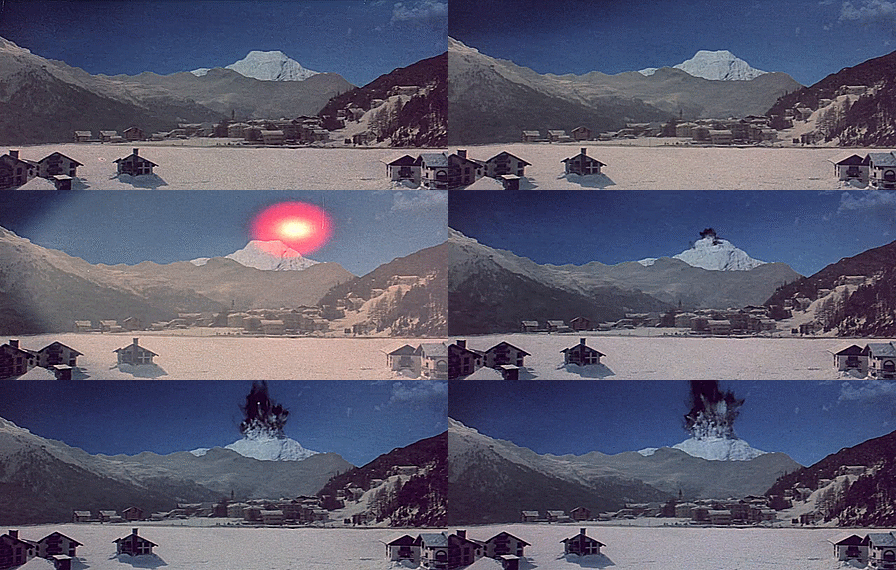
But, by the time all of that was done, the movie's coffers had little room left for post-production and special effects. It didn't help that by the time attention was being paid to the post-production, the group assigned to do the effects of the large threatening asteroid and the missiles designed to destroy it was summarily fired for the work for being below expectations.*
Now, there's a lot of grousing these days that "special effects don't make good movies." Goodness knows there have been a lot of movies where the special effects were sub-par, even in the 1970's (Logan's Run, for instance), even after the water-shed moment of the Star Wars premiere. And one has merely to look at the output of AIP's
post-Star Wars coat-tails films to see that their effects work was "made-in-the-garage" quality.
So, one is left with a Frankenstein-monster of a movie: An able cast with a somewhat shaky script (with some truly cringe-inducing dialogue), spliced with sub-par special effects sequences that—despite the many limitations—seem to go on forever, with no real editing scheme to create tension, but plopped into the film to fill the time with the shakiest of continuities.
There's no finesse to it at all—how could there be when the film was being pieced together so close to the premiere? One can only console oneself with a sequence where the all-star cast gets drenched in mud while trying to escape their command headquarters through the New York City subway system. The images call to mind so many derogatory descriptions for the movie. "Disaster" being the kindest one.
Hollywood wasn't quite done with the concept yet: 1998 saw the release of not one, but two "asteroid-threatening-the-Earth" movies: Armaggedon and Deep Impact

Apparently, there's a lot of "rockery" in neighborhood-space. And nothing new under the sun.

* Actually, two groups of special effects studios were let go, sucking up a lot of the "post" budget and pushing the time-line for the eventual team—they had a mere two months to complete the work before the premiere!

There was another major up-ending of expectations in the post-production: John Williams was given the job of writing the score for Meteor, but the production delays and the revolving door of special effects artists prevented any sort of semblance of "picture lock" for him to compose music for it before he had to go off and work on Steven Spielberg's 1941. Laurence Rosenthal was then hired to compose the score, which ended up being rather good—amazing, given his time-constraints.