Showing posts with label Dana Andrews. Show all posts

Tuesday, August 8, 2023

Laura

Laura
(
Otto Preminger, 1944) A favorite for many film-goers for the unique reason that it's a multi-hyphenate of genres. Laura ticks off many boxes: a detective story, a murder mystery, a love story, a ghost story, a "woman's picture," and a proto-film noir.

The story of the murder of advertising executive Laura Hunt (played by Gene Tierney) is an investigation into the gossipy underbelly of New York high society, contrasting the low-down jealousies and back-biting of the rich and famous amid the glamorous fashions and elite penthouse settings, all seen through the eyes of an unimpressed gumshoe trying to see the truth behind the lace curtains.
 
The film's production history is a tempestuous one, filled with office politics at 20th Century Fox--studio head Darryl F. Zanuck had an on-going feud with producer Otto Preminger, but with Zanuck in Europe with the Army Signal Corps documenting the war effort, he had no say in Preminger's work on an adaptation of the property, which came to him when it was still the first draft of a stage-play called "Ring Twice for Laura" written by Vera Caspary. Preminger saw it as a good vehicle to make his directorial debut, and tried collaborating with the author to make it a viable project for the stage...and screen.

Ultimately, the two parted ways and Caspary turned her story into a 7-part serial for Collier's magazine with play's original title, which when re-published in book-form was shortened to, simply, "Laura" and was bought for development at 20th Century Fox.
It falls on jaded New York police detective Mark McPherson (Dana Andrews) to find out who murdered the influential ad executive Laura Hunt (Tierney), and forensics doesn't help as she was killed by a shotgun blast to the face just inside her swanky apartment. No murder weapon has been found, so he makes the rounds of Laura's acquaintances to see if he can come up with any motivation behind the killing. First, he sees Waldo Lydecker (Clifton Webb), notorious newspaper columnist, who, after initially dismissing the ambitious Miss Hunt, became her Svengali/mentor. Lydecker used his column to promote the up-and-coming designer, but also to disparage any suitors approaching Laura on a romantic basis.
That didn't seem to dissuade Shelby Carpenter (
Vincent Price), Laura's fianceƩ at the time of her death and boy-toy of her aunt (Judith Anderson). McPherson gives them all third degree burns, but is no closer to cracking the case: which of these high-toned, impeccably-dressed lizards would have, well, just the bad taste to do in Laura? Appearances may be deceiving, so he doubles down on Laura's old haunts, her apartment, going through her letters and diary, trying to read between the lines, looking to her thoughts on who might be the culprit. Instead of learning more about any suspects, he learns more about the girl, finding a woman of ambition, yes, but, a different sort than the duplicitous phony-balonies she was navigating amongst.
That's where "the twist" comes in. McPherson finds himself falling in love with the dead woman, and things only get more complicated from there, deepening the resentments that the suspects have against the lower-class detective.
Once Preminger had the script he wanted (with some venomous contributions from 
Ring Lardner Jr.), but his plans to direct were vetoed when Zanuck came back from Europe. Preminger was relegated to producer, and the studio head ultimately gave the director's chair to Rouben Mamoulian, who must have sensed that his producer would lose in any battle with Zanuck, and so started to re-write the script and do his own casting, using a painting by his wife for the portrait of Laura, and favoring the more sinister Laird Cregar (Hitchcock's The Lodger) as Lydecker over Preminger's choice, the slight and haughty Clifton Webb.
 
Preminger and Webb prevailed, but none of the cast was happy with Mamoulian's direction in the first days of filming, where he ignored Tierney, Andrews and Webb, and encouraged a stagey performance by Anderson. A mutiny began among the cast and Zanuck was forced to fire Mamoulian and replace him with his antagonist, Otto Preminger. Preminger kept the cast, but re-staged all of Mamoulian's work, even going so far as to toss the portrait by the director's wife.
But, there was one more ingredient that was needed to make the film an immortal classic. Zanuck assigned 
David Raksin to do the score and the composer met with the TCF head following a screening: "I liked the picture at once but was disheartened to hear [producer Darryl] Zanuck immediately zero in on an essential scene in which...the detective assigned to solve the ostensible murder, wanders disconsolately around Laura's apartment at night. I gathered that the sequence had already been severely shortened, and now it was about to be reduced still further. . . . There was a horrified hush when I was heard to interject, 'But, if you cut that scene, nobody will understand that the detective is in love with Laura.' Zanuck turned toward me, then ... told me that he was about to trim the sequence again precisely because he felt that as it stood the audience would not understand it. . . . I persisted. 'This is one of those scenes,' said I, 'in which music could tip the balance--tell the audience how the man feels. And if it doesn't work, you can still trim the sequence.'"
Meeting with Preminger, Raksin was also disheartened to hear the director had planned to use Duke Ellington's "Sophisticated Lady" for the score, and told the director that he would have a better substitute by the next Monday morning. He was dissatisfied with his work—the legend goes—until he finally got around to reading the "Dear John" letter his wife had sent him. That was the inspiration for the "Theme from Laura", which Preminger was impressed by, Zanuck approved (the sequence wasn't trimmed any further) which became a huge hit, quite apart from the movie. It did add one element that was missing from the movie, even if it hinted at motivation—sentimentality, the melancholy sort. And it hammers home the point that love is such a strange beast that it can make one fall in love with a ghost. It is a love story, after all.
It was nominated for five Oscars (winning for Cinematography) and in 1999, it was voted into the National Film Registry. But, the ultimate test is that it still holds up today (even after being copied for at least one episode of every detective show on television) for its wit, sophistication, and downright grisliness. Good movies are not all that common. It takes a certain magic, an indefinable "something" of happenstance that makes one more than its separate elements. Given its turbulent production history and how many times it avoided mis-steps, Laura is something of a miracle.
Frank Sinatra had a hit with "Laura"
but there's something about Raksin's scoring that is...haunting.

Tuesday, August 23, 2022

Tobacco Road

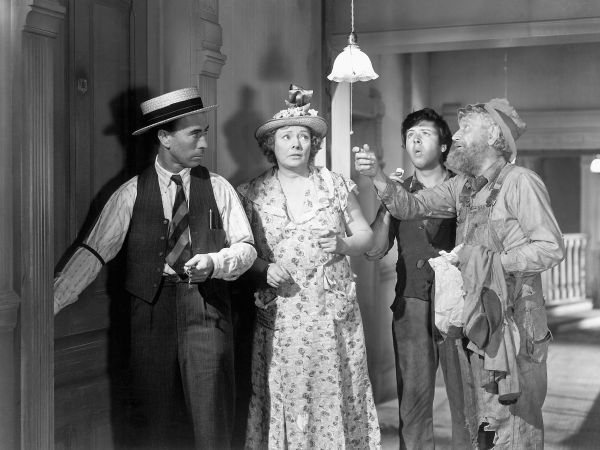
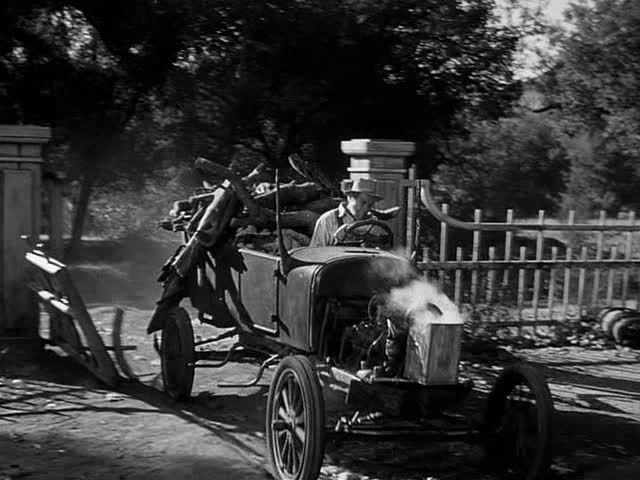
Tobacco Road (John Ford, 1941) The same year that Ford made the magnificent How Green Was My Valley (which won the Best Picture Oscar over Citizen Kane, a decision I'm still surprisingly ambivalent about) and after he'd made The Long Voyage Home, he made this oddity, an adaptation of the hit play that, itself, was an adaptation of Erskine Caldwell's scandalously bleak novel about the (to put it mildly) dysfunction among the Georgia poor. I'm not familiar with either, but the material is so venal and hard-scrabble that with each level of the airing of its dirty laundry, compromises had to be made to reach the stage and the screen so as to meet "community standards". By the time producer Darryl Zanuck and Ford got hold of it, it was a bizzarro version of their collaborative effort on The Grapes of Wrath, an out-and-out comedy of the "Kettle" variety, with much slapstick and hee-hawing, the novel's displays of greed, selfishness, shiftlessness and hypocrisy and (let's call it what it is) its animalistic depiction of rural poor life, neutered by low comedy and high over-acting. And to pass the censors and the Board of Review (not to mention the Catholic Legion of Decency), Caldwell's malicious intentions with its 13 year old brides, dead grammas, and apocalyptic "Wrath of God" fire (and no one would think of Gene Tierney possessing a cleft palate) is left by the way-side for lunk-headed males, religious loons, and the wholesale destruction of property. The effect is to take Caldwell's metaphorical screed...and turn it into "L'il Abner."
It's a little dispiriting
. The material is so compromised as to be toothless, with no bite at all (although one might fear rabies), but any more mean-spirited and one couldn't see Ford—who could have trouble tackling tough subject matter head on—directing it. It's a bit like how Ford started handling the production of Mister Roberts as a service comedy, rather than a barnacled "rust-and-all" look at the war-Navy. But here, the strategy was sanctioned by Zanuck and the powers that be, not only at Fox, but at the Breen Office, just to get a hot property on the screen, even if lukewarm.
Compromise is not new to the movies, it's an integral part, actually (unless you're ideologically fundamentalist on the auteur theory). But, as it was, the only reason to make this version of the film was to make hay, cashing in on the notoriety it had generated, while still getting away with it, something that must have appealed to the huckster-showman in Zanuck. The producer loved a good story, liked to push the envelope, but also knew what chances he could take, before bringing down the ire of the blue noses. And Ford could do comedy—he was better at it when it provided a relief from drama, or as texture inside of it—but he could do it, and economically, in a minimum of footage.
So Tobacco Road was made a comedy, curdled and dusty, and if some of Caldwell's malice got into it, so much the better, better than none at all. Such compromise brought Maugham to the screen and Faulkner and Hemingway and Fitzgerald. Not unadulterated, but some of it. 

One could make a case for Ford trying to desanctify his image of "the people," away from the respectful, earnest portrayals of The Grapes of Wrath, but Ford never painted with a wide brush and not all of his "po' folk" were saints. Far from it, in fact. So, there has to be some back-story to this one, some vital piece of information, but for now, the "get-it-on-the-screen-any-way-you-can" theory fits Occam's razor.
However, it has had one effect on me. It's going to be tough to watch Ford's westerns with their solemn funerals with ragged voices singing "Shall We Gather at the River" after seeing what's done with it in this film.


Like I said, "compromise."


Ford still makes it look gorgeous, though.

Saturday, April 3, 2021

While the City Sleeps

Saturday is traditionally "Take Out the Trash" Day, and while this film is certainly "trashy," it's sophisticatedly multi-layered.

While the City Sleeps (Fritz Lang, 1956) 

"I wonder what the nice people are doing tonight?" asks esteemed writer-author-journalist-TV personality Walter Mobley (Dana Andrews).

Well he should ask, because there are few nice people in his circle of work, which happens to be some form of multi-headed Hydra of journalism, known as Kyne Enterprises. The head of Kyne has just died and the heir-apparent Walter Kyne (Vincent Price) is now in charge, but is a bit feckless and knows nothing of the news business, nor, apparently is he willing to have anybody tell him about it as he decides to delegate. He's going to create a new Executive Director position that will answer to him without having to know all the details. But who is it going to be?
There're many to choose from, besides Mobley, an Edward R. Murrow-type: there's also the urbane head of the wire-service Mark Loving (George Sanders); crusty newspaper head John Day Griffith (Thomas Mitchell); and there's television head "Honest" Harry Kritzer (James Craig). They all want the job and will stoop to any advantage to get it. But Walter has other ideas. He's going to make the contenders fight for it in a "Hunger Games" kind of run-off—winner take-all, and the losers...well, they extend to more than Kyne Headquarters.
It just so happens they're in the news business and New York has a big news story: there's a serial killer in town breaking into apartments and attacking women and has been labeled "The Lipstick Killer"—that would be the ironically-named Robert Manners (John Drew Barrymore), a nervous, slimy type dressed in leathers. It's okay that we know who it is—Lang starts the film out with him carrying out one of his strangulations—as the director is more interested in the power struggle of the media elites eating each other to get the job of "Top Toady."

Meanwhile, as they connive, deceive, and block each other from finding whodunnit, the City sleeps, albeit not very peacefully.
This is territory Lang has worked with before, as early as his silent films for UFA in Germany. In his films Metropolis, Spies, the "Mabuse" features, authority figures wrangle in power struggles completely ignoring the plights of the ordinary citizens who might fall victim as a result. But, those films involve cat-and-mouse games between authorities and criminal masterminds. In Where the City Sleeps, the field of play is publishing/broadcasting, and the criminal is not mastermind, but a craven nobody like the child-murderer of Lang's M. While the department-heads wring their hands worrying about advantage, he's in the streets looking for opportunity.
Lang's film has enough layers that one might even miss that his film is lumping the newsmongers in with the serial killer in more ways than mutual benefit. For instance, how do they maneuver and manipulate the "contest" to their advantage? By throwing women under the bus, of course: Loving uses writer Mildred Donner (Ida Lupino) to seduce Mobley in order to get any inside info from the anchor (it doesn't matter that Mobley is engaged to Loving's secretary, Nancy Liggett, played by Sally Forrest); Kritzer is having an affair with Kyne's wife (Rhonda Fleming) in order to use her as a mole for scoops and news oh his standing in the contest and so she can talk up her lover—they've even set up a rendezvous apartment, which happens to be close to Liggett's, as well; and finally, Mobley hatches a scheme with the police lieutenant working the case (Howard Duff) to set up the "Lipstick Killer" using his fiancĆ©e as bait. "Nice!"
Mobley's little scheme is to go on the air, using inside knowledge of the investigation and taunt the Killer into targeting his fiancĆ©e as an act of revenge. Then, it should be an easy thing to just keep tabs on her until the killer makes his move. Easier said than done, and things get dicey enough that it gives these paragons of the public trust a little taste of terror in the midst of stabbing each other in the back for a single rung up the power ladder.  
The cast is great; everybody's a character actor who can milk their scenes for all they're worth and rattle off movie lines like they're still stuck in the 40's. The only thorn among roses is Barrymore, who seems to have gotten directions from Lang that might have been more effective in the silent era. He's all slack-jawed, hooded-eye malice who could only look like more of a pervert if he had the letter "M" chalked on his leather jacket.
Still, that's the only glaring misstep from one of the masters of German cinema, still employing the old tricks and getting away with it (because the tricks were novel and original when he invented them). One still sees the high-contrast shadows—even though the film is mostly a daylight picture, it's still considered "noir"—the surprises just out of frame, the window-partitioned world, and dĆ©cor that reflects character. Lang even gets to use his old trick of having his actors facing the camera and delivering their lines directly to the audience, challenging them—in the age of television, it happens all the time!

I first saw While the City Sleeps—one of the last films Lang made in America—about a year ago, and I notice it's becoming a staple of movie channels, especially those that feature packages of "noir films." It's becoming more and more available and makes for entertaining viewing.

Friday, February 9, 2018

The Ox-Bow Incident (1943)

The Ox-Bow Incident (William A. Wellman, 1943)  Guy (Henry Fonda) walks into a bar with his buddy (Henry—nee Harry—Morgan). He just came off the trail and is a might ornery. His girl's left town without a word, he hasn't had a bath in...well, he can't seem to remember...but, the whiskey's good, even if the company ain't. Then the fight happens; before too long, Fonda's character is just full enough of piss and vinegar (and whiskey, which from the looks of the bar, could be the same thing) that he picks a fight with a local tough (Marc Lawrence) using the bar to support him while delivering a nasty double kick to his head, until the barkeep clobbers him with a bottle of inventory which shatters over his thick skull, and sends him (rather blissfully) into the arms of Morgan, who drags him like a sack of potatoes to a waiting cane-chair, choreographed like it had happened before.
Welcome to the rough-and-tumble world of "Wild" Bill Wellman, a director of such sensibilities that you can practically smell the sweat coming off the denizens of Bridger's Wells, Nevada. In a simple scene, Wellman differentiates himself from the more genteel sensibilities of Ford and Hawks, and into his own greasier, meaner, no-nonsense view of the West. He's the better choice to present an immorality tale like The Ox-Bow Incident, about rough, western "justice" being meted out for the murder of a local rancher by a team of cattle rustlers. The Sheriff's out of town, the deputy's itching for action, the local judge is an ineffective blow-hard, and the posse-in-lynch-mob clothing have motivations, diverse but petty, such as false moral rectitude, mean-spiritedness, opportunism, and just plain boredom. Truth to tell, they're a pack of hungry wolves waiting for any prey to abuse.
They find three men—a new rancher nobody knows (Dana Andrews), who's had recent dealings with the dead man, an old, demented hand (Francis Ford, John's brother), and a Latino tough (Anthony Quinn) just corrupt enough to know not to play along...with anybody. Lip-service is paid to justice, process, and prayers, but ultimately, like politicians reacting to the #MeToo movement, it's just lip-service; the purpose is to string the three up and get revenge as quickly as possible. In this court by mob-rule, the flimsiest of circumstantial evidence is not as important as the sturdiness of the rope, and waiting for facts just gets in the way of the excitement—it's a necktie party in every sense, except the common one. The cooler heads are seen as weak, obstructing, or just plain kill-joys.
No good can come of it and Wellman (working with Lamar Trotti from Walter Van Tilburg Clark's 1940 novel) writes a case for due process whatever the cost, even if the only thing wasted is time. Vigilance is not the same as vigilantism and the two should be frequently opposed to each other. And if one were to be so foolish to think that Westerns are no longer relevant to the issues of today, you haven't been reading the papers.
This was one of Henry Fonda's favorite films he appeared in (the others being The Grapes of Wrath—also featuring Jane Darwell—and Twelve Angry Men), and in 1998, The Ox-Bow Incident became part of the National Film Registry.
The Ox-Bow Incident mural emblazoning Stage 9 on the Fox lot

Tuesday, May 19, 2015

Ball of Fire

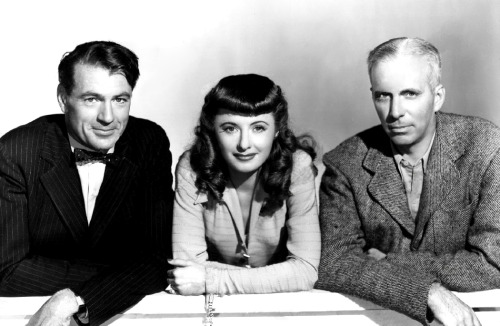
Ball of Fire (Howard Hawks, 1941) It doesn't get much better than this: screenplay by Charles Brackett and Billy Wilder (from a story by Wilder), produced by Samuel Goldwyn, photographed by Gregg Toland, music by Alfred Newman and directed by Howard Hawks. Add that it's a swing-era version of "Snow White" stock-piled by anything-but-dwarvish character actors (Henry Travers, Richard Hayden, Oscar Homolka, S.Z.Sakall), some nifty up-and-comers like Dana Andrews and Dan Duryea, and top-lined by Gary Cooper (in pixie-ish Capra mode) and Barbara Stanwyck (who usually runs on all cylinders, but seems turbo-charged in this one) and you have the makings of a great, stylish and culturally-winking comedy, with lots of great musical material, too.*

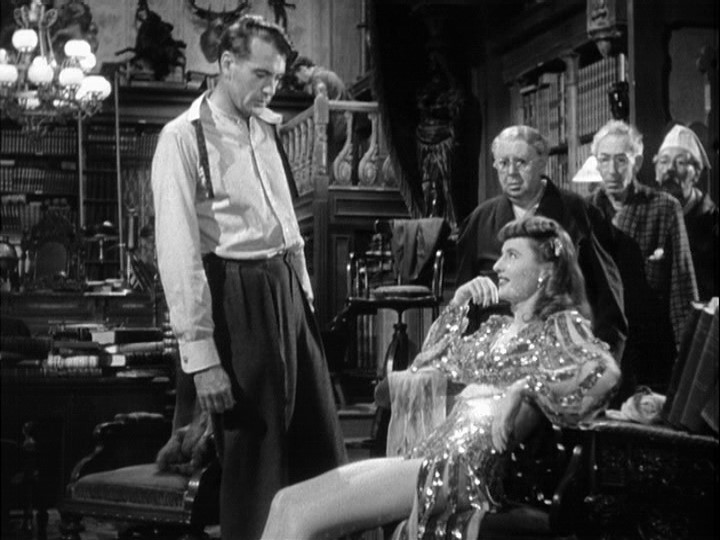
It's a charming conceit: years in the making, the Dutton Encyclopedia, written by eight myopic scholars, is hitting the skids just as it's hitting the "S" words. Professor Bertram Potts (Cooper) has just finished a 26 page treatise on "Slang," when a garbage-man walks in with some fancy (and utterly incomprehensible) patter that puts his research to shame. Potts determines that he will leave his ivory tower and venture forth into the world to see what all the...what's the word? *flip/flip*..."rhubarb" is about. He stumbles upon a nightclub (where Gene Krupa happens to be playing) and taking on the lead vocals is "Sugarpuss" O'Shea (Stanwyck, in full "bad-girl" mode), mob-moll to Joe Lilac (Andrews) who's being investigated by the New York cops. The focus of their flat-footing is Sugarpuss, who can give them a lot of inside information, so she has to go on the lam, and the professor's invitation to her to be a part of his slang symposium, gives her the perfect hideout, going "to the mattresses" with the eight encyclopediacs, even though under the distrusting baleful eye of their housekeeper, Miss Bragg.
Complications arise, with the possibilities of broken and/or ventilated hearts, as it turns into a particularly pointy triangle between Potts, O' Shea and Lilac, with a suddenly energized Greek chorus of academics trying to deal, rather haplessly, with the real world. "Snow White" is the inspiration, but fans of "The Big Bang Theory" will also see that show's roots in this and its Grimm ancestor. One also has Ball of Fire to thank for Billy Wilder's directing career, as Hawks let him sit in on the set, auditing during the making of the film, observing, taking notes, prepping for his own directorial turn that year with The Major and the Minor.
This is one of the great unsung Hawks movies, slightly different from his formula, thanks to Brackett and Wilder's script, but it still falls under his M.O. of story material where a team of differently skilled people—in this case scholars—come together under circumstance to form a like-minded unit, even if, as here, it happens a little late in the proceedings. It was Hawks' version of making a film about film-making, but obliquely, showing that any group of gypsies can unite under a common goal despite their differences. It's part of the charm that makes Hawks one of the most American-minded of film-makers, those films being a reflection of the melting pot of the Great National Experiment.
* One of Hawks' trademarks is a musical number in the proceedings, often by amateurs to show they're bonding in their efforts.

  Ball of Fire was re-made eight years later by Hawks in a musical version called A Song is Born (also photographed by Toland, but this time in technicolor) starring Danny Kaye and Virginia Mayo.