The Story: If Sunset Boulevard is the cinema's homage to itself, All About Eve is its homage to theater. Both share the common theme of illusion and reality confused with art and artifice—of players being played. Sunset Boulevard shows an incident that indicts the industry. All About Eve does the same, but implies it's all in the game.
Both films are love letters to their arts, but sealed with arsenic on the flap. Both are films by writer/directors about their mouth-pieces—actors—and all too eager to demonstrate how close the acting profession enters from stage left arm in arm with pathology.
It's interesting the deletion here from the original script to what made it on-screen. Birdie's interjection with the "It was so cold..." joke was taken out, maybe because the mention of a bra would cause an un-hooking hissy-fit with the blue noses at The Breen Office. Maybe, when it came time to edit to a theater-friendly length of two hours, it was dispensed with as unnecessary—it distracts from Eve's story at this point. The scene already has ample evidence that Birdie (bless her!)* can be an irritant. She is, after all, the smartest one in a roomful of sophisticates.
But it was probably cut out as a little too much fore-shadowing. Eve has center-stage and Birdie interrupts her, taking the spotlight—like any good vaudevillian—and Eve "looks at her unsmilingly" it says in the description. Not a big deal on the page—it indicates a lack of reaction. On film, it would have sent off alarms in the audience, especially given the performance of Anne Baxter, never the subtlest of actresses—very theatrical—for whom this part is a career high-point. She's splendid and smart in it.
As is Davis—this is also a career high-point in a storied career full of them. Interesting to note that Davis was not the first choice for the role. Claudette Colbert was. But when Colbert was unavailable, Davis grabbed onto the part with both hands and ran it across for a touchdown. It's a brave role for an actress, too, played even more bravely by Davis, who wasn't afraid to make herself seem unattractive as long as she could remain fascinating—she plays this whole scene with cold cream on her face. And the character of Margo Channing—theater diva approaching middle age, trying to grab onto youth with a younger man, and fending off attacks across her prow by a younger, ambitious actress—is full of smart talk, foolish actions, and scenes that would be easier to play on a roller-coaster. Davis grabbed onto it, dug her fingernails in, and made herself indelible in Margo's image. When Davis was feted with the Post Office's honorial stamp, they based it on a publicity shot from All About Eve, although with Margo's perpetual cigarette discreetly left out for the sake of the one thing Margo might not abide—political correctness.
The Set-Up: It is another triumphant night on-stage for Margo Channing (Bette Davis). Backstage is another story. Tonight she meets "her Number One fan"—in the Stephen King sense—the girl who's been hanging outside the stage-door for every performance..."the mousey one with the trench-coat and the funny hat." Tonight, her best friend Karen Richards (Celeste Holm), who has yet to learn that the path to Hell is paved with good intentions, will take pity on the poor girl and bring her into the fold: Enter Eve Harrington (Anne Baxter).
There is no Exit.
Action!
Script deletions are in Red
They all laugh.
 Karen goes to the door, opens it. Eve comes in. Karen closes the door behind her. A moment.
 EVE (simply): I thought you'd forgotten about me.
KAREN: Not at all.
(her arm through Eve's)KAREN: Margo, this is Eve Harrington.
 Margo changes swiftly into a first-lady-of-the-theater manner.
MARGO (musically): How do you do, my dear.
BIRDIE (mutters): Oh, brother.
EVE: Hello, Miss Channing.
 KAREN: My husband...
LLOYD (nicely): Hello, Miss Harrington.
EVE: How do you do, Mr. Richards.
MARGO (graciously): And this is my good friend and companion, Miss Birdie Coonan.
 BIRDIE: Oh, brother.
MARGO: Miss Coonan...
 LLOYD (to Birdie): Oh brother what?
 BIRDIE: When she gets like this... all of a sudden she's playin' Hamlet's mother...
MARGO (quiet menace): I'm sure you must have things to do in the bathroom, Birdie dear.
BIRDIE: If I haven't, I'll find something till you're normal.
 She goes into the bathroom.
 MARGO: Dear Birdie. Won't you sit down, Miss Worthington?
 KAREN: Harrington.
 MARGO: I'm so sorry... Harrington. Won't you sit down?
EVE: Thank you.
 She sits. A short lull.
 MARGO: Would you like a drink? It's right beside you...
KAREN: I was telling Margo and Lloyd about how often you'd seen the play...
They start together, and stop in deference to each other. They're a little flustered. But not Eve.
 EVE (to Margo): No, thank you.
(to Lloyd) Yes. I've seen every performance.
 LLOYD (delighted): Every performance? Then - am I safe in assuming you like it?
 EVE: I'd like anything Miss Channing played...
 MARGO (beams): Would you, really? How sweet-
LLOYD (flatly): I doubt very much that you'd like her in 'The Hairy Ape'.
EVE: Please, don't misunderstand me, Mr. Richards.
 EVE: I think that part of Miss Channing's greatness lies in her ability to choose the best plays...your new play is for Miss Channing, isn't it, Mr. Richards?
 MARGO: Of course it is.
LLOYD: How'd you hear about it?
EVE: There was an item in the Times. i like the title. 'Footsteps on the Ceiling'.
LLOYD: Let's get back to this one. Have you really seen every performance?
 (Eve nods)
LLOYD: Why? I'm curious...
Eve looks at Margo, then drops her eyes.
EVE" Well. If I didn't come to see the play, I wouldn't have anywhere else to go.
 MARGO: There are other plays...
 EVE: Not with you in them. Not by Mr. Richards...
 LLOYD: But you must have friends, a family, a home-
 Eve pauses. Then shakes her head.
 KAREN: Tell us about it - Eve...
Eve looks at her - grateful because Karen called her "Eve."
Then away, again...
 EVE: If I only knew how...
 KAREN: Try...
 EVE: Well...
 Birdie comes out of the bathroom.


 Everybody looks at her sharply. She realizes she's in on something important.

 She closes the door quietly, leans against it.
 EVE: Well... it started with the play before this one...
LLOYD: 'Remembrance'.
MARGO: Did you see it here in New York?
EVE: San Francisco. It was the last week. I went one night...
 EVE: ...the most important night in my life - until this one.
 EVE: Anyway... I found myself going the next night - and the next and the next.
 EVE: Every performance. Then, when the show went East - I went East.
BIRDIE: I'll never forget that blizzard the night we played Cheyenne. A cold night. First time I ever saw a brassiere break like a piece of matzos...
Eve looks at her unsmilingly, then back to her hands.
 KAREN: Eve... why don't you start at the beginning?
 EVE: It couldn't possibly interest you.
 MARGO: Please...
Eve speaks simply and without self-pity.
 EVE: I guess it started back home. Wisconsin, that is. There was just mum, and dad - and me. I was the only child, and I made believe a lot when I was a kid - I acted out all sorts of things... what they were isn't important.
 EVE: But somehow acting and make-believe began to fill up my life more and more,
 EVE: ...it got so that I couldn't tell the real from the unreal except that the unreal seemed more real to me...
 EVE: I'm talking a lot of gibberish, aren't I?
 LLOYD: Not at all...
 EVE: Farmers were poor in those days, that's what dad was - a farmer. I had to help out. So I quit school and I went to Milwaukee. I became a secretary. In a brewery. (she smiles)
When you're a secretary in a brewery - it's pretty hard to make
believe you're anything else. Everything is beer.
 EVE: It wasn't much fun, but it helped at home -
 EVE: - and there was a Little Theater Group... like a drop of rain in the desert. That's where I met Eddie. He was a radio technician. We played 'Liliom' for three performances, I was awful -
 EVE: ...then the war came, and we got married. Eddie was in the air force - and they sent him to the South Pacific.
 EVE: You were with the O.W.I., weren't you Mr. Richards?
 (Lloyd nods)
 EVE: That's what 'Who's Who' says... well, with Eddie gone, my life went back to beer.
 EVE: Except for a letter a week. One week Eddie wrote he had a leave coming up. I'd saved my money and vacation time.
 EVE: I went to San Francisco to meet him.
(a slight pause)
 EVE: Eddie wasn't there. They forwarded the telegram from Milwaukee - the one that came from Washington to say that Eddie wasn't coming at all. That Eddie was dead...

 (Karen puts her hand on Lloyd's)
 EVE: ... so I figured I'd stay in San Francisco. i was alone, but couldn't go back without Eddie. I found a job. And his insurance helped...
 EVE: ...and there were theaters in San Francisco.
 EVE: And one night Margo Channing came to play in 'Remembrance'... and I went to see it.
 EVE: And - well - here I am...


 She finishes dry-eyes and self-composed. Margo squeezes the bridge of her nose, dabs at her eyes.
 BIRDIE (finally): What a story. Everything but the bloodhounds snappin' at her rear end...
 That breaks the spell. Margo turns to her-
 MARGO: There are some human experiences, Birdie, that do not take place in a vaudeville house - and that even a fifth-rate vaudevillian should understand and respect!
 MARGO (to Eve): I want to apologize for Birdie's-
 BIRDIE (snaps in): You don't have to apologize for me!
 BIRDIE (to Eve): I'm sorry if I hurt your feelings. It's just my way of talkin'...
EVE (nicely): You didn't hurt my feelings, Miss Coonan...
 BIRDIE: Call me Birdie.
 BIRDIE (to Margo): As for bein' fifth-rate -
 BIRDIE: i closed the first half for eleven years an' you know it!
 She slams into the bathroom again. At that precise instant BILL SAMPSON flings open the door to the dressing room. He's youngish, vital, undisciplined. He lugs a beat-up suitcase which he drops as he crosses to Margo-
All About Eve
Words by Joseph L. Mankiewicz
Pictures by Milton R. Krasner and Joseph L. Mankiewicz
All About Eve is available on DVD from Fox Home Entertainment.
* Thelma Ritter's line about the dogs snapping at her rear-end is one of my favorites—the very reason why I wanted to use this scene, and I've neglected mentioning anything of Ritter, one of the best character actresses Hollywood has had. But she'll turn up again, in a similarly straight-talking role for Alfred Hitchcock.


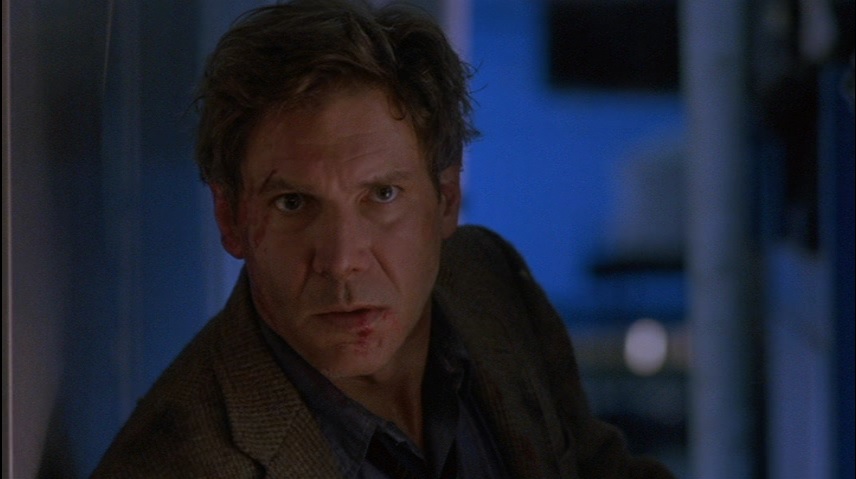
 When word of a movie-remake reached the press, I was skeptical. The series ran for four years, 120 hour-long episodes, and had a neat arc as Kimble drifted around the country, making at least 120 narrow escapes from the police, while his pursuit, the "One-Armed Man," made ever increasing appearances during its run. Trying to do "The Fugitive" in a mere 2-hour feature? Impossible. It would never work.




.jpg)