Showing posts with label Robert Forster. Show all posts

Wednesday, April 22, 2020

The Stalking Moon

The Stalking Moon (Robert Mulligan, 1968) Only a few years after teaming up on their multi-award-winning adaptation of the Pulitzer Prize winning novel of To Kill a Mockingbird, its producer Alan J Pakula (only a year before making his own directorial debut), its director Robert Mulligan and its star Gregory Peck came together once again to work on this western about revenge, the clash of cultures, and its inherent affect on those caught between them in the post Civil War era in The Stalking Moon.

Given the scenario, one could think of the film as yet another variation of John Ford's The Searchers—with different souls, certainly, and different outlooks, but a similar set of circumstances that are a continuation of that story if it was set a few years after the timeline of its captor, and runs closer to the story on which The Searchers was based—the true story of the capture of Cynthia Ann Parker, taken by Comanche warriors in 1836 at the age of 10, during a raid on her family's settlement. She was mother to the last Commanche chief, the formidable Quanah Parker.
But, that's history. The Stalking Moon is merely fiction.

Sarah Carver (Eva Marie Saint) is found in a Cavalry raid and returned to "the White Man's World" after 10 years of living in the Apache's. With her is her son (Noland Clay), his father being the Apache warrior Salvaje (Nathaniel Narcisco), whose name means "Ghost" or "He Who Is Not Here." 
Carver is at the Army camp awaiting a military escort to take her and her son to the town of Hennessy to board a stage for her original home of Columbus, but that will be in five days and Carver will not wait, wanting to get out of military custody...now. She implores a retiring Army scout Sam Varner (Peck) to take her to Hennessy. He's on his way to his home in New Mexico, so it's just one more stop along the way, so it's just a matter of leaving her and the boy at the stage station and moving on. 
But, it's not that easy, and should give Varner reason to wonder what the hurry is all about. There'll be a wait for the stage, and the Boy (he's never named) runs off—Varner is once again persuaded by Carver to go an another errand, one complicated by a sandstorm that will make the search difficult. The child is found hiding in a cave and the three ride out the storm during the night.
The one they can see, anyway. There was another storm that they were lucky enough to miss, one that was man-made—when the three return to meet the next stage, the town of Hennesy is wiped out of any life. Salvaje, apparently, is tracking them, but what his ultimate plans are, like his tactics, unknowable, and Varner decides to waste no more time waiting for stages or locomotives. The timetable, now, is Salvaje's, and the near-mythic Apache warrior is calling all shots.
Which makes Varner's plan to take Carver and son back to his ranch in New Mexico somewhat perplexing. Perhaps, it's the mountainous terrain surrounding his ranch, maybe "the-country-you-know" will give some advantage in the fight, but it seems like giving the Apache plenty of room to hide runs counter to a safe strategy, and one thinks that knowing the territory might allow for some better preparedness, maybe even a snare or two. Without it, the desert gives very little cover and might be a better idea.
But, it's back to New Mexico they go, and The Stalking Moon becomes more of a thriller with the protagonists having to make a stand against a highly-estimated antagonist that is far too trained to go bump in the night and give away his position. And even allies like Varner's wizened ranch-hand (Russell Thorsen) and his ranger-trainee (Robert Forster in a wonderful early performance) become merely red-shirts to increase the suspense without impinging on any domestic situation that may ensue. Director Mulligan thought the project (handed down after director George Stevens bowed out) as a Western/Hitchcock hybrid, but one doubts The Master of Suspense would play it so safe and not toy with the audience's expectations of an ultimately happy ending.
But, give Mulligan credit for giving it a try. His eye for composition is comparable to Hitchcock's in making emotional use of the frame, although his way of communicating the point-of-view of his players is far more organic and less stylized than his British counterpart (who, at the time, was struggling to make Topaz a signature film). The film is spare on dialog—contrarily, Peck's Varner is the most loquacious in the film and even gripes about it during a quiet dinner—so there's a lot of communicating through looks and glances (which is handy when you have a legendarily crafty Apache warrior targeting your house.
Finally, this is where the film ultimately fails—false advertising. After building up a "boogey-man" persona for Salvaje's character, he is not as good as he's said to be. The man has massacred whole towns and still pursues his prey in the course of the movie, but how what he does in the final set-piece is not what one would expect of such an antagonist. Perhaps those unfortunate way-stations (two of them) merely got that way because he's just very thorough—an OCD Apache warrior. He certainly is persistent. Either that, or he had to be given a bit less skill in order to be believably (or otherwise) defeated by Peck's Varner. In either case, somebody compromised in order to have a standard outcome—they way TV writers do when they know that a character has to return next week. It's drama by contract, and except for having to sit with the lawyers, there's no suspense (or terror there) there.

But, think what a better movie it might have been if they hadn't. 
Mulligan is on record of why he wasn't satisfied with the film: “It just didn’t work, and a lot of that may have to do with the basic silence of the movie.”

On the contrary, the silence works in the film's favor...and has in westerns whenever the dogs start barking (then stop) or the insects get quiet. The quiet of the outdoors is one of the things that draws us to sparser settings...while also keeping us awake the first couple of nights. 
No, the silence that hurt the picture is the one didn't object to weakening the script.

Wednesday, May 16, 2018

The Descendants

Written at the time of the film's release (as will become abundantly clear). Ultimately, The Descendants won the Oscar for Best Adapted Screenplay (and that was it). The Artist swept most of the Awards that year.


"Finding Grace in Paradise"
or
"Keeping the Kidneys and Other Vital Organs Working and Hoping for the Best"

There's a lot of water in Hawaii. It's an island, after all, a string of volcanic mountains surrounded by water on all sides. Plus, there are the myriad rivers that course through, invading the land, falling off the mountains combined with the torrential rains that sometimes beat down with such ferocity that they turn highways into flood corridors, making negotiating trails on the islands difficult. All that water does have an advantage—it turns the volcanic soil green with lush verdant beauty.

And it also hides the tears.
Alexander Payne's adaptation of Kaui Hart Hemmings' novel The Descendants is something of a miracle, a nearly perfect adaptation, much like James L. Brooks' transformation of Larry McMurtry's Terms of Endearment (and if there's any justice...or taste...in Hollywood this awards season, Payne's film will be awarded as much gold as Brooks'). It retains Payne's way of nailing a particular culture, as he has with right-wing religion, high school politics, retirement wanderlust, and the pretentious pseudo-culture of Napa Valley. In The Descendants, it's the extreme casualness of the privileged Howlies, who have invaded the island culture, overcoming it like a tsunami.
But, there's a difference here. All of Payne's films have been a trifle dodgy, askew or off-kilter. Not The Descendants. It is a fine distillation of the book, taking the best of the dialogue, a perfect cast of vets and unknowns and bringing it together with polish, exquisite comic timing and poignancy.
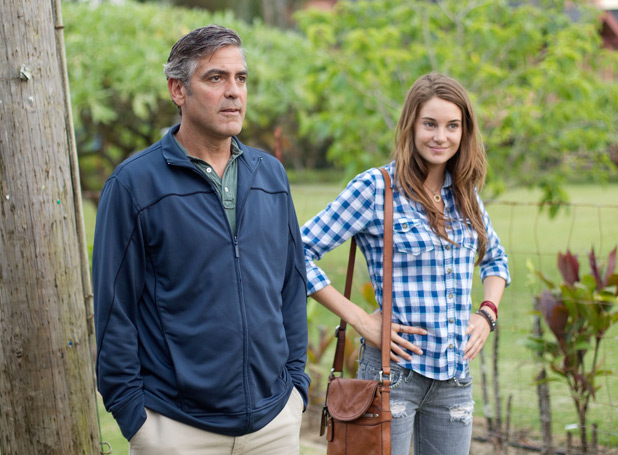
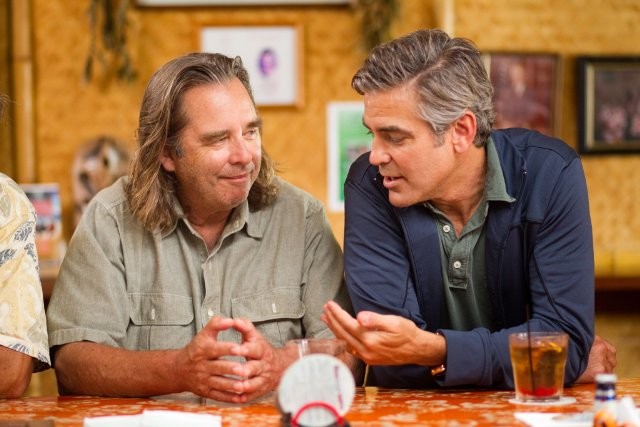
Attorney Matt King (George Clooney) is the last in a long line of Kings of Hawaii, who trace their roots back to King Kamehameha, a family history that has held in trust 25,000 acres of undeveloped, still natural Kauai'i coastline which will be out of trust in seven years. Matt is the sole trustee, but is in negotiations with his family on how to deal with the land.  A decision is to be made soon.
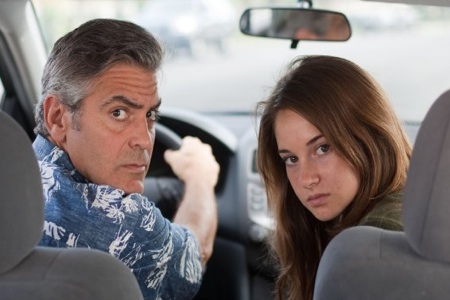
But, that's the least of Matt's concerns. His wife, Elizabeth, has been put in a coma from a boating accident. He is left with her medical decisions and the caretaking of their two daughters—Scottie, 10 (Amara Miller), and Alexandra "Alex," 17 (Shailene Woodley, I hesitate to mention he performance as a standout, because everyone is great)—a difficult task as the aloof and professional Matt is, for all intents and purposes, "the back-up parent." Scottie is starting to react to her mother's hospitalization in odd, destructive ways...and Alex? She's already been shipped to another island to a strict boarding school for dabbling in drugs and older boyfriends. "What is it with the women in my life that they want to destroy themselves?" Matt asks in one of the many narrations that dominate the film.
Good question. And the answers to that one aren't even explored in depth here.  Let's just say that Matt is responsible, and must be more responsible if he is to save his family, nuclear or extended. However diligent he might be as a man or a person, he cannot prep for the emergencies that life hands to him. He cannot research what to say or argue before the court of his kids, and absolutely must find a way through the briar-patch of mercurial emotions that has nothing to do with reason or law. There is no precedent to draw upon for what he is going through. This is life, not jurisprudence. There is no preparing for that. Life is off-the-cuff, on the wire, winging it because life is what happens (as John Lennon said) "while you're busy making other plans." In the film, Clooney's character must deal with both death and life and find the personal grace to do both, simultaneously, letting go of the past and dealing with the essential unforeseeable future. 
There are two axioms that I hold dear in life as true, and recently they came up again, in my life, to steer me to a clearer, calmer path. The first is "actions speak louder than words." Words are fine, nice, even comforting. But they are useless, and can be even considered lies if not backed up by a concurring action.* The other is one of the few things I take as absolute truth from the Bible and that is that "love never dies." I realized that with the death of my parents, but it is only reinforced to me, day after day. Like energy in science, once it's generated, love never leaves the Universe. It can change, sometimes savagely, turning into hate (at least, temporarily, because the opposite of love is indifference), but it never goes away...never "vanishes." And The Descendants, in its funny, quirky way, eloquently speaks to those truths.
I love this movie. There are choices that Payne and his co-writers have made in the presentation of Hemmings' novella that are oddly poetic, even beautiful, and with the clear-eyed collaboration of his actors, have made up some of the most memorable scenes in a film that have moved me this year. It is certain that many of them will show up as "Moments" in the year-end wrap-up of the best of 2011. This one might be the best film of the year.
But, the movie-year, despite being deep in its 11th month and on the cusp of the 12th, is still young. Who knows what lies ahead? 

The view from 2018: 2011 was a very good year for movies: Look at the Oscar nominees—War Horse, Hugo, The Tree of Life, Moneyball, Midnight in Paris, The Help—most of those I recall quite fondly and have stuck in my mind. But The Descendants is still probably my favorite of that year because it moved me so consistently (not that the others didn't) and so intensely. Just a good adaptation of a good novel with a mind of its own that sort of vaults it beyond "adaptation." I revisit it quite a bit.
* It's especially true of politicians.  Think of that during the next political campaign.