"As Long As the Plot Doesn't Twist!" (Foreshadowing)
There's never been a Looney Tunes feature film. No, No. Not the ones, where they combined live action with animation, like Looney Tunes: Back in Action or the SpaceJam's (which kind of ham-strung the characters), or the compilation-movies that were put out to make a quick buck. I mean an actual feature film that featured the characters—any of them—in a full-blown story that lasted more than an hour. No, they were usually confined to ten minute shorts that used to be shown in between newsreels and previews in theaters ('way back in the day), or were syndicated into packages for Saturday morning consumption and maybe even prime-time. They were a ready-made property of the Warner Brothers studio and enough of them garnered recognition, even Oscars, that the studio kept churning them out, even as budgets got scrunched, then the Animation Department (dubbed "Termite Terrace") was sold lock, stock, and barrel (all made by Acme™) the finished product then scattered into whatever format made the old Warner studio the most money, the charactersadorning T-shirts and appropriated for other swag. The characters were put out to pasture, to be re-processed into new versions by nostalgic directors like Spielberg. At the moment, there is a division of the studio called Warner Brothers Pictures Animation, which will make things like The Lego Movie or DC League of Super-Pets. The history is complicated, the business even more so, to the point where one of the intended Warner movies, Coyote vs. Acme, was shelved by current CEO David Zaslav, supposedly as a tax write-off (although it may be picked up for distribution by Ketchup Entertainment). This is a lot of boring business talk to start a review of a cartoon.
Speaking of which...Ketchup is releasingThe Day the Earth Blew Up: A Looney Tunes Movie, because, although Warner might have given up on their animation projects, sometimes they turn out pretty good. And The Day the Earth Blew Up is not half-bad. Certainly, it has an interesting design sense, manages to keep the momentum going for the majority of its run-time, and does that enviable thing that few cartoons even try for these days: appealing to the adults while entertaining the kids. Sure, its basic plot is a compendium of sci-fi films like The Day the Earth Stood Still, Invasion of the Body Snatchers, Night of the Living Dead, and even Deep Impact and Armageddon. But, every once in awhile, a character will make an off-hand remark or an aside that will genuinely make an adult spit-take their Coke-Zero. It's usually Daffy Duck.
Now, this Daffy is not the later Chuck Jones-version, vainglorious, craven and greedy, the antithesis of the cool, collected sneaky Bugs Bunny. This is the Daffy of the early cartoons, who was genuinely crazy and would often go off on a pin-wheeling, room-caroming fit of the hooting yips. That's because The Day the Earth Blew Up is done in the style of one of the most idiosyncratic of the Warner directors, Bob Clampett,* so the characters will look a bit "off" from modern interpretations, and they will be far more elastic as well. It will remind you of the animation of John Kricalfusi (the creator of "Ren and Stimpy")—a big fan of Clampett's style.
What happens is...a meteorite is spotted by an astronomer flying over the city of Grandview—home of the Goodie Gum Factory—and when he goes to investigate, he is overcome by glowing green goo and turned into a shambling zombie. The asteroid also puts a big hole in the roof of the home shared by Porky Pig and Daffy Duck, who were rescued as infants by Farmer Jim (who, curiously, is not very animated—comedically so—and is done in a painterly style like Thomas Hart Benton). Farmer Jim just...leaves one day (don't ask too many questions, kids!) and bequeaths their house to Porky and Daffy, and tells them they should always stick together. Easy to do in a town where the major industry is making bubble-gum.
That hole in the roof is pretty inconvenient, as the P and D have just done a once-over of their house for the "annual home standards review" and when the harridan of a mayor's wife comes to inspect, she gives them ten days to fix the hole or face demolition. But, without money to hire a contractor, they're forced to find a job, or—because of Daffy—a series of jobs that don't last very long.
Finally, they do get a job at the gum factory, where Daffy witnesses that zombie-astronomer drop that alien goo into a batch of the brand-new gum flavor "Super-Strongberry", which, when consumed, turns an ordinary person into a alien-controlled zombie. Daffy is put into a Qanon-like panic over the populace being taken over, but what he doesn't know is that it is all a plot by an alien invader trying to take over the mind of every human on Earth. Dastardly!
It's so over-the-top and done in an exaggerated almost horrific style that one can have a good time just watching the contortions of Daffy's and Porky's expressions as things transpire. This is not subtle stuff here, and every so often it is laugh-out-loud funny and that is tough to sustain in a feature-length cartoon.
Animation is a tricky business, and while the depicted spaceship is computer-generated, and some of the backgrounds have a pixelated feel, for the most part the film is plain old fashioned hand-drawn cartooning one frame at a time. You can spot some cost-cutting measures here and there, but the figures don't skimp, and some of the backgrounds have the reassuring weirdness of Maurice Noble from the old Warner days.
And it gets in a couple of digs at Warner management while doing so, which is right in the anarchic spirit of the Looney Tunes legacy. Maybe the execs should spend less time looking at their bottom line and looking at their product. At ten minutes, these things were classics. At feature length, they might be stretched a little thin (like chewing gum), but for a first time effort, this one does quite alright.
* Clampett had a long career at Warner, but he is perhaps better known for his creation of "Time for Beany" (the favorite show of both Albert Einstein and Groucho Marx) and its animated follow-up "Beany and Cecil".
Dragonslayer(Matthew Robbins, 1981) In Hollywood's post-Star Wars frenzy to capitalize on that film's success, there was a resurgence of fantasy and sci-fi films hoping to find the same "magic formula" of George Lucas' effort, which, by the time of this film's release, had already spawned one sequel. Writers Hal Barwood and Matthew Robbins were inspired by "The Sorcerer's Apprentice" sequence from Fantasia (they were apprentices of a sort to Steven Spielberg) and pitched the idea, which was rejected by various movie studios until picked up by Walt Disney, which co-financed in conjunction with Paramount (the two had also produced Robert Altman's Popeye). Dragonslayer begins with a story already in progress. It is the Middle Ages and the King of Urland has made a deal with the devil, literally. In order to protect his village, the King, Casiodorus Rex (Peter Eyre) has instituted a lottery each solstice of all the virgin maids in the village to sacrifice one of them to a 400 year old dragon, Vermithrax Pejorative ("The Worm of Thrace Who Makes Things Worse"). As the film opens, a collection of Urland villagers have traveled to far-off Cragganmoor to implore its wizard Ulrich (Ralph Richardson) to kill the dragon, lest any more women be killed.
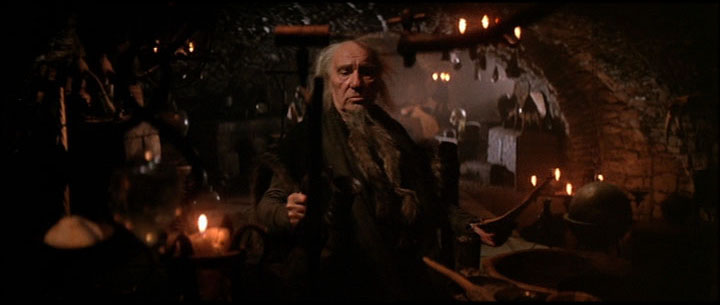
The group is led by young Valerian (Caitlin Clarke) who begs the old wizard to intercede on the village's behalf. After first being rebuffed by the sorcerer's servant Hodge (Sydney Bromley), the mage's young apprentice Galen (Peter MacNicol) convinces him to see the townspeople. But Ulrich is still reluctant, having just seen his own death in a vision, but deigns to meet with them, anyway. The meeting with Valerian and the villagers does not go exceedingly well; all the other wizards who might help are dead (by Ulrich's account) and it is because of them that dragons exist in the first place (well, almost—Vermithrax is the last dragon still alive).
Then, a soldier loyal to Casiodorus, Tyrian (John Hallam), who has been tracking the villagers on their journey intercedes, intimidating the party that what they're doing is against the King's policy, although he has no love for Vermithrax. He doubts the old wizard's power, and Ulrich offers a test. He gives Galen his mystic amulet and tells him to go back up to the tower of Cragganmoor and throw down a sharp dagger. Once that's done, the doors and windows of the room slam shut, trapping Galen inside, while Ulrich proves his powers to the doubting Tyrian—the test is to hold the dagger to Ulrich's heart and plunge it through.
...which does not go so well. Ulrich looks heaven-ward...and falls Earth-ward, dead. And magically, while Galen mourns his dead master, the doors and windows of the room that have trapped him slowly open. Tyrian laughs, having proven the wizard a fraud, and returns to Urland, followed by the villagers, their last hope dashed. But, Galen is plucky. He and Hodge have a proper funeral for their master, cremating the body on a pyre (the flames turning an unnatural green) and Hodge scoops the ashes in a pouch for safe-keeping. Galen takes Ulrich's mystical amulet and sets off to follow the villagers to offer his services as a wizard to kill the dragon and save the maidens of the village. When he reaches them, they are skeptical, but a trip to the mountain lair of Vermithrax inspires him to try a unique solution: using the amulet he creates a cave-in at the dragon's entrance, trapping the dragon there forever.
The village heralds the death of the dragon and its long reign of terror with a communal dance and celebration, where, the danger having passed, some of the villagers can finally let their hair down. A triumphant Galen is told by Tyrian that the King wants to pay his respects, and so they go to an audience with the King, who regards his skills and accomplishments with some skepticism, and defends his policy of appeasing the dragon in order to save the village. Galen upbraids the King for not trying to kill Vermithrax and sacrificing the daughters of the village, instead. For this insolence, Galen is thrown in prison.
With Galen locked up in the dungeon, the village goes on with its daily life. But, an earthquake that rattles the countryside sets everyone on edge. As well it should; Vermithrax is not dead and has found a way out of its entombment and, in anger, ravages the village, raking it over with blasts from it's fiery breath. Woe is Urland. Who can save them now?
At this point, you don't really care because the real star of the film begins to make an appearance in something more than glimpses and hints. Vermithrax Pejorative is an awesome creature of the movies. It reminds one of Ray Harryhausen's stop-motion mythical creatures, but with less of the empty stare of his creations. From afar in its attack on the Urlanders, it's a huge shape that blurs past, a dark shadow leaving fire and destruction its wake, untouchable and unfathomable.
It is when things come to close quarters, that it really gets interesting. When Galen makes his first...stab...at trying to subdue the creature with an enchanted lance and a fireproof shield made of the creature's own scales, Barwood shows it in aspects of those previous reveals. It is only when the dragon is revealed in its full glory, having snuck up behind Galen and waited until he's noticed, that we get a good look at the thing, scaled and breathing, puffing up its chest like a bellows to vomit a fireball at the presumptuous wizard that it becomes truly menacing in the real. The designers of Vermithrax give it a baroque look and a bit more personality than Harryhausen could evoke. But, to see it crawling around its cavern home like a bat, then it becomes truly unnerving and more real than previous dragons depicted on-screen. Vermithrax was a result of George Lucas' SFX house Industrial Light and Magic and their recent advances in stop motion animation they dubbed "go-motion," which they'd used to great effect in The Empire Strikes Back. Dragonslayer was the first non-Lucasfilm product they worked on.
Dragonslayer is not my favorite movie by any stretch. But, one thing I did like about it was it's tone that is as far afield from the more light-hearted "boy's adventure" feel that something like "Star Wars" and its clones offered up. Barwood and Robbins' Middle Ages are far less black and white (from an attitude standpoint as well as a lighting one) and more cynical in its sensibilities than you'd find in most fantasy films. The only character here who doesn't have a secret or some hidden agenda and is forthrightly acting on its instincts is Vermithrax. Everybody else is duplicitous, right down to that Disney icon, a princess.
Urland's visiting priest (future Emperor Ian McDiarmid) finds his own version of Hell
I like that. These people are in a bad situation and they're trying to "game" it to their advantage, despite the seeming invincibility of the magic dragon. That feels more like the real world than the fantasy ones of heroes and villains with clear demarcation points. And Barwood and Robbins aren't afraid to toss in sub-textures of the at-odds models of faith—magic and religion, set against the practical—appeasement and politics. They aren't afraid to hint at the heretical, either, no matter how vaunted the subject of their ridicule.
Casiodorus Rex isn't afraid to take credit for other peoples' work.
Dragonslayer is now rated PG-13 (it was rated PG when first released, as the "-13" designation wasn't adopted until after the second "Indiana Jones" movie), but even with that rating it is a very mature PG for 1981...and for Disney. Not only is there the barbecuing of several people, but there is also some hungry gnawing on parts of one of Urland's maidens, and both male and female nudity—and, yes, it's dramatically necessary. It was quite the shift for Disney, whose most well-known death up to that time was Bambi's mother. But, declining sales at the box-office made them start to produce more edgy material and eventually creating its own "mature" studio—"Touchstone"—for those films the "Disney" shingle did not fit. And they must have felt a bit burned that "the youth market" was lining up to see the "Star Wars" films, and not one of theirs.
Of course, today that point is moot.
Another fine aspect of the film is its unusual, weird score by film-music master Alex North (who'd written the scores for A Streetcar Named Desire, Spartacus, and Cleopatra, but who is probably best remembered as the writer of "Unchained Melody," which he'd composed for "B-movie" prison film). Brutal, other-worldly and tuneless, it rejected European romantic traditions and evoked a more primitive time, managing to keep any notions of swash-buckling out of this fantasy-realm. It also allowed North to recycle some of the music he wrote for his rejected score for 2001: A Space Odyssey.