Showing posts with label Lily James. Show all posts

Friday, July 5, 2019

Yesterday

The Most Complicated Joke I've Ever Heard
or
Suddenly/There's No Beatles Iconography
OR
Drinking From the Poisoned Chalice (To Lead a Better Life/I Need My Love To Be Here)

I'll be hitting 64 (as in "Will You Still Need Me/Will You Still Feed Me...") in another week or so, and, having been born in 1955, I am very familiar with The Beatles ("for you youngsters out there"—as Ed Sullivan used to patronize—their Beatlemania hey-day was between 1962 and 1970, my adolescent-teen years). For me, the experiences of my parents during The Great Depression (1929-??) and World War II (1940-1945—we used to have shorter, more efficient wars back then, and a citizenry who weren't complacent with the practice) seemed "of the past" and ancient history. So, I imagine talking about "The Beatles" will seem, to a contemporary audience, like my folks talking about Rudy Vallee

Well, tough. The Beatles were a "Big Deal." Revolutionary to those of us who were used to hearing Elvis and The Four Seasons on the radio. That The Beatles built their music on American rockabilly and their version—"skiffle"—didn't make them any less revolutionary. What seems revolutionary is often, upon examination, merely evolutionary—built on what came before. But, the group then took it and changed music, changed what "pop" was, expanding it, twisting it, experimenting with it and going from "Yeah, yeah, yeah" to "Goo-goo-ga-joob."
The new film by director Danny Boyle and screenwriter Richard Curtis (there's an oil-and-water combination for ya), Yesterday proposes a big "What If?" story: what if The Beatles never existed? It's easy to imagine—it's easy if you try—what if John Lennon, Paul McCartney, George Harrison, and Richard Starkey never hooked up. I once had a conversation with a radio host of a Beatles program where we concluded that that particular combination of kids with their personalities, interests, drives and talents created what amounted to a "perfect storm" of musical creativity. But, perfect storms are rare. The conditions and factors have to be just right. What if original drummer Pete Best stayed with the group? Would they have been as good, as popular, would they have achieved the original nexus they had and the hysterical acclaim they generated if any of the elements were missing? Probably not. The world would be a different place slightly, as The Beatles influenced music, ideas, fashion and culture. Boyle and Curtis could not have made a film of all the possible ramifications. So, they have a sliver of the possibilities for their rom-com/musical.

Jack Malek (Himesh Patel) is a busker. It's his hobby as it really doesn't supplement his income as a warehouse-stocker at PriceStar. It's a bit of a dream-chase—he was considered musically talented at the age of 9, the performance which brought him together with his long-time platonic companion/roadie/manager Elly (Lilly James). But Jack is at the end of his guitar-string. A chance to play at the Latitude Festival in Suffolk results in his playing in a thinly-occupied tent. "Great day," encourages Elly. "Yeah!" Jack agrees, sarcastically "I really can't take much more of this."
But, driving him home—she teaches "maths" and has a car and he rides a bike—Elly tries to be encouraging: "Miracles can happen! Like Benedict Cumberbatch becoming a sex symbol!" True dat. But, Jack can't be consoled. "This was my last gig." He bicycles away, accepting his fate.

But, fate can change. As he's biking home in the rain, the entire world experiences a 12 second blackout. And in those 12 seconds, Jack is hit by an SUV, upending his life, giving him a concussion, knocking out two of his front teeth, smashing his guitar and bicycle, and creating a huge opportunity. When he wakes up in hospital, diligent Elly is there to tell him the bad news—bad accident, lost the teeth, lost the beard. She fusses over him, then must leave for her job. "Will you still feed me when I'm 64?" Jack sings after her. She dead-stops in the door-way. "Why 64?" "Well, it's the song, you know..." She doesn't. it's the tip of the iceberg.

At a party upon Jack's release, his friends throw a party and gift him with a new guitar, encouraging him to play again, but he demurs: "If God had been remotely interested in my stuff, somebody would have written me a fan letter besides my mum." But, he will play. "A great gift deserves a great song," and he begins the chords to McCartney's "Yesterday." Finishing it, eyebrows are raised, emotions are moved, and jaws are dropped (and this..."well, it's not Coldplay It's not "Fix You"). "What the hell was that?" It was "Yesterday." "When did you write that?" "I didn't write it. Paul McCartney wrote it! The Beatles!" "Who?" Jack is incredulous...and a bit miffed, thinking that his friends are having fun at his expense. 
But, no, instead of it being "the most complicated joke I've ever heard," a Google search reveals only the bug, not the band. The Rolling Stones are there (wait, their first hit "I Wanna Be Your Man" was written by Lennon and McCartney...but...okay), but no third-letter-"a" "Beatles." They've been Thanos-snapped out of existence. So have a few other things, but I won't spoil it.
"Don't you realize you're the first three people on Earth to hear 'Let It Be?'" "That's nice, sun..."
He tries other songs. People don't know them. He barely knows them-what are the lyrics to "Elanor Rigby?" "I Wanna Hold Your Hand." "I Saw Her Standing There." "Let It Be." All draw a blank. Performing in coffee houses doesn't turn it into The Cavern Club and his close acquaintances are supportive, but think he's getting a bit of a head when he takes offense at them not realizing the greatness of the songs. Seems a bit stuck on himself, really. But only Malek knows the songs are iconic...or would be if they'd been written. And if people assume he's the author...well, what can he do about it?
An engineer at a low-rent recording studio offers to record him (it's gotta be low-rent because it's built on the side of a rail-road track--interference and low-end rumble, much?). But, the tracks attract attention—Malek gives them away at the PriceStar and it gets him an interview on the PriceStar channel, where he's called "The Singing Wholesaler"...even after he's debuted "In My Life" on the program! What is wrong with these people?
But, one person notices the interview—Ed Sheeran (my response was "who?" and after I read about him and listened to a couple of his songs, I repeated "who??"*) and he pops over to Malek's place (actually Malek's parents' place) and asks him to open for him at a concert in Moscow. Opening for Ed Sheeran? Da-ah! What does he open with? "Back in the USSR," of course. Du-uh! And he makes a sensation, and Sheeran is mystified. When did he find the time to write the song? It was only a three hour flight (brilliant touch to call it the old name of USSR, though...but still).
The viral videos out of Russia (they DO get around, don't they?) of Malek's performance attracts the attention of Sheeran's agent, Debra Hammer (a scary and hilarious Kate McKinnon at full satirical strength—be afraid) and she signs Malek on, prompting—Hammer doesn't prompt, exactly—a trip to Los Angeles for a career make-over and "mind-bending meeting of all meetings" to make him The new sensation. 
But, Malek is worried. The marketing emphasis is on his song-writing ability—the debut album is titled "A Man Alone"—and he knows the songs he's acclaimed for are not his own. He fears being exposed world-wide as a fraud and the guilt and shame are starting to make him crack. Plus, Elly has taken up with that recording engineer a long, long time ago (I can tell you from personal experience that THAT doesn't happen...). It begins to feel that the life he's always wanted isn't the life he actually wants. Life's what happens to you when you're busy making other plans (who wrote that? Actually, more to the point, who DID write that?)
"Can we change 'Hey, Jude' to 'Hey, Dude?' Makes more sense, doesn't it?"
Those conflicts, those issues, are what Yesterday is all about, rather than making some grand sci-fi epic about "The Day the Music Disappeared." It is still a "What if..." story, but a more relatable "What if," about choices, career and happiness...and fulfillment.

How does it get resolved? If you have to ask, you haven't seen many movies written by Richard Curtis. Along the way, the absurdities of a public life are skewered and pilloried, as well as those of Corporate Overseers both large and small. The film also takes one very surprising chance that I did not see coming, and may make some consider some sort of heresy (he'd laugh), but I found it a lovely moment in a parallel Universe where choices are important, especially if you're making them yourself.
No Beatles lyrics for that. You can't write 'em all.

The gloriously ecstatic advice-song "She Loves You." 
Now, if Jack had actually listened to this song, he wouldn't have needed the movie.
"Oo-oo-oo-oo-oo!"

* Okay. Give it up to Sheeran for this:
Thursday, January 4, 2018

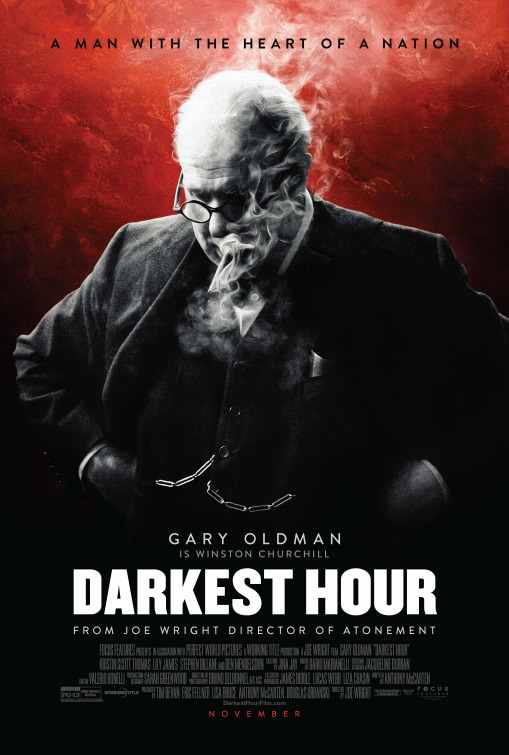
Darkest Hour (2017)

The Other Battle of Dunkirk
or
"Are We Terribly Old?" "Yes, I'm Afraid You Are."

If Christopher Nolan's fractured telling of the events of Dunkirk wasn't enough for you this year, Joe Wright comes along with Darkest Hour, a straight-forward timeline of the changing of England's Prime Ministry right before the fall of Europe to Nazi Germany, as made clear by the pushing of England's "entire professional soldiery" (as they are described here) to the sea. Wright, as a director, visited the story once before in his highly-recommended film of Atonement—and managed it in one long continuous five minute "shot" that  encompassed the desperation of the soldiers trapped on the beach.

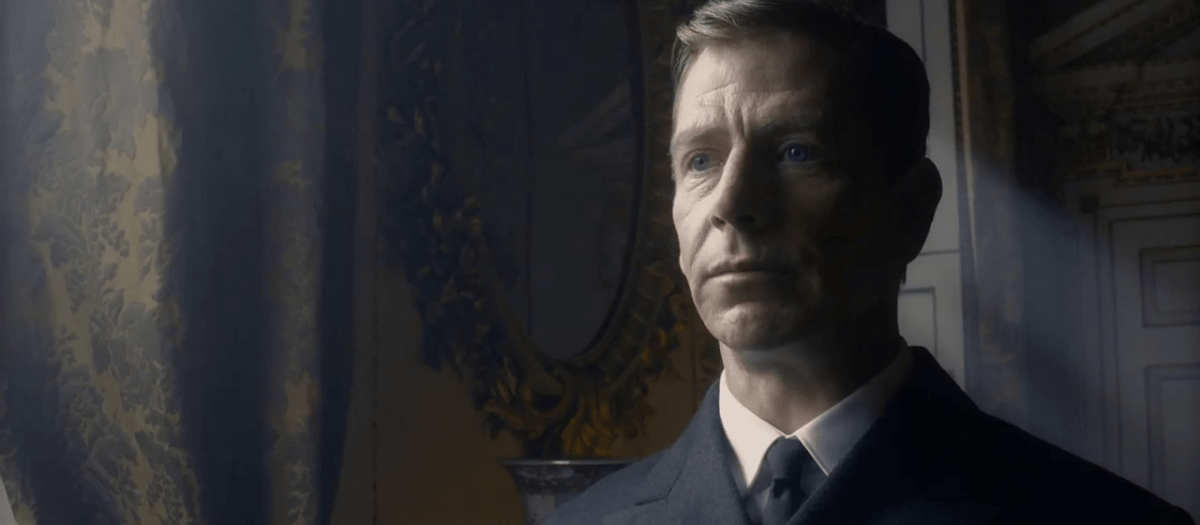
Meanwhile, during a clear demonstration of their military against the German war machine, Britain was having a crisis of confidence. Prime Minister Neville Chamberlain (played by Ronald Pickup here), in 1938, had secured an agreement from Adolph Hitler to stop his aggression across Europe—the Munich Accord—which the dictator promptly violated. After an attempt by Allies to create a front against German forces appeared to be a route, Chamberlain resigned and after some dithering, the PM position was handed to the Conservative Party with Winston Churchill's call to service by King George VI (you remember him from The King's Speech, don't you, and he's played—rather uncannily—by Ben Mendelsohn). 
This was not a popular choice. Churchill, as per his countenance, was a bit of a bulldog. While Chamberlain sought to negotiate, Churchill would broker no talk. Not with Hitler. And the man saw no comfort in the moat around their island-nation, not with the extended range of Germany's luftwaffe. Churchill's answer was to meet Hitler force to force, which was not popular in Parliament. He was...very reluctantly...tapped for the Ministry, and was opposed from his first days in office.     
Gary Oldman is not the first choice that comes to mind to play Churchill, but the man is such a chameleon that once you start getting used to Oldman's higher timber of voice, you buy into it. The make-up crew have done a heroic job of getting him to the suggestion of Churchill's famous mug and then the man just morphs into the mannerisms, the gruffness, and the cadences. 
But, when the story starts, after some documentary footage and back-story for viewers "who just came in," Wright begins the story proper with a device that he will use continually throughout the film—a high overhead shot looking directly down at Parliament. At this juncture, the camera will snake down among the quarreling Lords, as Chamberlain resigns and director Wright turns to Churchill's empty chair while concerns are nattered about his absence and why—"to ensure his finger-prints are not on the murder weapon" is the comment.
But, no. Churchill is in bed. The first we see of him is the red flare of a cigar being lit in a darkened room before the curtains are thrown back to reveal daylight. He is waiting. Knowing full-well that he is not the first choice to be picked, he is content to let the waffling go on without him. And he must break in a new secretary, Elizabeth Layton (Lily James—last seen in Baby Driver), who has been informed of Churchill's tendency to mumble through his dictation, and misinformed that he likes his missives typed single-spaced. Having screwed up that "the time is right" rather than the time is ripe," Layton runs out of the room, more than willing to quit the first time out when she is greeted by Mrs. Churchill—"Clemmie" (Kristen Scott Thomas)—"Did he shout at you?" then turns and roars up the stairs "He's an awful brute!!" before storming the bed-room and mollifying his eccentricities and patiently telling him that his behavior must be changed. It is HIS fault, not the secretary's. And Churchill can only back down before her authority, which is sacrosanct.
Now, back to those overhead shots: Wright has always had the tendency to be a bit "showy" behind the camera—that five minute "Dunkirk" shot is an example. The thing is that tendency is rarely cheap and gets paid off by some remarkable resonance somewhere else in the film. It usually happens when he is "opening up" the film outside of the stuffy rooms and cloistered bunkers in which conversations are practiced in usually civil tones—those shots are inevitably at eye-level, the best vantage to see the daggers flying. 
But, outside the ideology and tactical speculation, the world is seen from God's point of view, whether he is looking down at refugees fleeing Belgium, or across a flight-path pock-marked with bomb-craters.*
That strategy will be capped by a shot that back-tracks a previously-mentioned Brigadier Nicholson, charged with a suicide mission to distract the Nazi advance, as he reads a telegram telling him reinforcements will not come, but he still puts on a confident show for his men as he moves forward through his position, only to look up, as the camera moves overhead, is eclipsed by a German bomber and we follow its bombs down as they snuff out any hope...or any doubts.

It's moments like these—Wright's well-considered tricks and sleights-of-hand—that elevate Darkest Hour from your standard "Masterpiece" presentation (ala The King's Speech) and moves it into a realm where art and history combine to evoke memory...but better than we imagined it.
Wright must have watched Casablanca recently...

* That will be paid off when the angular motion across the field will morph into the body of a war victim, their open terrified eyes glowing red with the fires of war. That one sent a chill up my spine. Arty, yes, but gutsy, too.