Seance on a Wet Afternoon (Bryan Forbes, 1964) Psychological thriller about a mad British couple, who decide to kidnap a child for nefarious purposes, and they might get away with it if both of the perpetrators weren't both mad as hatters!
Myra Savage (Kim Stanley) has a cottage industry as a medium in London, that is only moderately successful. This puts a financial strain on the couple as her husband Billy (Richard Attenborough) cannot hold down a job, due to his asthma. Billy's guilt for that and his general lack of spine accounts for his being totally under Myra's sway, probably initiated when the couple lost their child, Michael, in childbirth and he accommodated her every whim during her break-down afterwards. Whether this encouragement contributed to Myra's living in a fantasy where she speaks to the soul of Michael in her seances is up for debate. But, what's not debatable is who has the power in the family dynamic.
It's Myra...and Michael.

Then, Myra comes up with a plan to make more money and it's indicative of her madness...but there is some method to it. As her powers as a psychic are medium to none, she decides that she will scare up some business. She proposes to Billy that he kidnap the daughter of some well-off neighbors. They will keep the child in their home—and, of course, demand a ransom—and Myra will offer her services—as a psychic, mind you—to help the police find the missing girl. Her "reputation" as a spiritualist will then For Myra, it's a slam-dunk. For Billy, it's a potential charge of kidnapping if they get caught. Billy cannot say "no" to Myra. But, neither can Bill depend on Myra to keep herself together and not have something catastrophic happen.
If only he had someone around who could...I don't know..."see the future".


 Kaufman takes us into the dark-hole of the jet-engine, and inside we hear echoing voices and whistles and the sound of drums, and before we can register the change, we're not in the negative space of the engine anymore, we've transitioned to another channeled tube of energy—we're traveling through a tunnel riding atop a limousine from an astronaut's perspective...
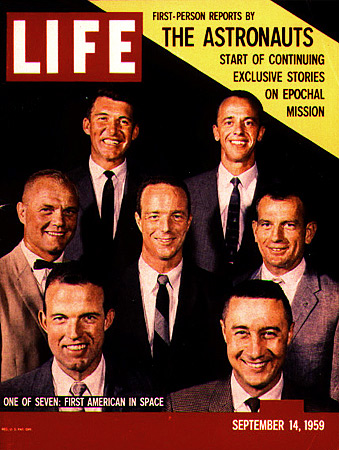
 ...as President Lyndon Johnson stands on a flag-draped stage and welcomes the seven Mercury astronauts to an out-sized barbecue in Houston--the new home for the Manned Space Center, as well as the astronauts and their families. Their homes, their furnishings are all paid for by the Houston developers who are benefiting from Johnson's earmarks. The Mercury 7 are living the good life, while the Man who Broke the Sound Barrier makes a run for space.
 Both these incidents happened and are mentioned in Wolfe's book, but they took place months apart, while Kaufman has them happening simultaneously. To what purpose will become clear later, but in the meantime, we follow Yeager (
 And in one spectacular shot, we see space bend and warp as we approach the feathery layer of a cloud-ceiling, then go through it...
 ...and the picture fades to an incident from that barbecue--an odd detail that Wolfe found funny and sad and a bit pathetic, but Kaufman turns into visual poetry. For some reason, the Houston event organizers chose as one of the entertainers stripper
  But Kaufman takes that incident and marries it with a running theme throughout the film. The Moon has been a beckoning image throughout The Right Stuff, and now, as the clouds that Yeagher is punching through become the delicate feathers of Sally Rand's fans, she dances to an orchestral version of the melancholy "
 Kaufman stays on his images of empty space and feathers and lights, then to shots of the astronauts and their wives reacting to the irrelevance and embarrassment of it all. And then, something strange happens....
 ...and Shepard's not even watching the stage-show. He's lost in thought...
 ...as is
  Glenn turns to look at
  ...who is already looking at him.
 Grissom turns and looks at his buddy,
  ...who is his usual grinning self, but he's subdued. We transition back to Sally Rand...
 ... and a blaze of kleig-lights to Yeager trying to "punch a hole in the sky."
 Yeager reaches top altitude, then his engines give out and he's given one tantalizing glimpse of the stars in space...

 ...before his fighter-jet begins to rapidly tumble back to Earth.
 Unable to bring it under control, Yeager makes a fiery ejection...
 ...and Kaufman holds on him--trailing smoke, because as we'll see his helmet is on fire--and we watch his long, long fall through space as he tumbles through the silence--a modern Icarus...


 ...who disappears into the clouds.
 The clouds fade back to the feathers of Sally Rand.
 ...and to the astronauts, who are somewhere else.

 Glenn, on edge, looks to Grissom and Cooper...
 Grissom is wary...
 Cooper, head bowed, tentatively looks up...
 as does Slayton...
 And Shepard cranes his gaze to the ceiling...
 We transition to Sally Rand, and on the soundtrack we hear a distant boom.
 With a hard cut, we're back in the California desert.
 Reverse angle to an ambulance approaching in the shimmering desert heat.
 The driver points ahead "Sir? Is that a man?"
 Amid the smoke and heat-waves, a silvery shape emerges.
 "Yeah," says Ridley (
 As the music swells, Yeager carrying his parachute, his face burned, but still chewing gum, approaches the ambulance.
 Yeah. You bet it is. It's great film-making, too. And a brilliant sequence by Kaufman that shuffles real time a little, but makes a point about the competitiveness of air-men, giving way to a brotherhood. All of the men in the sequence have competed with each other as well as Yeager to be "at the top of the ol' pyramid," going faster and higher than any person before. The astronauts were test-pilots competing with Yeager, then signed on to become astronauts, "spam in a can" in the test-pilots' jargon, achieving a fame Yeager never would...until Wolfe's book...and this movie