Showing posts with label Judy Garland. Show all posts

Thursday, November 3, 2022

The Wizard of Oz (1939)

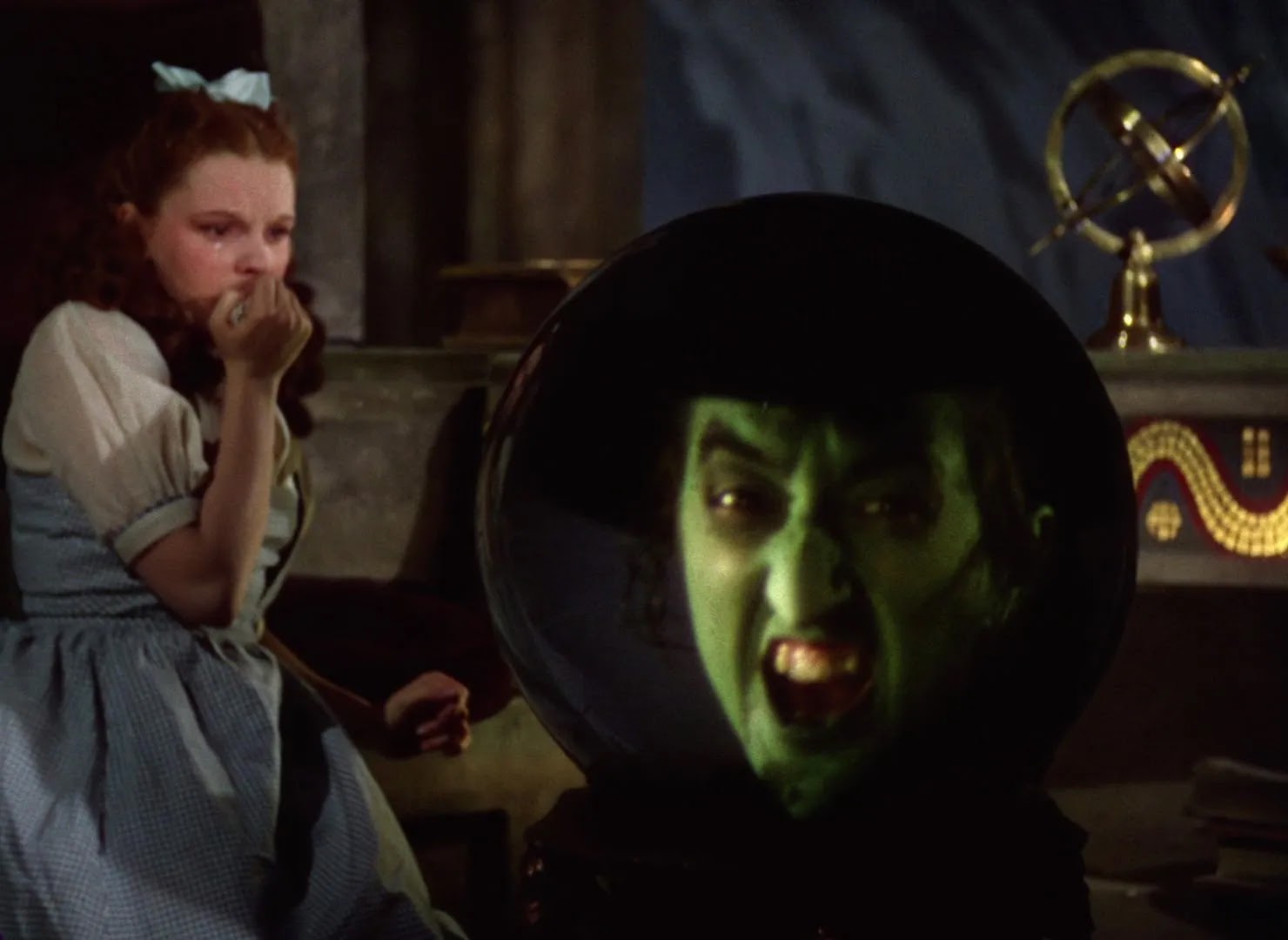
The Wizard of Oz (Victor Fleming, Richard Thorpe, Mervyn LeRoy, George Cukor, Norman Taurog, King Vidor, 1939) It was designed to be M-G-M's "prestige" picture of 1939—a concept inspired by Irving Thalberg as a production intended to show off the studio at its best, rather than to turn a profit. 
 
Those aspects would be creative, as far as music and dance numbers (for which the studio was renowned) and script (constructed by some of the best and brightest scribes*), technical for photography (employing both black and white AND Technicolor cinematography), costumes, make-up, and special photographic effects, both practical—on-set—and optical. The film had little star power—young M-G-M contract player Judy Garland was hired for the lead, and the cast was filled out with vaudevillians, comedians and character actors under contract.

And "Toto", too.

Although the Wisdom of the Tribe maintains the rumor that the movie was a financial flop, it actually did very good—and very brisk—business. It's only when you look at the studio ledger sheets that the movie seems to have faltered, having lost $1,145,000 in its initial run, but merely because the cost of producing the picture was so high. It was, after all, designed for prestige, not for profit.
Even if the film is not regarded a financial success (it is, but let's just suppose that it isn't), it is well-regarded a success in hearts and minds, and one of those rare movies that is only grudgingly (and curmudgeonly) besmirched by negative opinions. More people have seen The Wizard of Oz than any other movie, according to The Library of Congress, and the LOC voted The Wizard of Oz into the initial batch of 25 films selected for The National Film Registry.
So, why talk about this today? Well, the first television broadcast of The Wizard of Oz was on November 3, 1956 (66 years ago), when 45 million Americans tuned into the last episode of the "Ford Star Jubilee" on CBS. Yes, it was broadcast in color—Ford Motor Company could afford it—but very few people had color television sets, so that wondrous transition between sepia tones to neon Technicolor must have looked pretty unimpressive. Still, television is where most of us caught up with The Wizard of Oz in our youth, whether it was on CBS, NBC, the WB or any of the Turner Network stations. Some of us even remember it being a yearly ritual during the Holidays—the one time in the year (before home video re-wrote the studio monopolies) when you could catch that favorite film...with commercials, of course. When The Wizard of Oz was on television, it was a special day, indeed.
That's a pretty impressive reputation. More people have seen The Wizard of Oz than any other movie—despite what the Top Ten box-office receipts say. What is its appeal? Well, there's "Over the Rainbow" (which was nearly cut because it was a "pace-killer"), that spectacular tornado sequence, the various guilds of Munchkinland. It seems like every kid was creeped out by the flying monkeys—even Captain "I get that reference!" America (whereas I was scared by the hourglass and the Wicked Witch replacing Auntie Em in the crystal ball). There are the delights of the "If I Only Had a Brain/Heart" and the (darkly celebratory) "Ding! Dong! The Witch is Dead!" songs. The great lines that infiltrate our shared culture—"Toto, I don't think we're in Kansas anymore!" "There's no place like home" "Lions and tigers and bears! Oh my!" "What a world! What a world!" "Put 'em up! Put 'em uuup!" "Follow the yellow brick road!" "Pay no attention to that man behind the curtain!" "I'll get you, my pretty! And your little dog, too!" "Surrender, Dorothy!" 
There are those eye-popping ruby slippers that fetch kings' ransoms at auctions. The truly scary visage of The Great and Powerful Oz phantasming through fire and smoke. The childish Suessian zing of "We're off to see the Wizard/The Wonderful Wizard of Oz/He is, he is a whiz of a Wiz/If ever a Wiz there was." Those things lie sleeping in our deep alligator-brains alongside breathing and hunger pangs.

The movie is critic-proof***, which puts it right in the hallowed land for "deep" analysis. There's no questioning if it's "any good." There's just the spelunking for nuggets of themes and meanings, the exploring of a movie's sub-conscious, exposing more of what's on the mind of the seeing than the seen. So, no throwing water on it as it's stronger than the cotton candy fluff its disparagers say it is and it's good. Good enough to glow emerald in a cynical world with little chance of it dimming no matter how dark the landscape gets.**
One could say that the section in Oz is all the result of a post-concussive fever dream, or an attempt by Dorothy's unconscious to balance the mind-pre-occupying travails on the plains by utilizing what she knows—the farm-hands, nature, her own instincts and impulses—to realign things to again make her home a place of sanctuary and safety. Freud would have had a field-day with it (and might have as Polly McCormick's essay on "The Uncanny" spells out), but The Wizard of Oz defies analysis, psychoanalysis, and whatever currently fashionable disciplines in its ability to dramatize its lesson that, yes, you can wish for a place over the rainbow, but you'd better learn to appreciate what you have before you tornado off to something bright and shiny. Be grateful in the now. So, you can be so in the future. That's a great and sophisticated lesson and one that gets lost in the humming drum of life.
Cynicism aside, The Wizard of Oz still shines. In fact, it's glowingly evergreen, surviving unsullied while the world around it changes.
In the 1960's when the populace was compelled to no longer disregard race, one couldn't help but notice that the 1939 version was incessantly white, so some brilliant artists transmogrified it into "The Wiz" and...nothing changed (merely the cosmetics).**** In 1995, with the world seeming less black-and-white and more dialectic, Gregory Maguire reverse-engineered the story to consider motive and we got "Wicked"—the book, the Broadway musical, the upcoming film—and nothing much changed, merely the perspective. The movie even resists "improvement": when the brilliant Walter Murch went back to the book's roots to make Return to Oz—making Dorothy closer in age to Baum's and her companions less anthropomorphic—he made a wonderful tribute, but audiences stayed away, perhaps because Murch went so far afield of the '39 zeitgeist, or maybe because he couldn't compensate for the cult of personality around Garland, Bolger, Haley, and Lahr (Oh my).
But, the artistic success and legacy of The Wizard of Oz is not just about them. It has a lot to do with L. Frank Baum, who looked for an alternative to the European fairy tales and the ghastliness of Grimm, and chose, instead, to make America's "first great fairy tale" written at the cusp between the agrarian and the industrial ages, of surviving in a New World with new challenges, channeling his own desire to balance work and home-life and seeking to create (as he wrote in the first book's note to his readers) "a modernized fairy tale, in which the wonderment and joy are retained and the heart-aches and nightmares are left out." Or, at least, understood and overcome.
The MGM wizards had the talent and ingenuity to present Baum's home-spun homiletic fantasy in the language that they knew best to bring it to startling light and still retain those core values and re-emphasize certain truths: that pluck and empathy and intelligence are just as powerful as magic, that we all have gifts we don't realize we have (or deny) and that things are black and white in Kansas.
 
There's no place like The Wizard of Oz.

* Ogden Nash contributed to the script and Herman J. Mankiewicz, the author of Citizen Kane had it long enough to have his idea of transitioning from black-and-white Kansas to technicolor Oz retained.

** This item from IMDB: "Rick Polito of the "Marin Independent Journal" in Northern California is locally famous for his droll, single-sentence summations of television programs and movies which the newspaper reports will be broadcast. For this film he wrote, 'Transported to a surreal landscape, a young girl kills the first person she meets and then teams up with three strangers to kill again.'"
 
**** here's a good quote: Stephen Sondheim was asked what his favorite Broadway show was (that he hadn't written) he answered "The Wiz": "Because it's the one show which makes you feel better when you come out of it than you did when you walked in."
 
The inspiration and several yellow bricks for this piece came from a sterling documentary by Tracy Heather Strain and Randall MacLowery called "American Oz" for the PBS series "The American Experience" (which, I've provided below—for instructional purposes only—for however long it's allowed to last). 
 
My childhood—and my love for movies—was enhanced by seeing The Wizard of Oz every year at Thanksgiving. After six decades or so, I'm still grateful.
***CinemaSins clocked only 51 sins associated with The Wizard of Oz (Spoilers...(duh))


Tuesday, April 17, 2018

Judgment at Nuremberg

Judgment at Nuremberg (Stanley Kramer, 1961) It was Katharine Hepburn who shepherded this film from its origins as an episode of "Playhouse 90"* to this version as a three hour epic.** The movie is padded with shots of Spencer Tracy touring the city (still in rubble in 1960, twelve years after the judges trials at Nuremberg***), and background of the characters, including a chaste meeting of minds with a Nazi widow (Marlene Dietrich, still oozing mystery at the age of 60). Screenwriter Abby Mann makes the citizenry complicit in his expanded screenplay, despite their protestations of ignorance. And the military at the time of the trial was in the middle of the Berlin Airlift, their attention now turned to "the Bolsheviks" and cozying up to Germany for strategic advantage, casting the worth and even the result of the trial in question for political expediency. The movie is allowed much more cynicism than the Playhouse 90 broadcast, where the words "gas chambers" were subject to censorship by sponsor The American Gas Association.
The movie threatens to swamp itself with star-power but leavened it by Tracy disappearing into his role. Maximilian Schell repeats his television performance (winning an Oscar in the process, as did Mann for his adaptation). Of the newcomers, the best performances are Montgomery Clift in face and body language denoting a characters damaged by the brutality of the Nazi regime. And Judy Garland, who'd always seemed like a raw nerve in her films, acts merely from the neck up—and that's all that's required. Not as controlled are Richard Widmark, whose prosecutor is a bit too demonstrative in private for a courtroom strategist, and Burt Lancaster, given a great speech but, a weakness of the actor, aware of it. Laurence Olivier was intended to play German Ernst Janning, but dropped out. I'm not sure that would have been an improvement, but it would have been interesting.
Kramer struggles with the material; he would later become an expert on courtroom directing. But here, he's more intent on making the drama look interesting with camera moves by circling witnesses and, most egregiously, using a fast zoom to zero in on a dramatic moment. It's used sparingly, but even that's too much for the material. He would learn to trust his actors and inherent drama of the scene to carry it.
But, Judgement at Nuremberg manages to be something that eludes most Kramer films—it's a bit more timeless, especially in regards to the short-sightedness of chipping away at bedrock principles for today's political viability and the future's further erosion. One could be speaking of water boarding as torture in Abby Mann's summation speech.
****
Read it. Read the whole thing. But linger on the words after the picture below.

Judge Haywood: The trial conducted before this Tribunal began over eight months ago. The record of evidence is more than ten thousand pages long, and final arguments of counsel have been concluded.

Simple murders and atrocities do not constitute the gravamen of the charges in this indictment. Rather, the charge is that of conscious participation in a nationwide, government organized system of cruelty and injustice in violation of every moral and legal principle known to all civilized nations. The Tribunal has carefully studied the record and found therein abundant evidence to support beyond a reasonable doubt the charges against these defendants.


Herr Rolfe, in his very skillful defense, has asserted that there are others who must share the ultimate responsibility for what happened here in Germany. There is truth in this. The real complaining party at the bar in this courtroom is civilization. But the Tribunal does say that the men in the dock are responsible for their actions, men who sat in black robes in judgment on other men, men who took part in the enactment of laws and decrees, the purpose of which was the extermination of humans beings, men who in executive positions actively participated in the enforcement of these laws -- illegal even under German law. The principle of criminal law in every civilized society has this in common: Any person who sways another to commit murder, any person who furnishes the lethal weapon for the purpose of the crime, any person who is an accessory to the crime -- is guilty.

Herr Rolfe further asserts that the defendant, Janning, was an extraordinary jurist and acted in what he thought was the best interest of this country. There is truth in this also. Janning, to be sure, is a tragic figure. We believe he loathed the evil he did. But compassion for the present torture of his soul must not beget forgetfulness of the torture and the death of millions by the Government of which he was a part. Janning's record and his fate illuminate the most shattering truth that has emerged from this trial: If he and all of the other defendants had been degraded perverts, if all of the leaders of the Third Reich had been sadistic monsters and maniacs, then these events would have no more moral significance than an earthquake, or any other natural catastrophe. But this trial has shown that under a national crisis, ordinary -- even able and extraordinary -- men can delude themselves into the commission of crimes so vast and heinous that they beggar the imagination. No one who has sat at through trial can ever forget them: men sterilized because of political belief; a mockery made of friendship and faith; the murder of children. How easily it can happen.
There are those in our own country too who today speak of the "protection of country" -- of "survival." A decision must be made in the life of every nation at the very moment when the grasp of the enemy is at its throat. Then, it seems that the only way to survive is to use the means of the enemy, to rest survival upon what is expedient -- to look the other way.

Well, the answer to that is "survival as what?" A country isn't a rock. It's not an extension of one's self. It's what it stands for. It's what it stands for when standing for something is the most difficult!

Before the people of the world, let it now be noted that here, in our decision, this is what we stand for: justice, truth, and the value of a single human being.


* if you want to see it, it is here. 
 
** Probably to give her love and paramour Spencer Tracy another plumb acting role. His health (owing to his tendency to drink to excess) was always improved when he was working.

*** Although shots of Richard Widmark driving through the city are obvious process shots.

**** William Shatner's sitting in front of Tracy. Tracy was Shatner's hero and when he saw Tracy do the speech in one take, he blurted "I didn't know film actors could DO that!" Tracy shunned him for the rest of the shoot.