This was written at the time of the film's release....ten years ago (don't expect a card...)
 "Heavin' Steven"
or
"Asshole! Can You Stop Blowing Things Up for Two Seconds and Move the Camera?"
J.J. Abrams already had told you what this film would be with his first teaser-trailer and before anyone knew he was working on it.* That first teaser had all the candy-smudged fingerprints of Steven Spielberg's Close Encounters of the Third Kind (by way of Jaws) through it...with a noticeable twist—the utility vehicle that looks so much like Roy Neary's from that film drives onto some railroad tracks and crashes into a train causing a massive derailment, and the freeing of...something. Something that goes crash-bang-boom in the night. And won't take the time to let you complete five notes of Zoltán Kodály's musical hand-signs.
Super 8 is very clearly a Spielberg homage: the kid-centric cast of fresh faces; the swooping crane shots making parabolas before reaching for the high vantage point; the big faces turning toward the camera; the empty sky shots that are just waiting for something to fill them; the overlapping dialog; the hiring of local yokels for "color"; the slow reveals—things that make a lot of damage before we really see anything; the dysfunctional families; the ostracized pint-sizers and geeks; the showman's brio of opening the curtain just a little...then closing it...again and again and again.**
 Abrams is doing an homage to Spielberg (even got him to produce it), but it's still his movie, more so than, say, Tobe Hooper imprinted Poltergeist. If anything, this one is a little more polished (than MI:III and Star Trek [2009]) because it's trying to ape Spielberg—there's more technique and less hitting the camera for jitters' sake, like the movie was on a perpetual coffee-jag—even if the film purposefully, deliberately simulates 1970's film-grain and anamorphic lens-flares (that actually get irritating after awhile). But, the tone is more Abrams. If I can use a culinary metaphor, Spielberg's early run was like a sweet-and-sour dish at a family-friendly Asian restaurant; Abrams gooses everything up a couple spice-stars flipping the ratio between action and characterization (there's more of the latter than the former)—the action a bit grittier, the emotions a might more painful and the pangs a bit more heart-felt.
 For one thing, Abrams likes girls. And by that I mean that he knows how to write for them. For all the time that he spent contemplating the heavens, the boy-filmmaker Spielberg did not understand that men and women come from different planets.*** Spielberg's women (in his early films) were tom-boys with girl-clothes, or icons that the men-folk didn't/couldn't fathom. Here, the women are people (when they're allowed to be more than caricatures—the older sister, played by AJ Michalka, doesn't much rise above "petulant teen" mode). Elle Fanning's Alice Dainard feels like a real-life human being, her emotions raw and just under the surface. It's no wonder Joe Lamb (Joel Courtney), the hero of the piece, is obsessed with her, beyond the fact that they're both motherless children with absent fathers (Ron Eldard, as a guilt-ridden alcoholic, and the great Kyle Chandler as Joe's Deputy Dad). Of course, they gravitate to each other—they're both dependable people in undependable worlds.
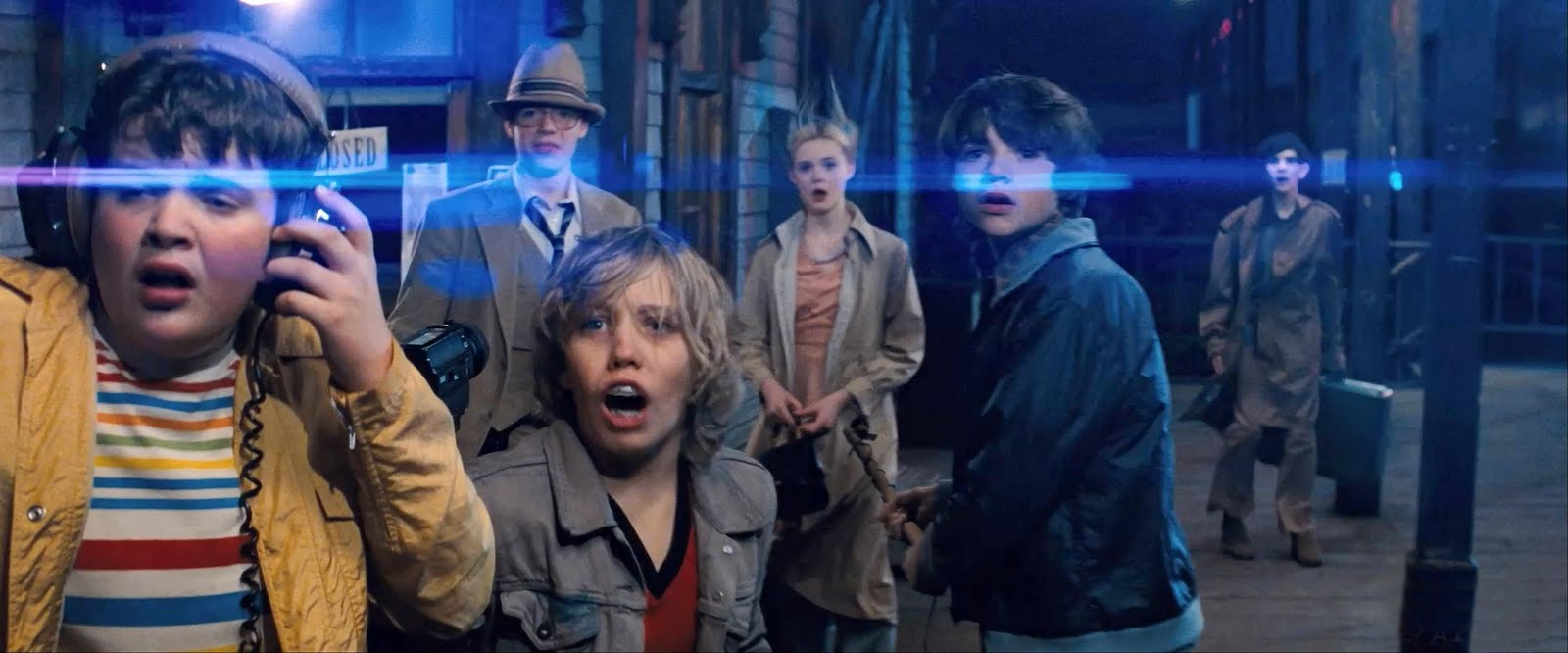
  They meet—well, they already know each other by reputation from school—because baby-Orson Welles Charlie Kaznyk (Riley Griffiths) is making a Super-8 zombie movie for a an amateur film competition. Joe's half the crew, and Charlie has cast Alice as the dutiful "wife" of a zombie investigator (wonder where they train for that). During a night-time shoot at a far-flung railway station, the kids are witness to, and almost victims of, the spectacular train-crash—of the teaser—caused by a truck travelling the tracks to deliberately de-rail it. The sequence goes on a bit too long, but it is a "Holy Crap!" inducing spectacular where, despite the CGI that was certainly involved you worry for the young actors dodging the fireballs and sizable debris hurtling through the frame. Abrams is a bit more visceral that Spielberg was, and has a cruel way of making sure you glimpse everything while not letting up the pace. He also keeps the reveal of the "thing" as delayed as possible, exposing only bits and pieces, various debris-fields and the governmental cover-up feint that insures we go through the bulk of the film's progress without knowing exactly what in Ohio is going on.****
 All for the better. With all the manic mayhem Abrams dishes out, the focus is more on the people caught in the web of circumstance than in the BEM behind it all—in that, Abrams has more in common with M. Night Shyamalan (specifically Signs, where it seemed apparent the writer-director didn't give a Sixth Sense about what the aliens were like, so much as what the humans were going through). This leads to a rushed finale where through some E.T. like-symbiosis the kids and the "creature" (oh, let's call him a "Horta," shall we?) come to a meeting of minds and a mutual focusing of priorities. Both must find "home," and both get there a might too hurriedly and conveniently.
 Still, Abrams, despite truncating any deeply emotional pay-off in his ending, does manage to stay focused on what's important—the holding-on and the letting-go. If Super 8 isn't as moving in its consummation as its inspirations were, at least it reminds us—as the whole exercise set out to do—of how rich they were and how their power should not be overlooked or taken for granted.
*

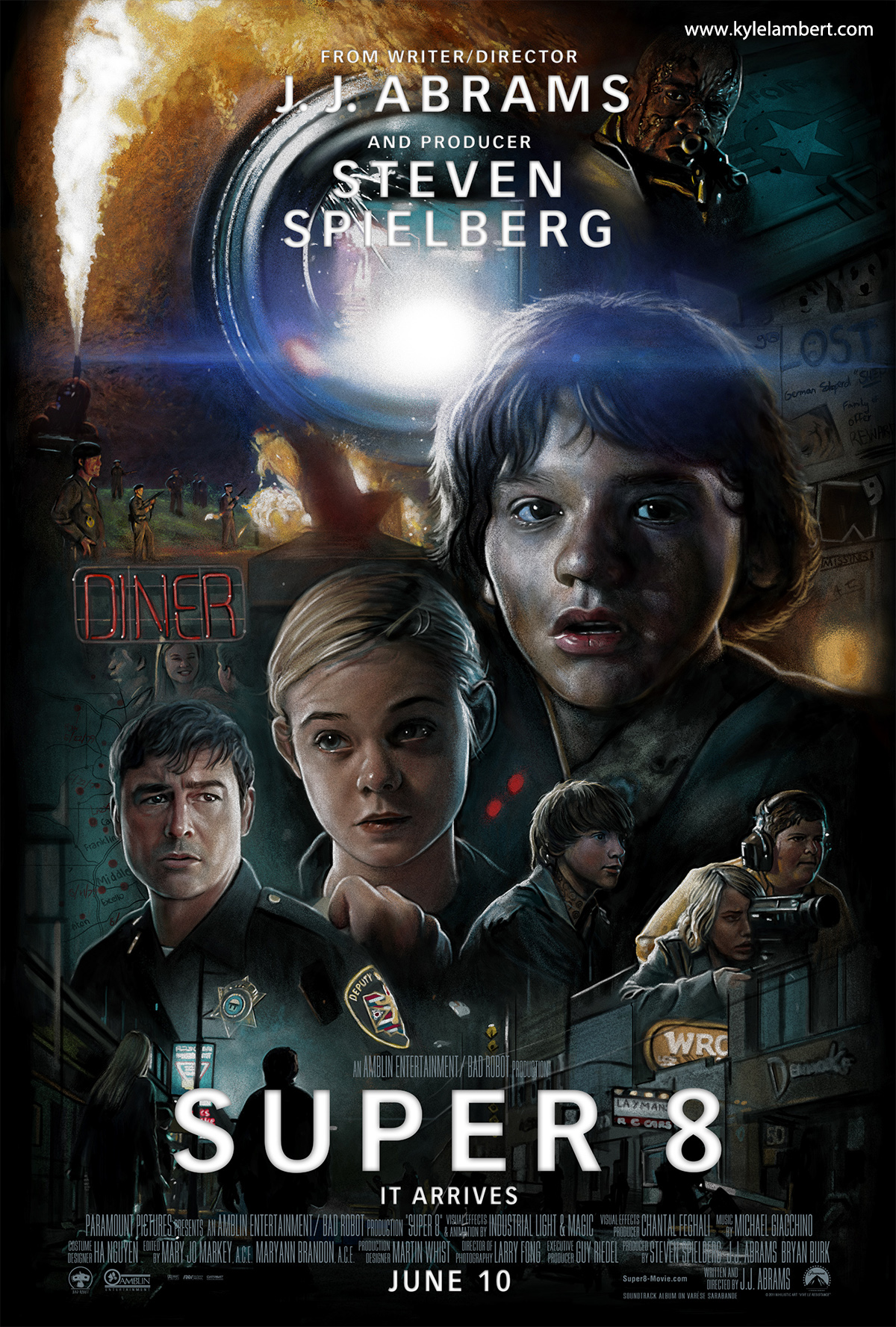
or
"Asshole! Can You Stop Blowing Things Up for Two Seconds and Move the Camera?"
J.J. Abrams already had told you what this film would be with his first teaser-trailer and before anyone knew he was working on it.* That first teaser had all the candy-smudged fingerprints of Steven Spielberg's Close Encounters of the Third Kind (by way of Jaws) through it...with a noticeable twist—the utility vehicle that looks so much like Roy Neary's from that film drives onto some railroad tracks and crashes into a train causing a massive derailment, and the freeing of...something. Something that goes crash-bang-boom in the night. And won't take the time to let you complete five notes of Zoltán Kodály's musical hand-signs.
Super 8 is very clearly a Spielberg homage: the kid-centric cast of fresh faces; the swooping crane shots making parabolas before reaching for the high vantage point; the big faces turning toward the camera; the empty sky shots that are just waiting for something to fill them; the overlapping dialog; the hiring of local yokels for "color"; the slow reveals—things that make a lot of damage before we really see anything; the dysfunctional families; the ostracized pint-sizers and geeks; the showman's brio of opening the curtain just a little...then closing it...again and again and again.**




** He missed one thing, though: the opening shot along a fence of some kind.
*** The funny thing is (if I can be gossipy for a moment) is that Spielberg didn't fully grasp women until he'd worked with his present wife Kate Capshaw, who gives one of the most irritating performances of any woman in his films in Indiana Jones and the Temple of Doom.
**** At one point, I thought it was going to turn into a "giant spider" movie.