Showing posts sorted by relevance for query Robinson Crusoe. Sort by date Show all posts

Tuesday, October 13, 2015

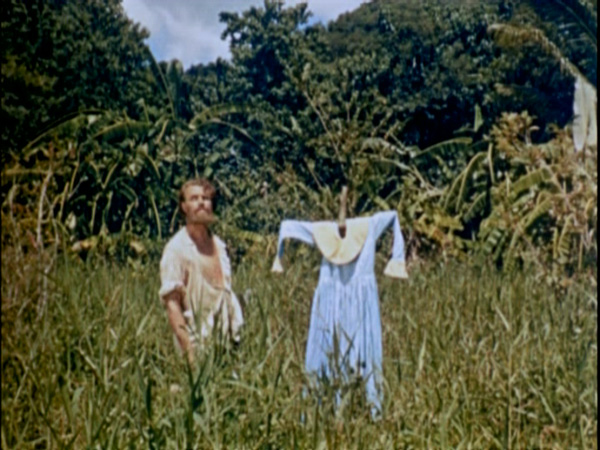
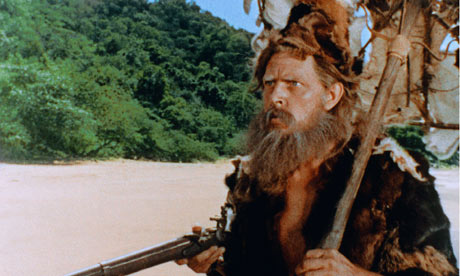
The Adventures of Robinson Crusoe (1954)

The Adventures of Robinson Crusoe (Luis Buñuel, 1954) This is another of those films that seems to be remade every few years (the attraction of the property being in the public domain is irresistible), but it would be tough from an overall perspective to improve on Bunuel's English language version (which was also made in the director's native Spanish) from 1954.

The story is familiar to everyone (it's been around since 1719)—of the British sailor who is stranded on an island after his ship is wrecked and must eke out an existence there without hope of rescue, despite his lack of experience taking care of himself.  Also, there is the man "Friday," who eventually becomes his companion on the island, leading to the "noble savage" mythology that is trucked around whenever somebody wants to point to relative "worth's" of races within the humanoid one.  

But, Buñuel, one of the peskiest of directors has nothing to do with all that, and the surrealist—and realist—in him, takes this Robinson Crusoe to some little-known parts of the island in this version of the adventure.  For example, Robinson Crusoe is on that ship as part of his work as a slave-trader, its wrecking serving as some kind of retribution for its business, and his exile a learning experience for what it is like for a man to have no choices in the world.
 
Crusoe is able to swim back to the ship to get a good amount of supplies before it finally succumbs to the sea, and manages to rescue a cat, Sam, from the wreckage. Once back on his island, with a raft so piled with supplies that it must have been in constant danger of sinking, he finds the Captain's dog, Rex, has also survived and made it to land. With that troika of inhabitants comes the most interesting part of the film, where Crusoe explores the island, sets up fire-stations in case a ship should sail by, hunts game, starts to raise livestock from the wild goats that live on the island, builds a walled compound around a make-shift cave where he lives. When he runs out of bread from the ship, he starts to raise wheat and grain and makes his own. A rescued bible provides study, and he even takes up pottery.  He has a lot of time and quite a bit of resources.
Years go by. Rex dies of natural causes, and Crusoe keeps to his daily routine, living well if eccentric in his ways, until one day he notices that his island has been invaded by cannibals. Being so industrious, you'd expect him to maybe start a small business, given the new source of traffic, but, instead he manages to rescue one of the intended victims and names him "Friday"* (Jaime Fernández) after the day of the week on which they met (Crusoe has an elaborate calendar).
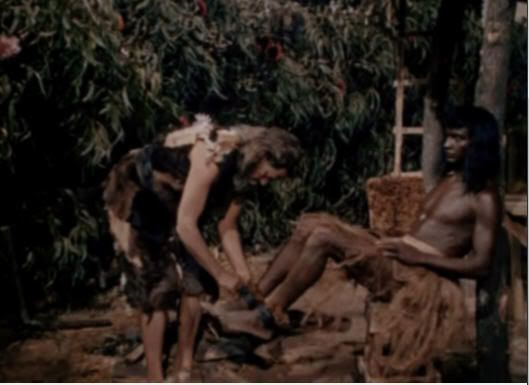
Not sure of Friday's eating habits, Crusoe returns to his old ways and puts the native under metal restraints that he carried over with him from the slave ship. Before long, he learns to trust the man, and one begins to wonder what the hierarchy between them is. The native is "Friday." Crusoe is, disquietingly, "Master." When Friday is barbering Crusoe's hair and the voice-over says it was a sublime time on the island, one is about to protest, when he gets up, the two exchange places and the former slaver cuts Friday's hair in reciprocity. Buñuel, you crafty old Marxist. "We found that two working together could do much more than working separately." We won't spoil the part where Crusoe and Friday debate the Bible.

And as far as surrealism, the closest Buñuel comes to it is in a Crusoe fever-dream, where he is warned by his father (also played by O'Herlihy) never to stray from his native land (Buñuel, a Spaniard was living in Mexico City at the time, after spending a few years in the United States) with the sequence inter-cut with shots of the father (or is it an elderly Crusoe) drowning.

O'Herlihy is mostly known for his later career of playing ancient, menacing autocrats, but here he is a revelation, and it is, frankly, amazing that the film had enough attention that he was nominated for a Best Actor Oscar, the same year as Bogart for The Caine Mutiny, Bing Crosby for The Country Girl (an amazing performance, that), James Mason in A Star is Born, and the winner, Marlon Brando for On the Waterfront. Tough year.

It's interesting to note that Robinson Crusoe on Mars has a release in the Criterion Collection (not to quibble, I regard RCOM fondly), but this adult-oriented family film by one of the great directors of the 20th century is not.

*But, not T.G.I. Friday, because that would be something of a sick joke that nobody'd get until they invented shopping malls.

Wednesday, July 23, 2014

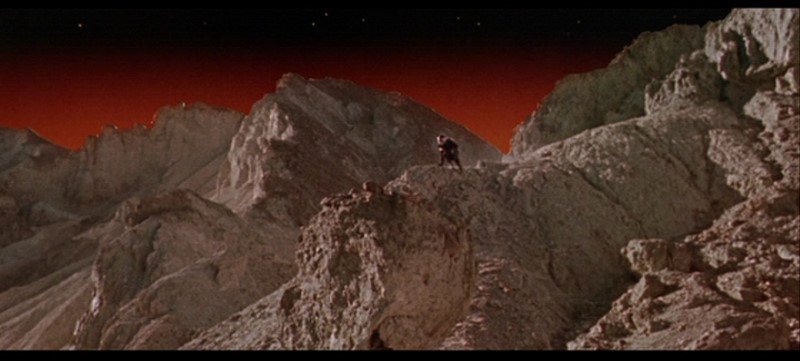
Robinson Crusoe on Mars

Robinson Crusoe on Mars (Byron Haskin, 1964) "This Film is Scientifically Accurate!" screamed the poster. "It is only one step ahead of present reality!" If "present reality" means ignorance about conditions on Mars, then one has to agree.  One might go so far as the opposite side of the orbit as to say Robinson Crusoe on Mars is more fantasy than science fiction.

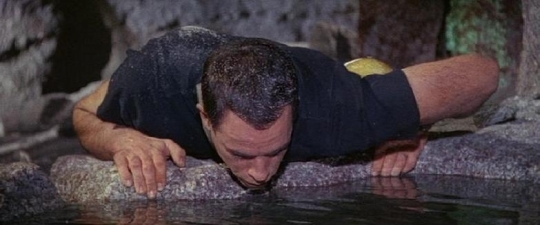
But, I still love it, with the same affection I had for it when I first saw it on some TV movie matinee show in the late 60's.*  Taking Daniel Defoe's classic story and putting it in the space realm wasn't much of a stretch, but what the filmmakers did with it made it an ingenious adventure film, full of obstacles that the lone survivor of a mission to Mars must overcome in order to last more than the 60 hours his air supply will allow in the too-thin Martian atmosphere.  With his mother-ship (out of fuel due to maneuvers to avoid "an unidentified mass") circling enticingly out of reach in orbit, Commander Kit Draper (Paul Mantee) must eke out an existence with anything the Martian surface can provide, even though it has all the appearance of a dead rock with volcanic activity. With the aid of a "mascot" monkey named Mona,** Draper is able to find sources for air, water and food, enough that the isolation on Mars starts wreaking havoc on his psyche. Be careful what you wish for, because soon he's being buzzed by creepily moving, thrumming spacecraft (looking suspiciously like the floating Martian craft from The War of the Worlds). ***
The director was special effects wizard/cinematographer Byron Haskin, who was a fine adventure director, helming that 1950's era The War of the Worlds, Disney's classic version of Treasure Island, From the Earth to the Moon, and many of the better episodes of "The Outer Limits." The man had a way of grounding the most fantastic of concepts to something that felt real, but his alien ideas always seemed sleek and properly "out-of-this world." And he knew how to keep things moving, with new surprises around every papier mache escarpment.
Particular praise must go to actor Paul Manteewho looks like he could have been one of the Mercury 7 astronauts, short, wiry, and with rugged features that made him no candidate for matinee idolatry—as for the majority of time RCOM is a one-man show. This sort of science-fiction story could easily be played for camp (and for that, see Mantee's unfortunate co-pilot, Adam West), but Mantee's low-key performance—an extended monologue with recorded soliloquies—never strays into that territory, even when an escaped slave from those pesky spacecraft shows up to serve the purpose of "the man Friday." Mantee would go on to make a career in television, and pop up in episodes of many dramas (and the occasional comedy), sometimes playing more than one character over the course of their runs—and had a recurring role on "Cagney and Lacey." A jouneyman actor with features that could be of a villain or a tough guy, he's one of those character actors you could depend on to "blend," and even excel when the need arose. Like shouldering an entire science fiction film and keeping it from spinning out of orbit. Mantee (and "Friday" actor Victor Lundin) did a commentary track for the Criterion release.  I'll have to give that one a listen.
* I estimate it to be 1966-1967.  The reason I watched it is that Adam West (then TV's "Batman") had a small role in it, barely a cameo, really.  Despite the actor's lack of presence, I was captivated by the film.

** It is, basically, a "kids'" film, as the makers regularly do "insert" shots of Mona to reassure us that the monkey is doing just fine. 

*** Thanks to some very intricate gap-editing tricks.

Thursday, October 15, 2015

The Martian (2015)

Robinson Crusoe on Mars (the Reboot)
or
"I'm Going to 'Science' the Shit Out of This"

Matt Damon is marooned on an alien planet for his second film in a row in The Martian (based on the best-seller by Andy Weir) and directed by Ridley Scott. And, as befitting castaway movies, an efficient little movie it is, setting up the circumstances for the film in the first ten minutes as an astronaut on a Mars mission is left stranded on the angry red planet with no hope of rescue for at least four years. There's no hope that his crew can come back and get him because in space, no one can hear you say "Can we turn this bus around?" And even if you could, space mechanics (despite Star's Wars and Trek) and Newtonian physics would prevent you unless a significant body with significant gravity could help you turn your bee-line into a 180.

Like its themic progenitor Robinson Crusoe on Mars (which trumpeted on its posters "This film is scientifically authentic...it is only one step ahead of current reality!"), the film is only a few years from what is possible, given political and budgetary will.  There are scientific lapses—the gravity is wrong, for one thing, people walk with the same gait as they do on Earth, objects fall with the weight of Earth gravity, not the roughly 1/3 gravity as would be experienced on Mars (by contrast the moon has half of that—1/6th—so Mars walking would be less galumphy than on our satellite, but still less oppressive than Earth). It just goes to show the moon-landing deniers that, even with the sophisticated special effects of today, it would still be damned difficult to fake something that would pass photographic scrutiny (if they had a mind to accept it).
The crew of the Ares abandons ship and one astronaut...in a dust-storm.
But, back to the movie...there's no getting around it that unless his buddies can get around something, Damon's character, Mark Watney, space botanist, is going to have a long wait, so he decides to hunker down and find a way to have enough oxygen, enough water, enough pressure, enough food, and some form of communication for four long years before he can get off the rock...and he'll have to make an endurance-testing planet trip in order to get to that next landing site. As he puts it, he's going to have to "science the shit out of it" if he is going to survive the long wait.
"So that's why they called it 'Lonely Planet'..."
To the crew of the homeward-bound Ares III and NASA, Watney is dead, killed by a careening communications dish that goes off its bearings in a Mars-storm. That same accident cuts off all communications with Earth from the surface, so Watney is essentially marooned without help or aid. He takes stock—the mission was cut short and it was a mission for six—and sets up a rationing schedule for how long he can make the meals last and comes to the conclusion quickly that he's going to run out of food if he's there for as long as he suspects, given the next landing. So, as he relates in his running log—probably the worst viewed YouTube channel in history—he decides that he's going to re-purpose part of his "HAB Alone" into a greenhouse in order to grow potatoes. He's a botanist, for crying out loud, and, as one of his crew-mates (the now ubiquitous Michael Peña puts it) "it's not science."
How he does so is so damned clever that you're willing to go along with Watney no matter what lame-brained scheme he may come up with along the way. He walls off a large section of the HAB enclosing it in plastic creating a greenhouse. He goes out and digs a considerable amount of Martian soil (which can't grow anything), fertilizes it with the freeze-dried waste of his fellow astronauts and sets up a reliably wet, tepid atmosphere for hydration by taking oxygen (which he has) and hydrogen (which he has) and burning it (which he can, verrry carefully) to create water, nearly blowing himself up in the process.
But the fundamentals work. Soon he has a crop of burgeoning potato plants that, if he doesn't binge, will get him to the next landing time. Good enough. Now, he sets himself up with two more problems: communication, and outfitting his rover for an extended journey which he will eventually have to take to get him to a landing spot 400 kilometers away—a distance far beyond the rover's battery life or environmental systems. Fortunately, there's some stuff he might be able to use.
Meanwhile, back on Earth, they're starting to notice something. There's an orbiter circling Mars taking shots of the Martian surface, and the wonks at Mission Control are starting to notice something peculiar. The crew has abandoned the Ares habitation module and there's supposedly no one left alive. So, who's moving things around? Why has the rover shifted position from one series of shots to another after the Ares has taken off? In lieu of shy "driver's permit"-carrying creatures that the cameras and instruments haven't detected yet, there comes the immediate suspicion that the announced-dead Watney may have survived. Inconvenient, as they've already had the funeral. "Uh, remember that astronaut we left for dead on Mars? Well, we were half right when we told you that. We left him, but he isn't dead. Our bad."

As Watney puts it on his video log: "Sur-priiise!"
It's at this point that the usually dour Ridley Scott has his moment to be the curmudgeon that he usually is. A wonk (Mackenzie Davis) sees the shifts, reports it to Mission Director Vincent Kapoor (Kapoor? He's played by Chiwetel Ejiofor!*), who then reports it to NASA Director Ted Sanders (Jeff Daniels) and Annie Montrose (Kristen Wiig), Director of Media Relations, who say "It took so long to take it up the chain of command, he's dead by now!" Well, no, they don't say that, they say "Don't let this get out. Don't tell the crew. Don't tell anybody until we're sure of our facts" which is NASA-speak for "we don't have a plan in place or a budget for bringing him back, so in our eyes, he's still as dead as Schrödinger's cat!" See how up-to-date the science is? Watney could be perceived as either living or dead without a government grant! Take that, Interstellar! Now that's REAL theoretical science!
Meanwhile, back at the HAB, Watney is operating without a budget. He's appropriated batteries, augmented them with solar collectors, and a nicely warm nuclear generator as an independent heater and has managed to make the rover a longer-range vehicle that can be recharged during the day and operated at night and more importantly, be livable day or night. Good thing he came up with that idea first because his next goal—communication—will take a little trip to borrow some radio equipment from a not-too-next-door neighbor.
He's heading for the closest Mars Rover, which ran out of battery power many years before and whose home-base, Pathfinder, used to send back all its selfies to Earth. Well, with brand new batteries and a Swiftering of its solar panels, Watney sets up a little audio-visual show for the Jet Propulsion Laboratory, if they happen to figure out what that spurious signal is being generated out of Mars. After all, it's been awhile since Pathfinder had something to write home about. Now, it says "there goes the neighborhood."
When Kapoor and company see his tire tracks leaving his habitat, they start wondering where he's going. A quick look at a map of Earth things on Mars show he's heading in the direction of Pathfinder and so, without telling NASA, Kapoor flies out to JPL in Pasadena and says "Ya know, that Pathfinder you've been ignoring for a decade? You might want to take a look..."
Very clever stuff. The sort of "necessity-is-a-mother" thing that's been intriguing since Robinson Crusoe and before to when you start thinking about how things were invented in the first place with just the things available at the time. Things like "duct tape"...
The whole movie has that "ya gotta do what ya gotta do" sort of feel that permeates all aspects of the story and gives it a bit of rebelliousness to it that tosses out the game plan and improvises no matter what anyone else says. That goes down to the story-telling, too, so much of which is done visually, aided and abetted by Damon's journals as the driving force, which, thankfully, is short on drama and awash with self-effacing humor (one of my favorites: "Seven days ago, I ran out of ketchup.") that still manages to make note of the uniqueness of the situation and its inconveniences. One of the running gripes Watney has is the library of music that the Commander of the mission (Jessica Chastain) has left him with, which consists solely of disco music. Thankfully, we're spared "Stayin' Alive" by The Bee-Gees (that's owned by Paramount and this is Fox), but the final credits song could not be more appropriately chosen.
The Martian is also, given director Scott, mercifully short of hardware-fetish (although it is there and taken for granted that we know about artificial gravity and such) and remains solidly "can-do/make-do" in spirit. The performances are uniformly terrific, given their scope, although Damon commands the thing in a "one-man show" performance. It is relentlessly entertaining, in a way that is uncommon in most Ridley Scott movies. Scott always seems to want to find the dark cloud in the silver lining and rub your nose in it. Here, his touch is light, but with echoes of past films in framing and ideas. We spend less time outside of ships and buildings watching them dance or evoke an image and more time inside with the crew. We're not distanced from the drama by set design or bleak pauses of recuperative silence. In this story, time and resources are of the essence, and Scott wastes little of it on indulgences. It's all for plot and character, rather than point.
The Martian is such a fun film to watch and is such an efficient entertainment, it made me suspicious. I wasn't sure exactly of what, other than there was no agenda from the director other than making as spare and bare-bones a film as he could. He wasn't trying to "out-Kubrick" Kubrick or throw some arbitrary ambiguity into the mix to give it some tonal frisson. There's no impractical schmutz in the air (except where it IS practical) or anything else to filter what is essentially a story about survival at its most essential. Could Ridley Scott have seen the story as a simple story of life or death and merely allowed it to "let it be?" I LIKE this no-nonsense Ridley Scott. I hope to see more of him.
In back: Chastain, Hennie, and Damon
In front: Stan, Mara, and Peña (the Marvel kids)

Wednesday, May 3, 2017

The Power

The Power (Byron Haskin, 1968) A sci-fi "who-thunk-it" by the producing-directing team of George Pal and Byron Haskin, whose work included the 1953 War of the Worlds, When Worlds Collide, and Robinson Crusoe on Mars. The subjects of the Pal-Haskin team were usually puerile, with sophisticated special effects that dazzled the child in anyone, no matter their age.  The Power, however, is light on special effects, and the sub-text is less extra-terrestrial than sensorial.

A team of scientists (George Hamilton, Suzanne Pleshette, Richard Carlson, Earl Holliman, Nehemiah Persoff, and Arthur O'Connell) are working on a top-secret project testing astronaut endurance. They are visited one day by their government liaison Arthur Norlund (Michael Rennie) who is skeptical of the worth of the whole project, other than the ideas of the team crack-pot, anthropologist Henry Hallson (O'Connell) who is convinced by his survey studies that one of the subjects has paranormal abilities. His outbursts embarrass the entire board, especially Dr. Tanner (Hamilton) who tries to beat down the doctor's ideas at every opportunity. However, a simple test proves that one of the scientific team has extraordinary mental powers.

Before you can say "Agatha Christie's 'Ten Little Indians'" the scientists start being knocked off in strange ways that only we, the audience, are privy to. First Dr. Hallson is found dead, centripetally squished in a centrifuge run amok. Then Dr. Tanner is fired from the project, accused of never having attended college, and faking his way into his position. He teams up with fellow researcher (and main squeeze) Marge Lansing (Pleshette) to try and track down who the murderer could be. In the meantime, more of the research team end up incapacitated, and it becomes readily apparent to Tanner and Lansing that they're going to end up on a slab unless they can find the killer. But who is it?
The movie is quite clever in how it clicks along, even if the love story feels a bit tepid, and Haskin's stage sense is always assured at making the strange either commonplace or particularly fascinating.* For instance, the scientists work in a facility where their offices are separated by glass, so everybody can keep tabs on everybody else, making hiding the killer a difficult project. Once Tanner is fired, however, the confining space is taken out of the equation, and the individual attempts at messing with people's minds are given free reign and can come out of anywhere...and nowhere at the same time.
As far as the acting is concerned, it's a bit cheesy, with O'Connell over-emoting until you wonder about his credentials, and Hamilton smolders throughout, as if told he'd be the leading man, but not told how. He's at his best convincing us that the illusions he sees are real, and the horror/confusion that he feels play across his face. That's when he truly bonds with his audience, and is the filmmakers' best asset in making the movie come across.


  * Haskin had worked with Disney live action films, and did the more superior episodes of the original version of "The Outer Limits" as well as the first pilot for a little series called "Star Trek."

Saturday, December 2, 2017

Doc Savage: The Man of Bronze

Dog Savage: Man of Bronze (Michael Anderson, 1975) Lester Dent (writing as Kenneth Robeson) produced the "Doc Savage" series of stories for Street & Smith Publications from its first issue in March, 1933 (based on a first outline by publisher Henry Ralston and editor John Nanovic) through the summer of 1949, "pulp" publications, known for the low quality paper used to print them. "Doc" Savage was of the gruesome adventure variety, a kind of Sherlock Holmes without the deductive gifts, more the type along the lines of "The Shadow" (also published by Street & Smith), Fu Manchu, and "The Avenger" ("Justice, Inc." variety), heroes with a sense of the exotic and the somewhat mystical. The "Savage" series made a phoenix-like resurrection in the 1960's with their re-printing in paperback editions (one per month!) published by Bantam Books (with those freakishly attractive Larry Bama covers.)

But "Doc" Savage (real name: Clark Savage Jr.),apart from the dark edge of the stories, had a shining bright side—a giddily altruistic hero, scientist, inventor, surgeon, biologist and all-around paragon of virtue and athleticism, a soldier-of-fortune without need of wealth, altruistic to the point of not considering romance (despite opportunity) to protect any loved ones from being a target for revenge.


This doesn't stop him from surrounding himself with a devoted clutch of idiosyncratic specialists who serve as both Dei ex Machina and comic relief when Doc gets in a jam. personally or professionally. For this reason—"The Fabulous Five" as they're nicknamed—if anybody does another Doc Savage adaptation (and there are talks of Dwayne Johnson being approached as a sort of "Rock" Savage), it is going to be very crowded.
If anyone does another Doc Savage film, the 1975 version is a must-see...for what not to do. The last film to be produced by the ingenious producer-director George Pal (The War of the Worlds, The Time Machine, Destination Moon, The Seven Faces of Dr. Lao, to name a few), the film is a-clutter with his design sense, but none of his sensibility. Whatever genre Pal put his imagination to—science fiction, fantasy, puppetry—there was a seriousness of purpose, even for a project as rife with puerile pot-holes as Robinson Crusoe on Mars
This was 1975, the year before the U.S. bicentennial, but two years after the resignation of President Richard Nixon before he could be impeached. In the years after Watergate, cynicism about anything, let alone altruism, was the easy answer—the knee-jerk reaction—of the day. Heroes were not to be believed, but, rather mocked, not just because they were "too-good-to-be-true," but because such a "goody-goody" attitude was naive...and stupid. After all, If you can't trust your President, who can you trust? Roger Moore was James Bond (Moore didn't believe in that type of hero and played him as such). And in a litigious society, where everybody is "lawyered up," and PR is a major industry in a perpetual "spin-cycle" to make their shady clients look good, the mere appearance of honesty leaves one suspect.* 
Directed by Michael Anderson, who always seemed to make any film, no matter the budget, look a little cheap-jack, Doc Savage: Man of Bronze engenders worrisome thoughts from the get-go. A tiny American flag gyrates over a frozen wasteland. That flag is attached to a snowmobile, one embossed with a "Doc Savage" logo on it (apparently all of his vehicles, be they cars, autogyro's, what-have-you, will have it) as it approaches a perfectly made igloo on the snow surface. Doffing his parka-hood, Ron Ely makes his first appearance, revealing a shock of blond hair and a literal, animated twinkle in his eye as Narrator Paul Frees intones "This is Doc Savage...The Man of Bronze!" Then the music comes up—the subsequent title will say "Music by John Phillip Sousa" specifically "The Thunderer" as it is adapted by Frank DeVol—a fine craftsman, but even he can't do anything with something that's 100% joke material.
Oh, good Lord. The thing sets out to "out-camp" the "Batman" television series from the 1960's. Some of that is part of the "'Doc' Savage" appeal—for instance, check out the "Code of Doc Savage" below. My favorite line in it is a perfect example, as Savage explains to the female lead (Pamela Helmsley, not the most expressive of actresses unless she was playing "the bad guy") why he can never have a woman in his life after she has suddenly (and somewhat inexplicably) blurted out her love for him. "I understand," she says, betraying just a hint of disappointment behind her stoicism. Doc gently cuffs her chin and says amicably, "Mona...you're a brick." I seem to remember that line from the book and chortling over it, but, how "camp" is that? 
Ron Ely plays Doc Savage the way Charlton Heston played everything. Given the circumstances and the silliness with which the whole thing is presented, he could have taken "camp" lessons from Adam West, who at least managed to "play straight" while always letting you know he knew there was a joke going on. The main villain is played by Paul Wexler, who seems to have no appetite for scenery-chewing (which is disappointing, especially when one of the villains has the habit of sleeping in a crib) or maybe he just didn't know how to do it entertainingly. The whole thing is horrendously "dubbed" the sets look cheap, the locations very "back-lot" and one has to put the blame on Anderson, who even managed to make his next film, Logan's Run, look cheap despite a budget of nine million dollars (Compare it to Star Wars which was made a year later for 13). Whatever is clever in the movie can be sourced to the novel—Doc's amazing inventions, for instance—but, in the year in which Jaws was released, Doc Savage: The Man of Bronze bombed horribly at the box-office.
Like so much of what passes for humor in movies these days, you have to be a little bit high, or in some other way impaired, in order to appreciate this film—any number of pharmaceuticals and concoctions can be used to lower the bar—and taste—sufficiently. But, look, if you can make a series of "Indiana Jones" parodies of B-movie serials, Lara Croft video-game movies, you can certainly make a serious (if tongue in cheek) version of the "Doc Savage" series and do it somewhat competently.
The film ends with this title card—part of it was filmed  but shelved when
The Man of Bronze did poorly at the box-office. Still, the second film boasted a screenplay by Phillip Jose Farmer, which one can only see as a missed opportunity.


I once talked to a lawyer over a contentious issue where he brought up "The Golden Rule," which he declared was "the one with the gold makes the rules" and I replied "Is that what they taught you in law school? I grew up with "The Golden Rule" being "Do unto others as you would have them do unto you." He looked at me with a pitying look, and I decided the best "do unto you" was not to strangle him by his cheap neck-tie.

Saturday, June 22, 2019

The Help (2011)

Written at the time of the film's release...

"The Other Side of the Bridge Club (Insuring Domestic Tranquility)"
or
"You Ought Not to Joke About the Colored Situation"

You go into The Help with a certain amount of trepidation.  Will it be so politically correct as to have no bite? Will it be a "TWGSTD" movie, where the true story of the oppresssed is supplanted by "the drama" of a privileged person's conscience to help? Will it be a Neapolitan "Chick-Flick," all sugary ice cream of different flavors and colors? We've seen plenty of those, and one would hope that we've evolved out of our tribalism enough that film-makers—even commercial film-makers—hedge their story by surrounding the center with white-washing vanilla.**

Stanley Kramer, after all, has been dead for ten years.
With The Help, it's a hesitant answer of "Yes" and "No." "Yes," the story has elements of "White Guilt" saves the day, but only in the short term, and said Guilty Party, Eugenia "Skeeter" Phelan (known as "Long-Haul" to her high school friends for actually attending and graduating college and pursuing a journalism "job," rather than settling for domestic tranquility) may have a sense of accomplishment, but it costs her. And the issue of "You think you're gonna help us?" is very pointedly brought up by the character of Minny Jackson (played by her real-life inspiration, Octavia Spencer, in an excellent performance).  Say it, sister.. Nice touch of dignity, that. 
Young Miss "Skeeter" (Emma Stone), is ambitious, as are all the white women in the segregated community of Jackson, Mississippi; her ambitions don't center around who throws the nicest bridge club setting (or has it thrown for them), or making a name for herself preserving the traditions of The South. She wants to be a journalist, which, given the times, relegates her to ghosting a "best-bleach-for-the-sheets" column for the local newspaper. 
But, gnawing at her no. 2 pencil is what happened to the woman who raised her as a child. No, not mother Charlotte (Allison Janney, who tends to periodically rise above her material), but the house-servant, Constantine Jefferson (the always wonderful Cicely Tyson—I've missed her), who accepted and applauded her graceless duckling ways in a city of debu-taunting swans, and who disappeared while she was away at college, never to return. The vacancy of Constantine and her story inspires her to talk to the "help" about their stories, and how they maintain during their domestic servitude. Fearing a backlash from amongst the womens' society, she initially only gets to talk to a reluctant Aibileen Clark (Viola Davis, whose movie this is**), who tells her of her early days and of her family's molasses-like progress from house-"slaves" to house-"servants."
It involves the telling of tales on the pastel and flower-printed white woman she works for, a friend of "Skeeter's" (Anna Camp) and of the Red Queen of the Bridge set, Miss Hilly Holbrook (Bryce Dallas Howard, a subtle, ethereal actress, allowed to go "broadly comic," which, as when Meryl Streep does it, is not pretty).*** 
Set about the time of the Medgar Evers murder, where any sort of racial consciousness-raising was cracked down upon by Jackson police and strict curfews enforced, The Help has a tendency to overlook the more serious event in the timeline of its narrative, veering more towards comedy in Tate Taylor's adaptation (Taylor is a lifelong friend of novelist Kathryn Stockett's and acquired the rights to her novel before publication), but there is enough genuine tension in scenes of servants trying to get home by curfew, that the plight of the women in the serving class, and the genuine danger they faced in up-braiding their employers, and the structure imposed on them, simmers under the surface.  
Even in the face of somewhat trivially humiliating comeuppance, any sense of triumphant table-turning seems negligible against the long road to some sense of justice, however piddling (though entertainingly apt to provide a shit-eating grin) those small victories might be. 

As such, The Help, like those small victories, is a measured success.

(And I appreciated the handy list of uses for Crisco).

* "The White Guy Saves The Day," ala "Robinson Crusoe," Dances with Wolves, Glory, Guess Who's Coming to Dinner, Mississippi Burning, The Last Samurai, Avatar, heck, even "Transformers"...

** The closest it comes to teetering over the edge is in a sub-plot of an ostracized Southern belle from the other side of the tracks (played by Jessica Chastain), who embodies a white version of Southern social stigma, and, in a reverse of the normal Hollywood strategy of "white moves first," is shown "the ropes" by one of "the help," an act that becomes mutually beneficial.

*** Octavia Spencer is a real "find" here and a shoo-in to get a Best Supporting Actress nomination come Oscar season, but I hope that Academy voters will also give a Best Actress nod to Davis, whose tremulous fire in her role would make it her second nomination in three years—her first being Doubt, in which her one-speech scene managed to outshine Meryl Streep, Amy Adams and Philip Seymour Hoffman.

**** As if this embarrassment of acting riches wasn't enough, Miss Hilly's mother is played by Sissy Spacek, who continues to play ordinary roles in a most extraordinary way.


*+