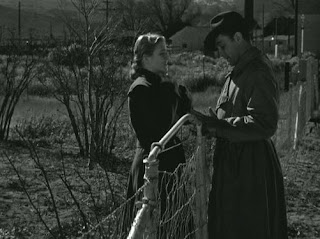
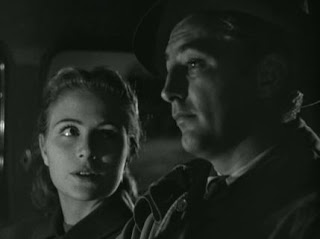
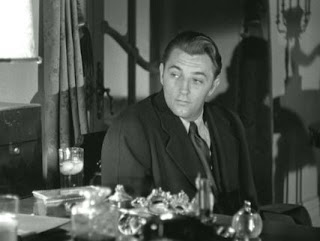
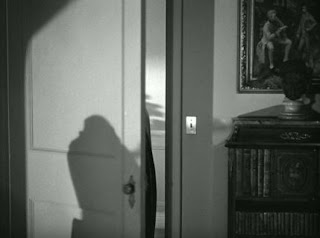
Actually, he lights two in this section of Out of the Past(known in the UK as "Build My Gallows High" after the novel on which it is based) and the one recalls an earlier one in which he might have set the match to his own Viking funeral, when he said yes to a questionable job which resulted in him going anonymous and a bit off the grid, changing his name and hopefully his life. Sparing it, hopefully.
But, like one smoke leads to another, Mitchum's character Jeff Markham (or is it "Jeff Bailey"?) can't run away from bad habits. Besides the occasional coffin-nail, Jeff can't resist wanting what he cannot have. It's what got him involved with Kathie Moffat, who turned into something more than an assignment and made him something more of a fugitive. He may change the name but not the man, because it's why he's involved with Ann Miller, whose steady is out of town a lot. He wants what he cannot have, and the tragedy is he knows it and can't escape it, no matter how many lives he leads.
But, now his past has caught up with him. And it's time to come clean—fortunate because it gives us a lot of back-story—but not so much because he's going to get dirty again in one of the most melancholy stories in the black soul of film noir.
Anybody got a match?
The Story: A "town-guy" (Paul Valentine) shows up in Bridgeport, California looking for the owner of the local gas station. That would be "the mysterious" Jeff Bailey (Robert Mitchum) who's "gone fishing"—no, really fishing—with his girl Ann Miller (Virginia Huston). He meets the "guy," who tells him an old client of his (Kirk Douglas) wants to meet him in Lake Tahoe. Bailey agrees, albeit reluctantly. He decides to take Ann along with him to Tahoe. It's a 90 minute drive. He's got a long story to tell.
Action.
MOTHER...with a man who won't pick you up at the door?
ANN MILLER Don't worry about them.
ANN Darling.
JEFF BAILEY It's no good, is it?
ANN It doesn't matter. It's just that they...
JEFF BAILEY Oh, honey, I know how they feel.
ANN Don't worry about it.
JEFF BAILEYI'm not.
ANN Then don't look so grim.
JEFF BAILEYNo, it's something else.
ANN What?
-
JEFF BAILEYThat guy that showed up today...
ANN Yes?
JEFF BAILEYYou want to take a ride with me
up to Lake Tahoe?
ANN Now?
-
JEFF BAILEYYes, now.
I want to tell you something.
ANN All right, Jeff.
JEFF BAILEYYou told me once
I'd have to tell you sometime.
JEFF BAILEYWell,
JEFF BAILEY ...this is it.
JEFF BAILEYNow, the first thing I wanna get off my
chest: My name isn't Bailey, it's Markham.
ANN Markham.
ANN Jeff Markham?
JEFF MARKHAM I should have told you before.
I meant to, but I kept putting it off...because I didn't like any part of it.
ANN Please tell me, Jeff.
JEFF MARKHAM Some of it's gonna hurt you.
ANN It doesn't matter.
JEFF MARKHAM Well, our friend Markham
lived in New York.
He worked with a sort of stupid,
oily gent by the name of Jack Fisher.
JEFF MARKHAM We called ourselves detectives.
That was about three years ago,
maybe more.
Wintertime. One of the coldest days
I remember in the town.
And we got a call to come and see a big op.
ANN A what?
JEFF MARKHAM An operator, gambler.
He didn't come to see us because he was
too high-powered a character.
JEFF MARKHAM Also, because some dame had taken
four shots at him with his own 38.
Made one of them good.
JEFF MARKHAM He was taking it in stride,
but he had a friend who was a ball of fire.
Cross-fade...
JOE STEFANOS Newspaper guys, wise guys,
JOE STEFANOSwho do they think they're kidding?
So he shot himself
cleaning a cap pistol.
So I shot the ace of spades
out of a sleeve during a gin game.
JOE STEFANOSA guy can't even get shot by a dame...
JOE STEFANOS...without the whole town
starting to buzz like a...
WHIT STERLING Like you? Smoke a cigarette, Joe.
WHIT STERLING You just sit and stay inside yourself.
You wait for me to talk. I like that.
JEFF MARKHAM I never found out much
listening to myself.
Sterling laughs and winces in pain...
WHIT STERLING It amazes me how she missed so often.
JEFF MARKHAM Maybe you were moving.
JACK FISHER Yaknow, a dame with a rod is like a guy
with a knitting needle.
WHIT STERLING What's he doing here?
WHIT STERLING I called you.
JEFF MARKHAM My partner.
JEFF MARKHAM Should I ask why you didn't call the law?
WHIT STERLING Should you?
JEFF MARKHAM I guess not.
JEFF MARKHAM Anything happen to her?
WHIT STERLING She ran out on me.
JOE STEFANOSWith 40,000 bucks.
WHIT STERLING I want her back. JEFF MARKHAM Or the money?
WHIT STERLING You know, I once bet $40,000 on a horse
that ran dead last,
WHIT STERLING so I bought the horse.
JEFF MARKHAM Yeah, that's what I mean.
WHIT STERLING Oh, that's where you're wrong. I put that horse
in a nice green pasture...so he'd never get his foot
caught in a mutuel machine.
JEFF MARKHAM You should go out and visit it sometime.
WHIT STERLING No, I just want her back.
WHIT STERLING When you see her, you'll understand better.
JEFF MARKHAM Maybe she's just an impulsive girl.
WHIT STERLING Shall we let it go at that?
JEFF MARKHAM I can let it all go.
WHIT STERLING An even 5,000 now
and 5,000 when you bring her back.
WHIT STERLING And expenses.
JEFF MARKHAM Now, that should have been
the first thing you said.
WHIT STERLING Find her, Jeff. Bring her back.
JEFF MARKHAM Why me?
WHIT STERLING Well, I know a lot of smart guys
and a few honest ones,
WHIT STERLING ...and you're both.
JEFF MARKHAM What happens to her?
WHIT STERLING I won't touch her.
JEFF MARKHAM Okay.
Sterling tosses him a wad of bills.
JEFF MARKHAM Get me the stuff on her family,
pictures, anything interesting.
JOE STEFANOSYou'll get it.
JEFF MARKHAM I'll see you.
You bring it over, Joe.
JEFF MARKHAM Come on, let's go.
JEFF MARKHAM Oh, by the way, you mind
telling me her name?
WHIT STERLING Kathie Moffat.
JEFF MARKHAM Thanks.
JACK FISHER She must be quite a dame.
A wild goose with 40 G's.
JACK FISHER You know, for a smart guy, that Sterling
sure trusts you, don't he?
JEFF MARKHAM Why not?
JACK FISHER Am I going along?
JEFF MARKHAM Nope.
JACK FISHER Oh, he doesn't like my personality, huh?
Well, I'm still in, Jeff, 50/50.
JEFF MARKHAM Did I say anything different?
JACK FISHER All right, all right. It's a good soft touch.
Don't get hot at me.
TakeGhostbusters: Afterlife(please). The director and co-writer is Jason Reitman, son of the original's director (the real-life sequel if you will). But, Jason has made some terrific movies in his own right—Thank You for Smoking, Juno, Up in the Air, Young Adult, Tully—that eclipsed the quality of his father's work and heralded an original and mature director whose film-making instincts would, at least, be interesting and, more often than not, thought-provoking and challenging.
What one does not expect is a work of desperation, of a studio in need of a tent-pole of a franchise, even one that has suffered in the past (except for the first one) from its own haphazardness and money grubbing, and of a director in need of a hit who doesn't want to wade in the world of mass-market spandex and not fall too far from the money-tree. I'm sure the Sony execs were crowing that they had the best of both worlds—a younger director with a track record who was close enough to the material (and its initial legacy) that he wouldn't try to re-invent their hit (as had been tried...with disastrous box-office results).
Is there life in Ghosbusters? Or after-life? Stay tuned.
Callie Spengler (Carrie Coon), divorced mother of two—that would be Trevor (Finn Wolfhard) and Phoebe (Mckenna Grace)—has just been evicted from her place and she and the kids pack up everything and move for the Summer to—Summerville, Oklahoma—as her only assets are the tumble-down dirt farm, where her father, Dr. Egon Spengler—former Ghostbuster—moved and ultimately died (under mysterious circumstances). Callie has nothing but vitriol for her father—science skipping a generation—for abandoning her and her family for something having to do with his work. The house itself is a disaster, with books stacked high ("symmetrical book-stacking..." Humans DO do that, evidently), and a secret laboratory in the basement (accessible by fire-pole), and an abandoned Ecto-1 in the back-broken barn.
While Trevor tries to make friends working at the local burger drive-in, Phoebe, the science-nerd takes Summer science classes from Mr. Grooberson (Paul Rudd), who plugs a horror movie into the VHS (funding...) while he investigates the strange seismological activity happening in Oklahoma. Fracking? "Fracking annoying!" responds Callie. The humor here is mostly visual, although verbal attempts are constant, usually consisting of some sort of cynical comment that hurts.*
Eventually, everyone becomes aware that Granddad was a Ghostbuster, and shows up at the house by inhabiting inanimate objects and moving them around—chess pieces, lights, desk-drawers. Trevor gets Ecto-1 going again, despite its age and rust and oxidating gas supply. And Phoebe wins this year's "Mary Sue" award for figuring out how Egon's "unlicensed nuclear accelerator" proton pack works without any sort of guidance. "Why worry?"
Why, indeed? She catches her first ghost on her first pursuit and traps it. It results in some substantial property damage around town and she, Trevor, and their buddy "Podcast" (because...he...does a...ah, forget it) wind up in jail, with their equipment confiscated and Mom being really pissed at them for interrupting her date with Mr. Grooberson.
Eventually, it's determined that Summerville is the epicenter for another emergence of Gozer the Gozarian (who'll appear as Olivia Wilde in an uncredited cameo) as Ivo Shandor (J. K. Simmons), the designer of the building that was ground zero for "The Great Manhattan Crossrip of '84") built the town just for that purpose. Mom Callie and Mr. Grooberson become the gate-keeper and key-master for the return.
Basically, the movie is "Goonies Meets Ghosbusters" while using the same strategy as The Force Awakens by bringing back most of the elements of the original (including SPOILER ALERT: the remaining Ghostbusters) in another locale and pulling a Carrie Fisher by having the late Harold Ramis appear as the spirit of Egon, complete with Obi-Wan Kenobi blue-shimmer. The devil-dogs appear, and so do possessed Stay-Puft marshmallow men. Everybody but Rick Moranis. But, it's the same story filled to busting with call-backs, heavily encrusted with nostalgia.
The kids are alright, though. Wolfhard is a good presence, and Mckenna Grace is a highlight as young Phoebe, using the same straight-faced strategy as "Young Sheldon"'s Iain Armitage, that somehow enhances the amusement factor as when told that as key-master and gate-keeper, her Mom and Mr. Grooberson have probably "done it": "No, I just don't show my emotions like everyone else, on the inside I'm vomiting." It's not the line; it's the delivery—the singer, not the song.
One goes into these things with such hope. But, movies in a franchise need to grow not just regurgitate and please the fan-base or the investors. It's funny. They could really do some interesting things with the concept of an after-life**besides resurrecting "force-ghosts." But, "Ghostbusters" has always been a bit shallow in its intentions and this version does not intend to dig any deeper. But, then, it's not so much a movie, as it's a wake. For Ramis. And for the franchise.
* Phoebe wishes her Mother good night with : "Have a good night! Don't be yourself." Paul Rudd has a good line: "History is safe. Geometry is safe. Science is a safety-pin through the nipple of academia!"
** I had a friend who professed to be a psychic, and the most believable thing about it was he was so casual talking about it. A casual mention of ghosts and he blurted "Ah, ghosts are ASS-holes, man..."
Yes, a flawed classic that we've become blind to. Robert Wise's 1961 version is beautiful to look at, technically stunning, the dancing is amazing, the music is always good, and Natalie Wood's gorgeous. And Rita Moreno. And Rita Moreno.
But, everybody's too old. Too clean. It feels like play-acting (certainly play-fighting). The Sharks are, for the most part, white guys in tan make-up, as is Russian Natalie Wood's Maria. And no one believes Richard Beymer for a second. Handsome guy, sure. But not for a second. Then, the story-line has always had issues, particularly in its hysterical third act. It did on stage, and even trying to correct it in the movie didn't work.
So, yeah, it needed to be done. And Steven Spielberg (who loved the original) has been wanting to re-makeWest Side Storysince he was sixteen. Sometimes, when you hear a factoid like that, it's a case of being careful what you wish for. A Spielberg version of it would (one would think) at least be an interesting amalgamation of his youthful ideals with his more mature film-making stance of late, the "Gee-Whiz" Kid meets the Craftsman.*
So, how is it? Glorious. And calculated. If you're worried about the emotional "chill factor," the story and the music and the songs still punch you in the heart in the same way when you were an impressionable teenager and would cry over the punctuation of a love note (not enough "!!"'s) or the tragedy of "Romeo and Juliet" (do we really have to explain the piece's origins?). But, it's a different, less vacant world than the one of the '61 version. People look out the window and look at you crazy if you're singing by yourself in the middle of an alley-way. It's a cluttered, messier world and people talk over each other and speak Spanish in emotional dudgeon before being scolded to "speak English!"
It's messier and transitioning. New York's inner city looks like a war zone (It is). Gentrification is going on with blocks being demolished for an in-coming "Lincoln Center." The film starts with an overhead shot of rubble—including (grim foreshadowing smile here) fallen fire-escapes. Then, a Jet pops through a roof-door and the gang starts skipping down the street (not in Jerome Robbins-tight choreography) carrying paint cans. Kicking over a "Man Working" sign, it's apparent they're on a mission, but first they have to leave a slum area in decay to a busy slum area where the people haven't given up yet.
It's smart, less random, and in its own way, sets the precedent for the whole strutting-dancing-fighting correlation that needs to be crossed for "West Side Story" to work. It ends up in a brawl, but no one is high-kicking each other, the punches crunch, one kid gets a nail through an ear-lobe, and there is blood.** The point is made. This is going to be a tougher "West Side Story" with resentments about things other than turf. At one point, Jets leader Riff (a very good, very weasly Mike Faist) says "Ya know, I wake up to everything I know being sold or wrecked or being taken over by people I don't like" (just in case anybody accuses the movie of not being "relevant") and they're pegged by a New York city cop (Corey Stoll) as being just "slum clearance."
That's the milieu; how are the leads? Reviews I've scanned have problems with both of them, but I think that's wrong. For me, the biggest problem of "West Side Story" was always Tony. You're not sure what his motivation is, other than not to be part of the gang—while being part of the gang. Spielberg and screenwriter Tony Kushner have beefed up the character by giving him additional back-story. Here, Tony is just trying to stay straight: he's been in prison for a year for nearly killing a kid in a past rumble, sort of like John Wayne's Sean Thornton in The Quiet Man—he's haunted by his past actions—and now, he's out on probation, keeping his nose-clean, and working for Valentina (Rita Morena) running Doc's drug store in the old neighborhood. Tony is played here by Ansel Elgort, who's done great work in The Fault in Our Stars and Baby Driver. Elgort can dance, although he doesn't do much of it here, and he has a fine singing voice and isn't shy about hitting the high notes—if I have a complaint about him it's that he seems to be concentrating on the technical side of the singing rather than the acting. But, his Tony is interesting, the guy everybody looks up to (because he's a head taller than everybody) and he only gets MORE interesting once he meets Maria at the dance.
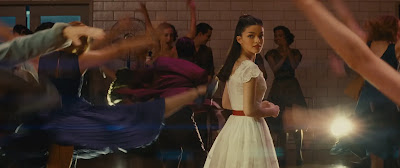
At first—the way Spielberg stages it—she's just someone he sees out of the corner of his eye dancing with another guy, enjoying herself (it's her first dance of the night). Then, he walks the outside of the dance floor, stalking, riveted, and it's almost like that attention is what makes Maria notice him. And from that moment on, he's like Brando's Terry Malloy in On the Waterfront—completely gob-smacked, struck stupid by "the thunderbolt" to the point where he'll do anything—anything—for her. And that previous internal conflict just goes away. "All my life, it's like I'm always just about to fall off the edge of the
world's tallest building. I stopped falling the second I saw you." So, she's gotta be something special.
And Rachel Zegler is. There's something preternaturally attractive about her and not in any traditional way. Her eyes are Disney Princess-huge—of COURSE, they've cast her in the live-action Snow White—sunk deep in her skull and they cut across her entire face. She's doll-like, unnatural, but in the way that sinks into the alligator cortex, turns into goo, and makes you want to buy a puppy. And Maria, the character, is a tough sell, with fast emotional transitions and, if done wrong, can seem like the architect of such chaos that one has no sympathy for her, not even at the end. Some wickedly tough songs, too. Fortunately, Zegler is up to the task, and Kushner has given her far more spine than previous versions. You want these kids to work it out and get out of this dump.
Spielberg takes advantage of every moment—and sometimes just beats of music—to tell his story. There is sure to be some grousing about musical choices and positionings, particularly how the song "Cool" is used—it's moved in transitions from stage to screen to screen, and here it's Tony's number (which, given his role as thwarted peacemaker, works)—and there is one song that I was horrified when it started to come up in the position that it did, but it gives a needed distraction after the big rumble, and raises emotional goal-posts setting up a particularly savage transition for Maria's character to make.
And some may disagree how the work's most famous piece, "Somewhere," is used—and who it's given to—but the choice is an apt one, making its meaning more ethereal and more universal. Emotionally it feels right.
And the big show-pieces are wonders. The show-stopper is always "America" ("I like the island Manhattan/Smoke on your pipe/and put THAT in") and Spielberg opens it up in keeping with maintaining as much location work as possible. I've made no mention of David Alvarez as Bernardo, the boxing leader of The Sharks or his girl Anita, who is played by Ariana DeBose, and that oversight may be criminal. The two are meant to be more flashy than Maria and Tony and they are the life of the party, all flash and dash, smirk and flirt. Their spontaneity can't be contained, so instead of staging the number on a limited rooftop, it moves from back-alleys to city-streets, whirling and sashaying and running at full gallop until not only the show stops but New York traffic as well. The exuberance is contagious, but freer and feels more risky, more dangerous, more alive.
Why re-make it, you ask? (I dunno. Why remake "Romeo and Juliet?") Because with new interpretations come improvements—or not. It's the chance one takes with producing art. They're not going to stop re-staging it in theaters, nor should they. But, if one must cling to the original, there's always what author James M. Cainsaid when an associate (John Leonard) criticized a film-version of a novel of his: "They haven't done anything to my books" (pointing to his study) "They're still there on the shelf. They paid me and that's the end of it. They're fine." The original is still there—I have it on DVD—and naysayers can watch it anytime they want. I prefer this version, and I'll prefer it...until a better version comes along.
* Robert Wise, when he made West Side Story, had been making films for 17 years. Spielberg has been making them for 47 years. Hmm.
** Later, Spielberg will have a fight where he borrows a few set-ups from a brawl in A Clockwork Orange. He's not kidding around.
The Handbag Company That Didn't Know a Thing About Baggage
or
"Father, Son, and House of Gucci" (The Sign of the Double-Cross)
The family Gucciare not happy with Ridley Scott's House of Gucci, and for once I have something in common with them. Scott's second film released this year is the lesser of the two—the other being The Last Duel—but both films deal with people obsessed with legacy and imagine themselves more important than they are and taking things to such an extreme that one can see the results and consider that hubris could be considered a cause of death.
"Inspired by a true story" (which means that there are more factual liberties taken than one "based on a true story" in some sort of cinematic legalese), it tells of Patrizia Reggiani (played bodaciously by Lady Gaga, who should, at least, get some sort of award for most extreme hip-swing), who rose from being a book-keeper at her step-father's trucking business to the wife of Maurizio Gucci (played—rather tentatively—by Adam Driver), prodding him from being a law student with no desire to be part of the family business to becoming the majority stock-holder of the company.
Maurizio ended up running Gucci, despite his initial reticence, and then began living the "Gucci lifestyle" of spending money recklessly and running the business into the ground, as well as having affairs that would occupy his time and his budget. Finally, he asked Patrizia for a divorce, and she hired, through a psychic advisor of hers, to have Maurizio murdered in front of the Gucci building. She, the psychic and the hit-men were all convicted and sent to prison. End of story.
So, it must be embarrassing for the family that House of Gucci is less about them than it is about Patrizia, less about the glorious history of Gucci selling high-priced shoes and accessories to a easily-impressed world, than it is about a non-Gucci and the way that she so easily manipulated and up-ended the House of Gucci-branded cards. Well, live by public gullibility, die by public gullibility—the attention is directed from over-priced flotsam to scandal and once things like murder and tax evasion are put in court documents it becomes part of the public record and not so easily manipulated in-house. No wonder they're pissed.
Not that Scott and his writers have done such a miraculous work of art. Scott keeps things moving along with much less fluff in the air this time (perhaps indicating that this whole world is a bit unnatural?) and the luxurious furnishings and art knock-offs adorning the spaces are in fine crystal-clear display. It is cast with a buzz-inducing corral of actors in the secondary roles that created so much anticipation for this one that it couldn't possibly live up to expectations (live by the press release, die by the press release) and it simply does not.
They have their moments—Jeremy Irons as Maurizio's estranged father Rodolfo (living in his film-career past), Al Pacino as Uncle Aldo (in a sort of nightmare-version of what Godfather III could have been like) and Jared Leto as cousin Paolo (portrayed as something of a dim-wit, but in that weird Leto-land situated somewhere between comedy and tragedy). Irons, at least, plays things fairly straight, giving Rodolfo a diseased dignity even in his knowledge that his best days are past while he ruefully wallows in them—the best scene of the film is his "meeting" with Leto's Aldo trying to gain acceptance for his fashion sense where he charitably considers all his ideas and politely savages them. But, Pacino's avuncular Aldo has the same DNA as Eli Wallach's Don Altobello in GIII—smiling, but with a knife up his sleeve, a slow trickster, not altogether good at what he does. He has two explosive moments—both in involving Leto—but for the most part the three big supporting actors are in another movie where they're starring.
But, it's La Gaga's movie. Pratizia Reggiani is the only character in the piece who is seriously ambitious (without being deluded), while everyone else is either lethargically complacent or spineless. Like Gaga herself, the part calls for someone with ambitious goals and a ruthless way of achieving them and she tears into the role with a fierceness that is almost animalistic.
It would be ironic if Scott found his project becoming known as being "that Lady Gaga movie" and having it wrested from his hands in the same way the Gucci's saw their work being taken from them. "Inspired by a True Story," indeed.
After watching Moanalast year on a television-sized screen and being overwhelmed by the beauty and color and detail that the Disney animators put into that film (despite watching it in an underwhelming format), I vowed that were I to watch another Disney film of such dexterity, it would have to be in a theater first.
And so, with Disney's release of Encanto for this holiday season (in theaters only it should be pointed out), I headed for a theater, lest I miss something, and was not disappointed for making the extra effort.
Encantotells the story of the Madrigal family which, for the story's purposes, begins with a refugee experience, as the young Alma and Pedro Madrigal, with their three toddler children, must flee their homeland from a conflict to a new beginning. Papa Pedro does not survive the trip, sacrificing himself for the family's safety, but his spirit is imbued in a mystical candle, whose eternal flame lights the family home, the Casita, imbuing it with powers that come in very handy on a day-to-day basis, but which presents a gift to each family member as the generations unfold.
The original trio have separate abilities: Julieta (Angie Cepeda) can heal the afflicted with her cooking; Pepa (Carolina Gaitán) can control the weather; and brother Bruno (John Leguizamo) can see the future. Bruno, probably because of this ability, is a family exile as one of Lin-Manuel Miranda's songs explains ("We Don't Talk About Bruno").
Bruno never marries. But Pepa and her husband have a daughter Dolores (Adassa), who has incredible hearing, son Camilo (Rhenzy Feliz), who can shape-shift, and youngest son Antonio (Ravi Cabot-Conyer), who will gain the gift of talking to animals. Julieta and husband Augustin (Wilmer Valderrama) have three kids—all daughters: Isabela (Diane Guerrero) considered the "perfect child" who can make flowers bloom at will (of course she can!), Luisa (Jessica Darrow), who is exceptionally strong, and Mirabel (Stephanie Beatriz), who...has a good personality...but was somehow left out of the cosmic loop when extraordinary abilities were being passed out. She CAN, however, play the accordion.
Well, in this day, when every character in movies has—and everybody on the street claims to have—a super-power, maybe it isn't so unusual that the Familia Madrigal seems to be like The Incredibles or The Avengers (both Disney properties, by the way)...but one should remember that even the Seven Dwarfs—or are we saying "Seven Little Men" now?—had specific character traits, just so you could keep track of them, and in an extended multi-generational family that sort of thing just keeps things from getting out of hand.
Anyway, Mirabel is the "special child" for the mere fact that there is nothing "special" about her (if you don't count having the majority of the songs to sing including the required "'I Want' song" which, here, is "Waiting on a Miracle"), except that she takes that three paragraphs of exposition I just did and squeezes it into a very fast four minute ditty called "The Family Madrigal" which explains the whole thing. Personally, I think her super-power is rhyming "Madrigal" and "autobiographical" and negotiating the hyper-Miranda-rap without seeming to take a breath. She is also awfully good at breaking the "fourth wall" as she does consistently through the movie.
Yeah. Just like that.
Antonio's being bequeathed the gift of talking to animals only emphasizes that Mirabel got squat for powers when it was her time, but she is haunted by a vision of cracks running through the house and destroying it. This sets her on a quest to find out what the heck it is all about and if it has anything to do with Bruno or whether it is some anomaly in magical reality. It's a nice little hero's quest movie without having to do much traveling as the issue is "right upstairs." It's also a movie about gifted people who, at the same time, feel it's a bit of a curse and, rather than make life better, over time it makes things worse. And ultimately it says we're all gifted and we're all gifts. nice. Tough to argue (even though comments sections are filled with people who do).
One thing that constantly surprises me about these things (and I don't think anybody can argue about) is how these animated films keep getting visually richer and more impeccably designed. Every new one I see has left me jolted about how far the technology and design sense has improved. There's a scene here where Mirabel is covered in dust that feels absolutely photo-realistic (even though the character isn't), or the perfection portraying the way a drum-head vibrates when it's hit, and there were a couple of instances where transitions made me think "oh, they've gone live action" only to see with the sight of a figure—"wait, no, they haven't.
Computer animation has come such a long way since the time I was sitting listening to a panel discussion with Pixar animators in 1994 about their revolutionary new release which was being called Toy Story, and remarking that the render time for a scene that involved a woven bed spread required thirty hours for each frame. That first one still doesn't look bad, even though some of the human figures still come out looking a little crude, but now it's getting downright scary how good these features now look. At the beginning, I was looking at some of the Encanto character faces and thinking, "Geez, I should be seeing pores in the skin." Then, two shots later, Grandmama Alma shows up and she has liver spots. Texture and shading has gotten rid of much of the plasticene look of characters, but the artistry and expressiveness possible almost make that a non-consideration anymore.