Showing posts with label Rita Moreno. Show all posts

Wednesday, August 14, 2024

Jim Henson: Idea Man

I'm Your Puppet
or
Having a Hand in Everything
 
When I was growing up, I fixated on several things to the point of obsession. One was the comic-strip Peanuts. One was America's Space Program. Howdy Doody. Looney Tunes cartoons. J.P. Patches (if you know, you know).
 
Puppets. I think I watched everything that Paul Winchell did. Kukla, Fran and Ollie, Shari Lewis.
 
And Jim Henson. This was before he became the creator of "The Muppets," and was an up-and-coming skit contributor—he'd appear on "The Ed Sullivan Show" and other variety venues, and he had a regular "gig" on "The Jimmy Dean Show" with Rowlf the Dog.
 
But, Henson did things differently. His "bits" would be his bizarre looking puppets (including one which would become well-known as "Kermit the Frog") lip-syncing to some popular record and the bit would usually end with some 90° turn, sometimes violently. They were hilarious and seemed to erupt from some fertile ground of imagination that none of the other entertainers on "The Tube" seemed to have access
.
Henson hadn't intended to become a pioneering puppeteer. He just wanted to get into television, a medium that fascinated him. Although he'd been introduced to puppetry watching the tube, he wasn't personally involved with the art until his last year at Northwestern High School in Hyattsville, Maryland, continuing to study it at The University of Maryland, College Park, where he met his "Muppets" partner and future wife, Jane Nebel.
With wife Jane, Henson devised the skits and bits that the Muppets performed on local and national television shows, as well as doing commercials. On weekends, he began experimenting with film projects, exploring stop-motion animation, rhythmic editing, and juxtaposed cross-cutting. His first, Time Piece, was Oscar-nominated for "Best Live Action Short" in 1965 (it's presented in its entirety below).
Kermit's origins began from the discarded green coat of Henson's mother.
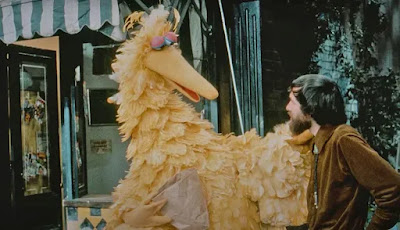
The rest you no doubt know, from Henson's work on Sesame Street—also directing many short avant-garde films for various "numbers" segments—with its vast array of puppets and full-size figures to walk on-set, "The Muppets Show" and movies, "Fraggle Rock," a brief recurring stint on the first season of "Saturday Night"—the percursor title for "SNL," the films The Dark Crystal and Labyrinth. Hundreds of hours of content for movies and television. Plus innovations in puppet-performing, animatronics, special effects, and film-making...not to mention overseeing the construction and manufacturing of building imaginative creatures.
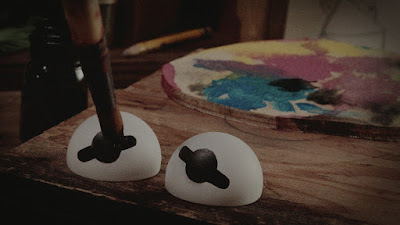
Painted halved ping-pong balls for eyes...
Now, Ron Howard just made a documentary about Henson—Jim Henson: Idea Man—and has been the case for Howard's product lately, it didn't get a theatrical release, but went straight to Disney+ for streaming (except for an appearance at the Cannes Film Festival) on May 31, 2024. So, what was it doing as an ABC special this past Sunday? Disney+, being notoriously stingy with their streaming product, put it on broadcast television within 3 months of its premiere...that's a bit unprecedented. But, follow the logic: Henson's Muppet properties (except those wholly owned by Henson) are owned by Disney. Disney also owns the ABC network, and the night it premiered NBC was airing the closing ceremonies of a much-storied Olympic Games. ABC needed to put something special up rather than roll over and die in the ratings. It's as simple as ABC. Or ABC/Disney.
The fledgling Muppet crew
Howard, who has had an illustrious career as a director—aside from his acting career—has turned in another "safe" documentary. Chapter headings, talking heads (good ones!), a smorgasbord of clips that would even please The Swedish Chef, and a design sense based on things Henson himself had innovated. It's by-the-numbers, like a Ken Burns documentary without that director's eye towards the breath-taking shot, the spurious but telling anecdote and the impeccable eye towards getting the most out of a photograph. Howard colors inside the lines.
Howard is no innovator. His films have no mystery, they never haunt, and they never linger in the mind with deeper implications. He tells the story, simply, effectively, and gets out leaving no after-image. Where a recent documentary on Fred Rogers by a great documentarian like Morgan Neville will leave you in contemplation, Howard makes you feel like you've heard the story enough to feel satisfied. It's like a bed-time story told by a competent nanny. Henson would have never done an auto-biographical film, but he would have made it a thrill-ride with thrills, near-spills and a bit of danger to it.
Those elements are best inhabited by the words of Henson's co-workers, kids, ships that passed, and stars that shined for him. Like Frank Oz, who joined Henson as a high-schooler and under his tutelage became a brilliant puppeteer, actor, personality and director and in his interview seems to share a weight of gratitude. Rita Moreno talks about guesting on "The Muppet Show" and blowing take after take because she couldn't stop laughing until the last take where she barely holds it together...and they used it! "The nostril-flares tell you I'm about to lose it." Jennifer Connelly talks about being a 14 year old on a Henson set...co-starring with David Bowie and feeling like the place was a playground.
 
And in a way, it was, one that we all had access to and could play in. We couldn't see the dollars spent, the hours of prep, the uncomfortable positions (try holding your arm up for 10 minutes!), nor could we see the actual performers, merely their avatars, hidden behind desks, tables, props, out of sight and, rather miraculously, out of mind—even to the people they were performing with. We saw the tip of the ice-berg of creativity, that by the time it appeared on-screen had been honed to a science, made easy to laugh at, without having to consider the men (and women) behind the curtain. 
 
Like Oz.

Henson never played it safe. Maybe, someday, there will be a documentary that will take his same radical tack at looking at this man perpetually behind the curtain while simultaneously so on-stage and call the man what he was: a magical genius.
 

Friday, December 10, 2021

West Side Story (2021)

Para Siempre
or
"Keep Looking for Better"
 
Why re-make it you ask? The original's a classic.
 
Yes, a flawed classic that we've become blind to. Robert Wise's 1961 version is beautiful to look at, technically stunning, the dancing is amazing, the music is always good, and Natalie Wood's gorgeous. And Rita Moreno. And Rita Moreno.
 
But, everybody's too old. Too clean. It feels like play-acting (certainly play-fighting). The Sharks are, for the most part, white guys in tan make-up, as is Russian Natalie Wood's Maria. And no one believes Richard Beymer for a second. Handsome guy, sure. But not for a second. Then, the story-line has always had issues, particularly in its hysterical third act. It did on stage, and even trying to correct it in the movie didn't work.
 
So, yeah, it needed to be done. And Steven Spielberg (who loved the original) has been wanting to re-make West Side Story since he was sixteen. Sometimes, when you hear a factoid like that, it's a case of being careful what you wish for. A Spielberg version of it would (one would think) at least be an interesting amalgamation of his youthful ideals with his more mature film-making stance of late, the "Gee-Whiz" Kid meets the Craftsman.*
So, how is it? Glorious. And calculated. If you're worried about the emotional "chill factor," the story and the music and the songs still punch you in the heart in the same way when you were an impressionable teenager and would cry over the punctuation of a love note (not enough "!!"'s) or the tragedy of "Romeo and Juliet" (do we really have to explain the piece's origins?). But, it's a different, less vacant world than the one of the '61 version. People look out the window and look at you crazy if you're singing by yourself in the middle of an alley-way. It's a cluttered, messier world and people talk over each other and speak Spanish in emotional dudgeon before being scolded to "speak English!"
It's messier and transitioning. New York's inner city looks like a war zone (It is). Gentrification is going on with blocks being demolished for an in-coming "Lincoln Center." The film starts with an overhead shot of rubble—including (grim foreshadowing smile here) fallen fire-escapes. Then, a Jet pops through a roof-door and the gang starts skipping down the street (not in Jerome Robbins-tight choreography) carrying paint cans. Kicking over a "Man Working" sign, it's apparent they're on a mission, but first they have to leave a slum area in decay to a busy slum area where the people haven't given up yet.
It's smart, less random, and in its own way, sets the precedent for the whole strutting-dancing-fighting correlation that needs to be crossed for "West Side Story" to work. It ends up in a brawl, but no one is high-kicking each other, the punches crunch, one kid gets a nail through an ear-lobe, and there is blood.**
The point is made. This is going to be a tougher "West Side Story" with resentments about things other than turf. At one point, Jets leader Riff (a very good, very weasly Mike Faist) says "Ya know, I wake up to everything I know being sold or wrecked or being taken over by people I don't like" (just in case anybody accuses the movie of not being "relevant") and they're pegged by a New York city cop (Corey Stoll) as being just "slum clearance."
That's the milieu; how are the leads? Reviews I've scanned have problems with both of them, but I think that's wrong. For me, the biggest problem of "West Side Story" was always Tony. You're not sure what his motivation is, other than not to be part of the gang—while being part of the gang. Spielberg and screenwriter Tony Kushner have beefed up the character by giving him additional back-story. Here, Tony is just trying to stay straight: he's been in prison for a year for nearly killing a kid in a past rumble, sort of like John Wayne's Sean Thornton in The Quiet Man—he's haunted by his past actions—and now, he's out on probation, keeping his nose-clean, and working for Valentina (Rita Morena) running Doc's drug store in the old neighborhood. Tony is played here by Ansel Elgort, who's done great work in The Fault in Our Stars and Baby Driver. Elgort can dance, although he doesn't do much of it here, and he has a fine singing voice and isn't shy about hitting the high notes—if I have a complaint about him it's that he seems to be concentrating on the technical side of the singing rather than the acting. But, his Tony is interesting, the guy everybody looks up to (because he's a head taller than everybody) and he only gets MORE interesting once he meets Maria at the dance.
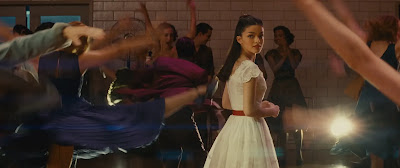
At first—the way Spielberg stages it—she's just someone he sees out of the corner of his eye dancing with another guy, enjoying herself (it's her first dance of the night). Then, he walks the outside of the dance floor, stalking, riveted, and it's almost like that attention is what makes Maria notice him. And from that moment on, he's like Brando's Terry Malloy in On the Waterfront—completely gob-smacked, struck stupid by "the thunderbolt" to the point where he'll do anything—anything—for her. And that previous internal conflict just goes away. "
All my life, it's like I'm always just about to fall off the edge of the world's tallest building. I stopped falling the second I saw you." So, she's gotta be something special.
And Rachel Zegler is. There's something preternaturally attractive about her and not in any traditional way. Her eyes are Disney Princess-huge—of COURSE, they've cast her in the live-action Snow White—sunk deep in her skull and they cut across her entire face. She's doll-like, unnatural, but in the way that sinks into the alligator cortex, turns into goo, and makes you want to buy a puppy. And Maria, the character, is a tough sell, with fast emotional transitions and, if done wrong, can seem like the architect of such chaos that one has no sympathy for her, not even at the end. Some wickedly tough songs, too. Fortunately, Zegler is up to the task, and Kushner has given her far more spine than previous versions. You want these kids to work it out and get out of this dump.
Spielberg takes advantage of every moment—and sometimes just beats of music—to tell his story. There is sure to be some grousing about musical choices and positionings, particularly how the song "Cool" is used—it's moved in transitions from stage to screen to screen, and here it's Tony's number (which, given his role as thwarted peacemaker, works)—and there is one song that I was horrified when it started to come up in the position that it did, but it gives a needed distraction after the big rumble, and raises emotional goal-posts setting up a particularly savage transition for Maria's character to make. 
And some may disagree how the work's most famous piece, "Somewhere," is used—and who it's given to—but the choice is an apt one, making its meaning more ethereal and more universal. Emotionally it feels right.
And the big show-pieces are wonders. The show-stopper is always "America" ("I like the island Manhattan/Smoke on your pipe/and put THAT in") and Spielberg opens it up in keeping with maintaining as much location work as possible. I've made no mention of David Alvarez as Bernardo, the boxing leader of The Sharks or his girl Anita, who is played by Ariana DeBose, and that oversight may be criminal. The two are meant to be more flashy than Maria and Tony and they are the life of the party, all flash and dash, smirk and flirt. Their spontaneity can't be contained, so instead of staging the number on a limited rooftop, it moves from back-alleys to city-streets, whirling and sashaying and running at full gallop until not only the show stops but New York traffic as well. The exuberance is contagious, but freer and feels more risky, more dangerous, more alive.
Why re-make it, you ask? (I dunno. Why remake "Romeo and Juliet?") Because with new interpretations come improvements—or not. It's the chance one takes with producing art. They're not going to stop re-staging it in theaters, nor should they. But, if one must cling to the original, there's always what author James M. Cain said when an associate (John Leonard) criticized a film-version of a novel of his: "They haven't done anything to my books" (pointing to his study) "They're still there on the shelf. They paid me and that's the end of it. They're fine." The original is still there—I have it on DVD—and naysayers can watch it anytime they want. I prefer this version, and I'll prefer it...until a better version comes along.


* Robert Wise, when he made West Side Story, had been making films for 17 years. Spielberg has been making them for 47 years. Hmm.
** Later, Spielberg will have a fight where he borrows a few set-ups from a brawl in A Clockwork Orange. He's not kidding around.