Sunday, May 3, 2020

Don't Make a Scene: Clerks

The Story: May 3rd today. May 4th tomorrow.

For fans of Star Wars, "May the Fourth" (as in "May the Force") is THE "Star Wars" Holiday—I just saw Disney+ advertise it for their channel. I've written that I always consider May 25th "Star Wars Day," as that's the day it opened nation-wide to relatively little fanfare in very few theaters, but the lines and audience increased exponentially like Covid cases at the ones that dared show it. Very quickly, the film became a Phenomenon.

And for some, something close to a religion. It ain't. It's just a damn good movie, simultaneously making and scuttling the career of George Lucas, experimental film-maker. Lucas sold the property (part of Lucasfilm, Ltd) to Disney for billions, for retirement and philanthropist funds—and also because nobody was happy when Lucas made his long-in-the-planning prequels, especially Lucas who found that you can't please everybody, especially fans of your work.

I couldn't blame him. Star Wars fans can be the worst, steeped in arcana that somebody made up and they take as gospel. It's just a movie and just a fantasy. You can't dodge blaster-shots, even with jedi powers...in fact, there are no such things as blasters. You can't turn corners in outer space, and travelling through hyper-space ain't like dusting crops (boy).

So, instead of a Star Wars scene, here's one for the fans...about the fans...from Kevin Smith's Clerks. Smith is a devotee and loves the franchise. This little aside comes out of nowhere like one of Quentin Tarantino's comic-book discussions, but it's close to the sorts of things discussed (and argued) in the Star Wars bubbles. 

It's just that...the Death Star isn't real—any of them—and nobody was thinking about toilet mains or conduits or breaker systems. The Death Star sets had as much integrity as one of those frontier towns where movie-makers just put up the frontages...and that's it.

It's all make-believe...like the lives of the characters in Clerks.

But, still...remember that scene where....?

The Set-Up: Randal (Jeff Anderson) works at the video store and Dante (Brian O'Halloran) at the Quick Stop Groceries.

That's about it.

Action?
The MAN exits as RANDAL enters. DANTE throws the canister away. 
DANTE Do you know that article is accurate? Caitlin's really getting married! 
RANDAL You know what I just watched? 
DANTE Me pulling a can off some moron's fist. 
RANDAL Return of the Jedi.  
DANTE Didn't you hear me? Caitlin really is getting married. 
RANDAL Which did you like better: Jedi or The Empire Strikes Back? 
DANTE (exasperated) Empire. 
RANDAL Blasphemy. 
DANTE Empire had the better ending: Luke gets his hand cut off, and finds out Vader's his father; Han gets frozen and taken away by Boba Fett. It ends on such a down note. And that's life-a series of down endings. All Jedi had was a bunch of Muppets. 
RANDAL There was something else going on in Jedi. I never noticed it until today. 
RANDAL follows DANTE as he cleans up around the store. 
DANTE What's that? 
RANDAL All right, Vader's boss... 
DANTE The Emperor. 
RANDAL Right, the Emperor. Now the Emperor is kind of a spiritual figure, yes? 
DANTE How do you mean? 
RANDAL Well, he's like the pope for the dark side of the Force. He's a holy man; a shaman, kind of, albeit an evil one. 
DANTE I guess. 
RANDAL Now, he's in charge of the Empire. The Imperial government is under his control. And the entire galaxy is under Imperial rule. 
DANTE Yeah. 
RANDAL Then wouldn't that logically mean that it's a theocracy? If the head of the Empire is a priest of some sort, then it stands to reason that the government is therefore one based on religion. 
DANTE It would stand to reason, yes. 
RANDAL Hence, the Empire was a fascist theocracy, and the rebel forces were therefore battling religious persecution. 
DANTE More or less. 
RANDAL The only problem is that at no point in the series did I ever hear Leia or any of the rebels declare a particular religious belief. 
DANTE I think they were Catholics. 
A BLUE-COLLAR MAN half enters the door. 
BLUE-COLLAR MAN Are you open? 
DANTE Yeah. Come in. 
He goes to the coffee machine and makes a cup of joe. 
RANDAL You know what else I noticed in Jedi? 
DANTE There's more? 
RANDAL So they build another Death Star, right? 
DANTE Yeah. 
RANDAL Now the first one they built was completed and fully operational before the Rebels destroyed it. 
DANTE Luke blew it up. Give credit where it's due. 
RANDAL And the second one was still being built when they blew it up. 
DANTE Compliments of Lando Calrissian. 
RANDAL Something just never sat right with me the second time they destroyed it. I could never put my finger on it-something just wasn't right. 
DANTE And you figured it out? 
RANDAL Well, the thing is...
RANDAL ...the first Death Star was manned by the Imperial army-the only people onboard were... 
RANDAL ...storm troopers, dignitaries- Imperials. 
DANTE Basically. 
RANDAL So when they blew it up, no prob. Evil is punished. 
DANTE And the second time around...?
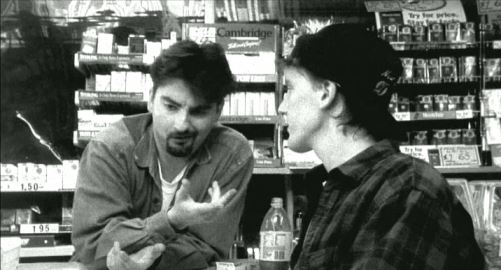
RANDAL The second time around, it wasn't even finished yet. They were still under construction. 
DANTE So? 
RANDAL A construction job of that magnitude would require a helluva lot more manpower than the Imperial army had to offer. I'll bet there were independent contractors working on that thing: plumbers, aluminum siders, roofers. 
DANTE Not just Imperials, is what you're getting at. 
RANDAL Exactly. In order to get it built quickly and quietly they'd hire anybody who could do the job. Do you think the average storm trooper knows how to install a toilet main? All they know is killing and white uniforms. 
DANTE All right, so even if independent contractors are working on the Death Star, why are you uneasy with its destruction? 
RANDAL All those innocent contractors hired to do a job were killed- casualties of a war they had nothing to do with. (notices Dante's confusion) 
RANDAL All right, look-you're a roofer, and some juicy government contract comes your way; you got the wife and kids and the two-story in suburbia-this is a government contract, which means all sorts of benefits. All of a sudden these left-wing militants blast you with lasers and wipe out everyone within a three-mile radius.
RANDAL (CONT'D) You didn't ask for that. You have no personal politics. 
RANDAL You're just trying to scrape out a living. 
The BLUE-COLLAR MAN joins them. 
BLUE-COLLAR MAN Excuse me. I don't mean to interrupt, but what were you talking about? 
RANDAL The ending of Return of the Jedi. 
DANTE My friend is trying to convince me that any contractors working on the uncompleted Death Star were innocent victims when the space station was destroyed by the rebels. 
BLUE-COLLAR MAN Well, I'm a contractor myself. I'm a roofer... (digs into pocket and produces business card) 
BLUE-COLLAR MAN Dunn and Reddy Home Improvements. And speaking as a roofer, I can say that a roofer's personal politics come heavily into play when choosing jobs. 
RANDAL Like when? 
BLUE-COLLAR MAN Three months ago I was offered a job up in the hills. 
BLUE-COLLAR MAN A beautiful house with tons of property. It was a simple reshingling job, but I was told that if it was finished within a day, my price would be doubled. Then I realized whose house it was. 
DANTE Whose house was it? 
BLUE-COLLAR MAN Dominick Bambino's. 
RANDAL "Babyface" Bambino? The gangster?. 
BLUE-COLLAR MAN The same. The money was right, but the risk was too big. I knew who he was, and based on that, I passed the job on to a friend of mine. 
DANTE Based on personal politics. 
BLUE-COLLAR MAN Right. And that week, the Foresci family put a hit on Babyface's house. My friend was shot and killed. He wasn't even finished shingling. 
RANDAL No way! 
BLUE-COLLAR MAN (paying for coffee) I'm alive because I knew there were risks involved taking on that particular client. My friend wasn't so lucky. (pauses to reflect) You know, any contractor willing to work on that Death Star knew the risks. If they were killed, it was their own fault. 
BLUE-COLLAR MAN A roofer listens to this... (taps his heart) not his wallet. 
The BLUE-COLLAR MAN exits.
DANTE and RANDAL remain respectfully quiet for a moment. An angry WOMAN opens the door and pokes her head in. 

Clerks 

Words by Kevin Smith

Pictures by David Klein and Kevin Smith 

Clerks is available on DVD and Blu-Ray from Buena Vista Entertainment.

Saturday, May 2, 2020

Get Smart

Written at the time of the film's release... 

"Would you believe..." written a MONTH after the film's release...

"86'd"

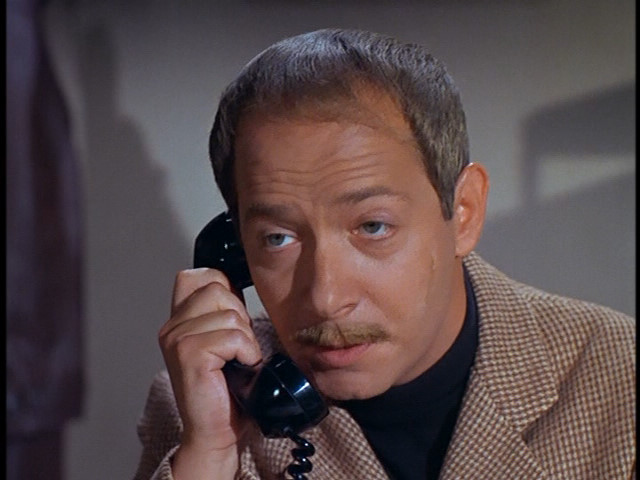
The latest film to make the unsteady transition from television to big-screen started out as a series collaboration between comedy power-houses Buck Henry and Mel Brooks, and is fondly remembered as a sharply-written schtick-filled send-up of the guns and gadgets formula of the James Bond series, starring Don Adams as Maxwell Smart, Agent 86 of CONTROL (the enemy agency was named KAOS). I have fond memories of the sure-fire laugh from my father at the finely-timed closing of a security door on Max's nose at the tail-end of each episode.


When it was announced that "Get Smart!" (the series had an exclamation mark, which seems to have gotten lost somewhere) would be made into a new film, * and that Steve Carell would be playing Smart, it seemed either a very shrewd move or a very bad one. Carell would be hard-pressed to match Adams' energy or his high nasal whine of a voice, and it's hard to imagine Smart without either of those.


Don Adams' crack timing was also something that would be hard-pressed to duplicate--it was Adams alone that made the constantly re-used "Cone of Silence" gag work, with just a razor's edge of silence before his "Eh?!" and that was done in two-shot with the unflappable set-up of Ed Platt as CONTROL's Chief. Plus, "Get Smart!" was sharply written--a "MAD" magazine pastiche of parody, comedy schtick, slapstick and pop-culture references (along with enough sure-fire repeatable gags from Henry and Brooks to fill out the half-hour). Even at its worst, "Get Smart!" was sure to entertain.

So, one approached the movie with hopeful skepticism. Carell has failed as often as he's succeeded, and the ghost of
Don Adams would be tough to emulate or shake off. Fortunately, there's not a problem; Get Smart is hilarious (occasionally), in many of the same ways as the series, but also with its own unique breezy rhythm that ekes out belly-laughs from sharp writing and performances. Only the casting of Terence Stamp (never a good clown) as KAOS operative Siegfried disappoints (series Siegfried Bernie Kopell makes a too-brief appearance). Anne Hathaway manages to be funny, vulnerable and commanding as Agent 99 (at one point donning a Barbara Feldon page-boy wig) who's a bit more Emma Peel than the original. Alan Arkin is a fine Chief, dry as dust, and "The Rock" a pleasant comedian. Bill Murray makes a cameo as the CONTROL agent, played by David Ketchum, that always hid in lockers, mail-boxes, garbage-bins.

But it's Carell's movie. The only gags he can't make work are, strangely enough, the old reliable ones from the show, and they're trucked out as if they were some sort of duty that had to be performed, reluctantly. But he does re-create the Smart persona in his own style--arrogant, foolish, running on fumes rather than juice, and all-too-willing to ignore his failings. But played sedately, and with an odd sort of rabbit-y vulnerability. He makes Max work, and that's a bit of a miracle, given Adams' identification with the character.
It's a good lark, trotting out bits from Bond and other spy-movies to make fun of (like a complicated fight in free-fall, a "Jaws"-type comic villain, and the gadgets), but in its final half-hour loses its good will with an extended chase involving planes, trains and automobiles that could have easily been sacrificed to get to the finale borrowed from The Man Who Knew Too Much. If, "Get Smart" had stayed smart...and funny...without depending on the too-familiar formula of vehicular mayhem, it would have been one of the more refreshing comedies to have come to theaters in a long time.

Missed it by that much.


* There already has been a "Get Smart!" movie, starring original Max, Don Adams, called The Nude Bomb, which tempting fate with that title, proved to be a bomb at the box-office.

Friday, May 1, 2020

Sight and Sound: The Cinema of Water Murch

Murch Ado About...

I've written a bit about Walter Murch—editor, sound-designer, writer, author, philosopher—specifically in the area of sound design (or "audio montage" as Murch coined it), where his work was industry-changing, moving away from recycled sound libraries (for example, that "ubiquitous" jangling "Universal" telephone ring!), and creating specific sound-scapes for the picture and tailoring them for the environment, be it physical or emotional. When it works, it becomes a singular emotional experience, wrapping an audience member into a cocoon of individual reactions and interpretations, getting under their skin and firing neurons in quite unexpected ways—making what McLuhan called a hot medium and cooling it off. When it's done wrong, the experience is that of a wall of sound and creating an expectation that every little detail in a scene must be given its aural due. 
Analog Murch super-imposed over digital Murch
Murch has done all sorts of interviews about sound editing and picture editing, and being a particularly curious individual has tried to convey the processes and the philosophies behind them in books, articles, video's and speaking engagements, sometimes a mix of the media. And these are all readily available with a simple browser search utilizing "All", "News", "Images" or "Video."
He had me at The Star-Child: Lefkovitz begins with an image from 2001
Documentary-composer-editor Jon Lefkovitz has done all that searching for you and made a broad overview entitled Sight and Sound: the Art of Walter Murch, which does the exact opposite of Murch's job, starting with a through-line narration made of Murch talking points and concepts and does an interpretive picture match illustrating those concepts—those sequences being from Murch's work when he could, but also from a broad swath of films that Murch had nothing to do with, but still manage to hit the point that is being made in the shortest time possible.
"Should I be doing this?": Murch edits a scene in Jarhead featuring a sequence he edited in Apocalypse Now.
Murch worked with Francis Coppola—still does, in fact—George Lucas (in pre-Star Wars days), Anthony Minghella, Philip Kaufman, Fred Zinnemann, Sam Mendes, Jerry Zucker and Katheryn Bigelow, and directed a film of his own, the culture-smashing film of Return to Oz (which we'll look at next week), his first encounter with the Disney Company (which he seems to have bad luck with), and the films all presented different challenges—some brought acclaim, some languished at the box-office—and despite Murch's legendary status, he can still get fired (he was on Tomorrowland) 
One could go on...but there are links and you can look up past posts. The film itself is a fast view, probably 80 minutes as the credits are vast. And it's a nice little tutorial the power and potential of the film medium, and nice skimming of Murch's career.
"Sometimes you have to kill the chicken to save the monkey..."

Thursday, April 30, 2020

The Bourne Legacy

Written at the time of the film's "a-bourning."

Baby, We Were Bourne To Run
Or
Pursued By Our Inner Damon's

The "Bourne" series laterals the ball to another player in The Bourne Legacy, the fourth film of the series, which, by now, has nothing to do with the Robert Ludlum books on which they are titularly based (which is fine, as I read the first one decades ago and found it one of the worst reads ever).

When last we left Jason Bourne, he'd jumped into the East River to make a desperate escape from his pursuer/handlers, a nice turnaround from when the series started with him being fished out of the water with no clue as to his identity. We start there again, but this time, we're Bourne again in another body of water with Aaron Cross (Jeremy Renner) on a training mission way out in nowhere, Alaska (all the better to see Russia, apparently), while the events of the previous Bourne trilogy play out in the States, sending a panic through the intelligence community and an order to purge the Treadstone Project (or is it Operation Outcome...or Operation Blackbriar...only Tom Clancy could keep track of this...and then he'd start a book-series (ghost-written) on each one!).  
Whichever project is being scorched to the Earth, the talents from the previous movies (Scott Glenn, Joan Allen, David Straithairn) are dealing with the ramifications of Bourne's re-appearance, another intelligence head* (Stacy Keach-welcome back, sir) puts another middle-management type (Edward Norton) in charge of damage control (an impossible task in any recent spy film).**
As it becomes readily apparent on Renner's training mission, we didn't know diddly about the Bourne project (whatever name it was), as there are other agents like him, who are not only trained, but drugged to enhance their physical endurance, but also mental faculties (take the green and blue pills, but the yellow one you should really take with water or it gets stuck in your throat, evidently). Just as Cross is about to rotate stateside, he and another agent get a drone-launched nasty-gram stating unequivocally that the mission is over.
That's how it starts, and goes all over the world, subsequently, even while it doesn't really go anywhere.  Oh, things happen, and things explode and people run around a lot (Rachel Weisz is a really good runner, by the way), but it's mostly just movement without any story momentum.  Most movies have a beginning a middle and an end, but this one is content to merely have a beginning, a middle and a chase.  
Tony Gilroy (who cracked the code for the first film—taking the germ of the idea and stream-lining it into a bare essentials man-on-the-run movie—directed the brilliant Michael Clayton and the disappointing Duplicity, one of those "I-get-the-drift-but-it-doesn't-work" movies) co-wrote this one and directed, employing the same kind of Paul Greengrass "run and shoot" style, but taming it down a bit, so it can be followed, as opposed to experienced in barely discernible flashes.*** 
It's a risk because the Greengrass adrenaline-fueled style keeps one from asking too many questions about the slowing-down factor of injuries and leaps in story-logic.  All well and good, I suppose, but one still gets the sense that Legacy is half-baked, with the kernel of an idea, some complications to keep things from getting too stale and large holes in the script filled with "a fight breaks out," "a chase happens," and "hero jumps from a fire escape into a window." 
These all happened in the previous films, but I'll be damned if I can remember which specific ones—I suspect the answer is: "All of them." They all blur together as the most memorable things are the action sequences, and there's a remarkable...uh...consistency to them. The stakes are only the agent's own and most of the film's have very little resolution to them. Legacy has none. It just ends.
While one can admire the proficiency with which it is done, there's nothing all that memorable about this one...or the last one.  Even with fresh faces and a new idea of two, it's the same old thing, hardly worth being "Bourne" at all.
* You know, one could make a case for the excesses of "Big Gov'mint" just by noting the cast of good character actors in the "Bourne" series and all the different intelligence branches and mid-levels.

** Who fixes things in these films-and why haven't the unemployment rates dropped as a result?
*** This helped by a change in the style of Dan Bradley, who seems to have taken a film directing class in the interim, because his second unit direction in the chase sequences actually have some shots that feature relationship perspective going so far as to even including both participants in the chase in the same frame.  That's some kind of break-through after his disastrous work on Quantum of Solace.

Wednesday, April 29, 2020

Duplicity

Written at the time of the film's release...

"All's Fair in Love and War"

After screenwriter Tony Gilroy's powerful directing debut with Michael Clayton, one looked forward to what the talented triple-threat would come up with next, considering that film's street-smarts, sharp characterizations and deft direction. What we got is Duplicity and it's a wisp of a movie, a comedy without laughs, and a drama without weight; a shell-game; much ado about nothing; more in keeping with Gilroy's in-name-only association with the "Ocean's Eleven" series than his better efforts.

As with
Michael Clayton, the playing field is the backrooms of corporate America, where warring CEO's protect their fiefdoms from interlopers and pitch pre-emptive strikes to keep them at bay. Their knights: a string of white-ops intelligence teams who spy on the competition, using the techniques once used in political battle-fields. That back-drop is nothing new: John le Carré's been using the "corporate espionage is every bit as sordid as political espionage" gambit in his works since the fall of Russia. le Carré even went so far as to suppose spy agencies ginning up threats to justify their budgets and existence, just as they do in the business world. Need a purchase order? Create a threat, and the money rolls right in.

Gilroy sets the tone early by beginning his film with a lo-mo credit crawl where Corporate heads Tom Wilkinson and Paul Giamatti grapple at each other like pawing animals in a zoo. The silliness of these two going at each other in artfully composed tableau should be funnier than it is, but the whole thing feels like such a surreal con that you don't buy it for a second. Hence, the stakes in the story seem minor, even the McGuffin* is tame, as the two adversaries are pharmaceutical companies. In the middle of it are two ex-spies Ray Koval (Clive Owen, nattily rumpled) and Claire Stenwick (Julia Roberts), who know each other only too well, she having stolen some Air Force secrets from him during a one-night stand at a Dubai fete years ago.** 
The encounter stings Koval, and now, years later, he's realizing that Stenwick is the Player on the Other Side in their current Corporate Wars. It's an interesting study of two people so locked in strategic thought that they might drown standing in quick-sand, so pre-occupied are they with motivation and nuance and who might try to move first. Interesting, but not always entertaining. At times, the mind-games approach "Get Smart!" absurdities, as both sides play the "I'm thinking they're thinking I'm thinking that they're thinking" game. A little of that goes a long way, especially if the protagonists don't have a smile on their faces when they're saying it. And the humor is only of the clever variety in Duplicity, not particularly the amusing kind.
Still, it's one of those movies that travels well: to Rome, New York, London and the Bahamas, the costumes are fine, but the whole thing has all the zing of champagne left open overnight (composer James Newton Howard tries to add some zip by tossing in some Spanish dance music). It all seems too familiar and a bit too flat.

It's also one of "those" movies that demonstrates that Julia Roberts' most valuable asset may be her ability to smile under duress. 


* After Hitchcock's name for "the secret" that parties try to retrieve in a suspense film, usually it doesn't matter what it is—after the story of the man who inquired to another man what was in his suitcase: "It's a McGuffin, for trapping lions in the Scottish Highlands." "But there aren't any lions in the Scottish Highlands!" "Then, that's no McGuffin!"

** This also seems overly familiar with Prizzi's Honor, Undercover Blues, and Mr. & Mrs. Smith as previous warring spy-couple films.

Tuesday, April 28, 2020

Michael Clayton

Written at the time of the film's release.

"This keeps getting better and better"

Michael Clayton is not himself today. A lawyer for the firm of Kenner, Bach and Ledeen, he finds himself at 45 and the end of his rope without a knot, deep in debt, estranged from family, and very aware that that "whooshing" going by outside his Mercedes window is his life and he doesn't have much to show for it. Then he gets a phone call. "Arthur Edens just stripped down naked in a deposition room in Milwaukee." As its the firm's biggest case at the moment with billions on the line, he has to go fix it.

That's what Michael Clayton does. He has little to do with the law. He's a fixer. Need a fast consult? He does it. Need palms greased? He does that. Tickets to the big game? Scored. A leaning story in the press? Not worth a thought. "I'm not a miracle worker," he says to a rich client who's just run over a jogger in one of his cars. "I'm a janitor." And his territory is the moral sludge that he must wade through on a daily basis
"I'm not the enemy here" he tells his friend Edens, who's off his med's and has broken down to a Howard Beale-ish moral clarity that is legally inconvenient. The madness drops from Edens' eyes. "Then who are you?"
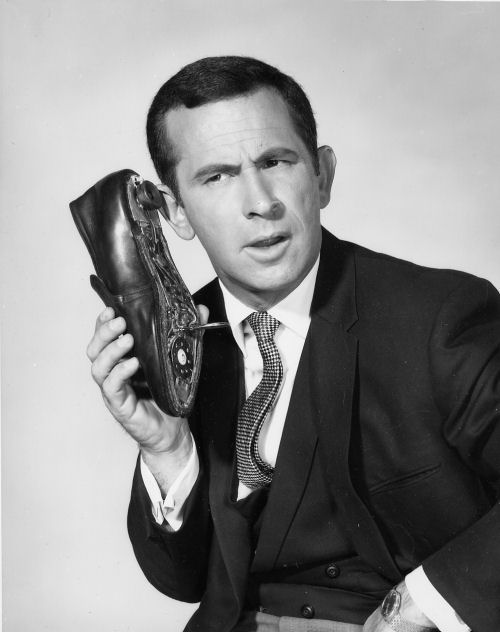
That's the question. And at that point, to say any more would be spoiling one of the best, deepest and engaging drama-thrillers to come down the aisle in a long time. 
Supposedly, when Clooney saw this script by Tony Gilroy he wanted to direct it, but deferred to Gilroy who probably saved this screenplay for himself. One of the better script doctors, it was his work on the "Bourne" series of films that made his name, and his directorial debut crackles with the same precision he brings to one of his unaltered screenplays. Just to allay Warner Bros. fears, the film is top-heavy with directing talent: Clooney stars and produces, Steve Soderbergh and Anthony Minghella are on the production side, as well as Sydney Pollack (the film feels like a Pollack project) who pulls off a career-best performance as the law partner on top of all the chaos.
Michael O'Keefe makes a welcome return to films as the firm's "asshole" (I wonder if its on his business cards), and Tom Wilkinson's Edens—babbling, disheveled, isolated, walking around in a pure light that only he knows is there—is the showiest part, has the best lines and the actor throws off his customary restraint and relishes the opportunity. Tilda Swinton is all contained paroxysm as an outwardly smooth CEO whose veneer of respectability is as thin as that of the chemical company she heads. Then there's "The Clooney", all-furrowed, with a Raymond Burr hood over his eyes, hating himself and everything he's doing. His one moment of respite has all the subtlety of a burning bush.
And then, things get interesting.

It "synopses" like a drag, but it's sharp, cynical, and has a "nailed it" kind of ending that makes it all worth it.