Showing posts with label Albert Finney. Show all posts

Wednesday, July 27, 2022

The Entertainer (1960)

The Entertainer (Tony Richardson, 1960) One thing about Laurence Olivier, he was an actor for all genres. Yes, he was primarily known as a stage and film Shakespearean, probably the greatest, but he also did light comedies, thrillers, period dramas, horror films, the occasional cheese-fest...everything...including the kitchen sink. Kitchen sink dramas, that is. 

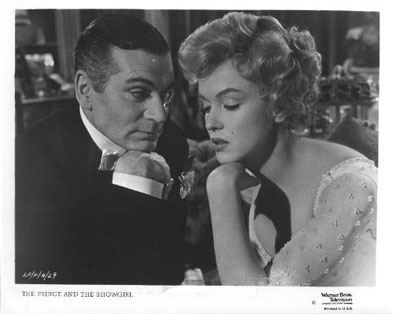
In My Week With Marilyn—the fictionalized telling of the filming of The Prince and the Showgirl—Kenneth Branagh's Olivier announces he's done with directing (after his on-set tussles with Monroe and finding out she's incandescent on-screen, anyway, despite his direction) and is going back to the stage to do a John Osbourne piece. That would be "The Entertainer," the play on which this film is based. On stage, it vacillated between life on-stage for Archie Rice (Olivier), and at home, where...well, he's never really OFF-stage, a needy vaudevillian with an alcoholic second wife (Brenda De Banzie), three kids (>Albert Finney, Alan Bates, and Joan Plowright—who would become the last Lady Olivier), and a slightly more talented, but no more wiser live-in Da (Roger Livesey).
For now, Archie is scraping by, as star/producer of a boardwalk diversion at a seaside holiday camp, in the perfect venue—an old, faded theater, where the air is as stale as his material. His day is only vital in the afternoons and early evenings in the bustling chaos of on-stage and backstage. The rest is the hummest of drums—wife in her cups, son off to war in the Suez, youngest son helping Dad in the dive, and daughter teaches art to a bunch of barely interested teddy-boys and girls. She goes to the seaside, seeking out Father, looking for some form of stability before settling into a perfunctory marriage.
She should have gone somewhere else
. Archie is only accessible on-stage, and when off, he's trying to hustle another season, another venue, another donor, another prospective starlet. Life just isn't good enough for him if a limelight isn't on him and the money's starting to run out to pay the electric bill. Much was made of the play as a comment for the fading empiricism of Great Britain, as personified by the propped-up jolly-good Archie, for whom the show must go on, despite not having any juice in it for years, surviving with a heavy layer of rouge and grease-paint to give the long-distance impression of vitality and youth, blithely ignoring the march of time and pasting it over with the false grin of performance, no matter how desperate it may come across.
Richardson's film opens the play up, puts instance on Archie's transgressions on-screen instead of just being talked about and blubbered over, and Olivier sticks out like a sore thumb—rightly so—apart from the rest of the cast. Where Livesey is old-school formal and the kids are new-broom casual, Olivier sticks to his guns with a theatrical performance which feels appropriately, desperately false, which benefits the film while also making the character of Archie a complete outsider, a role he no doubt relishes. There's only one star in this "revue," everybody else is a bit player. 
For Olivier, it must have fulfilled some need—to slum, maybe, or to reach out to the new material being generated by Osbourne, Richardson and others in the new school of British rebellion. Maybe, after his long string of kings, princes and noblemen, he wanted to explore the has-been's and ignoble men, to cultivate portraits of characters of a more stratified than rarefied stripe. There's also an element that Olivier might have been familiar with—the performer's ennui, bordering on contempt for his audience. 
At this stage in his career, Archie is performing for himself—the money's not great, the material stale, and any creative collaboration is non-existent—the most intimate relationship he has is with his make-up mirror and even that is betraying him. Olivier is not above showing bitterness—he was particularly adept at tartly spitting out the ironic put-down in the guise of civility. And he was acknowledging his age (he was a very old Hamlet in his film of it) and the potential for failure, by portraying it, challenging it, mocking it, waving a red cape at it, maybe exorcising it.  It was a brave interesting role for Britain's leading thespian
.

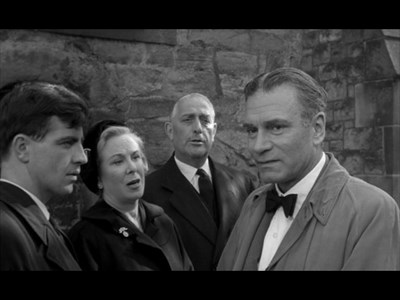
Olivier as Archie Rice: "The Roar of the Greasepaint"

Tuesday, May 5, 2020

The Bourne Ultimatum

Written at the time of the film's release...

Bourne ...Again?

I read "The Bourne Identity" decades ago, back when there was still a "Carlos, the Jackal" wandering the Earth, discriminately causing focused havoc and then disappearing. No one had seen him. He had never been photographed, and his reputation as an international terrorist (back in the day, when it had an odd, ghoulish glamour to it) was known world-wide. I bought the book for the "Carlos" angle, and dove into it eagerly.

I hated it. One of the dullest "thrillers" I've ever read, it seemed like it would never end. I wanted to have amnesia just to forget it after finally making it to the last page. It was made into a Richard Chamberlain mini-series which I never saw, and then into a film back in 2002. At the time of its premiere, there was no feeling that it would amount to anything, after all, it starred Matt Damon as Bourne, and his last couple of movies tanked quickly. There'd been a ton of re-shoots and the opening delayed for six months. All bad signs.
So, when I finally caught up with it, I was surprised to find it a good, credible thriller. How? Tony Gilroy's screenplay threw out the book, and kept the "amnesiac assassin" part. Doug Liman's direction kept the thing moving, the fights were spectacular, and even the tired concepts like a car chase through Paris were done with a great deal of panache. It also had a great supporting cast with Famka Potente, Brian Cox, Chris Cooper, Julia Stiles and Clive Owen. Paul Greengrass followed up with an equally spectacular version of The Bourne Supremacy and he's the man in charge of "Ultimatum."
As an exercise in montage, it's absolutely amazing. I rarely saw a shot held for more than five seconds. Greengrass has such a command of what he's shooting and is such a whiz supervising the cut, that you get just enough information to propel you forward--no more, no less--but you never lose a sense of where things are, and the danger the protagonists appear to be in (as opposed to, say, Michael Bay who cuts just as much but never with the discipline of story-telling that Greengrass does). Case in point: there's a long, protracted fight (of course, one of several) in a Tangier apartment. At one point, it heads into the kitchen most of it done in an overhead shot, presumably to hide the stunt-doubles. Now I was watching pretty closely, but, as is inevitable in the kitchen, a knife becomes involved, but I never saw it. I only HEARD it.

Just enough information to advance the plot. It is fascinating to watch.

But despite that, one has to confess that The Bourne Ultimatum has little to differentiate it from The Bourne Supremacy, or The Bourne Identity, other than there are key plot-points, like "The Story Begins" or "A friend is killed." This one picks up immediately where Supremacy ends. Some personal details are cleared up, but it's basically "run to Moscow/London/Tangier/New York and avoid detection/fight/chase." All cleverly done, mind you...but it's barely different from what we've seen before. There is a resolution of sorts, which distinguishes this entry, but that's about it. And, amusingly, the whole thing wraps up with a circular story-telling logic that puts us right back to square one.
"It's over when we've won!" bromides David Strathairn's anti-terrorism "deep cover" head*

With all the room for a sequel that this movie provides, I guess we haven't won yet.

------------------------------------------------------------------------------
Now, to be perfectly silly, here is the chance that the Producers had to have a hit song by changing the title to "Bourne 3." My lyrics for the Main Title song are as follows (to the tune of "Born Free")

Bourne "3"
As "3" as a trio
With fights of such brio,
Bourne "3," just like "1" and "2"

Bourne "3"
The Bourne Ul-ti-ma-tum
Not hard to cre-ate 'em
Just change the cars and locales

Bourne "3"
'cuz trilogies make dough!
The box-sets are in the store
in time for number "4!"

Bourne "3"
The last one that I'll see
It just don't intrigue me
Un-less it's freeeee!

* It's another great cast with Joan Allen and Julia Stiles returning--Greengrass makes maximum use of Stiles' lack of expressiveness--Scott Glenn, and Albert Finney, and a seemingly endless supply of stunt actors who look convincing carrying a gun.

Thursday, April 30, 2020

The Bourne Legacy

Written at the time of the film's "a-bourning."

Baby, We Were Bourne To Run
Or
Pursued By Our Inner Damon's

The "Bourne" series laterals the ball to another player in The Bourne Legacy, the fourth film of the series, which, by now, has nothing to do with the Robert Ludlum books on which they are titularly based (which is fine, as I read the first one decades ago and found it one of the worst reads ever).

When last we left Jason Bourne, he'd jumped into the East River to make a desperate escape from his pursuer/handlers, a nice turnaround from when the series started with him being fished out of the water with no clue as to his identity. We start there again, but this time, we're Bourne again in another body of water with Aaron Cross (Jeremy Renner) on a training mission way out in nowhere, Alaska (all the better to see Russia, apparently), while the events of the previous Bourne trilogy play out in the States, sending a panic through the intelligence community and an order to purge the Treadstone Project (or is it Operation Outcome...or Operation Blackbriar...only Tom Clancy could keep track of this...and then he'd start a book-series (ghost-written) on each one!).  
Whichever project is being scorched to the Earth, the talents from the previous movies (Scott Glenn, Joan Allen, David Straithairn) are dealing with the ramifications of Bourne's re-appearance, another intelligence head* (Stacy Keach-welcome back, sir) puts another middle-management type (Edward Norton) in charge of damage control (an impossible task in any recent spy film).**
As it becomes readily apparent on Renner's training mission, we didn't know diddly about the Bourne project (whatever name it was), as there are other agents like him, who are not only trained, but drugged to enhance their physical endurance, but also mental faculties (take the green and blue pills, but the yellow one you should really take with water or it gets stuck in your throat, evidently). Just as Cross is about to rotate stateside, he and another agent get a drone-launched nasty-gram stating unequivocally that the mission is over.
That's how it starts, and goes all over the world, subsequently, even while it doesn't really go anywhere.  Oh, things happen, and things explode and people run around a lot (Rachel Weisz is a really good runner, by the way), but it's mostly just movement without any story momentum.  Most movies have a beginning a middle and an end, but this one is content to merely have a beginning, a middle and a chase.  
Tony Gilroy (who cracked the code for the first film—taking the germ of the idea and stream-lining it into a bare essentials man-on-the-run movie—directed the brilliant Michael Clayton and the disappointing Duplicity, one of those "I-get-the-drift-but-it-doesn't-work" movies) co-wrote this one and directed, employing the same kind of Paul Greengrass "run and shoot" style, but taming it down a bit, so it can be followed, as opposed to experienced in barely discernible flashes.*** 
It's a risk because the Greengrass adrenaline-fueled style keeps one from asking too many questions about the slowing-down factor of injuries and leaps in story-logic.  All well and good, I suppose, but one still gets the sense that Legacy is half-baked, with the kernel of an idea, some complications to keep things from getting too stale and large holes in the script filled with "a fight breaks out," "a chase happens," and "hero jumps from a fire escape into a window." 
These all happened in the previous films, but I'll be damned if I can remember which specific ones—I suspect the answer is: "All of them." They all blur together as the most memorable things are the action sequences, and there's a remarkable...uh...consistency to them. The stakes are only the agent's own and most of the film's have very little resolution to them. Legacy has none. It just ends.
While one can admire the proficiency with which it is done, there's nothing all that memorable about this one...or the last one.  Even with fresh faces and a new idea of two, it's the same old thing, hardly worth being "Bourne" at all.
* You know, one could make a case for the excesses of "Big Gov'mint" just by noting the cast of good character actors in the "Bourne" series and all the different intelligence branches and mid-levels.

** Who fixes things in these films-and why haven't the unemployment rates dropped as a result?
*** This helped by a change in the style of Dan Bradley, who seems to have taken a film directing class in the interim, because his second unit direction in the chase sequences actually have some shots that feature relationship perspective going so far as to even including both participants in the chase in the same frame.  That's some kind of break-through after his disastrous work on Quantum of Solace.

Tuesday, August 22, 2017

Murder on the Orient Express (1974)

Murder on the Orient Express (Sidney Lumet, 1974) There's a new version of Agatha Christie's "bottle mystery"* coming at the end of the year (directed by and starring Kenneth Branagh). I'm not sure why it's necessary as it was remade in an excellent version of the British television series featuring David Suchet in his long-running portrayal (24 years) of Christie's eccentric Belgian detective with the extremely effective "little grey cells." 

We'll discuss that very interesting version a little later. For now, we'll turn our attention to the all-star version produced by EMI and distributed in the U.S. by Paramount, with Albert Finney as Hercule Poirot. Producers John Brabourne and Richard B. Goodwin wanted to "pull out all the stops" on the production just to get the film rights from Dame Christie, who was still alive at the time and had expressed that, after the Miss Marple movies of the 1960's starring Margaret Rutherford, she was "allergic" to filmed adaptations and clutched her film-rights to her like a precious jade statue. The two producers enlisted Brabourne's father-in-law, Lord Mountbatten, to reassure Christie of the producers' elevated intentions and she gave her guarded approval.**
Sidney Lumet was hired to direct—he was acknowledged to be a "tasteful" director, one who could supervise good performances out of most actors, and he'd recently had success with Serpico—and he began the process of casting, first hiring Sean Connery (with whom he'd worked often and whom Connery had hand-picked for movies he had some creative control over) in order to attract other A-listers, who, with Connery's presence, flocked like seagulls. Lumet had fond memories of making Orient—he centers most of the anecdotes in his book "Making Movies" around that production and how smooth it was. Lumet focused on "elegance" hiring cinematographer Geoffrey Unsworth, production and costume designer Tony Walton, and to touch up Paul Dehn's script, playwright Anthony Schaffer—who went uncredited. 
There are some movies that can only be described as a "souffle" and Murder on the Orient Express is one of those. Hercule Poirot (Finney) must catch the Orient Express at the last minute, but his conductor-friend Bianchi (Martin Balsam) manages to find a room for him in coach when a Mr. Harris fails to appear. Because the Express is unusually crowded for the time of year, Poirot is grateful for the consideration and settles in for a pleasant trip. The passengers are a mix of the rich—the Princess Dragomiroff (Wendy Hiller), the Count and Countess Andrenyi (Michael York and Jacqueline Bisset)—the nouveu riche—actress Harriett Belinda Hubbard (Lauren Bacall) and Col. John Arbuthnot (Connery)—and the humble—missionary Greta Ohlsson (Ingrid Bergman), governess Mary Debenham (Vanessa Redgrave) and servants McQueen (Anthony Perkins) and Beddoes (John Gielgud),*** in the employ of an uncouth American businessman Samuel Rathcett (Richard Widmark).
Ratchett strong-arms Poirot into dinner to ask for his protection—he believes his life to be in danger and that he might be murdered on the train. As Poirot happenstantially is in the room next to his, the detective thinks it highly unlikely, and retires to his cabin, where he has a restless night punctuated by a scream, Mrs. Hubbard complaining about a stranger in her room, and a mysterious woman in a red kimono. Oh yeah, and the train has come to a stop due to an impassable snow-drift. 
It turns out Ratchett is not only uncouth, but rather psychic, as well. In the morning, he is discovered in his locked and chained compartment—the window open—dead from multiple stab-wounds, by his servant Beddoes and secretary McQueen. Now, I'm no detective, but I've seen lots of movies, so seeing as how the secretary is played by Anthony Perkins and the victim died of multiple stab-rooms, it makes him the most likely cinematic culprit—especially given the mysterious woman in the red kimono.
Clues start to appear that Poirot tracks like a pig hunting truffles. He interviews all the passengers on the train, who react in varying degrees between timidity and righteous indignation and the train's kitchen seems to be having a run of red herring. What's an Agatha Christie detective to do?
Why, pull everybody into the dining car and start a spirited game of musical murder motives that touches on every single passenger sweating in the dining car, intercut with highlights from the interviews that Lumet now has in one of his more obvious tropes—the flash-backs now occur in his trademark wide-angle lens close-up's distorting the faces into disturbing emphasis****—as if the cut-aways themselves weren't enough to make us pay attention to them. If you watch enough Lumet, you can tell when he wants you to really notice something—by bending the world into unfamiliarity. It's as subtle as being hit with a hammer.
Murder on the Orient Express is unique in the Christie mysteries—the detective comes up with two possible solutions to the murder and must decide which of the alternatives to present to the authorities. It is a case of literally choosing the lesser of two evils—now, that would have been a hell of a title—and Poirot must weigh the consequences of the morality of his choice—one of the few instances where Poirot feels himself morally compromised and must live with his conscience for his choices. The only other time that happened was his last case, "Curtain."
But, not so much here. Lumet and Dehn and Schaffer are having such a grand ol' time, such moral ambiguity never comes up, only a sense of self-satisfaction in an extended curtain call of sorts (Vanessa Redgrave even winks sassily!) all to a frothy, jaunty Richard Rodney Bennett score that sound like it would be a good accompaniment to a Victorian ferris wheel.
And that's the problem. Lumet's first choice as a composer was one of the great film-music masters, Bernard Herrmann. Lumet expressed interest in him creating something fun and opulent after Herrmann screened the film and Herrmann became apoplectic. "That train," he roared "is a train of DEATH!" 
And just so. It doesn't matter how much you gussy up a corpse, it's still rotten. Herrmann, who had scored many a murder—and much passion—in his career (and who would close out his career, and life, scoring Taxi Driver) could not and would not put music celebrating getting away with murder. But, Lumet, who excelled at details but could miscalculate spectacularly in The Big Picture, just didn't see it. He—and the producers—wanted an all-star romp. And that's just wrong. Evil, even under the guise of self-righteousness, even when practiced in the most opulent of board-rooms and Presidential Suites, is not a parlour game. It is what makes Christie's work—emanating from such a source as she—is so perverse.
I much prefer the 2010 ITV production starring David Suchet as Poirot, which is darker, grittier, and less concerned with glitz and star power—despite a meticulous production design and a cast that includes Eileen Atkins, Barbara Hershey, Hugh Bonneville, Jessica Chastain, David Morrissey and Toby Jones. In a darkened Orient Express—power has gone out on the snow-trapped train—the suspects huddle in the dark and tensions are high. It is also mentioned (with Christie's inherent class-prejudice) that such a polyglot of like-minded people could only emanate in the melting pot of America. Suchet's Poirot is far more conflicted, and the last shot is of the detective walking away from the scene of the crime, his eyes tearing from the cold, maybe, but probably for the same reason he clutches a rosary in the fervent hope of forgiveness.
So, again...Kenneth Branagh is doing a new version to be released in November of this year, and one can only speculate where it falls on the morality question, as it is written by Michael Green who's had a hand in the scripts for Green Lantern, Logan, Alien: Covenant and Blade Runner 2049. It's hard to say, but it will probably depend on whether it's written by one hand...or by committee.
* "Bottle mystery" because the setting is restricted to the train—the many suspects contained in a single space from which they cannot escape, the fabled Orient Express. Christie's story was published in the U.S. under the title "Murder in the Calais Coach" to avoid confusion with a Graham Greene book that, itself, had its title changed for the American market.

** She quite enjoyed the film with one caveat—as much as she enjoyed Finney as Poirot, she didn't like his mustache.

*** There are also character actors Colin Blakely, Rachel Roberts, Denis Quilley, and George Coulouris (of The Mercury Theater). As the jokes goes: "Any names?"

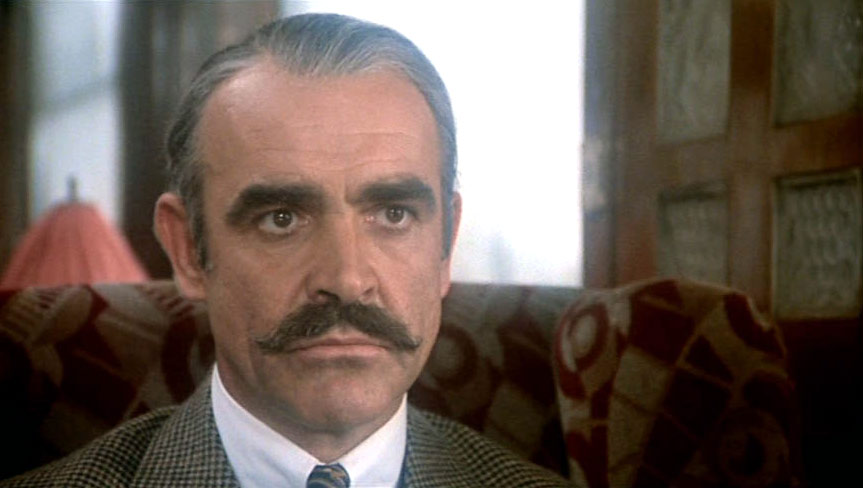
**** Examples of Lumet's technique—initial and flashback: Wendy Hiller and Sean Connery.

Friday, July 29, 2016

The Complex Art of Film Noir: Winter 2007

Written at the time of the films' releases. I still find it interesting that both these movies were released on the same day.

I: "Before The Devil Knows You're Dead"*

In Broad Daylight

The road to Hell is paved with good intentions. Just ask Andy and Hank Hanson. They both need money because they want to do right by their families: Andy, so he can get out of debt and maybe move with his depressed wife to Rio de Janeiro; Hank, because he's a few months late in child support, and he wants to do right by his daughter...oh, and his mistress, and ...well, all of Hank's dreams are short-term.

But Andy has a plan that's fool-proof: a robbery. "No one gets hurt. It's perfect." Trouble is, Hank's a fool, and he agrees before he knows all that it entails. Andrew, a real estate accountant, gives him a down-payment. "There's $2,000. See what that does for you. Imagine the rest."
They can't imagine. Because, as they say in the magazine-shows, things go "horribly, horribly wrong."
Before the Devil Knows You're Dead might belong to that sub-genre of comedy films called "The Incredible Mess," where seemingly simple plans go increasingly awry, but it's no comedy, except in the perverse way perfect disasters pile upon perfect disasters. 
I would contend, however, that the movie, as written by Kelly Masterson, is a film noir, that species of film where the world maliciously has it in for an honest man, and corruption runs so deep that it's manifested in a shade of fathomless blackness--"where the world is dark with something more than night," as the saying goes. One of the laureates of the proto-noir story was Raymond Chandler, who laid out the ground-rules for his brand of detective fiction in an essay titled "The Simple Art of Murder," first published in 1944, and quoted extensively below.** In it, he railed against the "drawing room" brand of detective fiction as weak and unrealistic, and that a detective-hero must try and find Truth in a fabric of deception, obfuscation, and agendas so thick it's like wading through a cess-pool. 
Before the Devil Knows You're Dead is so steeped in layers of corruption that any transgression amplifies to the worst possible conclusion, and by chain reaction drags the innocent down as well as the guilty in a tragedy of Shakespearean consequences. No one is immune from the veil of evil. The world of Before the Devil Knows You're Dead is so corrupt, there is no hero. And it all happens in broadest daylight.
There have been "daylight-noirs" before, like Gun-Crazy, and, of course, Chinatown, which takes place in sun-blasted L.A. But Devil is centered in New York, and mostly gentrified New York at that. New York, because the director is Sidney Lumet, who quite rarely makes a movie anywhere else. Lumet's an odd choice for a noir film, although he's made many films in The Big Apple's squalor—Serpico, The Pawnbroker, Prince of the City, Q & A, and he's made many movies that intertwine family and crime—Dog Day Afternoon, Murder on the Orient Express, and Family Business. As a director, he's not very stylish, and is, in fact, pretty clunky, as in Twelve Angry Men, and Fail-Safe, or, dare I mention it, The Wiz. Lumet expends his energy on performance, rather than construction. In fact, Lumet has rarely risen above his roots as a director of live television: a master shot, the occasional close-up, and that's about it. His camera work is utilitarian at its best, sometimes inelegant, brightly lit, nothing fancy. He tends to downplay using film scores (except as punctuation, however, when he wants mood, he will overdo it, as per Murder on the Orient Express), thinking them too pervasive and detracting from a scene's manufactured reality. When he does try something different (in other films, it was crudely distorting lenses) it's always in your face. Here, it's an editing transition that flashes forward and back three to four times, similar to the "druggy" transitions in Easy Rider, but with an annoying clacking noise at each edit. The story-telling technique employed is similar to that of another noir, Stanley Kubrick's The Killing, where the actual caper is viewed from one character's point of view, then rewinds back to another participant's during the same time period and beyond. The plot advances and coalesces in increments until the inevitable end-game where all stories come together. And Devil ends in the only way this noir-in-daylight could end.
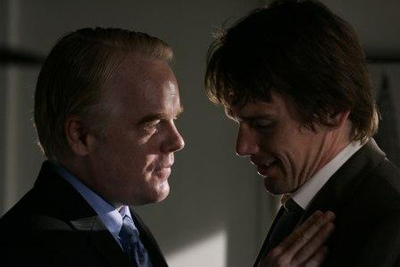
Because it's Lumet, it's the performances where the movie shines: Philip Seymour Hoffman is all sweating self-pity as Andrew, Ethan Hawke is Hank, a pitiful train-wreck doing a poor job of trying to appear "together", Albert Finney goes a bit over the top as their father Charles, and Marisa Tomei shows the promise that her early Oscar win belied as Andrew's wife, caught in the middle. But the smaller performances of minor characters like Michael Shannon and Aleksa Palladino stand out as well. It's a blackly depressing film that owes whatever greatness it achieves to the writing and performances.

II: "Gone Baby Gone"

That, in All Things

Now, walk down these mean streets a little further--all the way to Boston. Here you'll find private detective Patrick Kenzie, the very definition of the term John D. MacDonald used to describe Raymond Chandler. "He writes," said MacDonald "like a slumming angel." Kenzie knows the back-alleys, the crack-dens, the gang-bangers, the dealers, the dive bars and the angles and he knows how to handle them with a cock-suredness that belies his years.*** But that street cred only takes you so far, because although he's lived in Boston his entire life, New Orleans transplant detective Remy Bressant (Ed Harris--extraordinarily good) tells him "I've been here longer than you've been alive."
And Bressant has seen the long continuous story of those places Kenzie merely visits. But if Bressant knows more, nobody tops Captain Doyle (Morgan Freeman, completely dominating the three scenes he's in), whose daughter was kidnapped and killed, and has dedicated his life to making sure it doesn't happen again on his watch. 4½ year old Amanda McCready has gone missing from the neglectful eye of her good-for-nothing mother and Kenzie and his partner Angie Gennaro (Michelle Monaghan) have been hired by an aunt to find her, however reluctant they are to take the case. Within 24 hours, there's a good chance they can find her alive and unharmed. She's been gone, now, for 60.
And soon, after all the slumming and the chance-taking, the compromises with the police and the stake-outs gone bad, the case comes to a dissatisfying end, and like any good noir dick, that's just not good enough for Kenzie. He has to keep pushing for Truth, no matter how hidden, no matter the consequences. But the Truth hurts and can lead to decisions made for the best of reasons but the worst of consequences. And this "slumming angel," this noir-hero by Chandler's precise description, will suffer the consequences for his decision, both personal and professional. But because he is the hero, he must fight that corruption even if the result is not a more perfect world, but the same tainted world as when he began. And maybe, even one that's worse.
As it happens, there is no moral high ground here. There is no "right" and "wrong" for the situation is too far out of control for there to be a "right" and a "wrong" and the two step over each other's line as often as a police tape is crossed. The resolution of the story, the choices made can be argued for days, and the last shot of the movie damns even as it takes the film to a logical conclusion.
This has been a great year for Casey Affleck. First, he stepped out of the star-crush to become more than a glorified extra in Ocean's 13, carried the bulk of The Assassination of Jesse James by the Coward Robert Ford, and now holds his own against Morgan Freeman and Ed Harris at the height of their powers. His performance in Gone Baby Gone shows great versatility and an amazing range. 
But if Casey's potential has come to fruition, the emergence of Ben Affleck as a director is nothing short of a revelation. Here he shows a command of time and place, and a wonderful eye for faces that lend authenticity to the grime of the surroundings. An action scene at night may not be as focused and suspenseful as it should be, but the rest of the movie is assured, and negotiates moral discussions without getting bogged down in high-handedness or slowing the movie down. That fine directorial touch extends all the way to the wickedly oblique final shot that will creep on you days after the fade to black. Given this auspicious debut, one looks forward to the next film featuring Ben Affleck behind the camera.

The view from 2016: Before the Devil Knows You're Dead was Sidney Lumet's last film; Gone Baby Gone was Ben Affleck's first. I still find Lumet's approach to making films limited and dispassionate. As a director, he is not subtle in how he shapes a film to get a reaction out of an audience with his invasive angles and choice of lenses. He is not so much a story-teller as a propagandist—and not in the sense of having a political leaning, although he had one, which has nothing to do with his film-making approach. Lumet makes directorial choices that does not let an audience make up its own mind...on anything. That technique approaches the dictatorial in how he presents—when Lumet makes a point, he makes it with all the subtlety of a brick through a window. In a way, I think Lumet has never trusted an audience. If he had, he might have played things a little looser, which might be why, when he's attempted a comedy, they've tended to fall flat.

Which is why the pairings of Gone Baby Gone and Before the Devil Knows You're Dead is of such interesting coincidence. I'm not going to say that first-time director Ben Affleck is a better director than Sidney Lumet, but he sure does trust the audience more. He leaves you with such a complex moral dilemma that it generates more questions than answers. Lumet would never allow questions and would telegraph the answers. Lumet may generate outrage, but he doesn't generate thought (unless he's so obtuse, you wonder what his point was). Affleck, with this movie and his second film The Town**** (but not Argo, his crowd-pleasing Oscar-winner—that one's pretty cut-and-dried) did not telegraph easy answers or opinions. If anything, he left you hanging with ambiguity, wondering what came next. Starting out, at least, his movies seemed to indicate that they continued to have life after he shut off the camera. Affleck leaves you wanting more. Lumet says everything that he has to say.

Affleck has had the benefit of more hind-sight than Lumet and less time in the director's booth of TV. That's an advantage, and his movies feel less staged and less in a bubble-universe all their own than Lumet's.

I guess that this is an explanation that all these years later, that I think Affleck's first film is better than Lumet's last. Interesting.


* After the Irish toast: May you have food and raiment, a soft pillow for your head. May you be forty years in heaven before the devil knows you’re dead.

** Raymond Chandler, perfectly describing the fetid world of "noir" in "The Simple Art of Murder:"

"The realist in murder writes of a world in which gangsters can rule nations and almost rule cities, in which hotels and apartment houses and celebrated restaurants are owned by men who made their money out of brothels, in which a screen star can be the fingerman for a mob, and the nice man down the hall is a boss of the numbers racket; a world where a judge with a cellar full of bootleg liquor can send a man to jail for having a pint in his pocket, where the mayor of your town may have condoned murder as an instrument of moneymaking, where no man can walk down a dark street in safety because law and order are things we talk about but refrain from practicing; a world where you may witness a hold-up in broad daylight and see who did it, but you will fade quickly back into the crowd rather than tell anyone, because the hold-up men may have friends with long guns, or the police may not like your testimony, and in any case the shyster for the defense will be allowed to abuse and vilify you in open court, before a jury of selected morons, without any but the most perfunctory interference from a political judge.

It is not a very fragrant world, but it is the world you live in, and certain writers with tough minds and a cool spirit of detachment can make very interesting and even amusing patterns out of it. It is not funny that a man should be killed, but it is sometimes funny that he should be killed for so little, and that his death should be the coin of what we call civilization."

***
Raymond Chandler, "The Simple Art of Murder" again, describing the detective hero:

"In everything that can be called art there is a quality of redemption. It may be pure tragedy, if it is high tragedy, and it may be pity and irony, and it may be the raucous laughter of the strong man. But down these mean streets a man must go who is not himself mean, who is neither tarnished nor afraid. The detective in this kind of story must be such a man. He is the hero, he is everything. He must be a complete man and a common man and yet an unusual man. He must be, to use a rather weathered phrase, a man of honor, by instinct, by inevitability, without thought of it, and certainly without saying it. He must be the best man in his world and a good enough man for any world. I do not care much about his private life; he is neither a eunuch nor a satyr; I think he might seduce a duchess and I am quite sure he would not spoil a virgin; if he is a man of honor in one thing, he is that in all things. He is a relatively poor man, or he would not be a detective at all. He is a common man or he could not go among common people. He has a sense of character, or he would not know his job. He will take no man’s money dishonestly and no man’s insolence without a due and dispassionate revenge. He is a lonely man and his pride is that you will treat him as a proud man or be very sorry you ever saw him. He talks as the man of his age talks, that is, with rude wit, a lively sense of the grotesque, a disgust for sham, and a contempt for pettiness. The story is his adventure in search of a hidden truth, and it would be no adventure if it did not happen to a man fit for adventure. He has a range of awareness that startles you, but it belongs to him by right, because it belongs to the world he lives in.

If there were enough like him, I think the world would be a very safe place to live in, and yet not too dull to be worth living in."


**** Preview of Coming Attractions:  I'll post the review of The Town and Argo tomorrow.