No, this is history writ large, and blown up to distorted proportions. It needed to be to accommodate the characters Milius chose to inhabit this story: the man who instituted the crisis, the Raisuli (played magnificently, if improbably, by Sean Connery—with Scottish burr intact), and the then-President of the United States, Theodore Roosevelt (maybe the best role Brian Keith ever played).
Milius must have fancied this an "alternative" history while he was writing it. For instance, in the description, he refers to reporters being from the "Kane" papers (as in Charles Foster Kane, the fictional newspaper magnate from Citizen Kane), not the Hearst papers. Also, and I found this particularly charming, he wrote the screenplay in the past tense.
Of course.
But, The Wind and the Lion was an opportunity for Milius to write for one of his favorite figures in history, President Theodore Roosevelt, with all the brio, the bluster, and the b.s. that "Teddy" could spew, holding court. There is very little action for Roosevelt in this film—most of that is happening in Morocco—as he merely does Presidential things and use his "bully" pulpit. As his daughter Alice (played in the film by Deborah Baxter) remarked about him: "He wants to be the bride at every wedding, the corpse at every funeral, and the baby at every christening." The man did like being the center of attention. And he is portrayed that way in this film, except for one rare private moment at the end.
This post will be up for the Fourth of July, and usually, I put up the montage sequence from Mr. Smith Goes to Washington around this time. This year, though, rather than celebrating, we'll ruminate with Mr. Roosevelt about the American Character through the pen of John Milius.
Happy Birthday, America.
The Story: President Theodore Roosevelt (Brian Keith) is enjoying his days as President. He is building the Panama Canal, and running for another term. But there is always something—in this case, the kidnapping of the widow of an American diplomat, Eden Pedacaris (Candice Bergen) by Mulay Ahmed Muhamed Raisuli the Magnificent, sherif of the Riffian Berbers (Sean Connery) half a world away in Morocco.
Action!
Additions to the script are in green.Deletions are in red.
CAMP ON THE YELLOWSTONE DUSK
SCOUT:What'ya bring in, Colonel?
ROOSEVELT: Brought us some venison and a cougar.
ROOSEVELT: Heard about the bear...
ROOSEVELT: ...have you? SCOUT: Big one, I heard...
COOK: Coffee, Mr. President?
Roosevelt stood next to an enormous grizzly bear skin and head. Around him were various reporters for magazines such as "Colliers" and "The Nation" as well as those representing the Kane newspapers. He held the grizzly's head up.
REPORTER I: Is that the bear?
ROOSEVELT: This is the bear that attacked the horse camp at dawn.
ROOSEVELT: He knew that men would be asleep or at their worst at dawn.
ROOSEVELT: It, of course, as you've heard, injured one of the Indians severely...
ROOSEVELT: ...as well as killing several horses. REPORTER I: Did you, yourself, participate in stopping the bear, Mr. President?
ROOSEVELT: I regret to say, yes. REPORTER: Why do you regret, Mr. President?
ROOSEVELT:Because he's a fine creature.
ROOSEVELT: This was his valley.
ROOSEVELT: This valley belonged to this bear. We were the intruders here.
ROOSEVELT: We're used to animals taking flight at the sight of a man with a gun, but a grizzly bear fears nothing. Not man, not guns, not death.
REPORTER: Do you intend to have that bear as a rug in the White House, Mr. President? ROOSEVELT: Rug? No!
ROOSEVELT: No, I intend to have him stuffed and placed on exhibit in the Smithsonian Institute. He is a magnificent specimen. The grizzly bear, you know, is the true symbol of American character.
ROOSEVELT: A little blind and reckless, perhaps, but courageous beyond doubt.
ROOSEVELT: Oh, and one other trait that goes with all the previous.
REPORTER:And that, Mr. President?
ROOSEVELT: Loneliness.
ROOSEVELT: The grizzly bear must live out his life alone -- indomitable, unconquered, but always alone. He has no real allies, only enemies...
ROOSEVELT: ...and none of them as great as he. REPORTER: You feel this is...
REPORTER: ...an American trait? ROOSEVELT: Certainly, the world will never love us. They respect us...
ROOSEVELT:...they might even grow to fear us...
ROOSEVELT: ...but they'll never love us. We have too much audacity...
ROOSEVELT: ...and we are a little blind and reckless at times. REPORTER: Are you referring to the Panama Canal and the situation in Morocco?
ROOSEVELT: If you say so... He looked back at the bear. ROOSEVELT: Yes, the grizzly bear embodies the spirit of America. It should be our symbol, not that ridiculous eagle which is no more than a dandified vulture.
The Wind and the Lion(John Milius, 1975) I avoid seeing films twice unless I really, really love the film (due to a lack of funds).*When I saw The Wind and the Lionthe first time, it was as if I was seeing two movies at a time. The dialog was really wretched ("Mulay--that's a nice name"), but at the same time the photography, direction and editing were all fabulous. It was a film that had "sweep" (I assume that when a film has "sweep," the camera tends to move along a field, up a wall, through a street, "sweep" through the visual plane of the camera. Oh, but does this movie do that!) The Wind and the Lion just swells with movement of all kinds--inside the frame and the frame outside itself.
John Milius is a director I don't tend to think much of. I wasn't too fond of his Dillinger film, some good things, but not wholly satisfying.** But his direction in Wind & Lion is just marvelous. Some of the shots combined with Jerry Goldsmith's score*** are just chillingly beautiful: The trucking shot along a line of berbers silhouetted against a sunset; A diagonally rising crane-shot that drifts over a dune as an entire army of berbers move down a road while a dark, cloudy sky presses down on the whole scene;After the Raisuli (Sean Connery) has killed off the final horseman at the leper colony (that was the impression I got anyway) Milius cuts to a stunning shot of Eden Pedecaris (Candice Bergen) watching behind a net in the right foreground, while against a low sun on the ocean-tide, the Raisuli slows his horse and the now-riderless horse of his opponent still charges across the screen;Theodore Roosevelt (Brian Keith) and "his" bear towering over him, as he reads the "Wind and the Lion" letter.
The Letter: To Theodore Roosevelt - you are like the Wind and I like the Lion. You form the Tempest. The sand stings my eyes and the ground is parched. I roar in defiance but you do not hear. But between us there is a difference. I, like the lion, must remain in my place. While you, like the wind, will never know yours. - Mulay Ahmed El Raisuli, Lord of the Riff, Sultan to the Berbers, Last of the Barbary Pirates.
The second time around, my appreciation of the Milius direction grew. It was what I concentrated on throughout and because of it, the dialog that I was uneasy about went down easier and (My God!) some of that dialog was downright poetic. Roosevelt's speech about the bear as the U.S, symbol, his getting on his desk and growling at the camera for the Smithsonian--things that made me squirm in my seat before--I enjoyed this time around.
This movie is flawed to be sure. Some of the writing is still bad. There are inaccuracies in technique and in history. **** The fellow I went to see it with thought there were too many "riding-in-the desert" shots for his taste, but not for mine. And I heartily enjoyed myself and the film. I still enjoy it (now that I own it) and all qualms that I had about it are gone, and a lot of the things that I found a bit over-dramatic and even eye-roll-provoking are things that I now dearly love about it. I mean, the outlandishness is part of the appeal of the movie: who, for instance, would cast Sean Connery—with Scottish accent in full bloom*****—as an Arab chieftain? Somebody crazy enough to look past the piddly details and go for "what works"—and Connery is gloriously powerful and over-the-top in this.
Candice Bergen, who I found annoying the first go-'round, is perfect—she's supposed to be a burr under the Raisuli's saddle, like a grown-up Mattie Ross in True Grit—but she's also a very strong character in a movie that oozes testosterone. Faye Dunaway was supposed to play this and begged off—and Bergen more than manages and has a timeless look that's an improvement over Dunaway.
And Brian Keith—never better. The perfect actor to play TR in a performance that is winning, knowing and has more than a bit of "arena" in it, and the toll it takes on one when given a moment's privacy.
I neglected to mention the huge contribution that cinematographer Billy Williams brings to this movie. It is gorgeous, almost 3-D in it's compositions and depths of colors, as he carried out some of the beautifully outlandish shots Milius came up with.
I wish Milius was allowed to make more films (he's certainly been allowed to doctor scripts most of his career, and Turner gives him a mini-series or TV movie to do once in awhile). His is a singular voice in Hollywood, conservative, smart, and with an eye towards irony and a disdain for inaction and dithering. Along with his love of history and the U.S. (perhaps because of its flaws, rather in spite of them), his love of film is obvious, he's smart with what he does on film. One would wish.
Milius' cameo as a one-armed munitions dealer.
* This was 1975. It would be another five years before the video-tape boom that allowed folks to watch films in their own home, and even own media of that film. Seems like such a long time ago. Now, if one likes a film, one can buy it, and watch it as many times as they want. That's a great convenience--but it tends to make people cluster to stuff they like, rather than explore and take a chance on a new film. ** Again, this was 1975 and from the perspective of someone who, as yet, hadn't had to sit through Public Enemies which, by comparison, makes Dillinger look brilliant. I have to watch it again soon, because my memories of it—Ben Johnson's and Warren Oates' comfortable-shoe playing of their roles, Richard Dreyfuss' freak-out scene as "Pretty Boy" Floyd, the thread-bare look of the film because there was little money in the budget, but also, because it was the Depression—far outweigh any things I didn't like (which I no longer remember). *** An aside from this review here: "Goldsmith just happens to be one of my favorite film scorers. I snap up one of his albums as soon as it appears in the racks, and seldom am I ever disappointed with what I hear. However, one of Goldsmith's pieces doesn't seem to mesh correctly with the visuals--the Raisuli's initial ride on a horse gone hay-wire." Um--that was the composer's point, I think.
**** For instance, an incident like this DID take place during the Roosevelt administration. Ion Pedecaris WAS kidnapped by the Raisuli, in 1904. Ion was male. I'm sure it matters to history buffs and the sex-changing is probably sacrilege, but changing Pedecaris to a woman raises the stakes of the story, and provides a whiff of romance and exoticism. Without The Wind and The Lion that incident would have been lost in the sands of time. ***** My favorite line of the movie (and still produces a too-loud roar of laughter out of me) is a lovely panning shot of the desert and Connery's dreamy voice-over: "This is the Rif...I am Mulay Ahmed Muhamed Raisuli the Magnificent...sherif of the Riffian Berbers. I am the true defender of the faithful...the blood of the prophet runs through me and I...am but an instrument of His will." The cameras settle on Connery as he finishes his little resume to Mrs. Pedecaris, looking at her expecting some sort of reaction or acknowledgment, his horse restless beneath him. And when there is only silence, there is an exquisite pause, and in full Scot, barks: "You have nothing to say?"
Yankee Doodle Dandy(Michael Curtiz, 1942) Of all the films in James Cagney's storied career, his favorite was his most unusual—not one of his gangster films (some of which revolted him) or his dramatic efforts, but this one, the one that won him his Best Actor Oscar, the musical biography (very loose) based on the life of George M. Cohan. Cagney always described himself as "a hoofer," starting out as a dancer in vaudeville, and the athleticism did him well in Hollywood. Cagney's energy, timing, and directness—his grace (even if he was playing a hood)—came from this background, and the compensatory toughness came from his growing up and observing the streets, providing "that unmistakable touch of the gutter," as he eloquently put it in his acceptance speech for the second AFI Lifetime Achievement Award. Yankee Doodle Dandy begins with Cohan (Cagney) on Broadway playing Franklin Roosevelt in "I'd Rather Be Right" when he is summoned to the White House to receive the Congressional Gold Medal from FDR himself. The visit gives him a chance to tell his life-story to the President, which is presented in flash-back form, from his early days to performing with his family (Walter Huston, Rosemary DeCamp, Jeanne Cagney) to the lean years when stubbornness gets him blackballed in the theater community, and he has to struggle back to the stage by song-writing,*eventually coming back and becoming the King of Broadway.
It's still startling to see Cagney's dance moves; loose, limber below the waste, and ramrod straight above, his movements alternate between drunken sloppiness that looks like it could severely snap tendons if gone wrong, and stiff-legged woodenness, giving the impression that he's a puppet with the strings cut—not really in control of his own movements (and, of course, he always was—that was the illusion of it all, the mastery of it), but compelled to dance for the sheer energy of it forced him to do so. It's scary, but Cagney always is. He is, after all, the guy who shoots people by pumping the pistol forward, as if the movement puts more energy in the bullet to kill faster, make it more definite, more personal. His gangsters make the guns part of them, rather than just a tool.
Some of the moves look archaic, compared with the gymnastics-as-dance school today—the leaping and bouncing off a wall (as if there wasn't enough room on stage) looks tame now, even though it amazed me as a kid, but the high kicks I appreciate more, the toe-steps, the tap—all amazing. And they look spontaneous, which in itself is a marvel.
It's a feel-good musical about celebrating the spirit of America, which we all do on the Fourth of July. That it happened during war-time, added mightily to the propaganda potential of it (and, although it's always been denied, might've helped Cagney get rid of the "pinko" label he was being saddled with at the time—my, how times haven't changed). But, it's a fine achievement, and Curtiz, who's known for hating unused space in a movie frame, overcrowds the stages—every theater-piece for this director was "SRO." And, although something of an autocrat, with musicals he let loose the reins (something Cagney appreciated) and allowed spirit to flow. Maybe that's why Yankee Doodle Dandy still seems fresh.
It was voted into the National Film Registry in 1993 for being "culturally, historically, and aesthetically significant."
* Cagney could relate. He was constantly battling the Warner Brothers brass, at one point suing the production company and staying away. Jack Warner called him "The Great Againster."
** Evidently Cohan's final tap down the White House staircase at the end, was improvised.
Rock Me, Amadeus or Bravo Vibrato (Good and Bad, Heroes and Villains)
The other night I was casting around looking for something—anything—on television and landed on a PBS fund-raising version of "SoundStage" featuring "Brain Wilson and Friends," in conjunction with the release of his new album "No Pier Pressure" (heh...the promo is below) and the opening vocal harmony ("Our Prayer" from "Smile") raised the hairs on the back of my neck. It had the "Beach Boys" sound of blended harmonies, but had a melancholy, respectful air that moves the soul, a heady miasma of nostalgia and renewal. It's a revelation. Wilson, back in the time of "The Beach Boys," had far more "reach" than his fellow band-mates, who might have been content with surfing and car songs. But, while they were out on tour protecting the brand, recycling their hits over and over, Wilson moved beyond singer-songwriter and became what he was unofficially, anyway: producer. It was Wilson who came up with those "pet" sounds, odd combinations of instruments and timbres with their bizarre harmonics...that worked. It was revolutionary stuff, but had a childhood relatability that invited you in and imprinted themselves in your mind. His songs never go away...from the mind, from the heart, leavened with a look backwards, of nostalgia, upbeat still, but with grace-notes of regret.
Wilson is our Mozart—if Mozart had written about California beaches, girls and bikinis (which I'm sure he would have if he was ever made aware of them). Wilson's music was always several cuts above the standard "Beach Boys" fare, as his songs were fueled by serotonin, as opposed to testosterone. There was ambition in his songs, in the conception and production of them, ambitions that might not have been accepted in the pop marketplace of the '60's. But that is speculation. After the disappointing sales of his produced "Pet Sounds" album, (rebounded by the #1 hit status of the first release ("Good Vibrations") from their in-production album "Smile," band dissension, nervous record exec's and Wilson's own building insecurities scuttled what was to be the band's (and Wilson's) most ambitious album. For Brian Wilson, it led to creative roadblocks and a deep-ended wipe-out into a depression that he would not emerge from for years.
Wilson's story of his fall into and rise out of that depression is the make-up ofLove & Mercy, directed by Bill Pohlad (he's only directed one other feature) and written by Oren Moverman, who also wrote I'm Not There, the episodic Todd Haynes film "about" Bob Dylan, where different actors played aspects of the singer. A simplified version of the same approach is done in Love & Mercy, where Paul Dano plays Wilson pre-breakdown and John Cusack plays him post-breakdown. The results are mixed. But, one thing that is for certain is the eerie way Dano nails Brian Wilson in the heady days of The Beach Boys' success in the 1960's and his subsequent troubles. Dano resembles Wilson, he sounds like him, and captures the puppy-dog optimism of Wilson that percolated through his early songs and melodies, that could easily be shattered in a family crisis, which was inevitable as most of his band-mates were brothers or cousins, his father was their manager and estranged from the boys' mother.
Director Pohlad changes his style in the two movie sections, as well. The Dano segments switch from drama then zip to home-movie vignettes, like a Richard Lester movie. Cusack's segments are much more straight-forward and have far less energy, except from the fireworks provided by the actors—except Cusack. His Brian Wilson is a bit like a sad-eyed automaton, not entirely the actor's fault as Wilson at the time was being heavily medicated (more about that later), but it creates a fissure in the film that ultimately works against it—the segments post-"Smile" with Cusack just aren't as successful as the parts with Dano.
Evidently, there was a conscious decision between Dano and Cusack to not compare notes after their meetings with Wilson and their impressions of him; the actors playing Dylan in I'm Not There didn't confer, either, but the kaleidoscopic Dylan segments in that film aren't connected in any way—not in time, space, or (for that matter) dimension. Love & Mercy no matter its editing dynamic (in this case, going back and forth in time) is still a linear story—the artist went from here to there—so the two actors, so distinctive in look and style, make for an emotional disconnect. That they are two different stories in the same life—Brian's falling into depression, pre-"Smile"—and his rise out of it, offers no balm in that discomfort, it only enhances it. Having a different actor resolve the conflicts of the other leaves a feeling of a story only half-finished.
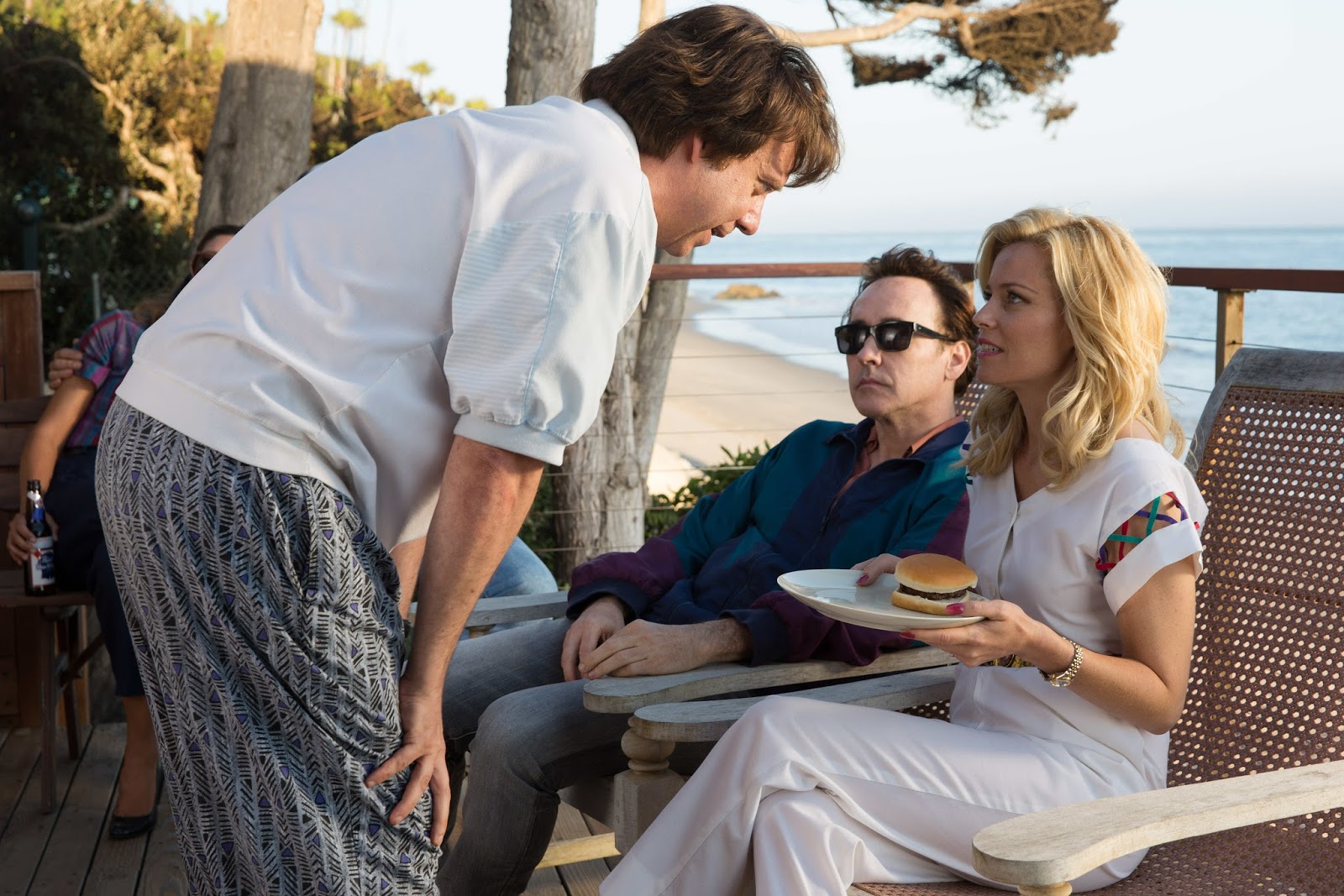
Cusack's part of the story is the one that is the most heroic, despite that Cusack is passive throughout (and you don't believe he could play, let alone compose, a lick of music). The purchase of a new car puts him in the orbit of car-dealer Melinda Ledbetter (Elizabeth Banks) who doesn't know he's "Brian Wilson of the Beach Boys" (as he will later be introduced)—of course not, he doesn't look a thing like Paul Dano. He's just a guy buying a car, albeit one who leaves a note on her business card saying "Lonely. Scared. Frightened." Before Banks can express her surprise by opening her mouth and blinking twice, into the showroom walks Brian's "minders," as well as Dr. Eugene Landy (played with a glowering malice by Paul Giamatti, acting on all thrusters), who smiles balefully through a tight smile, as he grills Melinda and Brian about what's going on, at the same time his eyes dart back and forth looking for signs of betrayal, his head lowered as if towering above people despite his small stature.
Giamatti's Landy is malevolent piece of work. Festooned in a toupee, he usually starts a conversation by apologizing for his previous behavior, like a bad father trying to retain your good side (and puts him in parallel with Brian's father Murry—played by Bill Camp—both self-important men who end up exploiting and resenting their meal ticket) Landy is Wilson's psychiatrist, life-coach, nutritionist, guru, and disciplinarian, as well as being the current tenant of his house (Brian's in another one and reveals his perpetual silver lining-search by saying "I got to pick my own room.") Landy sees the bond between Melinda and Brian and, in a requested meeting (by him), offers her "unprecedented access—but you've got to work with me." Landy's hold on Wilson is total, controlling what he eats and when, and hectoring Wilson into working at a piano (and taking co-writing credit). He's abusive, humiliating, while keeping his charge dosed on "allergy medications" that leave Wilson nearly catatonic. Landy has had him diagnosed a "paranoid schizophrenic" and while the singer-songwriter does hear voices in his head (usually in harmony), it's a wonder he's not paranoid what with the whole world against him, while lionizing him at the same time.
Except Melinda. For whatever reason, she decides to take on Landy—even when she is banned by him from seeing Wilson. For Brian, it's the end of a long line of using, usery authority figures, and, left alone, he is finally able to think for himself...and what he sees isn't too bad.
It's a great story and truly inspirational for anybody who has suffered clinical depression, as Wilson is an extreme case, crippled by his own need to achieve beyond his limitations and stalemated from being able to reach it, by forces without and within. Yet, there he is, now, in concert before thousands of enraptured fans, mixing old hits and new works (which are great, by the way—check out below) with a band of artists who manage to play his most complicated stuff...and do it live. Wilson finally cracked and completed "Smile" and performed it in concert before committing it to recording and posterity. Amazing. Heroic. He survived his second act and emerged triumphant for a third. His life, itself, is worth a standing ovation, and if Love & Mercy simplifies and homogenizes the depths of his despair for public consumption (as was done with A Beautiful Mind), at least it manages to capture some of the nuances that made the music so memorable the instant it went from Wilson's mind...to ours.