The Devil and Daniel Webster(aka All That Money Can Buy)(William Dieterle, 1941) I've known about this film for years, because it was the film that won composer Bernard Herrmann his only Oscar for Best Score ("of a Dramatic or Comedy Picture"), over 19 other scores nominated that year, including his own music from Citizen Kane.
The score is the stand-out element of the movie, with Herrmann accompanying the presence of "Mr. Scratch" with a particularly saw-toothed violin jig that raises the hair on the back of your neck. It is for sure that Academy voters had never heard anything quite like it, even if it did include some American folk-tunes (including "Pop Goes the Weasel!"). I was well acquainted with the music before I could track down the actual film.
It tells the story of Jabez Stonr (James Craig) a farmer, not making it in 1840 New Hampshire, who sells his soul to the Devil (Walter Huston) for seven years of prosperity, which he gets, along with a swelled head, the enviousness of the community, and a reputation as a cruel businessman and a cool husband. Still, he is prominent enough to make the acquaintance of Daniel Webster (Edward Arnold), famed orator, lawyer and politician—who has (so far) resisted Scratch's offer to make him President of the United States. But, as the contract date comes near, Mr. Scratch doubles down on the offer, tempting Jabez for the soul of his new-born son. Stone turns to Webster for legal help with the Devil, naturally.
The Devil and Daniel Webster, adapted from the Stephen Vincent Benet's 1936 short story published in The Saturday Evening Post, had a checkered history at the studio, though. After doing less than blockbuster
business, RKO Studios cut it by 20 minutes and released it with a sexier, less
folksy ad campaign (see right) under the name All That Money Can Buy,
which would seem to celebrate the profligate life-style its protagonist comes to regret wishing for in the film, rather than the
altruistic, socialist one ultimately preached.
It seems that Jabez
Stone only really finds redemption until he's joined the Grange. I may
be revealing the ending here, but, really, the outcome is inevitable
considering the extraordinarily heavy hand that is used to show the
tyrannies of wealth, lust, and greed that are the by-products of selling
your soul to the Devil. Fortunately, the great orator Daniel Webster
is around to plead the case for the defense when a breach of contract
occurs. Usually these scenes are the highlights, but in this film it's a
disappointment.
Even though played vigorously (by the least likely
actor, Edward Arnold,
well-known for playing power-brokers and fascists in many a movie) the
Webster homilies that are spun are so much sentimental goo and would
curl the lip of Aimee Semple McPherson, much less the hardened denizens of Hell that make up the jury in the matter. Even Frank Capra
must have rolled his eyes. But Dieterle seems to have shirked those
sections to go all-out for his scenes with The Devil. Mr. Scratch's
entrances are extravaganzas with light and smoke, he has the best lines
(of course), and a truly creepy performance by Walter Huston (John's
dad) with maliciously twinkling eyes, and a smile that's so broad that
it may turn feral at any moment. Huston is the thing to see in this
film, although Jane Darwell (Ma Joad from The Grapes of Wrath) and Simone Simon (just before she became big with Cat-People) do wonders with their material as well.
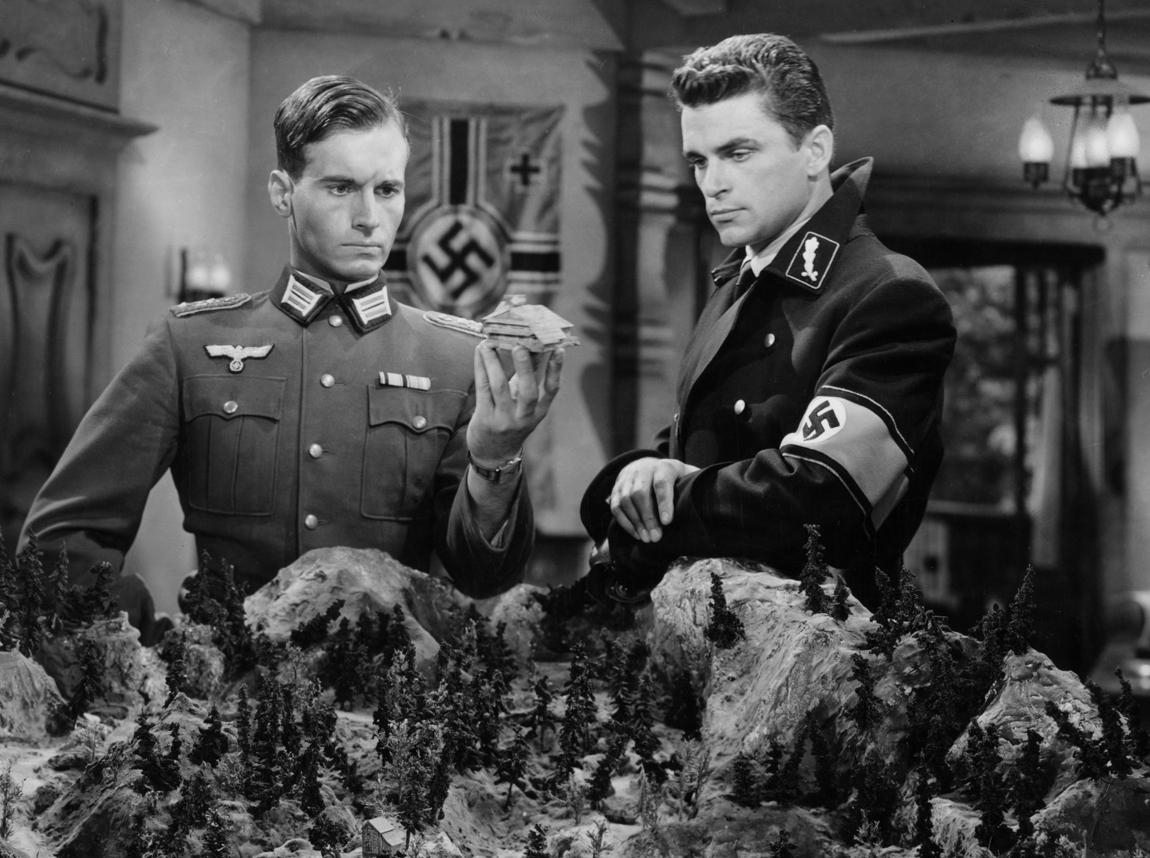
Whenever I was doing any sort of search for "Edge of Darkness"—one of the "Anytime Movies" from here—I would have to distinguish it was the 1985 British mini-series...or, eventually, the 2010 film adaptation...or another film done back in the 40's. I was always curious about that wartime propaganda film, and thanks to TCM I finally got to see it a couple weeks back.
Edge of Darkness(Lewis Milestone, 1943) A German reconnaissance plane flies over the occupied town of Trollness, Norway to find the unusual circumstance of a Norwegian flag flying over one of the buildings. The crew radios back to send a squad to find out why the expected Nazi flag of Germany isn't flying.
When troops are sent out, they find a town of corpses. They're everywhere—German and Norwegian alike—filling the streets, even going up to the Nazi commandant's office, where he still sits upright in his chair, dead. There has been a massacre and Trollness is deserted, save for one townsman, raving and extolling the Nazi's. He's clearly off his head, so they execute him without a second thought. So much for loyalty.
Being Nazi's, they probably wouldn't have spared his life even if they'd known his past. He was Kaspar Torgerson (Charles Dingle), the well-to-do owner of the town's cannery and their strongest supporter in town: as long as the Nazi's were in control and there were no conflicts, no danger of strikes, and the cannery kept running and he was making money, what could be the issue with them? And Torgerson would only be too happy to report one of his neighbors to the Nazi's as a troublemaker (which in the Nazis' view is "every man, woman, and child!"—and here I thought Nazi's discriminated)
The thing is, most of those "troublemakers" are relatives of his. Oh, brother-in-law Dr. Martin Stensgard (Walter Huston) remains neutral—presumably to "do no harm"—and his wife, Anna (Ruth Gordon) is merely passive. It must skip a generation because one of the most ardent members of the underground is their daughter Karen (Ann Sheridan), who, with lover Gunnar Brogge (Errol Flynn), heads the Nazi resistance—there are 150 Nazi occupiers and over 800 villagers, but as the Nazi's say "we have guns and they are afraid to die"—so the villagers must wait until arms are delivered to them from English submarines—it is, after all, a fishing village and boats are going out all the time.
Not that everybody is on board with the idea: Stensgard's son (John Beal), recently returned from university, is considered a Nazi sympathizer, and the town's priest (Richard Fraser) lectures from the pulpit about violence and God's judgment. And some folks, like the doctor, just don't want to get involved. But, if there is one thing Nazi's are good at, it's they can turn apathetic villagers to angry action. They're just like Frankenstein that way. It's the only thing they are good for.
Fairly soon, the arrogance turns to harassment then to rape and murder and even the most faint-hearted are soon flogging Nazis in the street, which allows the situation to escalate to horrific displays of aggression and violence that doesn't allow for any nuance of philosophy or conscientious objection...like any good piece of propaganda should. Made in 1943, it was a well-oiled agitprop by the studio that jumped on the war wagon first, Warner Bros. So, the performances are resolute and clear-eyed earnestness set against mustache-twisting villainy. Milestone, who'd started out in the silent era and who's All Quiet on the Western Front had won the Best Picture Oscar thirteen years earlier knows how to keep things moving quickly while not hesitating at outright manipulation to get the point across. Finish it off with Roosevelt's "Look to Norway" speech and you have a story that Americans can relate to, two years into the war effort.
Yankee Doodle Dandy(Michael Curtiz, 1942) It's the Fourth of July. Traditionally, I've stop-gapped the date by just tossing out James' Cagney's signature dance routine of "Yankee Doodle Dandy" (and not to stop the tradition, it's below). But, I've never reviewed it, musicals not being my particular cup of tea. But, Yankee Doodle Dandy is a little different. The biggest reason: Cagney. That man's presence is enough to make me want to watch any movie. But, he had made his name in films playing tough guys and gangsters—smart-alecks, who were strangely likable although capable of extreme, often shocking violence. Maybe it was because he was so believable, and so damn confident. And he had a tough grace with coiled intensity, an economy of movement and a theatrical flair. That quality might have been inherent as Cagney considered himself more of a song and dance man—"a hoofer," as he described it, even if his singing wasn't the best, the man sold songs so convincingly and with such brio, you didn't much care. 11 years in vaudeville (his first on-stage role was actually in drag), then starting his career in movies, the opportunities came more from acting than dancing. And he became—in the opinions of no less peers than Orson Welles and George C. Scott*—the best of the old studio actors, in that he was more than merely truthful and authentic, he was also theatrically interesting. But, his favorite performance was his Oscar-winning turn as George M. Cohan for the Warner Brothers bio-musical Yankee Doodle Dandy. It was a project born of a certain political necessity for the star, who considered it only after it had been tossed around as potential film material for years, owing to the difficulty in obtaining the cooperation of its subject, who was still alive at the time. With Cagney's enthusiasm assured—and studio-head Jack L. Warner had had issues with the star previously—Warner struck a deal with the stage entrepreneur to push the project forward.**
The film is told in flashback mode: George M. Cohan (James Cagney) has left retirement behind for the chance of playing President Roosevelt in a staging of a satirical musical "I'd Rather Be Right" and, after a night's performance, is called to the White House to meet with the sitting President. Fearing the worst (His wife Mary—played by Joan Leslie—reassures him "Don't worry, dear they don't telegraph you to come and be shot at dawn."), Cohan is escorted to the Oval Office, where he is greeted warmly by the President—the first time in American films that a current President had been depicted—and is asked to tell him his story. Cohan is only too happy to comply—in the film, Cohan's rival Eddie Foy (played by his son Eddie Foy, Jr.), looking at how many times Cohan's name is mentioned on a show poster, cracks that the "M" must stand for "Modest."
Cagney's Cohan tells of being born on the fourth of July, 1878 (it was actually July 3rd, but....1) it's a musical not a documentary and 2) it's the legend, so...) to a variety performer, Jerry Cohan (Walter Huston) and his wife Nellie (Rosemary DeCamp). With the edition of a sister Josie (Cagney's sister, Jeanne), the family becomes its own travelling troupe as per Cohan's narration:
I guess the first thing I ever had my fist on was the American flag. I hitched my wagon to thirty-eight stars. And thirteen stripes. You know, I was six or seven years old before I realized they weren't celebrating my birthday on the Fourth of July. Then my folks got a real break when my little sister, Josie, made her entrance. She grew to love show business just as she loved everybody and everything. We toured the kerosene circuit in a tank show called 'Daniel Boone on the Trail.' Everybody doubled in brass. Dad walloped the bass drum. For some reason they teamed me with a donkey. I was a good Democrat, even in those days. Mother and Josie threw out handbills. Their smiles would have sold tickets to wooden Indians. They kept putting new stars in the flag and the Cohans kept rushing out to meet them. We had jokes to match every cornfield. We sang at every milk station.
"I was a good Democrat, even in those days"—but Cohan (in real life) was actually a staunch conservative Republican. Well, it's not a documentary. The narration continues:
We trouped through depression and inflation. Part of the country's growing pains. We froze in winter and roasted in summer. But it was a good life. It's a lucky family that dances together every day. Eighteen ninety-one found our fortunes flat as a pancake. Then came a bolt from the blue. Jobs for the whole family in a play called "Peck's Bad Boy." We opened in Brooklyn. The town was noted for its spirited audiences. Even before it had a ball team.
"Peck's Bad Boy" becomes a hit for the family, and young George becomes the stand-out star, giving the kid a swelled head, and causing some friction in the family and amid the theater circuit. He's a constant self-promoter, always pushing himself, his songs, his plays—it gets to the point where the theater community blackballs him for his incessant braggadocio and grandstanding, which runs the risk of scuttling his family's careers and that of his new wife, Mary (Joan Leslie), herself a singer. The film follows Cohan's path from failure to success juxtaposing scenes of dealing and composing with musical sequences, showing off Cagney's skills—which are truly amazing at times—performing the various "greatest hits" of his career in back-rooms and on stage.
Many of the musical sequences copy the stagings of the original presentations , which is where the movie most adheres to some kind of truth. When songs were written and in what plays they appeared is all askew. And, the film suffers from the type of "he was inspired to write this" moments that make their way into most musical biographies. Also, Cohan had married twice—neither of his wives were named "Mary"***—and his mother died before his father. Cohan was only months before passing away and the production was a bit rushed in post, so that he could see a private presentation of it. It is said that, once the lights came up, he remarked: "It was a good movie. Who was it about?" But, that's such a good line, I even doubt the truthfulness of that (after all, he was the technical consultant on it).
But, more charitably he said "I'd hate to follow that act." One can see why given the energetic brio that the star brought to the performance and the movie in general. Cagney also manages to make Cohan extremely likable, no matter what shenanigans he pulls off, no matter how much a blowhard he is portrayed as. After all, if the man could make gangsters sympathetic...why not an accomplished hoofer? And, with the country gearing up for war (the film was in production when Pearl Harbor was attacked), the film's overt patriotism and pro-war stance—Warner was the one studio in Hollywood that wasn't afraid to be pro-intervention and publicly anti-Nazi—was perfectly timed to benefit from a country attacked and ready for a fight. Its patriotism served another purpose as well.
Cagney's battles with studio management—Jack Warner called him "The Great 'Againster,'" a term he reveled in—and his battles for Unions in positions both in front of and behind the camera in Hollywood (and, in his vaudeville days, he'd not been a fan of Cohan's after the man had sided with the producers' side in the 1919 Actor's Strike) put Cagney in a predicament with the House Un-American Activities Committee. The head of the Los Angeles chapter of the Communist Party had included Cagney when "naming naming" in secret grand jury testimony, and Cagney had been subpoenaed. The New York Times published a headline naming Cagney a Communist. Although exonerated of the charges, Cagney's business manager, his brother William, determined that, if they wanted to dispel any suspicions in the public's mind, "we’re going to have to make the goddamndest patriotic picture that’s ever been made." So, they campaigned Jack Warner to make the movie, with Cohan's approval (Cohan preferred Fred Astaire, but Astaire turned it down as the two men's dancing styles were, to his mind, too far apart). Cagney got the lead and the headlines stopped.
Liberals, progressives—whatever label you want to hang on it—have always had a history of being an irritant to this country. The status quo don't like being told that they're actually old fogies rather than protectors of the flame. So, the country's history is rich with the investigations into anti-American activities whether they're red or even slightly pinko. It is the tradition of the left to be chased by dinosaurs in the time they have before they become extinct. It's the big joke if a liberal survives the chase for long enough, they'll turn into the old fogey rallying against the next evolution of liberal. And it's been that way since a bunch of radicals created the concept of this country, saying to their bewigged masters-in-absentia an ocean away that government had more to do with what you could bring to the table, rather than who your father was. I'm sure they were called much worse than "lib-tards" for that idea. But, we celebrate them today, quite forgetting the squabbling of history. History is always the best judge.
*
** Cohan, while working with screen-writer Robert Buckner, asked "Would anyone go to see it? I don't want to be connected to a box-office flop." Buckner replied "Tell you what, we'll give away dishes and make sure." When the film was completed, it is reported after seeing the film by himself at a requested preview, he wired the writer "Thanks, kid. Hope you don't run out of dishes.
*** This was evidently because Cohan's ex-wife was putting pressure for money if she was depicted. Truth is more expensive than fiction.
It would be a lot like The Shanghai Gesture (made a year before Ilsa walked into Rick's), with a disparate group of diaspora all gathered around a central community house.
But, instead of Rick's Cafe Americain, it's Mother Gin-Sling's Casino, a casino of ill-repute that the Shanghai city-fathers (all white, all Brits) frequent with abandon, even while they're plotting to get rid of it ("I am shocked, SHOCKED that gambling is going on in this establishment!") The script is by von Sternberg, Gerza Herczeg, and Howard Hawks' scripter Jules Furthman, with emphasis on the smart-aleck remark, witty patter and easy irony. The writing is smart, the acting mannered (but in the von Sternberg manner of haughtiness and exaggeration for effect), and everything else from costuming, set design, and photographic style is elaborate.
Boris Leven's design for Mother Gin-Sling's Casino resembles a multi-level Pit of Hell
The men are von Sternberg's collection of stiffs, drones, and leering rakes (heck, von Sternberg turned Gary Cooper into one of the latter in Sahara). Walter Huston plays the stiff, a reforming developer who runs afoul of Mother Gin-Sling, while the latter is in the form of Victor Mature's "Dr. Omar," a Muslim "doctor of nothing," except one assumes, for a memorized expertise on "The Rubaiyat of Omar Khayyam."
The women are von Sternberg's complicated, well-lit archetypes, more devils than angels, the way he used Marlene Dietrich. They had to do a lot of cleaning up of the original play by John Colton, resulting in a "coded" film that "suggested" what was really going on.* The original location was a house of ill repute—a brothel (hinted at by the caged women ringing the casino's playing area, which, as designed by Boris Leven, looks like the Pit of Hell), the floosie (Phyllis Brooks) that Omar picks up in the street is a hooker, not a "dance-hall girl, in the play "Mother Gin-Sling" is named Mother Goddam, and the addiction the young thrill-seeker Gene Tierney playsisn't gambling (as in the film), but drugs, as suggested by her name "Poppy." So, yes, a lot of self-censorshp, but sophisticated audiences could see through the veiled references to see what the issues were.
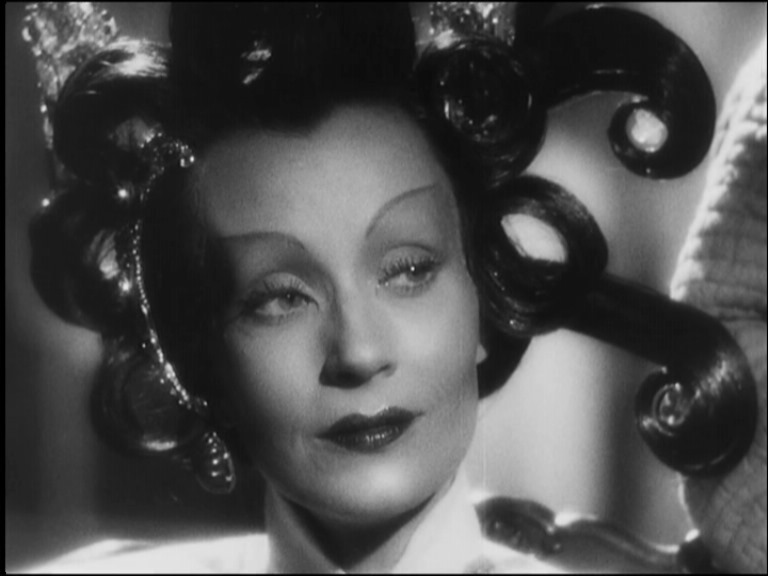
Von Sternberg was a stylist with an emphasis on glamor photography—his work with Dietrich is some of the most scrupulouslyaccomplished shadow work in movies—and his capturing of Ona Munson, Brooks, and especially Tierney is a tightly controlled use of light to emphasize the contours of the face. Munson's wild hair-styles suggest nothing so much as a medusa, and Tierney, once her slide down the slippery slope of..."too much gambling"...begins,is all broken doll in her body language, a marionette with some strings slashed (something foreshadowed by von Sternberg early on) Both Michael Curtiz (who directed Casablanca) and von Sternberg were directors who had penchants for filling up the screen-frame, but Curtiz kept things naturalistic, with his performers squarely rooted in specific places. Von Sternberg's close-ups are frequently floating heads, backed by a light pattern that has nothing to do with their surroundings.
But, that's where comparisons end: The Shanghai Gesture is a bizarre bazaar of weirdness, a combination of kitsch and creepiness, a glamorized descent into degradation and venality (beautifully shot, though!), with possibly the worst example of mother-love demonstrated on screen. It is the dark side of entertainment, gussied up with glamour to make the proceedings seem tolerable, something that could be said for all of the work of von Sternberg, master of both light and darkness.
The Shanghai Gesture is also unique for giving a credit to the extras.
* Furthman was great at that: in The Big Sleep he and Hawks suggested nymphomania by having the character suck her thumb.
The Criminal Code(Howard Hawks, 1931) The Hawks canon has always been about liberte, egalite, fraternite, and of the power of the group to come together to create something greater than the whole. So...a Howard Hawks prison movie?
Depends on the story, of course. But, The Criminal Code fits right into the Hawks niche, right down to the central authority figure who will give you a fair shake as long as you prove yourself worthy by adhering to their code as a "professional."
That figure is newly-installed warden Mark Brady (played by John Huston's dad, Walter) who's been brought up from his previous position as District Attorney. He's overseeing the imprisonment of some of the very men he sent to prison, so the resentment in "the yard" is palpable. So much so that his first day on the job, when he looks out of his office window overlooking the prison yard, he is greeted with cat-calls and "boo's" and the mutterings of threats. He responds, as any member of the court would, by confronting his accusers and going amongst them to talk and let them know what "the rules" are—look them eye to eye to say that as long as they kept their noses clean, there won't be any issues.
He's not without a heart, and he knows that he's responsible for the cons...and for a lot of them being there. He takes an interest in one young man (Phillip Holmes) that he sent away, now on his sixth year in the stretch, who's about to crack from the strain. He offers the kid, Robert Graham, a job as his valet, hoping that the change in situation and out of the harsh conditions of the prison's jute mill, will improve his psychological condition. It should come as no surprise that it does, especially once Brady's daughter (played by Constance Cummings) takes an interest in young Graham.
But, it's a prison movie, and it wouldn't be one if there wasn't an escape attempt made that would put Graham's improved life in peril. Three hoods—one of them Graham's former cell-mate Ned Galloway (Boris Karloff)—plan an elaborate escape, but during the attempt one of the prisoners is shot and killed. Galloway discovers that the other of the escapee's ratted them out, violating the prison code of silence, and he secretly plans revenge, warning Graham to stay away from that particular prisoner.
Even without seeing his face you can see the menace of Karloff
But, Graham is found, by happenstance, near the body, and even though evidence isn't found that he did it, and despite Brady's ministrations to save himself and tell him who the culprit is, Graham won't betray the ethic of the prison yard, even if it means taking the fall himself. Reluctantly, Brady sends him to solitary confinement.
It is unusual, for a Hawks film, for the communal spirit be the one amongst the prisoners, but the emphasis on the code of silence as the one mark of the professional prisoner that must be kept above all else runs right alongside the usual stoicism, the "keep-it-amongst-ourselves" attitude of the enclave that you'll find in most of the director's work. That it is among the criminal element makes The Criminal Code (with the title's double meaning) stand out from every other posse of professionals, be they cowboys, pilots, race-drivers, newspapermen, even big-game trappers.
The Criminal Code is a "pre-code" film, meaning it was made before the establishment of The Hays Code—Hollywood's attempt to police itself, amid calls that films were starting to depict too many immoral acts and that it might have an effect on the country. Even though there is quite a bit of violence and some of the prison guards are seen as corrupt, the "bad guys" end up punished and the "good guys" are given a second chance. It was still early in the days of Hollywood's own "code" and a few listed improprieties could be seen to still eke their way onto the silver-screen. Over the next few weeks, we'll occasionally be looking at some of those films to see what Hollywood was getting away with, so soon after the advent of "the talkies."
American Madness(Frank Capra, 1932) As contemporary a movie as they come, taking on The Great Depression, "bank-runs" and "the only thing to fear" being fear in this pre-Code film, originally begun as a project for Alan Dwan but ending up in the capable hands of Francesco Rosario Capra, All-American immigrant. Thing is, when Capra is on point, his films aren't just "contemporary," they're "for the ages," and American Madness speaks for today, just as it did for 1932, only the subject may not be about bank-runs, but about ignorance. Here's the story: It's a rough day for bank manager Tom Dickson (Walter Huston—father of John and grandfather of Anjelica, Tony, and Danny): He's got a meeting with the bank's board and they have blood in their eyes. They feel the bank is losing money and they want to merge with a local Trust and have Dickson resign. It seems he's a bit too "liberal" with the bank loans going out to the bank's patrons, trying to get on their feet after losing jobs, or trying to start a business or avoid losing the farm. He needs to be a bit more "conservative" with the loans, stop taking risks with the bank's money—after all, look at what they've done to earn it. Dickson is of the opinion that money isn't worth anything until you DO something with it, build something, make the money work—only in that way will they be able to combat the stagnation of The Great Depression.*So, yeah, he'll give loans out to farmers and local grocers and merchants, as well as to friends of the board.
Because it's the little guy that makes an economy work. Prosperity starts from the bottom up, not from trickling down. *Ahem* Speaking of the bottom...
The film begins with a ritual: the tellers are the first to arrive and in the dimness of the closed bank, go to the vault, open it and retrieve the trays of cash that they will use in their transactions. They joke, spar, and throw small-talk at each other. Prominent among them is Chief Teller Matt Brown (Pat O'Brien), who has been given a break by Dickson; Brown is an ex-con who got a bad break, but Dickson is giving him a chance to make a life for himself, a responsibility he takes extremely seriously and with a fierce loyalty to the bank and to Dickson personally. This puts him in conflict with a loan manager Cyril Cluett (Gavin Gordon), who's a bit of a blowhard and a guy who plays fast and loose with the rules, including flirting with Dickson's wife (Kay Johnson), who likes the attention, feeling somewhat neglected by her husband and his focus on business (the man even forgot their anniversary, for pity's sake!).
But Cluett is such a snake that one of his clients is a local mob-boss, and to get on the guy's good side and to avoid blackmail, he gives him entree to the bank. The crook is going to stage a bank robbery and Cluett gives him access. The bank-robbery does not go well. Yeah, the crooks make off with some cash, but in the attempt, a security guard is killed. Suspicions run to the guy with the keys, the Chief Teller, who is questioned by the police, but obstinately won't revel his whereabouts on the night of the robbery; there's a good reason for keeping silent—he tracked Dickson's wife to the apartment of Cluett, where he found them getting ready to have an after-play drink. Brown, out of loyalty to his boss, will not reveal what he knows, even if it points suspicions right at him, with his criminal record.
Dickson, however, has his hands full. News of the robbery turns to rumors throughout the city—the further afield it gets from the source, the further afield it gets from the truth, ie. the bank is insolvent due to the robbery and Dickson was the one who made off with the money. In a panic, the depositors start a run on the bank to withdraw their funds, so they can get their money out before everybody else and the bank runs out of money.
So, the bank starts filling up with panicked people wanting to get their money, out of the assumption that the bank is becoming insolvent and they'll lose everything. Meanwhile, the police are questioning Brown, who won't tell them his whereabouts on the night of the robbery because it will reveal the betrayal by Dickson's wife. The bank's board, further emboldened by this turn of events, wants Dickson out...now. Dickson implores Brown to tell him what happened, so that he can start to put an end to the mess, but Brown is adamant. He won't tell him where he was that night, lest he learn about the indiscretion of his wife.
"Ya trust ME, don't ya, Matt?"
For me, American Madness is emblematic of how Americans process information—that is, "badly." Even in this 24-hour news-cycle (but maybe, BECAUSE OF the 24 hour news-cycle), we colonists have a tendency to get things wrong and never get them right. Usually, in any big news story, there is a window of opportunity—a vacuum, if you will—that needs to be filled with information, good, bad, or...well, that's just it, it's going to be either good or bad, right or wrong. When news "breaks," unless somebody fixes it, in rushes questionable facts, speculation, ephemeral arcana, historical precedence, more speculation, and more questionable facts. Rinse and repeat ad infinitum (and there usually are an infinity of ads, as you have have to pay for this crap) until someone can say "what we know so far..." Time allows verification and verification gels fact.
In the meantime, however, everything that has gone before has implanted itself in the conscious or unconscious mind of the viewer, and, if they switch off without the verification, they may be left with the impression that the Martians are attacking Grover's Mill. Now, Martian have never attacked Grover's Mill, but more recent examples of major events are rife with speculation in the infancy of their reporting that is parroted back, mis-read, or mis-interpreted in the vacuum of facts that suck in the questionable first few minutes of confusion.
But, without the benefit of time or hindsight, verification, or refutation, or even the inability to accept facts and change one's opinion, that questionable information hardens into facts (although they are merely opinions, as they have no basis in fact) and the holders of those misbegotten ideas are merely looking for their own verification to shore up the opinions.
Rather hysterical publicity photo of Walter Huston holding off panicking bank customers with pistols.
So, let's face facts. In this electronic age—no one is facing facts. Or even recognizing them as facts. Thanks to the glut of information available to us—from the 24 hour news cycle and the internet—we have both the most informed and uninformed electorate simultaneously. One may take comfort in the Lincoln bromide "You can fool all of the people some of the time, and you can fool some of the people all of the time..." but only if you stay away from German history. Steven Colbert famously called the phenomenon "Truthiness" as in "my gut is more informed than my brain." I take the word from the song "Zippity-Doo-Da" and call it being "satis-factual," only holding those truths that make you happy. And that's the way it is, Tuesday November 8—Election Day. And that's American Madness.
* The story is based on the principles of Amadeo Giannini, who started the Bank of Italy in San Francisco in 1904. He was the son of immigrant parents and he adapted a radical concept, giving loans to the middle-class, rather than the upper-crust, basing his decisions on character rather than cronyism. One of his loans was to a young Harry Cohn, who started a movie studio called Columbia Pictures that made American Madness. Now, before you can say that the guy was "WRONG-G-G" and "a LOSER," let me just say that Giannini did NOT go out of business, but he DID change the institution's name...to "Bank of America." You might have heard of them.
Yankee Doodle Dandy(Michael Curtiz, 1942) Of all the films in James Cagney's storied career, his favorite was his most unusual—not one of his gangster films (some of which revolted him) or his dramatic efforts, but this one, the one that won him his Best Actor Oscar, the musical biography (very loose) based on the life of George M. Cohan. Cagney always described himself as "a hoofer," starting out as a dancer in vaudeville, and the athleticism did him well in Hollywood. Cagney's energy, timing, and directness—his grace (even if he was playing a hood)—came from this background, and the compensatory toughness came from his growing up and observing the streets, providing "that unmistakable touch of the gutter," as he eloquently put it in his acceptance speech for the second AFI Lifetime Achievement Award. Yankee Doodle Dandy begins with Cohan (Cagney) on Broadway playing Franklin Roosevelt in "I'd Rather Be Right" when he is summoned to the White House to receive the Congressional Gold Medal from FDR himself. The visit gives him a chance to tell his life-story to the President, which is presented in flash-back form, from his early days to performing with his family (Walter Huston, Rosemary DeCamp, Jeanne Cagney) to the lean years when stubbornness gets him blackballed in the theater community, and he has to struggle back to the stage by song-writing,*eventually coming back and becoming the King of Broadway.
It's still startling to see Cagney's dance moves; loose, limber below the waste, and ramrod straight above, his movements alternate between drunken sloppiness that looks like it could severely snap tendons if gone wrong, and stiff-legged woodenness, giving the impression that he's a puppet with the strings cut—not really in control of his own movements (and, of course, he always was—that was the illusion of it all, the mastery of it), but compelled to dance for the sheer energy of it forced him to do so. It's scary, but Cagney always is. He is, after all, the guy who shoots people by pumping the pistol forward, as if the movement puts more energy in the bullet to kill faster, make it more definite, more personal. His gangsters make the guns part of them, rather than just a tool.
Some of the moves look archaic, compared with the gymnastics-as-dance school today—the leaping and bouncing off a wall (as if there wasn't enough room on stage) looks tame now, even though it amazed me as a kid, but the high kicks I appreciate more, the toe-steps, the tap—all amazing. And they look spontaneous, which in itself is a marvel.
It's a feel-good musical about celebrating the spirit of America, which we all do on the Fourth of July. That it happened during war-time, added mightily to the propaganda potential of it (and, although it's always been denied, might've helped Cagney get rid of the "pinko" label he was being saddled with at the time—my, how times haven't changed). But, it's a fine achievement, and Curtiz, who's known for hating unused space in a movie frame, overcrowds the stages—every theater-piece for this director was "SRO." And, although something of an autocrat, with musicals he let loose the reins (something Cagney appreciated) and allowed spirit to flow. Maybe that's why Yankee Doodle Dandy still seems fresh.
It was voted into the National Film Registry in 1993 for being "culturally, historically, and aesthetically significant."
* Cagney could relate. He was constantly battling the Warner Brothers brass, at one point suing the production company and staying away. Jack Warner called him "The Great Againster."
** Evidently Cohan's final tap down the White House staircase at the end, was improvised.
 The Devil and Daniel Webster (aka All That Money Can Buy) (William Dieterle, 1941) I've known about this film for years, because it was the film that won composer Bernard Herrmann his only Oscar for Best Score ("of a Dramatic or Comedy Picture"), over 19 other scores nominated that year, including his own music from Citizen Kane.