Showing posts with label Brian Keith. Show all posts

Saturday, June 1, 2024

Meteor (1979)

Saturday is traditionally "Take Out the Trash Day"...

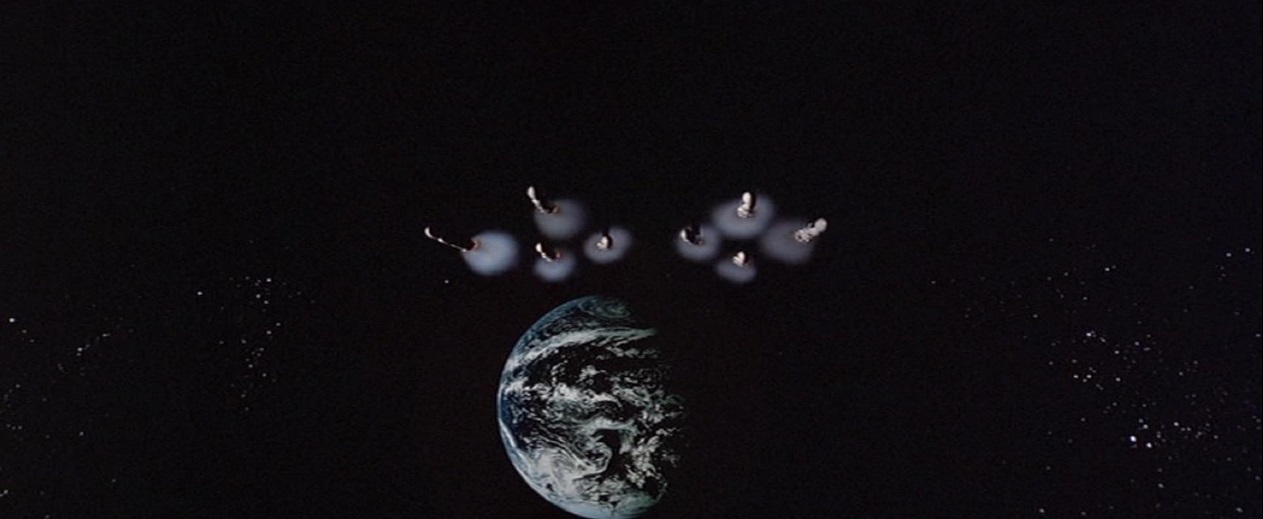
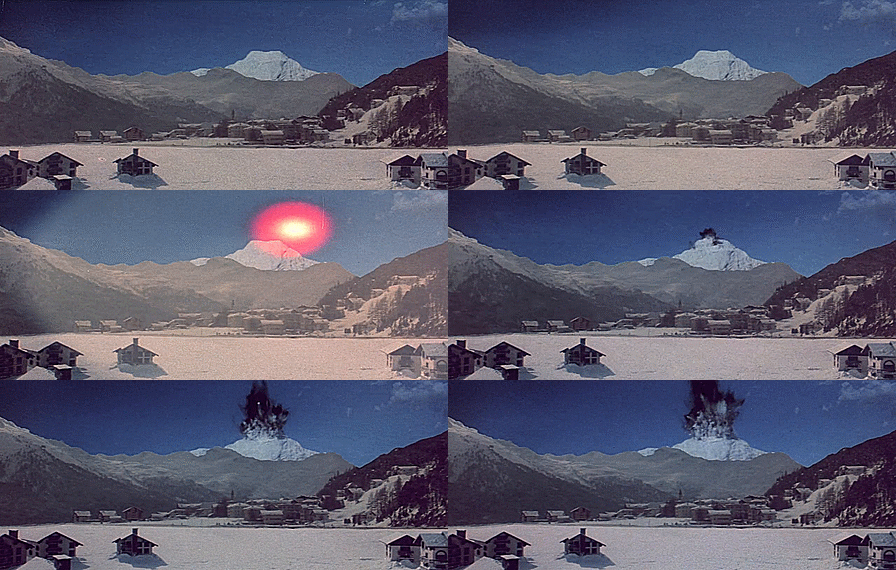
Meteor (Ronald Neame, 1979) A co-production between Shaw Bothers Studios, Warner Brothers, Nippon Herald Films and American International Pictures, featuring a script by Edmund H. North (who wrote The Day the Earth Stood Still and co-wrote Patton) and Stanley Mann (who wrote a couple of Sean Connery's early films) and featuring a cast that probably ate up most of the movie-budget—Connery, Natalie Wood, Brian Keith, Karl Malden, Henry Fonda, Martin Landau, and Trevor Howard all under the direction of Ronald Neame, who directed The Poseidon Adventure. The story was the most high-profile of topics—an asteroid (called "Orpheus") is headed for Earth and American and Russian scientists must cooperate and use their own orbiting nuclear defense systems to destroy it before it hits Earth and creates a global catastrophe.

What could possibly go wrong?
 
Budgeting. That's what could go wrong.
 
Although a lot of the writing in Meteor is overwrought, the cast does alright with it, and Neame's direction isn't particularly flashy, but manages to keep things moving briskly.
But, by the time all of that was done, the movie's coffers had little room left for post-production and special effects. It didn't help that by the time attention was being paid to the post-production, the group assigned to do the effects of the large threatening asteroid and the missiles designed to destroy it was summarily fired for the work for being below expectations.*
Now, there's a lot of grousing these days that "special effects don't make good movies." Goodness knows there have been a lot of movies where the special effects were sub-par, even in the 1970's (Logan's Run, for instance), even after the water-shed moment of the Star Wars premiere. And one has merely to look at the output of AIP's
post-Star Wars coat-tails films to see that their effects work was "made-in-the-garage" quality.
So, one is left with a Frankenstein-monster of a movie: An able cast with a somewhat shaky script (with some truly cringe-inducing dialogue), spliced with sub-par special effects sequences that—despite the many limitations—seem to go on forever, with no real editing scheme to create tension, but plopped into the film to fill the time with the shakiest of continuities.
There's no finesse to it at all—how could there be when the film was being pieced together so close to the premiere? One can only console oneself with a sequence where the all-star cast gets drenched in mud while trying to escape their command headquarters through the New York City subway system. The images call to mind so many derogatory descriptions for the movie. "Disaster" being the kindest one.
Hollywood wasn't quite done with the concept yet: 1998 saw the release of not one, but two "asteroid-threatening-the-Earth" movies: Armaggedon and Deep Impact. 

Apparently, there's a lot of "rockery" in neighborhood-space. And nothing new under the sun.

* Actually, two groups of special effects studios were let go, sucking up a lot of the "post" budget and pushing the time-line for the eventual team—they had a mere two months to complete the work before the premiere!

There was another major up-ending of expectations in the post-production: John Williams was given the job of writing the score for Meteor, but the production delays and the revolving door of special effects artists prevented any sort of semblance of "picture lock" for him to compose music for it before he had to go off and work on Steven Spielberg's 1941. Laurence Rosenthal was then hired to compose the score, which ended up being rather good—amazing, given his time-constraints.

Saturday, July 4, 2015

Olde Review: The Wind and the Lion

Written November 7th, 1975

The Wind and the Lion  (John Milius, 1975) I avoid seeing films twice unless I really, really love the film (due to a lack of funds).* When I saw The Wind and the Lion the first time, it was as if I was seeing two movies at a time. The dialog was really wretched ("Mulay--that's a nice name"), but at the same time the photography, direction and editing were all fabulous. It was a film that had "sweep" (I assume that when a film has "sweep," the camera tends to move along a field, up a wall, through a street, "sweep" through the visual plane of the camera. Oh, but does this movie do that!) The Wind and the Lion just swells with movement of all kinds--inside the frame and the frame outside itself.

John Milius is a director I don't tend to think much of. I wasn't too fond of his Dillinger film, some good things, but not wholly satisfying.** But his direction in Wind & Lion is just marvelous. Some of the shots combined with Jerry Goldsmith's score*** are just chillingly beautiful: The trucking shot along a line of berbers silhouetted against a sunset; A diagonally rising crane-shot that drifts over a dune as an entire army of berbers move down a road while a dark, cloudy sky presses down on the whole scene; After the Raisuli (Sean Connery) has killed off the final horseman at the leper colony (that was the impression I got anyway) Milius cuts to a stunning shot of Eden Pedecaris (Candice Bergen) watching behind a net in the right foreground, while against a low sun on the ocean-tide, the Raisuli slows his horse and the now-riderless horse of his opponent still charges across the screen; Theodore Roosevelt (Brian Keith) and "his" bear towering over him, as he reads the "Wind and the Lion" letter.
The Letter: To Theodore Roosevelt - you are like the Wind and I like the Lion.
You form the Tempest. The sand stings my eyes and the ground is parched.
I roar in defiance but you do not hear. But between us there is a difference.
I, like the lion, must remain in my place.
While you, like the wind, will never know yours. -
Mulay Ahmed El Raisuli, Lord of the Riff, Sultan to the Berbers, Last of the Barbary Pirates.

The second time around, my appreciation of the Milius direction grew. It was what I concentrated on throughout and because of it, the dialog that I was uneasy about went down easier and (My God!) some of that dialog was downright poetic. Roosevelt's speech about the bear as the U.S, symbol, his getting on his desk and growling at the camera for the Smithsonian--things that made me squirm in my seat before--I enjoyed this time around.

This movie is flawed to be sure. Some of the writing is still bad. There are inaccuracies in technique and in history. **** The fellow I went to see it with thought there were too many "riding-in-the desert" shots for his taste, but not for mine. And I heartily enjoyed myself and the film.
I still enjoy it (now that I own it) and all qualms that I had about it are gone, and a lot of the things that I found a bit over-dramatic and even eye-roll-provoking are things that I now dearly love about it. I mean, the outlandishness is part of the appeal of the movie: who, for instance, would cast Sean Connery—with Scottish accent in full bloom*****—as an Arab chieftain? Somebody crazy enough to look past the piddly details and go for "what works"—and Connery is gloriously powerful and over-the-top in this.  
Candice Bergen, who I found annoying the first go-'round, is perfect—she's supposed to be a burr under the Raisuli's saddle, like a grown-up Mattie Ross in True Grit—but she's also a very strong character in a movie that oozes testosterone.  Faye Dunaway was supposed to play this and begged off—and Bergen more than manages and has a timeless look that's an improvement over Dunaway.  
And Brian Keith—never better.  The perfect actor to play TR in a performance that is winning, knowing and has more than a bit of "arena" in it, and the toll it takes on one when given a moment's privacy.
I neglected to mention the huge contribution that cinematographer Billy Williams brings to this movie.  It is gorgeous, almost 3-D in it's compositions and depths of colors, as he carried out some of the beautifully outlandish shots Milius came up with. 
I wish Milius was allowed to make more films (he's certainly been allowed to doctor scripts most of his career, and Turner gives him a mini-series or TV movie to do once in awhile). His is a singular voice in Hollywood, conservative, smart, and with an eye towards irony and a disdain for inaction and dithering. Along with his love of history and the U.S. (perhaps because of its flaws, rather in spite of them), his love of film is obvious,  he's smart with what he does on film. One would wish.
Milius' cameo as a one-armed munitions dealer.

* This was 1975. It would be another five years before the video-tape boom that allowed folks to watch films in their own home, and even own media of that film. Seems like such a long time ago. Now, if one likes a film, one can buy it, and watch it as many times as they want. That's a great convenience--but it tends to make people cluster to stuff they like, rather than explore and take a chance on a new film.

** Again, this was 1975 and from the perspective of someone who, as yet, hadn't had to sit through Public Enemies which, by comparison, makes Dillinger look brilliant.  I have to watch it again soon, because my memories of it—Ben Johnson's and Warren Oates' comfortable-shoe playing of their roles, Richard Dreyfuss' freak-out scene as "Pretty Boy" Floyd, the thread-bare look of the film because there was little money in the budget, but also, because it was the Depression—far outweigh any things I didn't like (which I no longer remember). 


*** An aside from this review here: "Goldsmith just happens to be one of my favorite film scorers. I snap up one of his albums as soon as it appears in the racks, and seldom am I ever disappointed with what I hear. However, one of Goldsmith's pieces doesn't seem to mesh correctly with the visuals--the Raisuli's initial ride on a horse gone hay-wire." Um--that was the composer's point, I think.
**** For instance, an incident like this DID take place during the Roosevelt administration. Ion Pedecaris WAS kidnapped by the Raisuli, in 1904. Ion was male. I'm sure it matters to history buffs and the sex-changing is probably sacrilege, but changing Pedecaris to a woman raises the stakes of the story, and provides a whiff of romance and exoticism. Without The Wind and The Lion that incident would have been lost in the sands of time.

***** My favorite line of the movie (and still produces a too-loud roar of laughter out of me) is a lovely panning shot of the desert and Connery's dreamy voice-over: "This is the Rif...I am Mulay Ahmed Muhamed Raisuli the Magnificent...sherif of the Riffian Berbers. I am the true defender of the faithful...the blood of the prophet runs through me and I...am but an instrument of His will." The cameras settle on Connery as he finishes his little resume to Mrs. Pedecaris, looking at her expecting some sort of reaction or acknowledgment, his horse restless beneath him.  And when there is only silence, there is an exquisite pause, and in full Scot, barks: "You have nothing to say?"