Friday, May 24, 2024

Pixar: To Infinity and Beyond

I have something to post, but best to do that after recording a podcast for The Lamb on Sunday.

Instead, an entry for the Audio-Visual Department, something I do rarely these days (as they have to be really special...and, hopefully, have a long shelf-life on the internet. This salute to Pixar from Ash Arnold would appear to have both of those qualities:

The Fall Guy (2024)

"That Happily-Ever-After Stuff? Unsubscribed!"
or
"What's the Message of My Films?" "Nihilism is a Valid World-view?"
 
Watching Ryan Gosling and Emily Blunt's prickly banter when they were presenting at the Oscars this past year made one actually think that their upcoming movie The Fall Guy might be somewhat entertaining. Bear in mind that I'm one of those crusty souls with no heart and no sense of humor (and no taste, apparently) who is not a fan of director David Leitch. Or of producer David Leitch. I stopped watching the "John Wick" series after the first one, which I did not enjoy and I suffered through it wondering if it was, in fact, meant to be a comedy. I mean...c'mon...the stunts were only believable if you weren't considering what would logically be the collateral damage outside the frame. And Wick goes off because someone kills his dog. Really? That would be funny...if it wasn't so damned dumb. I mean, they made fun of it in Deadpool. You know, the good Deadpool...the first one...the one David Leitch didn't direct. I figure you have to have a screw loose to really get off on these films. That they're successful and have spawned their own series of films only further makes me hang my head and despair about the future of the medium.
In this, a loosely-based spin-off of "The Fall Guy" TV show from the 1980's, Gosling plays Colt Seavers (played on TV by 
Lee Majors*). At the beginning of the film, he's a successful stunt-man, doubling for star Tom Ryder (Aaron Taylor-Johnson), a big box-office draw, and he is having a heating-up relationship with camera op Jody Moreno (Blunt) until he's called to repeat a stunt—a wire-drop inside a high-rise edifice—that goes wrong and he's put in the hospital with a busted back. He emerges 18 months later parking cars at an L.A. Mexican restaurant and swearing off his stunt-man career. 
 
Besides, his phone isn't ringing, the one sure sign that nobody wants you in L.A..
Until, one day, the producer of those Tom Ryder movies, Gail Meyer, (Hannah Waddingham) calls to implore him that his services are once again needed—apparently Ryder has disappeared, whereabouts unknown (something Colt could care less about), but the signing bonus is the movie is being directed by first-time director Jody Moreno—former camera op, former flame. Colt gets on a plane to Australia where the film is shooting.
Told by Meyer that old flame Jody requested him specifically, Colt is sucker-punched when he finds out a) Jody didn't ask for him and b) she's surprised to see at all and c) she's pissed at how they broke up by not breaking up—Colt didn't return phone calls, didn't reach out, didn't do any of those things that men don't like to do, especially when they're fragile, physically and mentally. She proves her affection for him by having him repeatedly set on fire** and trip-wired to be slammed into a rock. Over and over again. Colt's way of responding to all of this is with his laconic "thumbs up" after surviving each take. Jody hates that. But, she still makes him do all that stunt work with a broken back. ("Get...on...a...plane, Colt!")
Um...you can see the crew in the sunglasses..."Props!"
So, immediately I began to question why Colt doesn't just leave as he was obviously there under false pretenses, and, if not the first thing, the second thing I would do after finding that out would be to verify if I was getting paid. Because, obviously, somebody in the front office is lying to him and if they're lying to him about that, there are probably all sorts of things they can't be trusted on. But, by this time, I had given up on the movie being any good and just hoping that it would eke out some entertainment.
It is, on occasion, because Gosling and Blunt are pro's and they can squeeze out entertainment no matter how necrotic the script is.
But, that's not how movies work these days. Entertaining as that may be, what the movie audience apparently wants, and the movie is determined to give them, is wall-to-wall practical action sequences. Things go boom, guys do gymnastic falls and fights, big puffs of smoke and dirt go up in the air for no real apparent reason, sparks fly. A lot. There are spectacular falls where Gosling pops up into the frame as if he did the stunt. Standard Operating Procedure. The movie is a professed love-letter to stunting people and, sure, I'm all for that. I'd rather see practical effects than CGI animation any day. Employ the hell out of 'stunt-people. But, pay them a living wage and make sure they have insurance, first. I mean, stunting is NOT a lost art. The only difference is it's being done in front of green-screens now.
It just doesn't look all that impressive when it's shown being filmed. Leitch doesn't exactly pull off the stunt that the story-stunts are more dangerous than the in-the-movie stunts (and they're still trying to make us believe the guy who cracked his spine a year and a half ago can do these things).
Two things did strike my mind while I was watching the thing scroll in one cortex and out the other: Movies save SO...MUCH...MONEY making a movie about making movies! You don't have to have sets, just people milling around with cameras and eating craft services, and walkie-talkies and cell-phones. You don't have to hide anything, or make believe it's real, and you can even shoot the dressing-trailers. It's so cost-effective as to be ridiculous.
The Fall Guy doesn't have a plot, so much as a thin thread to string between stunt sequences, like some of the really bad Roger Moore James Bond movies or the Mission: Impossible series...or like the Wick films. That seems so ass-backwards a way of making movies—well, of making movies that mean anything, anyway. For someone who sees movies as an art form, and its own unique form of communication, it's really a drag to see a movie like this.
 
The best you can say is: "Well, people were employed..."
Humor example: Blunt and Gosling are talking back and forth about story-approach, 
when she suddenly asks "What about split-screen?"
And before you can say "Oh, they're not..." (which I did),
they go split-screen. 
Laugh? (I didn't)

 
I never watched the TV version of "The Fall Guy"; this is as far as I ever got....
 
* Does Lee have a cameo? Yes, along with Heather Thomas in the post-credit scene (if you haven't walked out by then!)

**  Because she's an "old flame" "carrying a torch"? ...am I looking for sub-text that isn't there? Yeah, pretty sure I am!


Thursday, May 23, 2024

Shane

Shane
(
George Stevens, 1953) George Stevens came back from World War II a changed man...and a changed director. As documented in Mark Harris' book "Five Came Back" and its subsequent documentary, Stevens had started his career a director of comedies, but, after the war, he became a different film-maker. His service in the Second World War was in the combat motion picture unit from 1944 to 1946, where he documented the landing at Normandy, the Battle of the Bulge, the liberation of Paris and the uncovering of the horrors at the Dachau concentration camp, where he stated that he realized his function deepened from simple documentarian to collecting evidence of the greatest atrocities of the century. His footage was crucial in the post-war Nazi trials, but, he found no solace in the role he played. As he wrote to his first wife in 1945 "if it hadn't been for your letters . . . there would have been nothing to think cheerfully about, because you know that I find much [of] this difficult to believe in fundamentally."
 
Coming back from the war, he co-founded Liberty Films with fellow Army Signal Corpsmen Frank Capra and William Wyler, but made no films for the fledgling production house and the company folded. He would not make another film until I Remember Mama (1948), a film that bore some resemblance to his own upbringing in America. Then, 1951's A Place in the Sun, a dark tale of a man's duplicity and fall from grace, won him an Academy Award for Best Director. 
 
His follow-up film was far-afield from the subject matter that was associated with Stevens both pre-war and post-war—a Western that sharply demarcated right and wrong, almost naively making a world where good wins out over bad, without the complications and hollow justifications of an adult sensibility, Shane
In the Jackson Hole Valley of the Grand Tetons, the family Starrett are homesteading in a wild area still trod by deer and elk. In fact, in one miraculous shot an elk frames an approaching stranger between its antlers. When Joe jr. (
Brandon De Wilde), out stalking deer with his bullet-less rifle, spots the stranger coming onto their land, he alerts his Pa (Van Heflin), who is still trying to get rid of a stump he's been hacking away at for months. He and wife Marian (Jean Arthur) have been homesteading in Jackson Hole for some time, but he is frequently being sabotaged by cattle baron Rufus Ryker (Emile Meyer), who claims the land as his for grazing rights and has made it a campaign to rid the valley of "squatters," by having his men (including Ben Johnson and John Dierkes) run roughshod over Starrett's and the other homesteaders' properties).
So, Joe Sr. isn't altogether welcoming, seeing a stranger enter his property. He tells the buckskin wearing newcomer (Alan Ladd)
, who is suspiciously vague about what he's dong there, to vamoose.
As bad luck would have it, before Shane can reach the fence, Ryker and his goons show up with news. It seems Ryker is going to be providing beef for the nearby reservation and he needs Starrett's land for them to graze. Joe refuses and things start to get testy, until, finally, Ryker starts making threats.
At which point, the stranger re-enters the scene and introduces himself as "a friend of Starrett's" and seeing how he's armed, too, Ryker backs off with a final warning to clear out or the Rykers will clear them out themselves. The stranger's intervention casts him in a different light to Starrett, and introductions are made.
The stranger's name is "Shane." Just "Shane." No indication if that's christian or surname. And, for his stance on behalf of Starrett's family he's invited to stay the night and have a meal, which he compliments as "an elegant dinner." Then, without any prompting, he goes out and works on cutting out that stump as a thanks. Starrett goes out to help and between the two of them, they're able to clear the stump at night-fall, a task that the homesteader had been working on weeks. Starrett asks if Shane wants to work there, as he most certainly seems to want to help.
So, who is Shane? He doesn't say where he came from, and as to where he's going? "Heading North—one place or 'nother. Some place I haven't been." Some place he isn't known is what he means. That would seem to be a contradiction as he's quiet. Polite. Keeps his counsel. Knows his place even if he doesn't have a place. He's rootless...in a community trying to establish them. He feels comfortable there, despite that, but never so comfortable that he can't be snapped out of it at the first sign of trouble. He doesn't make trouble, but he's seen enough to know trouble will almost certainly come to him as it seems to have come to him in the past.
He's twitchy. When little Joey pumps his unloaded rifle, Shane whips around, ready to draw down on him. He's haunted, probably because of his skill with a gun and having had to use it. And he's ridden into a situation where trouble could come from across the fence, ready to tear that fence down if it's in the way. Ryker is one of those breed of men who fought hard to establish his stake and will fight just as hard to keep things the way they were when there was no one else but him. He's not interested in community—he's all the community he needs—and he resents seeing what he thinks is his from being parceled out to newcomers. To "others."
It's why the homesteaders are being harassed. Some have suffered enough intimidation that they're threatening to leave and it's only the entreaties of Starrett that keep them from leaving. Shane, himself, is on the receiving end of those taunts from one of Ryker's men, Calloway (Johnson), which ultimately leads to an old-fashioned bar-fight that wrecks the Grafton bar. Given the intervention of Shane into the struggle, Ryker brings in reinforcements, a sadistic gunfighter named Jack Wilson (
Jack Palance), who takes a satisfied glee in gunning down anyone he can provoke into a fight.
For a Western of that era, Stevens ramped up the level of violence than what audiences were used to. His fights were messy affairs that were tightly edited to maximize the cuts and scrapes one associated with the usual dust-ups. And anyone seeing Shane remembers the shoot-outs where a bullet could propel a person backwards like they were yanked off their feet (which they were, due to some discrete cabling).
In such a world it's no wonder that Marian Starrett tells her young son "Joey, don't get to liking Shane too much." There's always the possibility that a man such as Shane won't be sticking around for too long, whether riding out of town or being buried in the cemetery that overlooks the slip of a town. But, the kid can't really help himself. Shane is something of a mystery, not saying much, but giving the child the same level of attention as he does the father and the mother. That makes an impression on a kid. And his proficiency with his fists and his guns—all fascinating to little Joey—endears the man to the boy.*
Stevens is playing with Myth in Shane, and nowhere so boldly as in little Joey's hero-worship of the competent stranger, his version of a White Knight, who gives him a lesson in strength in restraint (something Joey doesn't quite comprehend) as well as the cold competency in "doing what has to be done." To standing up in the face of wickedness, not backing down, no matter the consequences, and fighting the good fight. At times, it's almost too much, with Stevens cutting back and forth between fights and Joey's wide-eyed reactions to the fireworks.
And it all comes to a head when, once the killing is done, Shane takes his leave, having brought resolution—but hardly peace—to Jackson Hole. The dirty work is done, and just as there was no place for a killer like Wilson, there isn't for Shane, either. And despite the child's entreaties, there is no going back...not from what you've done. And not from what you've seen. It's a weird scene, simultaneously a bit over the top, but also punches the gut on an emotional level. Even more so when you take in George Stevens' history in the war.
That ending resonates...and haunts. Not so much as a small child's plaintive pleas, but of the echoes embedded in them of a director who had seen the worst atrocities perpetrated by man, and, through that boy, implores 
the darkening wilderness for a world of forbearance and a return of the merely and simply decent. 

In context, Shane is so much more than "a Western", and is heart-breaking. Fundamentally.
 
* And to the point, author Raymond Chandler (who'd written a couple of Ladd's noirish movies) had said this about Ladd some years earlier: "Ladd is hard, bitter and occasionally charming, but he is after all a small boy's idea of a tough guy."

Tuesday, May 21, 2024

Wicked Little Letters

Post Pardon Depression
or
A Comedy of Ill-Manners
 
I think I've mentioned before that you can't watch a British mystery series without one episode involving the investigation of a rash of poison-pen letters (that may or may not be true) that disrupt a community. There was one major movie, Henri-Georges Clouzot's The Raven, that we mentioned previously. 
 
The origin of this particular trope came from the scandal of the "Littlehampton Letters", a Sussex incident that caused quite the scandal between 1920 and 1923. The general story is that Edith Swan, a spinsterish woman who lived with her upright Christian parents, began to receive letters of an unseemly manner and of such vulgarity that she made complaints to the police. Suspicions immediately turned to Edith's neighbor on Western Street, Rose Gooding, as Rose seemed a person of questionable character, known for causing rows and for her obscenity-laced language. It didn't help that the letters appeared to be signed by Rose. That first letter started: "You bloody old cow, mind your own business and there would be no rows. – R." That Rose had a child and was living with a man didn't help things. Nor did that the letters appeared after Rose was reported to Child Protective Services by someone in the neighborhood.
Rose was arrested and charged with criminal libel, and as she could not afford bail, she was in prison for three months. During Rose's incarceration, the letters naturally ceased. When she was released, the letters began again, expanding in scope, and Rose was again arrested, convicted and sentenced to 12 months in prison.
All neat and tidy, said the law. But the story didn't end there, through the efforts of a dogged police-womanSussex's first
Woman Police Constable Gladys Moss, who began to suspect that things weren't as neat and tidy as her male counterparts believed it to be. With the help of Scotland Yard, she was able to trace who the letters were coming from—the courts wouldn't allow writing analysis in the trials—and catch the actual culprit in the act.
Wicked Little Letters tells the story of the case, and, truly, it lives up to it's opening title: "This is more true than you'd think." Oh, there are little changes here and there, mostly for the sake of diversity in casting, and to ram home the point that those times were more prejudicious than our own (although it's ironic that they try to make the point of how good we've got it by casting non-white players to signal to us that these people are dealing with oppression and prejudice*). Actually, our times are just as bad, only less by a matter of degrees.
Edith Swan is played by 
Olivia Colman, her parents by Timothy Spall and Gemma JonesJessie Buckley is Rose Gooding and her live-in man is Malachi KirbyAnjana Vasan plays Woman Police Constable Moss, and Rose's neighborhood allies include Eileen AtkinsLolly Adefope, and Joanna Scanlan. However much kerfluffle may have been going on in Western Street in the 1920's, it couldn't have been as entertainingly chaotic as this cast makes the circumstances involved. Colman, particularly, is a study in contrasts. Initially making friends with Buckley's Rose, Colman's Edith couldn't be more thrilled—a little shocked at her raw forthrightness—as Rose is as free-spirited as Edith is repressed, belittled, and subjugated in her father's household. When the whole letter-thing is delivered at her doorstep, she becomes alternately victimized, outraged, and (once the papers get ahold of it) prideful of her role as upright citizen standing up for the decency of civilization. Her performance is a master-class of expressiveness whatever the role Edith takes on.
And Buckley holds her own with the more ostentatious part as Rose, unapologetically coarse even as she's being accused of coarseness, while fully realizing that she is just a gavel's slam away from losing her family as a consequence. But, her Rose is a scrapper, not willing to go down without a fight, even as it appears as her whole world is falling apart. And Vajan, after years of bit parts and one-line roles, pops right out of the screen as a determined copper not content to merely know her place, her eyes almost comically revealing the frustration and battling fierceness required to see justice done. 
Wicked Little Lies careens between comic (it's rated "R" for hysterically "pervasive language"), dire, and subversive—when dealing with authority figures (predominantly male)—and made with the intent of taking the mickey out of the status quo. There is just the hint of hysteria in the parties involved rebelling against their circumstances, even if the actions don't quite push through the complacency. One wants to call it a comedy of manners, if it wasn't so enthusiastically ill-mannered.
It's also rather deliciously quaint, as one can only imagine the reaction any of these characters would have if they were exposed to social media.
 
Crikey!
 
* I don't want to harp on this too much, because I'll sound like some backwards stick-in-the-mud—you cast people because they're good, not because they're a "type"—but it occurs in the same way with the writers portraying Rose Gooding as an Irish immigrant, to reinforce that she was an outsider of "low" character. Gooding was born in Lewes in Sussex, and merely moved into the neighborhood, rather than coming from Ireland. Sometimes I think these things are betraying prejudices in the act of pointing them out. Anyway, the real people were all lily-white, and the actors portraying them are damned good.

Sunday, May 19, 2024

Don't Make a Scene: Breaking Away

The Story: The late publication, Premiere Magazine, used to run a feature—"Classic Scene"—which was simply true to its title. They would run the transcript of a classic movie scene—just the words...and any necessary stage direction (which was rare) and just lay it out line by line.

All well and good...if you just wanted to read the script. But, film is a visual medium (if it wasn't, it would be called "radio"), and so when I started this iteration of the blog, I thought I'd carry on the tradition, the genesis of our Sunday "Don't Make a Scene" feature.

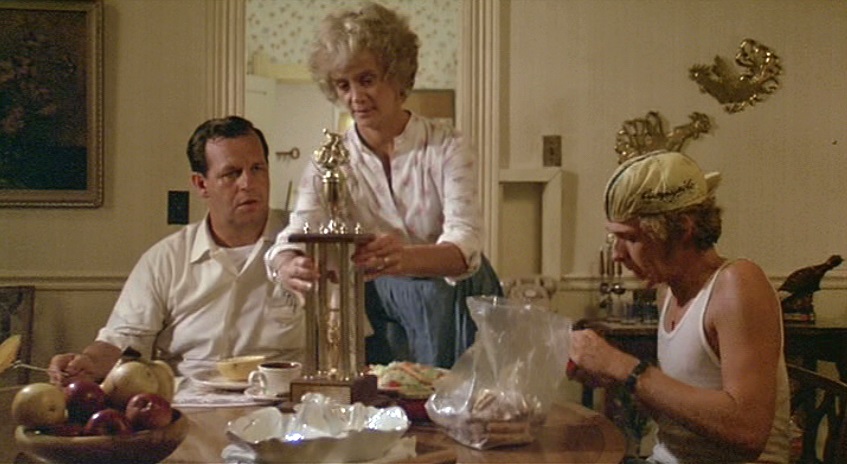
And here's another of the scenes "Premiere" featured, from the Best Picture Oscar nominee Breaking Away. But, I didn't copy the text from the magazine, I'm taking it from the script dated August 12, 1978, which was purchased under its working title "Bambino" (and which DID win the Oscar for Best Writing, Screenplay Written Directly for the Screen for its author, Steve Tesich). Tesich based the movie on the 1962 Phi Kappa Psi "Little 500" bicycle race, whose team was "anchored" by Dave Blase—you'll notice that's the name of the family in the script before it was changed to "Stohler" (which was the surname of the team manager). Blase rode 139 of the 200 laps and hero-worshiped the Italian racing team.

The scene is enlivened by the playing of Paul Dooley, who was a favorite character actor of Robert Altman's, by Barbara Barrie (who was nominated for Best Supporting Actor for her performance), and the eternally enthusiastic playing of Dennis Christopher.

If you've never seen Breaking Away, check it out. It's a good, funny movie...and gave early breaks to the actors portraying Stohler's "townie friends" played by newcomers Dennis QuaidDaniel Stern, and Jackie Earle Haley.
 
The Set-Up: "He was as normal as pumpkin pie. And now, look at him." Dave Stohler (Dennis Christopher), 19, has taken a year off after high school before going to college. In that time, he's been hanging with his best buddies...and pursuing his dream of bicycle racing like his heroes, the Italian racing team. But, he might be off a gear or two, as he's begun to act Italian, causing some confusion to the neighborhood and to his parents: (Barbara Barrie, Paul Dooley), but especially his father.


Action!

REVISED - "BAMBINO" - 8/12/78 11 _ X l f T. BLASE STOHLER HOUSE - DAY 10  
MR. BLASE STOHLER is sitting at a kitchen table. MRS. BLASE
STOHLER is boiling water. Mr. Blase does not look happy. He's got a flyswatter in his hand. He sees a fly. Whack. He hits it. 
He misses. 
MR. 
STOHLER It's that cologne he wears. 
MRS. 
STOHLER It's called...Neapolitan Sunset, it's called
MR. 
STOHLER Well, it smells like fruit punch to me and it attracts flies. 
Mrs. Stohler comes over and pours some hot water into his cup. She takes a package of Sanka from her apron pocket and puts it in the saucer. 
MRS. 
STOHLER There. 
Mrs. 
Stohler looks at the table. 
MR. 
STOHLER
This is it? 
MRS. STOHLER You have to watch your diet
MR. STOHLER Diet, if anybody found out I was on the diet they'd laugh me out of town. A diet
MRS. 
STOHLER
You know what the doctor said. 
MRS. 
STOHLER
At your age... 
MR. 
STOHLER
At my age—
MR. 
STOHLER
What the hell do you mean at my age. 
MR. 
STOHLER
Goddamn see-through coffee.
MRS. 
STOHLER
He says you have a bad heart. 
MR. 
STOHLER
Yeah, but it's got nothing to do with my age. 
MR. 
STOHLER
It's our son that's ruining my heart, Evelyn. 
MR. 
STOHLER
What's he going to do? 
MR. 
STOHLER
He wanted a year with those bums so I gave him a year. 
MRS. 
STOHLER
It hasn't been a year yet. 
MR. 
STOHLER
But, Evelyn. Look what's happened to him. He's turned into a ity; 
MR. 
STOHLER
It was funny at first but it's not funny anymore. Ciao, Papa. Ciao, Mama. Arrivaderchie. That's ity talk. 
MR. 
STOHLER
I used to think it was funny at first. It's not funny anymore.
MRS. STOHLER It's just hero worship. He says the Italians are the best bike racers in the world and he...  
MR. STOHLER This is America, Evelyn. Only paper boys ride bikes and they earn money doing it
MRS. 
STOHLER
Re did win his bicycle and he was quite sickly 'til he started racing around...
MRS. 
STOHLER ...
on that bike and in three years he's... 
MR. 
STOHLER
(INTERRUPTS) So now his body's fine but his mind is gone.
MR. 
STOHLER
He used to be a smart kid. 
MR. 
STOHLER
I thought he was going to go to college. 
MRS. 
STOHLER
I thought you didn't want him to go to college. 
MR. 
STOHLER
Why should he go to college? I didn't go to college. When I was nineteen I was working in the quarries ten hours a day. 
MRS. 
STOHLER
But most of the quarries have shut down closed.
MR. 
STOHLER
Yeah, well, let him find another job. 
MRS. 
STOHLER
But there aren't any jobs. Jobs aren't that easy to find.
MR. 
STOHLER
Let him look at least. Let him come home tired from looking. 
MR. 
STOHLER
He's never tired. He's never miserable.
MRS. 
STOHLER
He's young. 
MR. 
STOHLER
When I was young I was tired and miserable
MR. STOHLER I had my own place at seventeen. 
MRS. 
STOHLER
He says Italian families stay together, 
MR. 
STOHLER
BUT EVELYN, WE ARE NOT ITALIAN! 
MRS. 
STOHLER
I know, I know
MRS. 
STOHLER
It's just that 
MRS. 
STOHLER
I come from a big family myself. . .
MRS. 
STOHLER
and it really was kind of nice... (smiles, half EMBARRASSED) He thinks we should have another kid. 
MR. 
STOHLER
What? 
Dave enters carrying his trophy. 
DAVE Ah, buon giorno, Papa. 
MR. 
STOHLER
I'm your goddamned father, not papa. 
DAVE
Buon giorno, Mama. 
MR. 
STOHLER
She's your goddamn mother. 
MR. 
STOHLER
Whatcha do -- win again? 
Dave opens the fridge and takes out a hunk of cheese and a hunk of salami and starts eating. 
Mr. Stohler looks at him like a wolf and then he looks at half a grapefruit in front of him. He finds it unbearable to watch him chew.
DAVE
Yes, the victory ...she was easy. 
DAVE
But the promoter...'fondatore' 
DAVE
...He says the Italian team...it will come maybe soon...
DAVE
and I will race with the best...ITALIANO. 
DAVE
Like the nightingale they sing, like the eagles they fly. 
Mr. Stohler can't bear to watch him eat. He's starved. 
MR. 
STOHLER
Speaking of flies...there's a helluva lot of flies following you into the house. 
DAVE
Do you know Fly in Italian is 'mosca.' 
MR. 
STOHLER
Well Do you know in English it's a pest. 
MR. 
STOHLER
And speaking of pests... 
Mrs. Stohler senses an argument. 
MRS. 
STOHLER
It's a nice trophy isn't it, dear? 
MR. 
STOHLER
Yeah, 
MR. 
STOHLER
so what. 
MR. 
STOHLER
I've lived fifty years without ever getting a trophy. 
DAVE
You never got trophy, Papa? 
MR. 
STOHLER
No, never, and what's more... 
Dave interrupts. 
DAVE
Here, Papa. I give you. 
DAVE
You are 'Numero Uno.' King Papa. 
Dave hands him the trophy. 
Mr. Stohler is stunned. He takes it.
Before he can even think to give it back Dave kisses him on both cheeks. 
MR. 
STOHLER
Don't do that! How many times... 
DAVE
Now I have to go and take a shower. (starts to leave AND PAUSES) Such a big house and so few people. I wish I had plenty of fratelly and sorelly to greet me when I come home and to wave when I go
Dave leaves. 
Mrs. Stohler sighs. She too would like a big family. 
Mr. 
Stohler is holding the trophy and looking at it. 
Neapolitan music is heard coming from Dave's room. 
Mr. 
Stohler has had it. 
MR. 
STOHLER
There'-s that ity music again. 
MR. 
STOHLER
I'm going to have it out with him now. 
He goes to Dave's room carrying the trophy with him.
Mrs. 
Stohler follows him a few steps and stops. She waits... listening. 
She is apprehensive.
She wants to follow and help Dave out
but she stays behind wringing her hands. 
Mr. 
Stohler reappears looking quite stunned.
He's holding the trophy in one hand along his side. 
MRS. 
STOHLER
What's the matter? 
MR. 
STOHLER
HE'S SHAVING! 
MRS. 
STOHLER
Well, so what? 
MR. 
STOHLER
His legs, Evelyn. 
MR. 
STOHLER
He's shaving his legs. I saw him. His legs. 
 

Words by Steve Tesich


Breaking Away is available on DVD from Twentieth Century Fox Home Entertainment.