Gojira (akaゴジラ Ishirô Honda (1954) A kaiju film (怪獣kaijū). The most expensive film in the history of Japanese cinema to that time, Gojira is a cautionary tale on the horrors of atomic weaponry from the country upon which an atomic bomb had actually been used in acts of war. If any country has the right to protest the atomic age, it would be Japan. And the "Godzilla" series is the longest-running, most successful film series acting as a metaphor for a political-ecological statement ever created in the history of film.
But, it wasn't entirely their idea, though. The Beast from 20,000 Fathoms preceded it by some 16 months, after a successful 1952 re-release of the original King Kong inspired its production. Production of Gojira, being already expensive—and with its production simultaneous with Kurosawa's The Seven Samurai threatening to bankrupt Toho Studios—it was decided to create the monster effects with an actor in a suit rather than doing very time-consuming (and expensive) stop motion animation as was done—by Ray Harryhausen—with the American film.

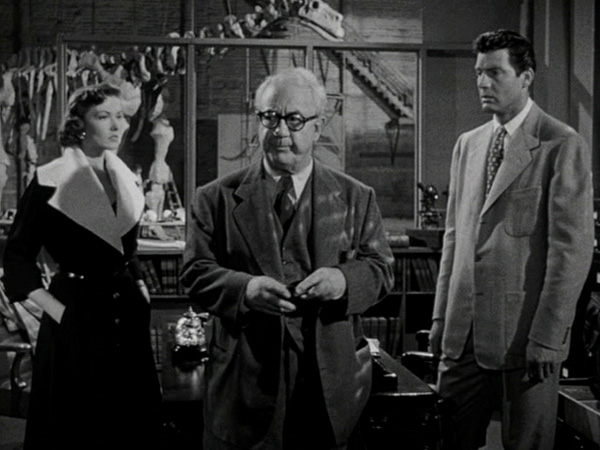
Two sea-vessels, a freighter and its rescue ship, are overtaken by sudden flashes and sunk catastrophically.* Survivors picked up by a fishing vessel tell of the ocean just blowing up and are on their way to nearby Odo Island, when they too are overcome. The islanders find survivors on a raft talking wildly about a monster in the seas. An elder talks of Godzilla, but he is dismissed as a superstitious old man with talk of sacrificing girls to the vengeful creature that destroyed their catches in the old times. That night, the island is beset by a terrible storm that destroys homes and livestock, and investigative hearing is held with eye-witness reports and a speculation by Dr. Kyohei Yamane (Takashi Shimura) that, with the reports of monsters, it might be some creature unknown to modern man. A investigative trip to Odo Island is sent out.
 |
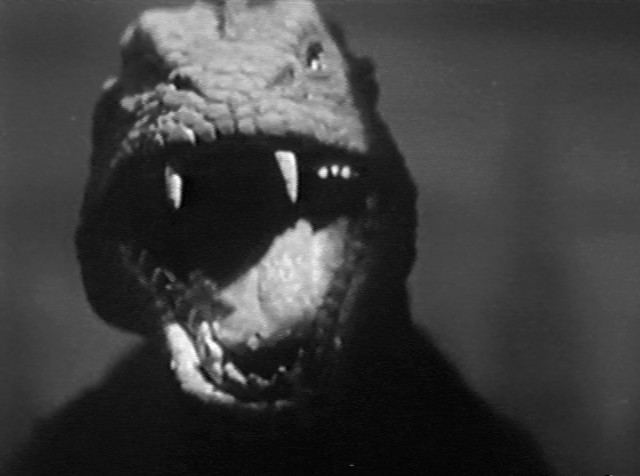
| The movie's first glimpse of Godzilla: "Run away! Run away!" |
 What they find is mysterious tracks, very localized radiation signs...and one very pissed-off dinosaur-like creature. It's that last one that convinces folks that something is seriously wrong with the ecology (although I'm sure there would be some denying it despite the giant lizard in the room—and, in fact, one official gets all blustery saying that the news is so important it should be kept from the public). A Counter-Godzilla Headquarters (yes, that's what they call it) is established and a ten frigate fleet is sent out to Odo to set depth charges to kill the creature.
Watching from the sidelines is Yamane, who, despite the destruction on Odo Island, is a lone voice, seeing the virulent hysteria against the creature and advocating for study and containment rather than destruction. Partially, his reasoning is that Godzilla has absorbed so much nuclear radiation that even a nuke would be useless against him (well, maybe if they missed him by a mile, but a direct strike might just do the trick!) It seems there always has to be a lone scientist who takes a contrary position, and Yamane feels isolated, but, given the possibility of further, and even greater, carnage, he feels he can only offer a dissenting opinion.

It's soon determined that, to protect the citizenry of Tokyo, the military should construct a wall—that always works—of rapidly constructed electrical lines, backed by a phalanx of Japanese weaponry involving machine guns and tanks. Now, let's step back a moment and think about that. If atomic weapons are considered to weak to handle Godzilla—not to mention the aversion the Japanese might have to using nuclear weapons (especially in a movie that has a back-message warning about nukes)—a stretch of high tension lines seems like an extraordinarily weak alternative, unless, of course, you've seen The Beast from 20,000 Fathoms, where it worked fairly well.

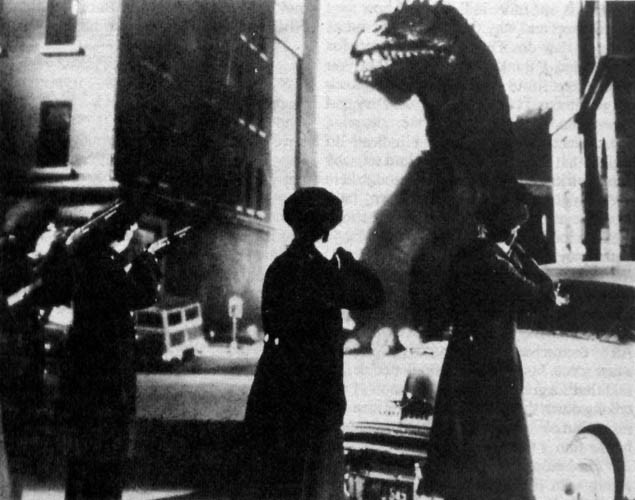
But, despite aggressive military action and that "beautiful" electrical wall, which is as effective as putting up large swaths of tissue paper, Godzilla manages to break through—without losing any waddling speed—and does what Godzilla is supposed to do—attack Tokyo and achieve massive annihilation and ruination, massive if you ignore the extensive model-work that stands—and more often, collapses—for the city-scape, but in an H-O scale.
It is also at this point that Godzilla rolls out his hidden super-power—charging up his dorsal fins in a glowing display and then spews an "atomic breath" that burns, melts and explodes everything in its halitosic path, resulting in what is described universally as "a sea of fire" that keeps flames roaring on any visible horizon.

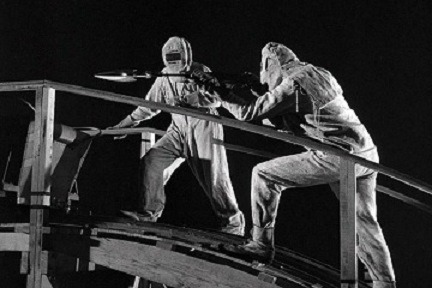
So, how doe you solve a problem like Godzilla? An "ecological-disaster-problem" like Godzilla? Well, unfortunately, it takes an equal ecological disaster to overcome him, and fortunately—or rather, unfortunately, if you make your home in Tokyo Bay—a scientist has come up with just such a violation of the natural order to do the trick. No, it's not Donald Trump's environmental policy. No, it's not a military drop of plastic six-pack rings (that would have already worked if it was). It is the invention of the sullen and reclusive Dr. Daisuke Serizawa (Akihiko Hirata), disfigured WWII veteran and former flame of the daughter of Dr. Yamane. He has created something which he calls an Oxygen Destroyer—just add water and it will suck the oxygen out of the water liquefying flesh and leaving a nicely leeched skeleton in its place. A demonstration of it horrifies Emiko Yamane (Momoko Kôchi). Good enough for government work. The government hires Serizawa to deploy the thing in Tokyo Bay.

It works well enough that it delays sequels for a few years, but sequels there will be. What is striking about the original unadulterated and un-Burr'd Gojira is its overall tone of sadness. The monster is dispatched, but not without cost and those who are sacrificed in his passing are mourned, but given the attitude of Yamane, so is the monster, as it is very much communicated that the death of Godzilla is an opportunity lost to science. Perhaps that is why the creature was revived for an increasingly less serious and affectionate series of films, and his reputation as a cultural icon maintained over the decades. Yes, the thinking may be, he may be a monster, but (dammit), he's our monster.

And one may be dismissive of the somewhat crude effects, but it took quite a lot of work to pull off. And yes, Godzilla is ultimately a guy in a suit, but the cost-cutting move is used in as unjarring a way as possible—the monster is seen only at night and with an impressively respectful camera angle, intercut with a hand-puppet version for close-ups, and enhanced with animation and, yes, even some stop-motion work done sparingly for some shots of Godzilla's destructive tail.
For a monster movie, it is far less giddy and far more sober than any other film in the genre.
 Godzilla, King of the Monsters (Ishirô Honda, Terry Morse, 1956) I had a cinema professor in University—he taught Cinema101—who outlined the difference between foreign cinema and American cinema: foreign cinema begins with setting, with long montages of fields, then workers walking to the fields, then montages of workers working the fields, then they look up, smiles begin to appear, then a tractor appears on the horizon, and the workers rejoice; in American cinema, you get a couple shots of fields, then, over the horizon, a plane appears, then it blows up.
Good joke, that. But, when you compare the two versions of Godzilla: the Japanese Gojira original and the "American" cut, Godzilla, King of the Monsters (released here two years later), you get a sense of what the guy was talking about.
Gojira begins with a calm setting disrupted by something mysterious happening, and a couple reels go by before we actually see the titular cause, where the American version begins 2/3 through that film's timeline, after the attack on Tokyo. As Tokyo burns, two men are found in a collapsed building—one of them is dead, but the other is alive, but quite wounded.
That would be Steve Martin (Raymond Burr) of United World News (as he's only so happy to tell people throughout the film), who is taken to hospital where he is recognized by Emiko Yamane (Momoko Kôchi), who just happens to be an acquaintance, seeing as he's friends with Dr. Yamane, Dr. Serizawa, and everybody else in the film, with the only exception being that of Gojira or "Godzilla" as he is called in this film. When asked to describe it by his editor, Martin pauses and says "Well...it's big and terrible," which is both fact and opinion in four words. Not exactly Pulitzer material, but, then, Martin is a man of few words, especially in Japanese. Convenient for Occidental audiences who don't want to read subtitles...or subtleties.
 |
| "Whyyyy...isn't that Dr. Yamane over there?" |
Steve is the American ambassador to all things Godzilla. He's there being questioned about seeing anything peculiar when he was flying over Tokyo Bay on his way to his stop-over in Japan...like seeing blinding flashes of light destroying two ships. He's there at every press conference and every secret briefing, and he's even there on Odo Island when they find the surviving sailor of the rescue boat, is there when Godzilla is part of a furious storm that destroys an Odo village, and he's there when G-zilla first pops his head over the hills to scare the party who've been moving to higher ground.

The man is everywhere, pipe at the ready to ponder the significance of each new wonder, knitting his brows and shadowing his forehead the way he would whenever Paul Drake handed him a note that didn't add up in the sequence of events of a murder trial—Burr would become TV's Perry Mason the next year. And conveniently, as he's standing just out of camera-range of the proceedings, he'll turn to his Japanese liaison and say "I'm afraid...myyy Japan-ese is a little rusty..." so we can be clued in to what's going on. he's there speaking into a tape-recorder when Godzilla is breaking through Tokyo's defenses, and he's well enough to be discharged from the hospital to watch Serizawa and Emiko's fiancee dive with the Oxygen Destroyer to take out Godzilla. The man does get around.

Other than the utter improbability that one can can be everywhere in the first movie short of being on the camera crew, Burr's Martin makes for a convenient host, if mostly just a glorified by-stander, and Morse does a "fairly" credible job of marrying footage of Martin with shots of the principals so that it looks like he's having conversations, albeit in dubbed English, with the other performers. The two places where it strains credulity is a phone conversation to have tea with Serizawa, where the stand-in manages to hide his face with his arm except for the signature eye-patch he sports, and a hallway encounter with Yamane, where the stand-in does not resemble Takashi Shimura, with the exception of white hair.
 |
| "I can hardly believe what has just happened. Now, it seems, Tokyo has no defense." |
Still, it's a game effort to translate—quite literally—the Japanese film for American audiences so they don't have to read, and throwing in enough sophistication in story-telling technique that flash-back and narration can be used to cover a whole lot of back-story holes, while still presenting the film as more of a thrill ride for American sensibilities than a slowly unfolding mystery...with a big, stomping lizard as the culprit.
 |
Burr would return as Martin for the American version of Godzilla 1985.
"Whaaat? Again?!" |
* This would have struck a nerve with Japanese audiences at the time—as a Japanese fishing vessel, the Lucky Dragon No. 5, was caught in the blast area of the Castle Bravo nuclear test in March, 1954, killing at least one of the fishermen once the ship got back to port.


 What they find is mysterious tracks, very localized radiation signs...and one very pissed-off dinosaur-like creature. It's that last one that convinces folks that something is seriously wrong with the ecology (although I'm sure there would be some denying it despite the giant lizard in the room—and, in fact, one official gets all blustery saying that the news is so important it should be kept from the public). A Counter-Godzilla Headquarters (yes, that's what they call it) is established and a ten frigate fleet is sent out to Odo to set depth charges to kill the creature.


 Godzilla, King of the Monsters (Ishirô Honda, Terry Morse, 1956) I had a cinema professor in University—he taught Cinema101—who outlined the difference between foreign cinema and American cinema: foreign cinema begins with setting, with long montages of fields, then workers walking to the fields, then montages of workers working the fields, then they look up, smiles begin to appear, then a tractor appears on the horizon, and the workers rejoice; in American cinema, you get a couple shots of fields, then, over the horizon, a plane appears, then it blows up.