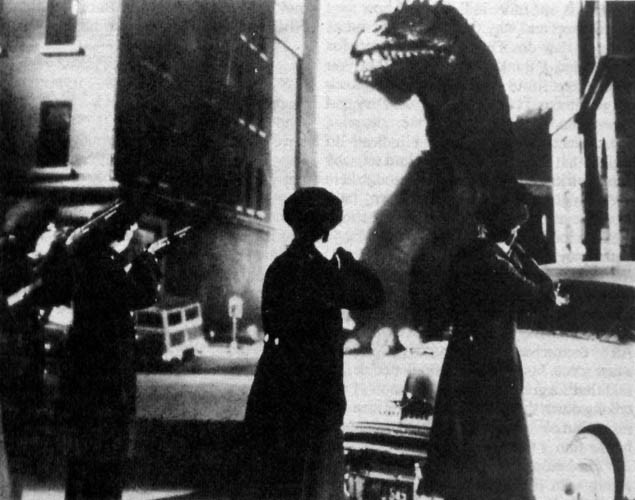
The Beast From 20,000 Fathoms(Eugène Lourié, 1953)Ray Bradbury is associated—and credited in the film—but he didn't really write it, so much as inspire it—his short story "The Fog Horn" had just been published, and the producers had wanted him to do the screenplay, and a deal was struck, where the story's screen-rights were bought, and Bradbury feted in the posters.
Other than that, the story's an original—and it was truly original back in 1952, when it was produced—about atomic testing unthawing a prehistoric creature from the ice, which swims down the coast of North America, and decides to chew on The Big Apple—"Nice place to visit, but I wouldn't want to be squished there." Yeah, yeah, there have been dozens of variations on the theme from dozens of countries of origin, but this one was the first, and hewed very close to the "Atomic dangers" theme that the movie used as a metaphor for the unnatural terror of The Bomb.
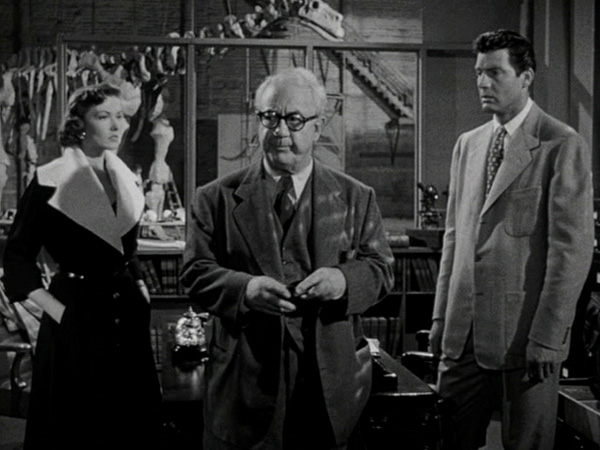
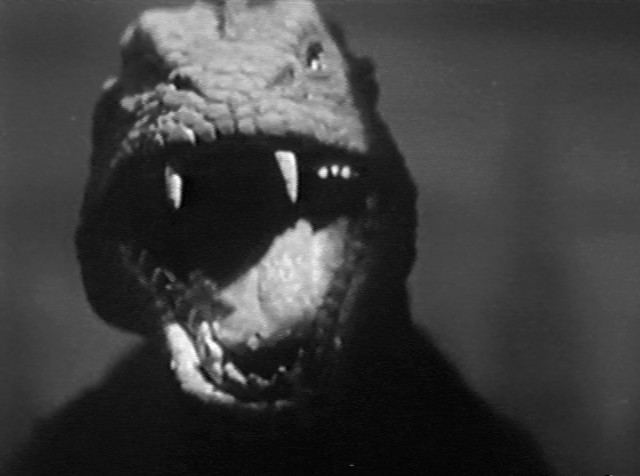
Atomic testing above the Arctic Circle, leads one of the scientists, Professor Tom Nesbitt (Paul Christian), a "nuclear physicist from New York"*to literally stumble upon a prehistoric lizard (designed, sculpted and animated by the brilliant Ray Harryhausen). When he's found, babbling about "b-b-b-big lizard!" he's laughed off by the Army (represented by Kenneth Tobey, who would take on The Thing years later) and the scientific community, including Dr. Thurgood Ellston (a bubbly Cecil Kellaway, quite different from his malevolent warlock in I Married a Witch). Only after a witness to a boat attack further down the North Atlantic Coast, corroborates the phylum of the critter do the pipe-smokers take an interest. Vindicated, Nesbitt takes an interest in Ellston's lovely assistant (Paula Raymond), who sports wide lapels and even broader gestures—"Très dramatique!" Nesbitt must think.
Ellston concludes that the Beast must be making its way down the coast, given the flotsam and jetsam (and a distinct lack of witnesses) heading for the States. Anticipating the Beast's arrival, he volunteers to take a diving bell to make observations, but, just before he can make measurements of the Creature's incisors, he becomes a victim of them.
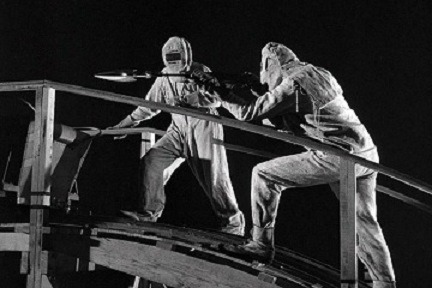
Good thing we have a French physicist in the cast, who decides that if he can get an Army sharp-shooter ("I've got a plan! Let the Americans do it!") with a grenade launcher and toss some fissionable material into the grenade, they can fire it into the open neck-wound and microwave the thing from the inside (Sounds safe to me!). And just because its blundered into Coney Island and is trapped inside the giant flammable roller-coaster near high-intensity electrical lines, it seems like the perfect time to take one of the cars to the highest part of the coaster.
It's like anything; it's never easy.
Man, it's silly. But it isn't pretentious—all the atomic speechifying is done at the beginning, saving the ending for roaring, roller-coasters and roasting rhedosaurs. "The End" comes up so fast you don't have time to wonder if there's a garbage-strike on so they can pick the thing up on Tuesday. And Harryhausen's stop-motion work is still amazing even in this age of CGI manipulation—it still amazes that he's got the dinosaur surrounded by roller-coaster at the same time he's combined it with live action footage—where does "it" stop and the film begin? I know I'm "old school," but, man, I buy this Harryhausen labor of love (done one frame at a time) over the most complexly rendered computer kerfluffle. I'll take 20,000 Fathoms over 20,000 pixels any day.
Lighthouse Envy—The image inspired by Ray Bradbury's story
*Although judging from his accent, apparently New York has a "French Quarter."
** The incident isn't referenced in On the Waterfront.
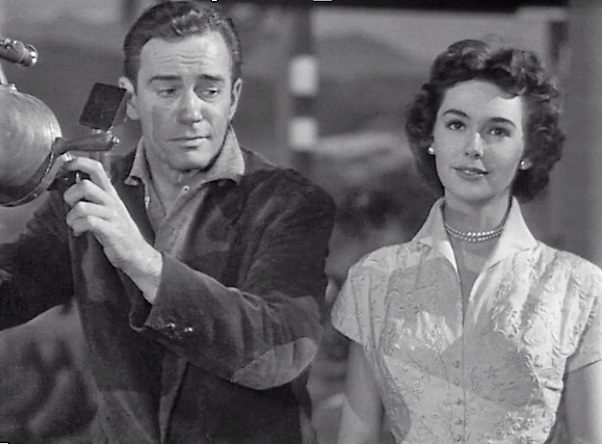
It Came From Outer Space(Jack Arnold, 1953) Before there was E.T., there was an un-abbreviated "IT." Writer and amateur astronomer John Putnam (Richard Carlson) is spending a quiet night in his desert home making lovey-dovey talk with his squeeze, teacher Ellen Fields (Barbara Rush)—frankly, she has the most earning power in this relationship—when he decides to take a look at the night sky. Well, he doesn't need a telescope to see what's coming our way. A big old flaming something-or-other comes streaking over the desert hills and crashes at the base of the desert foot-hills. Because he is so in love with his girlfriend, he decides to charter a helicopter from buddy Pete Davis (Dave Willock) to rush over to see what crashed. Hey, nothing to worry about! Little does he know that the thing is an alien space-craft, and one of its bug-eyed occupants (we'll call it "IT" for now) has exited the craft and started exploring the landing area, leaving a shimmering trail of...criminy, is that glitter? Do the "IT's" shop at Joann Fabrics?
You knows he's a 1950's writer because of the patches on his elbows. You know she's a 1950's teacher because she wears pearls.
No matter. John, Ellen, and Pete land by the crash-site at the old Excelsior mine (owned by Stan Lee, maybe?) and, interested as he is, he abandons his girl-friend and scrambles into the crater. There he finds a huge glowing orb that pulses with whatever energy or heat-waves are emanating from it. He sees what would appear to be a door at the front of it, figuring that, at that point, it's not a meteorite, but some sort of craft or device and, peering into it, he sees equipment. But, he doesn't see that he's being observed. As the door moves, it creates a small avalanche, and Putnam, no dummy, beats it out of there.
"Hmmph! Compensating for something?"
Putnam tells Ellen and Pete what he saw down there and they're a little skeptical—he should probably get used to that feeling, because over the course of the movie, nobody is going to believe what he says and they're going to think he's a kook. Doubling down on that begins almost immediately with the two most skeptical people anyone could find in a town—the sheriff (Charles Drake) and the local newspaper publisher (Alan Dexter). Putnam, still agog over what he saw, thinks nothing of telling them exactly what he saw, never once thinking "These guys could either lock me up or make me look like a loon in the paper." For a writer, he doesn't have much imagination. But, neither do police or newspapermen.
"Our town needs a soccer team..."
Of course, the sheriff is predisposed to think Putnam is a flake—he's had designs on Ellen for years (not that he'd let that get in the way of his job! *cough*) and things get a little uncomfortable between them...in front of the newspaper-guy, and so Putnam is persuaded to leave before things get worse and more people find out. But, on the way home, teacher Ellen gets a real education about maybe believing in what John saw down in the mine. But, now there's an IT blocking the road and they just avoid hitting it and trashing the car. When they get out to take a look—they get out and take a LOOK??!—the IT roadblock is gone, leaving only a trail of glitter like a "My Little Pony."
1950's prototype highway cameras...
After such a weird occurrence, Putnam and Ellen return to the Excelsior mine, where they find a circus of reporters, TV crews, police and scientists who are swarming all over the site. This might have been helped by that responsible newspaper publisher "fake-newsing" a front page headline that reads "Star Gazer Sees Martians." Way to vet, "Hearst." Putnam has microphones shoved in his face, but he and Ellen escape from the Press, but only after he is informed by one of the scientists that the craft is not radioactive. Good thing they're not in the Nevada desert in the '50's. They take a jaunt along the highway and scan the countryside with binoculars to see if they can see anything.
"I'm going to do a show called WHAT in the 60's?"
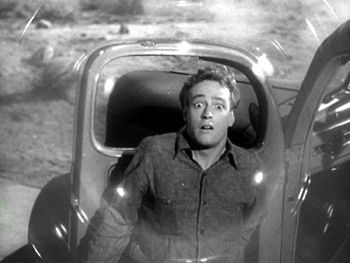
Along the way, they run into a couple of telephone linemen, Frank (Joe Sawyer) and George (Russell Johnson), who are working along the highway. Putnam stops and asks Frank if he's seen anything...ya know..."unusual." No, says Frank, but he's picking up weird signals over the wires. The two love-birds continue their searching while the two phone jockeys move down the line and have a close encounter—too close. George gets out of the close and while we get the IT's perspective through a "Jell-O" filter, he's enveloped by a noxious fog and collapses. Poor "Professor."
"John, why are all those people wearing red and blue glasses?" "I don't know, honey, but I'm glad I brought my pistol!"
Not finding anything up the road, Putnam and Ellen start worrying about the linemen they've left behind. They back-track and find the men's truck, abandoned, with some blood on the door. Putnam grabs his pistol (naturally) and the two start searching through the scrub, following the glitter to either find the ITs or Elton John. They don't get too far before they find George. But, George is, frankly, acting weird or—given that Russell Johnson is a pretty good thesp—acting badly. Speaking in a halting monotone, he has none of the personality of George and all of the personality of Al Gore. He is vague and unhelpful when asked about where Frank might be, but Putnam sees beyond a boulder an outstretched hand. Is it Frank? He doesn't intend to ask George or he'll probably get a lecture on carbon footprints, so they smile and act "normal" and get the Hell out of there.
Let me tell you about an Inconvenient Truth
Where do they go? The Sheriff's office. And why not? Just because he thinks you're a kook and has the hots for your girlfriend. What can go wrong? Putnam and Ellen convince Sheriff Matt to go with them because (gosh-darn it!) they have proof this time. And when they get there...the proof is gone. Even though it won't be invented for 15 years, someone has taken a Dust-Buster to the glitter. "But, we saw it, we tell you!" they argue, but the Sheriff just wants to get back to the office.
Too bad they weren't around 30 minutes earlier, when Frank woke up and saw two George's. The creature has taken on George's form, but reassures the two men that his kind would not take over their souls, their minds or their bodies. From now on in this post, we will refer to the ITs as "Xeroxians™." He tells them not to be afraid. It will only be necessary for a short time. We cut away before there are any questions about double Union wages for playing two parts.
Putnam and Ellen drive the Sheriff back to town, but they see Frank and George—or given their robotic walk and looks, their doubles. Putnam takes off after them and corners them, telling the Xeroxians that he wants to help, but asks where his friends are. He is reassured that they are alright, but to give the aliens time. "Give us time or terrible things will happen. Things you can only dream about." These guys sound like great Presidential candidates. Human beings must be like potato chips because the Xeroxians can't absorb just one. Pretty soon, they have a bunch of the township under wraps and unlike other alien probes, they're only violating their copyrights. Because he's a writer and amateur astronomer, Putnam decides to take the job of getting to the bottom of things rather than letting any professionals do it.
"Does this Jell-o filter make me look...?"
By any stretch of the imagination, It Came from Outer Space is not a great science fiction movie, although it does peg the ol' kitsch meter. So, it may come as a surprise that the story is an original treatment by Ray Bradbury, one the greatest lights in the night-sky of sci-fi. The screenplay is credited to Harry Essex, and the dialogue is sledgehammer subtle. But, the details are all Bradbury, most especially the concept that the Xeroxians are not invaders, but merely had to make an emergency landing on Earth, and are doing their best not to cause a distraction or garner attention to themselves. After all, they must think they've landed on the Planet of the Monkey-People and they're worried about being contaminated by our damn, dirty paws.
"Mischief Matters!"
Still, the psychology of the Xeroxians is a little contrived and very lucky for Earthlings. I mean, humans gets kidnapped and held hostage, sure, and their identities appropriated, but they're not exactly using their credit cards or something else heinous. However, on the Xeroxian side of the ledger, two of them get shot and immolated or dissolved, and they have no sense of regret or vengeance in any way displayed. Lucky Earthlings. Why, the Xeroxians don't even have a form a space small-pox that can cause lungs to explode to even the score.
"Who were those creatures?" "I don't know, but I wanted to thank them."
But, the Arizona Earthlings end up looking like doofi. There's not much tolerance displayed and a propensity to wave guns around, shoot first and investigate later. There's no sense of wonder but a prevailing sense of panic. And the Xeroxians? The worst you can say is they're dangerously middle-of-the-road—as in standing in it—and they have a lousy fashion sense. A black cocktail dress in the middle of the Arizona desert? Really? Still, that concept of non-hostile aliens is something of an anomaly in the science fiction firmament (although The Day the Earth Stood Still did it two years earlier), especially for a xenophobic time as the 1950's. Next week, same space, same time—another sci-fi movie with an equally reductive term for "the other."
Camera-saving VFX from the 1950's: evidently (you can tell from the left) that it was shot using a mirror.
Fahrenheit 451(Francois Truffaut, 1966) As long as we're looking at movies with dystopian society speculations, we should look at an unusual one from the 1960's with a different "take" on things. "Fahrenheit 451" is Ray Bradbury's conjecture, inspired by past Nazi practices during its Third—and final— Reich, the then-current McCarthy era (at the time of its writing) and future projections of thought-control, of a society where the written word is banned as subversive, and "firemen," in a time when houses are fire-proof, are, instead, tasked with burning contraband books. That is, all of them. In the society of "Fahrenheit 451" (supposed to be in the American mid-West post-1960), books are considered bad, as they offer a different perspective from the government's social engineering efforts to keep the populace passive and controlled. Books stir everything up, confuse and enervate (and inspire), so they are suppressed to keep people placid and "equal" (although some more than others).
Bradbury's book was first published as a novella "The Fireman" in the Galaxy Science Fiction magazine in early 1951 (written on a rented typewriter in UCLA's Powell Library) and expanded for Ballantine Books in 1953. It became a classroom perennial to teach students metaphorical concepts and to keep a wary eye on sponsored group-think (in a time before they all graduated to Facebook).
In 1966, French director Francois Truffaut, part of the French "New Wave," chose Bradbury's book to be the subject of his first English-language film (a language barrier that created a slight frisson with the European actors taking direction from an artist (talented, though he may be, visually) for whom English was an unfamiliar language (is that the reason the dialogue is all dubbed?). On the top of that, Truffaut's version of the future is clean, sterile, upwardly mobile, very "white" and slightly robotic, and heavily influenced by Albert Speer's monolithic, concrete city blocks.
The film's title sequence is a nifty introduction to the concept; over tinted zoom shots of roof-tops with broadcast aerials with no title-text, the credits, instead, being narrated by actor Alex Scott. It sets you up for a world without words, and the movie-proper starts with a call to the local fire-house and a small team of fire-men raiding a book depository, finding hidden books, creating a pile of them and setting them ablaze with ruthless efficiency.
Fahrenheit 451 tells the story of Montag (played by Oskar Werner, whose role in Truffaut's Jules et Jim made him an international star), who mans the flame-thrower on the fire-man raids on hidden libraries. He is mentored by Capt. Beatty (Cyril Cusack), who coaches him on the purpose and philosophy behind their fiery task. But Montag is pulled in other directions by two women: his wife Linda (played by Julie Christie), a willing product of the government's propaganda and desirous of an easy, uncomplicated life; the other is Clarisse (also played by Christie), an optimistic and inquisitive teacher who questions the status quo, and who elicits suspicion from the government.
Clarisse's curiosity infects Montag, who begins to question what he's doing, and even smuggles away a book during one of the raids, hiding it from his wife and painstakingly teaching himself to read.
He also begins to see the other side of what he's doing. seeing the devotion of the book-keepers, one of whom (Bee Duffel) chooses to be immolated, monk-like, with her beloved books. It shakes Montag right down to his bindings and he begins to see the whole society as having a broken spine, devoid of the passion that the books engender, and he begins to feel more isolated from his co-workers and his wife. After all, he is now a criminal...in his own mind, and in theirs, as well.
Truffaut's film is flawed—his published diaries reveal that is was a difficult "shoot," especially in dealing with actors (especially his former star Werner) and he was never satisfied with the English translation of the script, preferring the French version. Perhaps that is why the film seems to come most alive when he languishes his lens on all those montaged shots of books, as they explode into flame with an almost sensual fervor. Pages crisp and blacken among the collections of controversial books—and even an issue of Cahiers du cinéma, the magazine where Truffaut began his film criticism career—with all the unblinking fervor that Carl Theodore Dreyer used filming The Passion of Joan of Arc. Truffaut mixes the titles notorious at the time of the film with familiar classics long past their time of controversy ("David Copperfield" for instance) to show the wide spectrum of time and how it can outdistance objections of long-ago melted snowflakes.
There are moments that are dodgy—technically, on the effects side, the jet-packed police are clumsily wired in front of a projected back-drop that exposes the searchers as not moving independently in flight. But, on the other hand, the movie does forecast flat-screen television monitors (interactive ones!) and the way the media can invade one's life. Such things are much less jarring in current perspective than jet-packs (however poorly supposed).
Fahrenheit 451 does have an aspect to it that makes me regard it fondly, seeing past its flaws—its ending. In it (FLAMING SPOILER ALERT), once Montag has escaped his puppeteered pursuers—and is dramatically and fraudulently "killed" for the cameras—he makes his way along an abandoned railway track to his ultimate destination—a secluded wood that has become the home of the "book-people" who each devote their lives to a single book, memorizing it, archiving it in their minds, so that it can never be destroyed except by death (and even that is maintained with a hand-me-down oral history to the next generation).
It is one of my favorite sequences in film*augmented by an exquisite strings-only score by Bernard Herrmann. As the spken words commingle, Herrmann, whose score has previously gone turgid in moments of action and pursuit, breaks free and creates a delicate melancholy theme that is one of his loveliest compositions, certainly one of the most beautiful in cinema since the sound era. That he ends it with an unresolved blast of strings that resembles a cry of anguish finishes the film with an appropriate flourish of emotion previously not realized in the film. It moves me no matter how many times I've experienced it. After a couple of decades of an update being planned, HBO has produced a new version starring Michael B. Jordan, Michael Shannon, Sofia Boutella and Keir Dullea to be directed by Rahmin Bahrani (director of Man Push Cart and Goodbye Solo) which sounds very intriguing. They'll start showing it May 19th of this year.
 The Beast From 20,000 Fathoms (Eugène Lourié, 1953) Ray Bradbury is associated—and credited in the film—but he didn't really write it, so much as inspire it—his short story "The Fog Horn" had just been published, and the producers had wanted him to do the screenplay, and a deal was struck, where the story's screen-rights were bought, and Bradbury feted in the posters.