Showing posts with label Warren Oates. Show all posts

Saturday, June 26, 2021

The Rise and Fall of Legs Diamond

Saturday is traditionally "Take Out the Trash" day...

The Rise and Fall of Legs Diamond (Budd Boetticher, 1960) It sucks that the first film I see of director Budd Boetticher's it's a film he didn't particularly like the results of. He got to do what he intended with the limited budget of a B movie, but casting left a bit to be desired. 

Boetticher was hoping to cast a young Robert Evans for the role of Diamond, but Evans, after toiling in the acting field for awhile with only a few roles to his credit, decided to parlay his fortune from selling ladies' apparel into the movie-producing field and this low-budget gangster movie wasn't something to coax him back.

It might have had something to do with the character. Evans had played Irving Thalberg and the titular Fiend Who Walked the West, but Jack "Legs" Diamond was a small-time bootlegger, thief, and protection racketeer, who was perfectly willing to con and throw over anybody in his desire to rise through the ranks of gangster-hoods. 
Boetticher has Diamond (Ray Danton) and his brother Eddie (Warren Oates!) arrive in The Big Apple with intents to do some petty thievery, but witnessing a botched jewel-heist with the perp gets popped, Diamond scans the building, notices a rooftop entrance and starts to divine a plan. He picks up a dance-hall girl (Karen Steele), who rebuffs him because she's going to be in a dance-competition that night. He waits outside her flat for her partner and fractures his foot, then takes his place. The two win the competition—by Diamond setting the dress of the better couple's female half on fire—and go out for a celebratory movie.
Diamond ditches the girl in the theater for a stretch, making his way to the gents' and going out the window to second-story the jewelry store, dropping in from the roof. He nearly gets away with it, but he's ultimately convicted of the crime and goes to prison, where he spends his time planning his next step—by robbing the type of people who wouldn't call the police, that being gangsters. He sets his sights on Arnold Rothstein (Robert Lowery), who refuses to see such a small-fry as Diamond.
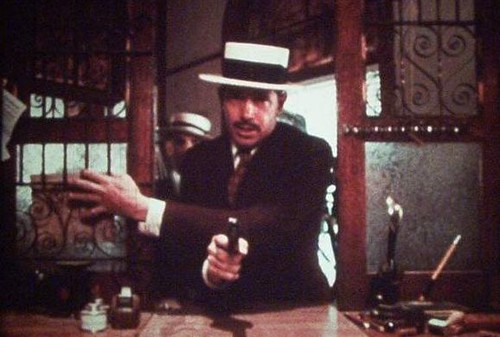
But, Diamond gets his attention by finding out Rothstein's personal account and charging $4,000 worth of goods to it. Diamond is hauled before Rothstein, who'd just as soon shoot him as make him his bodyguard, but Diamond gets a stay of execution when a hood-buddy of the big man takes a liking to Diamond, admiring his chutzpah, and signing him on as his hired gun. Doesn't go too well, though. The mobster and Diamond get gunned down, with Diamond somehow surviving and beginning to think that he can't be killed and becomes emboldened to climb higher.
Rothstein does hire Diamond for bodyguard duty—as he seems to be so successful at it (!) and Diamond uses the opportunity to also become his bag-man, as well, with a particularly rough way of collecting protection money for his boss. He sleeps with whichever moll can get him information, with the ultimate aim of charging the gang-bosses for his protection, something that doesn't go over to well among the thugs.
Boetticher's movie is bare-bones as far as budget, but he manages to keep the 20's setting fairly believable—Warner Brothers was the studio bankrolling it and they had a surplus of get-ups, gats, and jalopies, but the film has the thin veneer of Desilu's "The Untouchables" TV program all over it. something it has in kin with the Arnold Rothstein movie King of the Roaring 20's, made around the same period...about the same period. But, Diamond is such a louse in every way to everybody that Danton's smug demeanor only makes you like the creep less. The best movie villains have a style and swagger that, at least, can be entertaining (think Cagney), but Danton has none of it. Oh, he can wear the clothes...but so can a mannequin. The movie's just a little too set-bound, and set-lit to be very interesting, although Boetticher does try his damnedest.  It's the star that makes it such a stiff.

Wednesday, April 8, 2020

Olde Review: The Wild Bunch

This was part of a series of reviews of the ASUW Film series back in the '70's. Except for some punctuation, I haven't changed anything from the way it was presented, giving the kid I was back in the '70's a break. Any stray thoughts and updates I've included with the inevitable asterisked post-scripts.

This Friday's ASUW films in 130 Kane are Masaki Kobayashi's Hara-Kiri and Sam Peckinpah's The Wild Bunch.


The Wild Bunch (Sam Peckinpah, 1969)
"When you side with a man, you stay with him and if you can't do that, you're like some animal! You're finished! We're finished! All of us!"
This is the credo of the films of Sam Peckinpah. Throughout his film career--even before Peckinpah had William Holden speak those words in The Wild Bunch--it has been the thread that has bound his films together, formed their basis, given them a purpose. And this credo doesn't just apply to a band of outlaws as it does in The Wild Bunch, but also to employer and employee (as in The Killer Elite) or to husband and wife (The Getaway and Straw Dogs) and to former friends, even if they are on opposite sides of the Law, as in almost all of Peckinpah's films. In the realistic morality of Peckinpah's worlds, the combatants, though on opposite sides of their battlegrounds, are neither totally pure or totally evil. They are amoral, with aspects of both, and thus that credo--the credo of loyalty--is the only means we have of separating them and determining the better men.
"If they move, kill 'em"...right before Peckinpaw's director credit
Peckinpah has always been accused of being nothing but a "macho" film-maker, and though it may be true that he primarily focuses on the male world, I think the term macho is inappropriate. If "The Wild Bunch" are macho, they are blithely ignorant of it. They are not dedicated to their maleness as much as to their survival, and to the spirit of the credo.
Another thing that is popular to hit Peckinpah on is his use of violence--his explicit use of violence. And while The Wild Bunch is violent--even by today's standards**--it might be wise to keep in mind the work of a lot of hacks around these days*** who make more violent films and do so with less imagination and regard for anything. Peckinpah's uses of slow motion violence are not prolonged, they are quick vignettes of an individual confrontation with death, that much like the life itself, is here, then gone, leaving an impression in one's mind no matter how many deaths one sees.
Also, it might behoove you to keep in mind that Peckinpah doesn't just make Wild Bunch's and Straw Dogs'. He has made two recent films which I would urge you to see--Junior Bonner and The Ballad of Cable Hogue which are boisterous but gentle, apply Peckinpah's credo, but also celebrates life. Not only are they my favorite Peckinpah films, they are his, too. The reason he doesn't make too many films like them is that they don't make money.
The Wild Bunch has an all-star cast, uniformly excellent in their roles: William Holden, Robert Ryan, Ernest Borgnine,**** Ben Johnson, Warren Oates, Edmund O'Brien, Strother Martin, and L.Q. Jones (who, only incidentally, wrote and directed the film of A Boy and His Dog). These are just the stars, but this film is filled with people and faces that you will never forget. Nor will you ever forget the experience of The Wild Bunch.
Broadcast on KCMU-FM October 28 and 29th, 1975
The Wild Bunch (led by William Holden) and the motley crew that pursues them (led by Robert Ryan)

I'm still a big fan of The Wild Bunch and Junior Bonner and The Ballad of Cable Hogue, and Ride the High Country and Cross of Iron and Pat Garret and Billy the Kid, and Major Dundee, now that they've been released in versions that are closer to the way Peckinpah intended them. Producers had a habit of hiring him and then firing him and re-editing his films themselves (often into confusing plot-line dangling confusion), and I think that had a lot to do with The Peckinpah Credo about loyalty. He wanted them to know that if you hired him, you'd better trust him to make the film, but there's always disagreement about that when the red ink starts to flow.
I think Sam would crawl into a bottle if he saw how corporate loyalty invaded politics to create administrations of co-conspirators who couldn't think beyond their loyalty to their jobs and bosses. It goes to show that too much of anything can turn into a problem.
The Wild Bunch grows more interesting with age as a film about the old guard being unwilling to change in the face of the modern world, and convinced of their own transitory nature, while sticking to their code. It also shows layers of greed, between the outlaws and the members of Ryan's gang that have no moral hedge against body-robbing. There's a very fuzzy moral line there, but Peckinpah's morality could be very fuzzy. As fuzzy as the world lets it, I suppose.
The film was made part of The National Film Registry by the Library of Congress in 1999.

** Not so true today. Nowadays, The Wild Bunch looks tame. But, this film came out after audiences had been prepped by the "Dance of Death" in Bonnie and Clyde—the sequence influenced the editing and blood-spatter of the "Battle of Bloody Porch" sequence in The Wild Bunch—and even the relatively tame Butch Cassidy and the Sundance Kid.

***Don't know who was thinking of here, but, at the time, maybe Tobe Hooper, and Paul Bartel. But, the era of bloody violence—with wounds that would take more than a band-aid to heal—were in such mainstream films as The Godfather, Beneath the Planet of the Apes, Dirty Harry, and other films that came out during the "ultra-violent" Christmas Season of 1971 (which included Peckinpah's Straw Dogs).

****I've become convinced that Ernest Borgnine played one of the atypical roles of his life when he played "Dutch" Engstrom--who, from the evidence I see in the film, is gay (Ernest Borgnine?!). Dutch doesn't join in with the Bunch's whoring activities, and his cries for Pike Bishop during the finale show a definite emotion more than loyalty. Of course, there have been gay sub-texts before in Westerns, and in the classic ones, long before Brokeback Mountain made it seem revolutionary (Well, yeah, if nobody was watching...) Peckinpah snuck it right by--that's why I like the director so much.

Thursday, August 2, 2018

Triple Dillinger

Written at the time of the film's release...


"Pretty Boys and Baby Faces: The Romancing of John Dillinger"


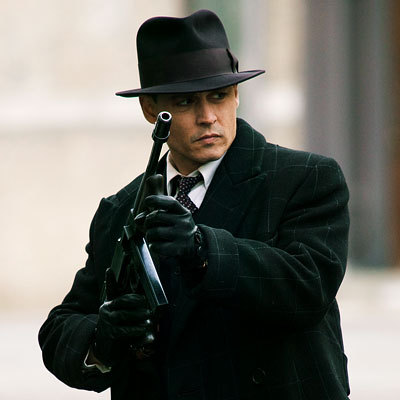
John Dillinger had enough publicity during his short* reign on the Most Wanted List, a lot of it generated by the man himself and his way of painting himself a folk-hero (he even saved his press clippings), so it seems like gold-plating a tommy-gun to make another movie lionizing him (see below). But Michael Mann—the director who created "Miami Vice" and has made a good movie or two (Manhunter, The Last of the Mohicans, The Insider, and Collateral) felt the need to make a new telling of the Dillinger legend—this one gussied up with Mann's usual stylish flair (although on more than one occasion the stylish suits and the familiar Chicago locations made me mindful of Brian De Palma's The Untouchables). Let us put aside for awhile the argument that the movie is morally wrong-headed to paint Dillinger as more sympathetic than his "Public Enemy" in the FBI, Melvin Purvis. Let's just examine where the movie Public Enemies goes wrong.

The opening break-out from the Indiana State Pen portrayed in the film has some relation to truth—guns were smuggled into the shirt-making shop in shipments of thread—but Dillinger wasn't there. He'd been paroled early due his step-mother's imminent death and was sitting in a jail-cell at the time from a small series of robberies that had been planned with his earlier cell-mates at Indiana. He was picked up at his girl-friend's house, which was being staked out by police. That hardly fits the legend of John Dillinger that
Public Enemies insists on pushing forward.

But then, the movie is less an accurate crime drama than a period romance. The film makes "
Billie" Freschette (Marion Cotillard) the love of Dillinger's life—the case could be made for Dillinger's wife who divorced him while he was serving his initial stretch in prison, breaking his heart and subsequently making him distrustful of long relationships with women. The absurdity is taken to an extreme case with a coda that is completely unbelievable, considering that Dillinger was famously gunned down in the company of a new prostitute girlfriend Polly Hamilton (Leelee Sobieski) and madam Anna Sage (Branka Katic)—the legendary "lady in red."** Still, one of the interesting stories about Dillinger is that the FBI staked out his boyhood home, hoping to arrest him the day he brought Freschette home to meet his folks. When the party broke up, three cars left the farm-house. The Feds followed the wrong one. It is true, as the movie shows, that Dillinger watched as Freschette was arrested and "cried like a baby" when he left the scene. He wasn't so broken up that he wouldn't take up with somebody else, though. And last words? Horseradish. Barbara Cartland could have written such sentimental sop.

The problems began from the beginning, when Leonardo DeCaprio was set to star as Dillinger, then when the project stalled, Johnny Depp signed on. Neither of these boy-men make a credible Public Enemy #1. Depp's performance is fine, but wrong-headed, his Dillinger looking more dyspeptic than criminal. It's a romantic's fantasy of John Dillinger, as is the concept of Dillinger being a one-woman man.
Still, Mann does some good things. Shot on video (by Dante Spinotti) the film is crystal-sharp, and looks great, even during its numerous hand-held sequences. The shoot-out at the Little Bohemia Lodge is completely inaccurate—the movie would have you believe that "Baby Face" Nelson died in the action as well as the two FBI agents who were killed—but the sequence is rip-roaring at times with Christian Bale's Melvin Purvis riding the running board firing a tommy-gun at the fleeing bandits.*** There are interesting cameo's—Billy Crudup does a fine impression of a young John Edgar Hoover, pugnacious, brittle and paranoid, and Lili Taylor shows up as Sheriff Lillian Holley. A made-up scene of Purvis and Dillinger taunting each other while the robber's in prison allows the two stars to have a scene together, but sacrifices the fact that Dillinger looked right at Purvis while walking out of the Biograph Theater his last night and did not recognize him.
But the film is as much fiction as fact, getting a lot of period facts wrong (there was no FDIC at the time of Dillinger's robbing career, yet a sign announcing the fact is displayed prominently, probably for comic effect, during a heist sequence) and the story a Disney version of actual events. It's a disappointment, considering a lot of the Dillinger story is stranger than fiction.


There have been other versions of the story****


Dillinger (John Milius, 1973) Produced at a time when American International Pictures was actually putting some money into their films, it gave USC maverick director Milius a chance to direct. There's a lot of Bonnie and Clyde in this Dillinger, and Milius indulges in some Peckinpavian slow-mo blood-spurting, but on the whole it's an interesting account of the Dillinger years. Milius also uses two members of the Peckinpah stock-company: Ben Johnson is too old to play Melvin Purvis, but the man lends considerable weight and history to the role and the movie which made a folk-hero out of Purvis on a par with Dillinger.***** In the title role, there could be no one better than Warren Oates, who not only looked like the real thing, but was a more pragmatic, less idealized version of the gangster. Along with Oates' better performance, Milius' film is a grittier, sparer version of things, not as glossy and feeling much more ambivalent toward both cops and robbers.

And look at that cast! Richard Dreyfuss (over the top as "Baby Face" Nelson), Michelle Phillips (late of "The Mamas and the Papas") as Billy Frischette (though she's present at Dillinger's death), Cloris Leachman as Anna Sage, and a wealth of character actors—Harry Dean Stanton, Geoffrey Lewis, Steve Kanaly, Frank McRae, and Roy Jenson.
This is the one to see, despite (and maybe because of) the protestations of J. Edgar Hoover at the credits' end.


Dillinger (Max Nosseck, 1945) Low-budget exploitation film that took the Dillinger notoriety and regurgitated the legends, fictionalizing the story and changing names (winning an Academy Award nomination for screenwriting in the process!). The film starred Lawrence Tierney, Hollywood bad boy, who had a long career as a hood-type up to and including Reservoir Dogs. But there are some good actors on hand like Marc Lawrence, Elisha Cook Jr., and Edmund Lowe. But the film is strictly of the "Calling All Cars" school, laughably simple-minded, with none of the style of the gangster movies of the previous decade, and Dillinger portrayed as a romantic figure—the female lead (Anne Jeffreys) refuses to pick Dillinger out of a line-up because she's got "the hots" for him. Not much to recommend it.


Just to let you know this lionization still exists (as if Public Enemies wasn't enough), July 22nd is traditionally "John Dillinger Day" and members of the "John Dillinger Died For You" Society do their traditional walk from the Biograph Theater, commemorating his death July 22, 1934.


* Dillinger's crime career (following his prison sentence for unsuccessfully cold-cocking a local grocer) lasted all of 14 months.

** Even that story's not true—Sage told Purvis she would wear a white blouse and orange skirt—which appeared red in the Biograph's marquee lights. The trio went to the movies to escape a hot apartment and the Biograph was air-conditioned; the movie—Manhattan Melodrama, a gangster film with Clark Gable, William Powell and Myrna Loy (she's given quite a tribute in Public Enemies, and Marion Cotillard does resemble her).


*** Bale does a good job as Purvis, but he's a bit too dapper to portray the Special Agent. He is, however, one of the few actors who can fire a large caliber weapon without blinking. Purvis' story is an interesting one: charged by J. Edgar Hoover to "get Dillinger," when the press lionized the Agent, Hoover became jealous of the attention paid to him, making life miserable until Purvis left the Bureau a year later. Unable to find further work in law enforcement (due to alleged interference from Hoover), Purvis became a private businessman, married and fathered three sons. He died in 1960 of a gun-shot wound to the head from the revolver given to him by his FBI colleagues upon his retirement from the Bureau. Hoover's FBI ruled it a suicide (and Purvis was suffering from cancer at the time), but others have speculated he was killed accidentally trying to pry a tracer bullet out of the gun. When the legend becomes fact...

**** Not including Young Dillinger starring Nick Adams, sort of an "I was a Teen-Age Dillinger."


***** Milius padded Purvis' resume a great deal, having him in charge of the captures of "Pretty Boy" Floyd and Dillinger, but also "Baby Face" Nelson (as does Public Enemies), and "Machine Gun" Kelly, "Handsome Jack" Klutis, and Walter Underhill.