Showing posts with label Walter Pidgeon. Show all posts

Wednesday, September 22, 2021

Warning Shot (1967)

Warning Shot
(Buzz Kulik, 1967) Based on a novel by Whit Masterson (who also wrote the book that had become Touch of Evil), Warning Shot was considered a good vehicle for David Janssen, who was in the middle of his run on "The Fugitive" TV series. The script was by "Fugitive" veteran Mann Rubin*
a prolific writer who wrote at least one script for most of the thriller/SCI-FI series of the 1960's and 1970's.
 
The story has a nice affiliation with Janssen's "Fugitive" persona in that he plays a discredited cop accused of killing an unarmed man—and nobody believes his story that the dead man was carrying a gun—a search of the scene has never turned up the weapon, and the prosecuting attorney (Sam Wannamaker) is more than happy to provide no reasonable doubt. It doesn't help that the L.A. police (in the form of Ed Begley's crusty superior and partner Keenan Wynn) have their own suspicions, whether to save face for the force or attain a promotion.
 
Plus, it doesn't help that Janssen has a face that always looks guilty.
It's true that during a drug stakeout, Sgt. Tom Valens (Janssen) has shot a man who was running away from him in the night, in the fog of a swimming pool, but Valens swears it was a "good" shoot; he didn't fire until the suspect drew a gun on him. But, in the light of day, the dead man turns out to be a respected doctor and no weapon can be found on the scene. Valens had been shot a year previously—so the whispers are that he might be a little trigger-happy. Facing manslaughter charges, Valens is forced to do a little investigating on his own.
The victim, Tom Ruston, was a respected doctor catering to diseases of the rich, but also well-regarded for his humanitarian work in Mexico. The doc's accountant (George Sanders) and his floozy wife (Eleanor Parker) are of no help, nor is the doc's assistant (Stephanie Powers). Nope, the only people who seem to have any sympathy for Valens' plight is his ex-wife (Joan Collins) and a pilot (George Grizzard) who lives at "the scene of the crime" and who offers to fly Valens down Mexico-way to see if the doctor's work in Mexico was legit.
Then, things start to get complicated; Valens acquires quite a few bruises after he's been beat up in an apparently random attack. Then, Ruston's nurse dies and the doctor's office is ransacked. Then, Valens is dosed with a mickey in his milk—this was the days of door-stop deliveries**—and nearly gassed by his own fireplace. It would have looked like an accident. But, Valens knows it's enemy action.
Now, it being the 1960's, there's a little bit of experimentation on director Kulik's part with camera angles that are a little too precious,*** and when Valens is beat up (not too convincingly and in sloooow motion) his POV is shown with vasellined and distorting lenses, which is groovy, baby, but didn't strike me as being very convincing. Frankly, when these sorts of shots appear I think less that the person is going unconscious and more that trends in film-making in the '60's were very fleeting.
Ultimately, the entire movie is not very convincing. The plot hinges on one of the most unbelievable and least likely MacGuffins**** in movie history (nope, I won't spoil it, but, once you know, you'll say "why would they use THAT?"). It's odd, but Warning Shot is one of those movies where the script is supposed to be deadly serious, but there are those moments—when Kulik is focusing on a bottle of milk at Janssen's feet, or a shot that shows just how convenient meeting in a graveyard can be—that you think they're trying to have as much fun with the material as they can, the results seeming half-hearted, like the film-makers realizing somewhere in filming they were making one of those Hitchcock "wrong-man" movies. The film is top-heavy with talent—Sanders, Parker, Walter Pidgeon and Lillian Gish—all playing characters they've played and excelled at in their careers—but, the film is far less entertaining than one would expect given all that. The film needs a little bit more absurdity to work. Especially given its ending.

 
* Yeah. No, he didn't write for "Star Trek" but for Irwin Allen and the "Bionic" people. Quite a few scripts for The Alfred Hitchcock show and most of the detective/mystery shows of the era.
 
** It's just a cautionary note in these pandemic times, but don't be like David Janssen and leave the delivered food on the stoop all day so bad guys can poison you...or the food gets so old it poisons you. 
 
*** Check this shot out—that's the heavy-hand of the prosecutor in the foreground during the manslaughter trial. Yup, the judge is Carroll O'Connor.
**** And just in case you don't know what a "MacGuffin" is, here is Alfred Hitchcock to explain...

Thursday, September 5, 2019

These Wilder Years

These Wilder Years (Roy Rowland, 1956) James Cagney plays Steve Bradford, an executive who, for once, takes time off for himself to take care of some unfinished business. He leaves his board of directors in charge and makes it known that if there's an emergency, he can't be reached and somebody else will have to handle it. He's got important business of his own. He doesn't know long it will take, but until it's taken care of, he can't be reached.

He goes back to his hometown and seeks out an orphanage run by Ann Dempster (Barbara Stanwyck), whom he he had contacted previously. She repeats that what he is asking for is quite impossible—she cannot give out the information he seeks. There are rules. That's not the kind of answer Bradford like to hear. He's a captain of industry, a Master of the Universe. He's used to getting what he wants, and if he can't get it one way, he'll find another way to do it—the ends justify the means.
What he's looking for is his son, given up for adoption twenty years previously when he was less successful and less capable of the responsibility. Now, he wants to make amends and be the father he never thought he could be in the past. 
The film was made in 1957 and the subject of unwed mothers was something that was rarely discussed, let alone put on movie screens. If it was, it was slapped with a "Not recommended for General Audiences" label (the kiddies would have to wait for the rating system 11 years in the future). But, this movie had the social conscience—and the business-savvy knowing that the story would never be shown on people's new television sets (where Lucy and Desi had to sleep in separate beds on "I Love Lucy").

So, it makes for an interesting subject to see in a movie from that era; they're not very clinical about it, and don't even use the terms "pregnant" or "unwed mother," and emphasize that these are young girls in a fix and someone has to deal with it and protect all the parties involved. The young men involved in the process are never mentioned—perhaps because you'd have to mention sex—and the only evidence that this might be a shared responsibility is in the character of Bradford who owns up to it twenty years too late.
The reason I was drawn to These Wilder Years was to see old pro's like James Cagney and Barbara Stanwyck playing off each other—in the only time in their careers. The two are a couple of my favorite thesp's and they are not sentimental in their portrayals, playing subtle combatants over the information Cagney's Bradford wants. Bradford is so single-minded and so used to getting his own way that he takes legal action against the orphanage to get what he wants, using his company lawyer Rayburn (Walter Pidgeon, playing with a cynical practicality) to sue Dempster in order to release the information to him...and presumably every other prodigal father.
Stanwyck has the more sympathetic role here, and she plays it with a functionary's stern patience. And Cagney, as always, is a revelation. He has a scene where, quite to his surprise, he finds what he's looking for, and his reactions are a study in complexity, going from realization to surprise to fear to shame to regret without pause or revealing of technique. There's no acting, but considered reacting. It's another example—in a long-running career—of why Cagney is considered THE actor's actor and an artist of the highest caliber.


Saturday, August 15, 2015

Man Hunt/Rogue Male

If someone pontificates the blanket statement "there's never been a remake of a film better than the original," here's a rebuttal (besides, say, True Grit) you can have at the ready:

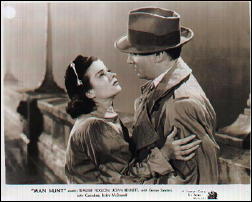
Man Hunt (Fritz Lang, 1941) Dudley Nichols' adaptation of the 1939 Geoffrey Household novel that begins with a sure-fire set-up: a big game hunter, Captain Alan Thorndike (Walter Pidgeon), travels to Berchtesgaden to shoot Adolf Hitler right in the Berghof with a long-range rifle. He "takes the shot," but then, on second thought loads a bullet into the chamber...too late. He's discovered, taken prisoner and tortured for information by Major Quive-Smith (George Sanders, at his most impenetrably cold). The Major wants the Captain to admit that his intent was to kill Der Fuhrer (something he understands being an avid sportsman himself) and sign a confession to that effect, saying that he was doing it for the British government.  Thorndike refuses, is beaten, then dumped over a cliff to make his death appear an accident.

But Thorndike survives, and makes his way back to England, barely ahead of his Nazi pursuers. With the aid of a cockney lass, Jerry Stokes (Joan Bennett), he manages to elude his pursuers, going, literally, underground by living in a makeshift cave and living off the land. But a cave has one drawback—it only has one exit, and this proves to be a weakness in Thorndike's cat-and-mouse with the Nazis.

It's a corker of a story, told with the visual paranoia that Lang excelled at. It's one long chase that finally goes elementally one-on-one. Where Nichols diverges from Household (aside from actually naming the dictator the author's anonymous hunter aims for, no doubt with the approval of the director, a German exile*) is in a neat insertion of a "woman's part," through the extended English city section, which becomes a deus ex machina for the final confrontations. "Jerry Stokes" was a Nichols creation, it being thought that giving Thorndike a visible love interest for the audience to identify with, would more humanize Thorndike and his quest.  "Jerry" has her origins in the book, but was only suggested. Nichols, Lang, and Bennett made flesh what Household only used as a back-story.   

Rogue Male (Clive Donner, 1976) BBC film of the Household novel that keeps the original more in its sights. Where Man Hunt is urban, has a love interest, and is quite light-hearted at times, Rogue Male is more to the point, quite brutal (the shots of Peter O'Toole's Thordyke after being beaten to a bloody pulp are tough to watch) and extends the cave scenes, making them much more a part of the story (Pidgeon spends barely 20 minutes in the cave in Man Hunt) as they are in the book.

But it is the character of Thorndyke where the two most diverge—Pidgeon's captain does what he does to survive. That's certainly true of O'Toole's characterization (it has to be!), but one also gets the sense that this hunter prefers life in a cave to one in the aristocracy. Any hint of romance is purely prologue, giving an ethereal quality to the unnamed woman, that O'Toole merely suggests with a melancholy cast of his eyes. Written with 20/20 hindsight by Frederic Raphael, the film is far more political than either the book or first film could ever hope to be at the time they were written, given the historical perspective nearly forty years can bring. Smart, intelligent, unwavering, the BBC version of Household's novel is an adaptation worthy of the anonymous Hunter.

The Lang version is more stylish and romantic, but Donner's TV-version has the novel down cold. O'Toole once stated that it is the favorite of all films.

* This supposedly worried 20th Century Fox exec Darryl F. Zanuck, as well as The Breen Office, as America, at the time, was neutral in the European War, not entering the fray until the attack on Pearl Harbor.