Showing posts with label Samantha Morton. Show all posts

Tuesday, January 17, 2023

The Whale (2022)

"I'm Sorry" (Repeat to )
or
Marked "E" for Effort
 
Darren Aronofsky's latest film— an adaptation of the stage play "The Whale"—sits right in his wheel-house about subject matter, and could, in fact, be a thematic sequel to The Wrestler. Being stage-bound, however, the director does something unusual for him, by limiting it to a single set, and, for the most part, one room, shooting it in the restricting Academy ratio.
 
There's a practical reason for that; the subject of The Whale is Charlie (Brendan Fraser), an online writing course instructor living in Idaho, who is the only one participating in his ZOOM courses "without a working camera". The reason? Charlie is morbidly obese, to the point where he is rooted to his central couch, where he teaches, eats, watches TV (and porn). It's easier to just stay there, set in place, rather than reach for the walker (and the grabber so he doesn't have to bend down) and haul yourself, straining the entire way, in order to be upright and shuffle off to whatever duty needs to be performed. This is the burden he must bear, given how things are...and how he is. Best to restrict what you do to what you CAN do and what you can reach. One must also pre-plan and make sure one is not in a hurry...or the near-occasion of emergency.
But, it's all an emergency. Charlie's health issues are manifold: hypertension, congestive heart failure, and a BP of 238/134—when he looks up those numbers, he is taken to this site, which advises "
seek immediate help and call 911." Not to mention the trouble breathing, the danger of choking, lack of oxygen, and a constant nagging cough that clears the lungs of fluid. The immobility weakens blood flow, can cause fluids to build up, and the legs to swell to the point where they crack and flake.
How could this happen, you ask? The Whale will spend its run-time telling you, through interactions with the few people who come to Charlie's unlocked door (it's too much trouble and strain to get up and unlock it). There's the missionary from "New Life", Thomas (Ty Simpkins), who is on rounds, walks in on Charlie and decides to make him his mission, help him find God before he dies, whether Charlie wants to or not. There's Charlie's caretaker (Hong Chau), who checks on him every day, begs him to go to a hospital (he won't, he doesn't want to spend the money which he says will bankrupt him), and suffers through his constant apologizing for making her life so difficult—she'll do it anyway, because her brother was Charlie's former lover (whom he left his family for ten years ago). She genuinely loves him and Charlie's health battles are her battles, but without the burden of weight.
Then, there's Ellie (Sadie Sink), his troubled 18 year old, struggling with school and with life. She understandably is bitter that Charlie is not a part of her life, that he abandoned her selfishly. She visits him because he's reached out to her—his health is bad and he violates the "no contact" rule of his divorce from his wife (Samantha Morton) to try to make some sort of amends to the kid. But, she's challenging. Quite literally. At their first meeting in years, she's stalking to the door and turns to Charlie to the couch and says "Walk to me." And it's an epic struggle, one he can't accomplish and ends up causing damage to the world-within-arm's-reach that he perpetually inhabits. There's cruelty to something so simple. But, for Charlie, it's like he's being asked to walk across the world.
So, how is the movie? Despite it being the most succinct and fish-bowlish of Aronofsky's films, he manages to invest a lot of world-building in it. And Brendan Fraser—here's a post of my only encounter with the man—is brilliant in it. The part could literally be a wallow. Encased in the most restricting make-up since The Elephant Man, he manages to make it a physical performance while maintaining eyes constantly clouded with regret.
But, for me, it was personal. Since my last day-job, I had been "care-taking" for a guy I'd met who became a friend. The man had a congenital hip problem, which made moving around very difficult and extremely painful; this last job was the last work that he could physically do without tremendous amounts of pain. After awhile, he just couldn't sit for a few hours. Too tough.
He moved into a small, spartan "adult living facility" and he would spend his days in a single lounge-chair. He was fine for money; he was on disability. But, his world shrank as he went from needing a cane to needing a walker, and, finally, a wheelchair (which he never got to use). Being sedentary, he never really burned calories, so he gained weight, which only made his immobility—and the struggle to move around—worse (he never got to the weight of the character in The Whale, not even close). Plus, he smoked, had COPD, and his lungs would fill with fluid, his metabolism slowed, his legs and feet swelled (which only made matters worse). Finally, he was on oxygen (while still smoking, although he never had a tank, just a recycler). His world was reduced to the chair, his TV, and the meals which he had delivered. His diet wasn't the best, but he did love his fruits and vegetables.
He loved movies, but even that got affected. His time-clock went all wonky, where he'd stay up all night, sleep during the day, but his attention span started to falter (I would get texts and phone messages at 4 a.m. because he had no sense of time). Movies he would've liked in the past, he couldn't stay awake through. He particularly didn't like movies with multi-verses; one was hard enough to handle on their own. He loved Batman movies, but hated 2022's The Batman because Robert Pattinson whispered all the time. "Epic fail!!" he texted me when he caught it on The Tube (I just held my opinion, saying I was sorry he didn't like it).* And, like Charlie in The Whale, he would apologize in abundance, not wanting to be "a burden." I never considered him so. But, I wish he could've made more of an effort, even though I knew how taxing those efforts were. It's not like he gave up. It's just that he stopped trying, so sedentary had his life become. He died last year. I miss him. 
And all those memories burbled up as I watched The Whale. Anybody not going through that, or knowing someone going through that, might not believe that someone could get themselves into such a state. And take that for not thinking much of the movie...or the character. It's just that grief can do some devastating things. And doesn't always make the most entertaining movies.

 
It's not that they don't care. Of course, they care. It's that they give up trying. Because it's so. damned. hard.

* One of many projects I have planned here are reviews of movies that he kept insisting I should see, but I never got around to. I'm going to do that this year.

Wednesday, August 12, 2020

Synecdoche, New York

Charlie Kaufman has a new film—I'm Thinking of Ending Things—coming out on Netflix September 4th.

This was written at the time of this film's release.

"And the Truth Is..."

All the world's a stage,
And all the men and women merely players:
They have their exits and their entrances;
And one man in his time plays many parts,
His acts being seven ages. At first the infant,
Mewling and puking in the nurse's arms.
And then the whining school-boy, with his satchel
And shining morning face, creeping like snail
Unwillingly to school. And then the lover,
Sighing like furnace, with a woeful ballad
Made to his mistress' eyebrow. Then a soldier,
Full of strange oaths and bearded like the pard,
Jealous in honour, sudden and quick in quarrel,
Seeking the bubble reputation
Even in the cannon's mouth. And then the justice,
In fair round belly with good capon lined,
With eyes severe and beard of formal cut,
Full of wise saws and modern instances;
And so he plays his part. The sixth age shifts
Into the lean and slipper'd pantaloon,
With spectacles on nose and pouch on side,
His youthful hose, well saved, a world too wide
For his shrunk shank; and his big manly voice,
Turning again toward childish treble, pipes
And whistles in his sound. Last scene of all,
That ends this strange eventful history,
Is second childishness and mere oblivion,
Sans teeth, sans eyes, sans taste, sans everything.

William Shakespeare "As You Like It" 2/7
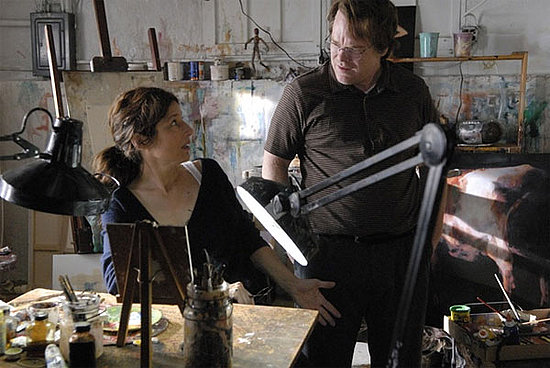
Director Caden Cotard (Philip Seymour Hoffman) wakes up every morning with a fresh pain to fuss about in the morning and a malady that he saves for the afternoon. He's a mess. So's his life, and the only time he feels comfortable is telling actors how to play their parts. But he frets about everything else. "I have 650 lighting changes! Why does it have to be so complicated?" "Because you make it complicated," says his wife Adele Lack (Catherine Keener), whose own art is to make paintings so small you need magnifying specs to look at them in the gallery. She's reductive. He likes to blow things out of proportion, which sometimes manifests itself, physically, as sycosis. "It's spelled differently," he tells his daughter Olive. "P-s-y 'psychosis' is when you're crazy, like Mommy is sometimes."
Welcome back to the World of Charlie Kaufman (and yes, after all the success you can still call him "Charlie"). Kaufman's screenplays are expanded "Twilight Zone" episodes where reality is warped and woofed through the gray matter of Kaufman's mind and some basic axiom of the human condition comes shining through like sunlight through cheese-cloth. Synecdoche New York is the same sort of Möbius-loop swirl like Kaufman's scripts for Being John Malkovich, Eternal Sunshine of the Spotless Mind, Confessions of a Dangerous Mind, and Adaptation.* (and his puppet-film, Anomalisa).** And as with those scripts, you not only get the story as it stands, but also a look into the soul of Kaufman, as well. Malkovich was the story of an street-artist who dreamed of being more than a puppeteer and ended up becoming a director of another man's life--a grander-scale puppet-master. Eternal Sunshine explored relationships and the hopeless act of putting one behind you. Adaptation. was a look at obsession, disguised as Kaufman's own frustrations at trying to write a screenplay for an un-adaptable book. Synecdoche New York is another step altogether: Kaufman makes his directorial debut in this film about a director who can direct anything but his own life.
"And the Truth Is..."

"...well, like most directors, I suppose, what I really want to do is act."

Mel Gibson's Oscar speech, 1996

As life sometimes happens, when one part of your life is going great, another slides. Adele has taken Olive to Berlin for a showing of her work, and the weeks stretch into months, and Cadon can't hold his fragile state enough to have an affair with Hazel (Samantha Morton) the ticket-agent at his theater. The he gets a MacArthur grant. How's he going to spend his "genius" money? He rents a warehouse--like a monolithic Quonset hut in the middle of Schenectady, and begins a series of work-in-progress workshops, where the play will begin to take shape. But pretty soon, the play cannot be contained, and Cotard begins to wander through an increasing maze of scenarios intertwined with a phalanx of actors seeking direction and a city-scape forming inside the warehouse. He begins to lose track of his life and the play's purpose until he hires Sammy (the terrific Tom Noonan) to play himself. Sammy claims to have followed Cotard for years and says he knows the director better than he knows himself. At the time, that didn't seem like quite a stretch. For awhile the two are inseparable.

And then things start to get a little bit weird.


syn•ec•do•che (sÄ­-nÄ›k'dÉ™-kÄ“) Pronunciation Key n. A figure of speech in which a part is used for the whole (as hand for sailor), the whole for a part (as the law for police officer), the specific for the general (as cutthroat for assassin), the general for the specific (as thief for pickpocket), or the material for the thing made from it (as steel for sword).
To explain any more of the plot is to do two things: 1) Give away what's going on, and 2) explain what's going on; I can do the first, but not the second, which 1) is anathema to film criticism and 2) required of film criticism. The stew of Synechdoche New York is so rich that one can only pick a flavor or two, a passing impression, the overall emphasis, but I can't tell you what it tastes like, other than to say "I enjoyed it immensely, and I'd order this item on the menu again." I can understand why it would completely overwhelm a casual tasting or appear too rich to stomach, and I can certainly see the polarizing effect it has on those whose tastes don't run to such things.

But taste is an individual thing, and the structure of Synecdoche New York, which, in itself, is its own false-front, is a deliberate shout-out that "Nothing is real," so if you're looking for explanations of some basic matters, it's just not going to happen, because the connective tissue that would provide the answers not only isn't there, it's considered irrelevant to the task at hand, and manipulated to actually confront, confuse, and consternate. And make a joke of it.

Which I find hilarious.

For instance, I love that Kaufman cast two actresses—Samantha Morton and Emily Watson—who I find, frankly, a bit indistinguishable, and cast them as an important woman in Cadon's life and the woman who's playing her in the play. That the two actually do become indistinguishable is a wonderful joke that I, alone, might get, but I still enjoy it. That the background score for a poignant telephone conversation seems to travel over the telephone line, as well (with the same tinny sound), is a great joke, but might frustrate someone else looking for logic or reason. That Adele coughs in a voice-over might make someone throw up their hands and question why someone would consider doing that only makes me giggle. That Hazel, when taking a tour with a real estate agent, makes a comment that she's really nervous about buying a house, but really wants to take the plunge, so much so that she'll ignore that the house is on fire, and, oh by the way, the agent's son is living in the basement, only reminds me of the compromises I've made and the flaws I've overlooked in similar decision-making processes. It also says something about the character...yes (*sigh*) in a lunatic way...but I found it funny.

"And the Truth Is..."

"I thought I was President of the United States. Then when my daughter was born, I realized I was just the Secret Service."
Seattle actor Ken Boynton, explaining Fatherhood

What's interesting to me is that I have my own ceiling of "guff" in movies: I'll "take" Kaufman because the spirit in which he creates is playful, the ideas he expresses I find, if not profound, worthy of consideration (such as the over-uttered point of "SNY") and the work, and the path taken to get there, entertain me; I appreciate the journey, even if the destination disappoints.
Yet, as a recent post on David Lynch's Inland Empire made abundantly unclear (my fault: I'm sorry, I was being illustrative of my frustration with the piece and its artist) there's only so much obfuscation I can take. There is a difference between an artist being deliberately "difficult" to understand, and an artist with a point to make. If you want to confound, go into the puzzle-making business. If you want to communicate—and that means taking the chance that your message may be received and judged—make sure that you're communicating. Inland Empire had no "Rosetta Stone," not even the orientation of humor, to guide the viewer, so whatever "TRUTH" Lynch was aiming for got lost in the scene-shuffle.*** One can argue about the cruel economics of the film business, but every so often an indulgent artist has to give his Muse a bracing cuppa joe, black, (and amusingly, Lynch, of all artists, should know this!) and show it where the audience is sitting.****

Which brings up the philosophical question: If a theater-troupe makes a play in an empty theater, does it make a sound

And the answer is: "Who cares?" Play on.


"And the Truth Is..."

I know now that there is no one thing that is true - it is all true.
Ernest Hemingway, "For Whom the Bell Tolls"


* I thought I'd posted my review of Adaptation.. Guess I was wrong. I'll post it next week....and my pissy little review of Inland Empire

** Although nobody ever brings up his writing for "Ned and Stacey" and "The Dana Carvey Show"

*** I don't make a habit of beating up on Lynch. I love 80% of his out-put, especially The Elephant Man, Blue Velvet, Mulholland Falls, and The Straight Story. Wild At Heart and Twin Peaks: Fire Walk With Mepffft!

**** At the Guild 45th late show, a late-comer sat across the aisle from me, and throughout the movie we separately giggled and hooted throughout the film, laughing at the same parts. Only when the credits came up did we glance at each other and, in a perfectly synched move, raised our drink-cups in salute to the screen.


Wednesday, January 23, 2019

Elizabeth: The Golden Age (2007)

Elizabeth: The Golden Age (Shekhar Kapur, 2007) Like its 1998 predecessor, Elizabeth, The Golden Age is sumptuously produced, ornate in both costuming and production design, but also in filming and conceptual work. It is one of the most beautiful films I've seen in a longish time—excepting the sequences of torture and carnage—but the material feels a bit shallow (if not altogether juggled, shuffled and finagled*), like one of those bio-pic's that attempt to tell a tumultuous life in 90 minutes; no one likes to have their life, especially a Queenly one, summed up in Cliffs Notes.

"When last we left"
Elizabeth I, she had ascended the throne, unmarried and without heir, but unbowed as "The Virgin Queen." Catholics to the right of her, Mary, Queen of Scots (Samantha Morton) to the left of her, and a seemingly endless line of suitors brought before her. No one has her back except her adviser Francis Walsingham (Geoffrey Rush returning to the role) and lady in waiting Bess Throckmorton (Abbie Cornish).

But there's one angle overlooked, although director Kapur has it covered with a dizzying number of overhead shots. Since the issue in The Golden Age boils down to whose side is God on—between the Protestant England and the Catholic Spain—a lot of time is spent from His point of view.**

Kapur, who started his career in Bollywood, uses color more imaginatively than most current directors (rather than embracing the current trend of leeching the color from films, he adheres to using it as another communicative tool). At the end of Elizabeth the audience was confronted with Elizabeth "the Virgin Queen" symbolized in all her alabaster glory. We see that same white Queen often in The Golden Age but are also confronted with different aspects of Elizabeth. Here, with the issue of finding a proper husband and the potential of an heir, she is frequently seen behind closed doors in far rosier tones than the alabaster appearance—"the divine here on Earth," in the words of Walsingham—that she uses for regal functions. She tells the Archduke Charles, a negligible suitor: "I have a secret, my dear. I pretend there's a pane of glass between me and them. They can see me, but they cannot touch me."


In times of regal impartiality, that "pane of glass" informs itself as the color blue in Kapur's direction. It sets Elizabeth apart and keeps her coolly disengaged and formal, as in the scene below, her she visits her former suitor, Sir Walter Raleigh (Clive Owen), and wife, her former lady-in-waiting to bestow her blessing on their first-born. The rest of the room, in slightly gloomy but warm colors, are off-set by her glowing in a frosty light.
And here, leaving the death-bed of a trusted adviser, she shows no emotion as Queen, allowing the man to know that he can die in peace, his work preserving her Monarchy—and her—is done.
The shot is also centered and composed like a Baroque painting, with many tableau layered in three-dimensions within it, each with their own lighting scheme. Kapur and his production designers fill the movie with such images (when the camera isn't flitting from one side of the room to the other), especially in the climactic sea-battle where some of the battle sequences look like they could have been copied from the cover of a Patrick O'Brian novel.
Ultimately, the cold blues and alabasters give way to "the golden age," and Elizabeth is bathed in a warm glowing sunlight, holding the child of Raleigh and Bess—her position of Queen finally legitimized in reality and defended in battle—and the child that might have been hers, a subject—part of her charge, with no man her master and all of England under her protection.


* The Wikipedia entry on "Elizabeth: The Golden Age" has a nice run-down of the shuffling of events in the Queen's reign. One wonders if they'll be more accurate in the inevitable sequel—after all, we haven't seen Essex yet.

** Before I get e-mails from the indignant, we'll use the paternalistic designation...because the participants of the film did.

Wednesday, December 21, 2016

Fantastic Beasts and Where to Find Them

Global Swarming
or
The Trials of the Mag-ecologist

I saw all the "Harry Potter" films, but didn't read the books; I only made it half-way through the first one, and it was at that point, I "knew" what style of writing I was in for and I didn't want to invest the time in reading the entire series. Plus, I'd had my fill of young mage's learning their trade, having read Neil Gaiman's "Books of Magic."

But, "Potterer" J.K. Rowling has an entertaining, spunky voice to her writing, and she needn't depend on writing "Potter" in perpetuity to make her living. But, as long as the "magic" happens at the bank, why shouldn't she keep up with the "Potterverse?"


Fantastic Beasts and Where to Find Them started out as a Rowling-penned encyclopedia of things odd and ambulatory, scaled and winged in the wizard's world. Rowling has fashioned that "reference" book with some arcana to make a viable screenplay for the film. If there is one criticism of the whole enterprise, it's that they're trying to squeeze a few films out of the threadbare source and have invented yet another Voldemort-style villain arc to create a through-line for the story. It seems like we've been here before and the basic concept is enough to make a couple less films with a strong story-line with a unique cautionary tale about bio-diversity and preservation without having to resort to the villain plot (especially when it seems so unnecessary to the basic thrust of what she's come up with for the "A" story). When you couple that idea with the character-reveal similar to the one in Harry Potter and the Sorcerer's Stone, one fears that we're going to be making too many trips to the magical well. That's the bad news.
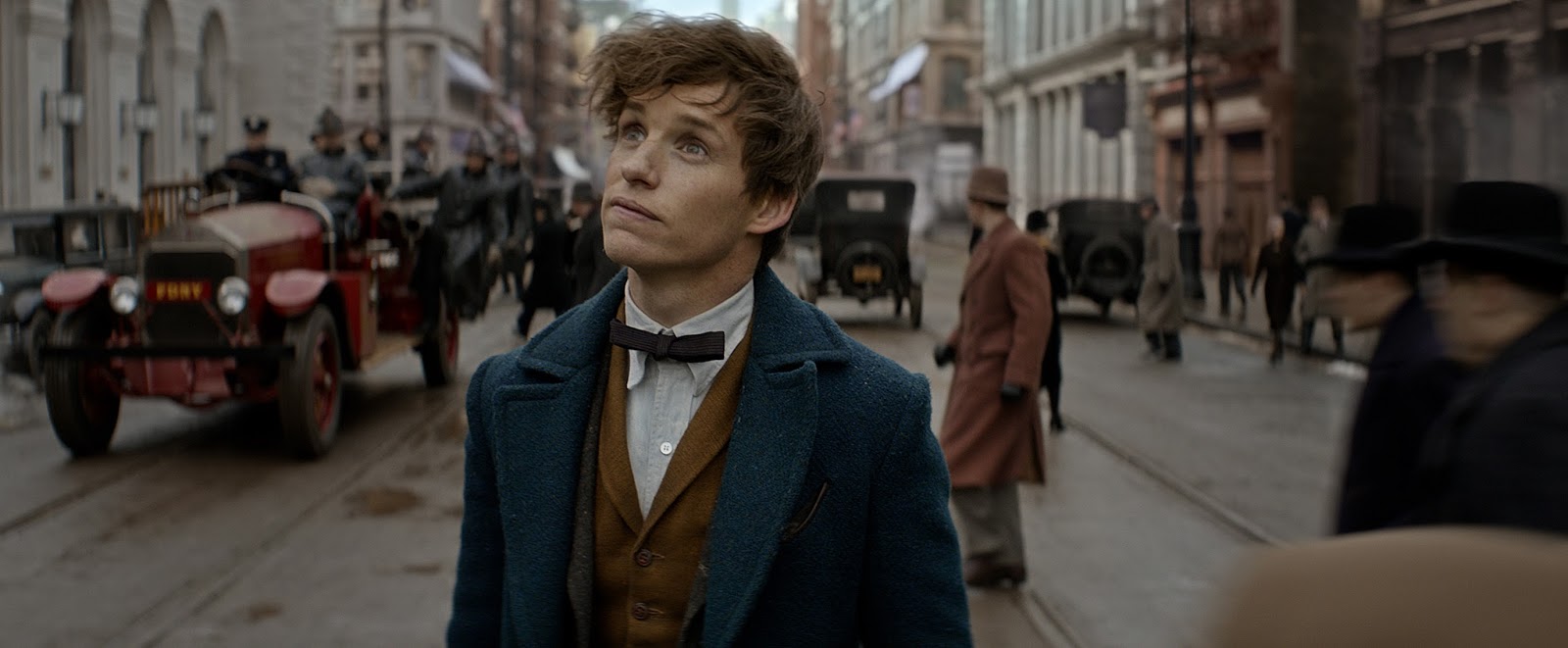
The good news is that Fantastic Beasts and Where to Find Them is a delightful entertainment, even with its bare-bones structure and shorn of the teen-angst of the Hogwarts alums, and the new film's hero, Newt Scamander (Eddie Redmayne) doesn't have the orphan-drama baggage of Master Potter and his class. There's less soap bubbles mixed in with the fairy dust, keeping the larger issue of magic/non-magic relationships and the specific mission of Mr. Scamander, which is the securing and maintenance of endangered beasts of a special nature.
Call him a mag-ecologist (although Rowling labels him a Magizoologist).
It is 1926, as Scamander travels to New York with a valise that that growls and shudders at the most inopportune times—like at the immigration desk. Newt has traveled from England (he was kicked out of Hogwart's and why is not specified in the film) to track down some escaped critters that might cause problems in the Muggle-world by exposing the existence of the magical one.
Things are already dire; as we learn in an opening montage of animated newspaper headlines (Rowling learned that trick from Alfonso Cuaron, who used the same technique in the third HP film), a magical miscreant named Gellert Grindlewald (???)* has escaped from some porous prison somewhere (magical rules are always slippery and the ones that might apply to Dr. Strange don't in Rowling's world) to do something we know not what—it can't be good, or specified apparently, and that's one of the shortcomings of the film.
The escape of Grindlewald is causing a conniption in magic circles (headquartered in New York at the Magical Congress of the United States of America, or MACUSA) because they want to stay secreted away from the Muggle (referred to as No-Maj's in the States) world—a way of life that seems extraordinarily impractical and convoluted, just to keep Muggle/No-Maj's from asking them to do magic favors ("I've got this thing...right here"). Well, MACUSA is all up-in-arms about Grindlewald, but they also know of the beasts that seem to have got loose and aren't doing much about it, other than to send a disgraced Auror, now investigator, Tina Goldstein (Katherine Waterston) to do some perfunctory looking.
The Magical Congress of the United States of America HQ
Newt and Tina encounter each other as the zoologist tries to trap an escaped "Niffler" (attracted to and given to the pilfering of shiny things) who has inconveniently run into a bank. Getting mixed up in the hi-jinx is Jacob Kowalski (Dan Fogler, the welcome "explain-to" character), a No-Maj who is at the bank to try and secure a loan for a bakery he wants to open. It becomes inconvenient to mind-wipe Kowalski and in best silent-movie convenience, he manages to swap valises with Scamander, letting loose a couple more creatures that the mage has hidden there.
A "Niffler" caught red-pawed in the act
One should explain that Newt's valise is the neatest space-bending device since the Tardis and provides all sorts of good comedic effects and a truly wondrous touring experience once we "get into it."
Anyway, "hilarity ensues." But, there are dark tidings beyond the levity. There are the Barebone family (led by Samantha Morton), who are the locus for the New Salem Philanthropic Society, a No-Maj organization that is convinced witches are real and should be expunged from society. She is treated as any crackpot but the MACUSA worry what might come of them if they are exposed as real. They, therefore, have a Chief of Security named Percival Graves (Colin Farrell in a nifty performance), whose radical ideas of security involve putting errant wizards to death.
He'd get along great with the New Salemers—and, in fact, he does, using the insecure young son Credence Barebone (Ezra Miller, the once and future movie-Barry Allen) as both spy and potential ally for seeking out information about both the Society and word on the street about wizards. That seems a little odd, doesn't it?
Director David Yates directed the last few Harry Potter movies in a way that did them service, but, to me, didn't do much else. But here, his direction pops, as if everything he learned from the earlier films freed him to do less with special effects—not that he ignores them, in fact there's more magic and imagination in this film than most of the "Potter's" and delightfully so—and concentrate more on telling a story artfully. The cast, especially Redmayne, do great work in the service of the story and everything comes together in a very entertaining package, quibbles aside.
It's a fine expansion of Rowling's wizard's world, and one hopes that the momentum can be sustained in the succeeding films (4 more of them?) to create something truly magical.

* Grindlewald appeared briefly in Harry Potter and the Deathly Hollows, Part 1 and his reveal at the end of Fantastic Beasts...is a little...disappointing.