Showing posts with label Richard Attenborough. Show all posts

Saturday, October 29, 2022

Seance on a Wet Afternoon (1964)

Seance on a Wet Afternoon (Bryan Forbes, 1964) Psychological thriller about a mad British couple, who decide to kidnap a child for nefarious purposes, and they might get away with it if both of the perpetrators weren't both mad as hatters!
 
Myra Savage (Kim Stanley) has a cottage industry as a medium in London, that is only moderately successful. This puts a financial strain on the couple as her husband Billy (Richard Attenborough) cannot hold down a job, due to his asthma. Billy's guilt for that and his general lack of spine accounts for his being totally under Myra's sway, probably initiated when the couple lost their child, Michael, in childbirth and he accommodated her every whim during her break-down afterwards. Whether this encouragement contributed to Myra's living in a fantasy where she speaks to the soul of Michael in her seances is up for debate. But, what's not debatable is who has the power in the family dynamic.

It's Myra...and Michael.
Then, Myra comes up with a plan to make more money and it's indicative of her madness...but there is some method to it. As her powers as a psychic are medium to none, she decides that she will scare up some business. She proposes to Billy that he kidnap the daughter of some well-off neighbors. They will keep the child in their home—and, of course, demand a ransom—and Myra will offer her services—as a psychic, mind you—to help the police find the missing girl. Her "reputation" as a spiritualist will then For Myra, it's a slam-dunk. For Billy, it's a potential charge of kidnapping if they get caught. Billy cannot say "no" to Myra. But, neither can Bill depend on Myra to keep herself together and not have something catastrophic happen.

If only he had someone around who could...I don't know..."see the future".
Forbes' direction is, to put it charitably, lethargic. The film does pick up a bit of pace as Billy is in London attempting to retrieve the ransom money knowing full well that the drop is being watched. Suddenly, Forbes camera becomes less claustrophobic and takes on the look of a security cam as Billy furtively tries to "blend in" with the pedestrian traffic. The sequence is helped by John Barry's underscore—which prior to this time has been dominated by ethereally echoing vibraphones—kicks in to the type of inexorably escalating music that he'd used for long sequences in the James Bond films. Barry was Forbes' secret weapon, shoring up his films like a masterful frosting hides a less-than-successful cake.
And then, there's Kim Stanley. Seance is notable, if only for Stanley's presence in it, as she preferred stage work to film and her film roles are few and far between...but memorable in the exquisite detail she brought to her work. Her Myra is a fascinatingly manipulative character, never a harpy, but quietly insistent and almost seeming to float in another dimension from reality. It's superb work, and almost makes sitting through this Seance a worthwhile experience.

Wednesday, August 26, 2020

The League of Gentlemen (1960)

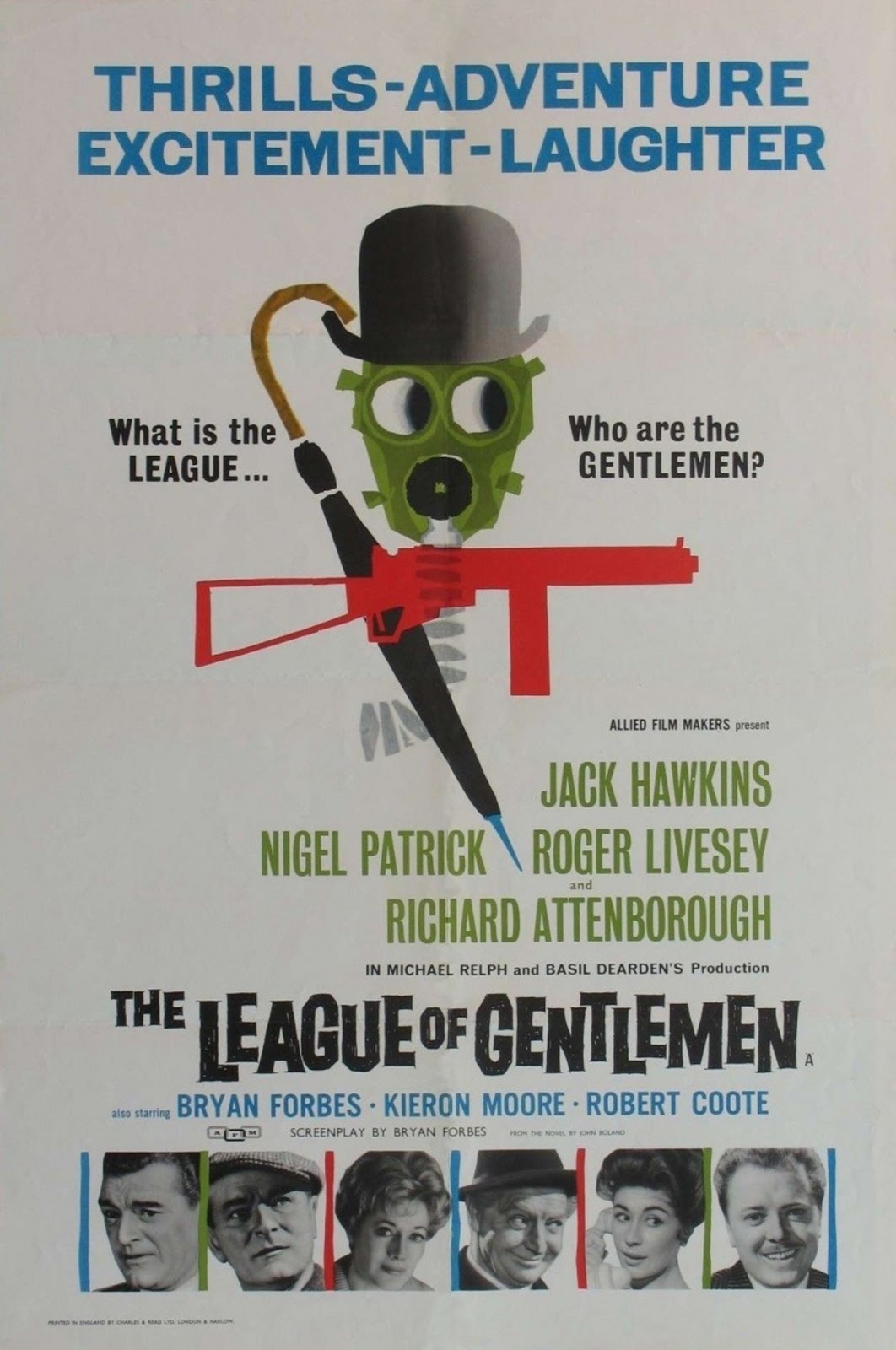
The League of Gentlemen (Basil Dearden, 1960) Basil Dearden's semi-whimsical heist film begins with a sequence that is quite out of whack with the rest of the film but gives a sense of the mind-set behind it. It is late at night on a dark noirish street, and the camera creeps up on a man-hole cover. It pops open to reveal Lt. Col. Norman Hyde (Jack Hawkins) surreptitiously looking about to see if his exit might be seen. Then he climbs out of the sewer dressed in a dinner suit. He then makes his way to a Rolls-Royce and and leaves the area.

It's a visual joke, one that would be expected—and was done—in a James Bond film. The juxtaposition of grime and well-heeled attire is a clever little summation of themes, especially in a society built on class, but except for the visual juxtaposition, it will have nothing to do with the rest of the film. In fact, the little episode is never mentioned again. The film proper begins with the next sequence.
Hyde returns to his home and cuts several £5 notes in half and inserts them, with an invitation from "Co-operative Removals, Ltd." to a lunch at the Cafe Royale, into copies of a paperback book of a crime novel entitled "The Golden Fleece."* He puts each into their separate envelopes and sends them out, seven in all. Their destinations are to seven particular men.
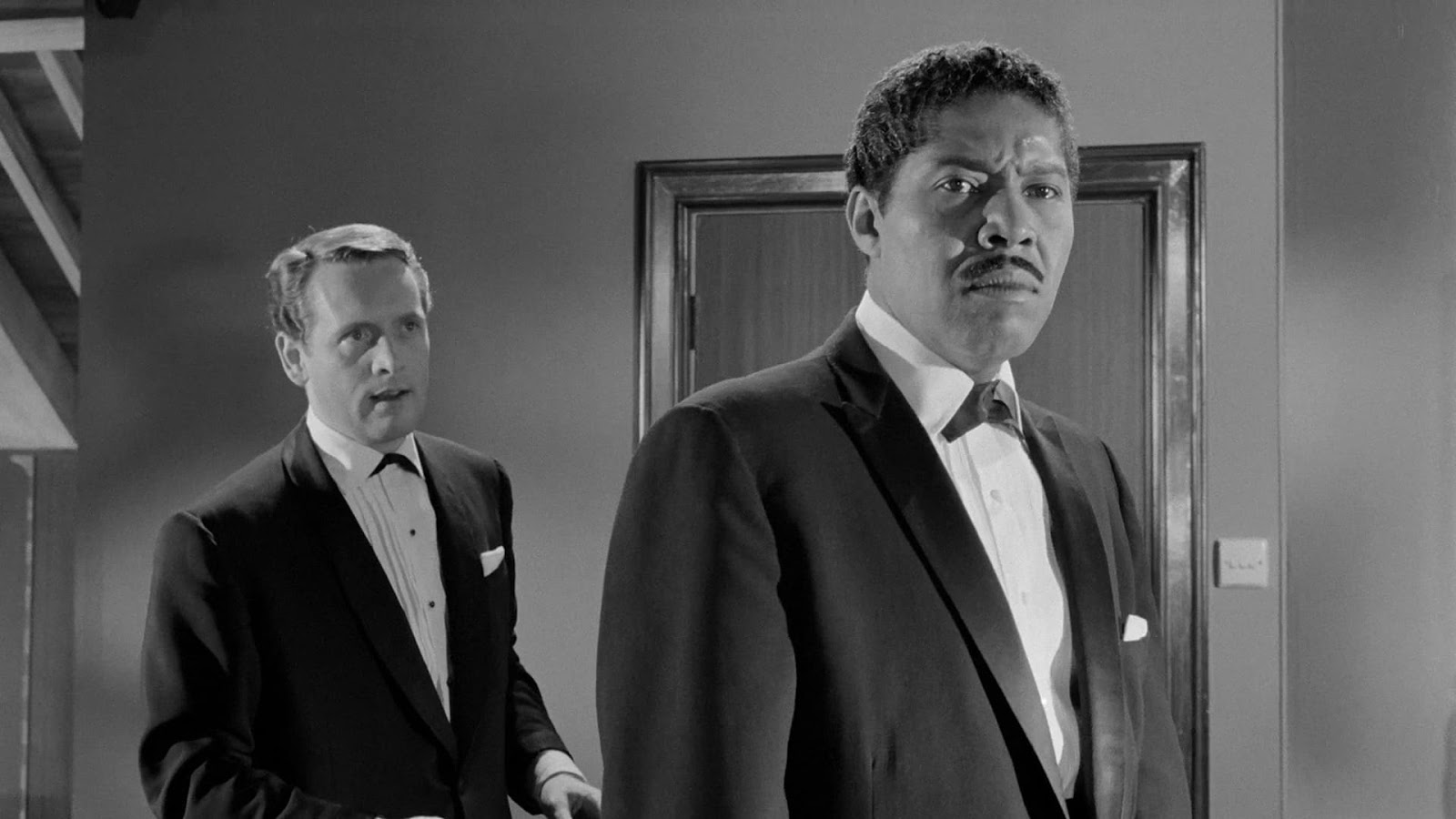
Their intended recipients—"all crooks of one kind of another," "all men of the world"—are disgraced military men, "trained at the public's great expense to do things with the utmost efficiency...which, frowned upon in peace-time are acclaimed in times of war." They are—in the photograph above, left to right: Captain Frank Weaver (Norman Bird), former leader of a bomb-disposal unit, drummed out for trying to defuse a bomb while drunk, which ended up killing four of his men—he now fixes time-pieces in his flat; Major Rupert Rutland-Smith (Terence Alexander), discharged "after some embarrassing mess of yours," resolved by hush-money from his rich wife which has left him hen-pecked and reluctantly accepting of her own many indiscretions; Captain Stevens (Kieron Moore), former fascist, forced out for his homosexual activities, which have made him a victim of blackmail, threatening his gymnasium; the high-toned Major Peter Race (Nigel Patrick), whose black-market activities led to his resignation, and now subsists on gambling and a room at the YMCA; Captain Martin Porthill (League screenwriter and future director Bryan Forbes) was kicked out for killing suspected Cypress terrorists and now makes his living playing the piano in dives and as a gigolo; Captain Padre Mycroft (Roger Livesey, of so many films by "The Archers"), formerly a quartermaster was convicted of "public gross indecency" and now, paradoxically, is a con-man using a contrivance of religious ordinations; finally, there's Lt. Lexy (Richard Attenborough), who sold secrets to the Russians and now runs an electronics repair shop for the lowliest of customers.
Hyde, for his part, "served my country well for 25 years and was suitably rewarded by being made redundant" and the experience has left him bitter and useless—all those skills and nothing to show for it. "The Golden Fleece" proved an inspiration on which he could hoist his revenge; he has researched and planned a bank robbery, and to accomplish he has gathered together a troop of morally compromised men with military discipline and specific skill sets to help plan and carry it out. He gives them a limited time to think things over, and, to a man, they agree ("Your presence here restores my basic disbelief in the goodness of human nature," he remarks); Hyde treats them as a military unit, barracking them in his own stately home for drills, research and to serve as a base of operations. Under the ruse of a food inspection for cover, they split off and while part distract the brass, the others steal guns, ammo, and other supplies making it look like an IRA action...when the loss is found.
Once all is arranged, they move their operations to a warehouse where the details are finalized. The goal is to rob a bank of enough resources that the men can split the money each receiving at least £100,000. Can British ingenuity and a proper military training pull off the raid despite improper motives (and the inevitable complications that pop up in these things?) All's fair in love and war...but war exercises?

Dearden, given the military nature of the heist is efficient and a bit ruthless in his direction—nothing fancy and nothing too rococo in how he plans his shots— Forbes' screenplay is witty and dry, and the actors all fill their niche-roles with Hawkins providing a commanding presence in both senses of the word, as both leader and star. The League of Gentlemen could be seen as a more austere version of such playful British heist films as The Lavender Hill Mob or The Ladykillers, but without their sense of twee or whimsy. Additionally, with such a collection of dedicated rotters, given their falls from grace in the eyes of Society, the film-makers evoke enough "sympathy-for-the-underdog" attitude that allows one to think that they just might pull the job off. 

It gives the film that added sense of suspense right up to the last minute.

* In the novel, the book is not "The Golden Fleece," but a real novel called "Clean Break' (written by Lionel White), which was filmed as The Killing by Stanley Kubrick in 1956.

Thursday, July 9, 2020

All Night Long (1962)

All Night Long (Basil Dearden, 1962) I've been watching a lot of Basil Dearden movies lately—the only ones already on the site, reviewed, are Khartoum and a horror anthology he'd participated early on in his career, Dead of Night—and they're pulpy but intelligently produced with an underlying social concern, interestingly framed, and with a sometimes perverse energy designed to take the audience slightly to the edge of their seats. They're at least designed to produce a nervous tick in the leg.

All Night Long, though, is more designed to keep a steady beat of foot-tapping, based as it is in the jazz idiom. In fact, for aficionado's, it's a bit of a must-see for performances by some "legends" (a much used word, but actually appropriate here), such as Charles Mingus (he gets lines to say!—"Hi, thanks for inviting me!"), Dave Brubeck, John Scott, John Dankworth, Tubby Hayes, Bert Courtley and Keith Christie. That's a great joy to the film, but I imagine it's frustrating for the very people who would want to see this for that purpose because it has a story and actors who distract from the performances and from the music for whole minutes at a time (I imagine that the first frenetic Beatles fans were frustrated with A Hard Day's Night for that same reason). On the other hand, for those folks into narrative in their films, they might be stymied by the story being stopped dead by performance drops. These people have never heard of or seen musicals.
The story is basically the story of Othello brought up to a jazz-beat (a bit uncomfortably) and a jazz-idiom. Entrepreneur and impresario Rod Hamilton (Richard Attenborough) goes to his club where he has prepared a very special night—a party celebrating the first anniversary of jazz King and Queen Aurelius Rex (Paul Harris) and wife Delia Lane (Marti Stevens), jazz pianist and songstress (retired), respectively. Guests are band-mates, acquaintances, and some notables in the industry and Hamilton has designed it to be a night of celebration and song for the happy couple. He should have checked the guest-list.
Brubeck and Scott and Dankworth are fine, of course—they're providing music. But along with Aurelius' inner-circle of Cass Michaels (Keith Michell) and his girl Benny (Maria Velasco), there is also drummer Johnny Cousin (Patrick McGoohan) and his wife, Emily (Betsy Blair). Cass is Aurelius' manager and completely loyal to him and a confidante to Delia. That relationship will become critical to the machinations of Cousin, who has been promised a side-deal for his own band by another manager, but only if he can persuade Delia to come out of retirement and join his band as vocalist. If he is to have any chance at success, he must drive a wedge into the happy marriage between Aurelius and Delia before she could even entertain fronting his group. And for that, he works on Cass.
He needs in-for-ma-tion. So, he invites Aurelius' manager to a private meeting on an outside landing and cozies up to Cass (who's been clean and on the straight and narrow for years and a dependable business partner) and plies him with some reefer, relaxing Cass enough to give Johnny inside intel on any weaknesses in the Rex-Lane marriage, which is (for him) disappointingly stable. But, he knows that Cass and Delia are close, so he devises a plan to make Aurelius suspect that the two are actually closer than her husband suspects. So, Johnny does a solo performance with everybody at the party, sewing doubts and intrigues and creating tensions where there are none.
It becomes apparent that Johnny Cousin is Shakespeare's Iago (and Cass is Cassio, which is not much of a name-stretch). But, where the bard's version goes through the play without any rationalization or motive for his actions (other than "I hate the Moor"), Johnny is totally and completely about getting his "gig" and, if a little chicanery and a marriage-split will advance it, then so be it. Suspicions are communicated between parties (at the party), but that can only go so far. And Johnny has a technological ally for fabricating proof.
Hamilton is a huge jazz fan, and part of his plans are to record a couple of sessions using a tape recorder (an EMI TR90 for you gear-heads), which Johnny uses to make recordings of some conversation. With that, he can take desired bits of conversation, and record his own voice for insinuating connections between the juicy bits to make it all seem like there's an affair going on between Delia and Cass to inflame Aurelius' jealousy. Anybody who's tinkered with tape will know that such an operation takes split-second timing (lest you erase the original) and you've got to have a stop-watch handy to be able to do it without editing—and in those days, you'd need a razor blade and tape, which is pretty obvious evidence of tampering. But, Johnny must be very good because his evidence doesn't even contain any electronic evidence that a tape has been started or stopped.
Technical quibbles aside, his gambit works—at least for a little while—and there is a real danger that he might get away with it, but not with the results he might want (this is based on "Othello," after all). There will be distrust and dust-up's, enough to ruin any high-class party, and certainly enough to interrupt any of the jazz interludes that pop up for the aficionado's. 
It is a thrill to watch Mingus and Brubeck jam in one of the pieces, particularly to watch the effortless fingering on strings and keyboard. That comes early on in the film, but there's enough good material throughout to keep folks who just came for the music to enjoy. And stick around: McGoohan learned to play drums for the film and he has a frenetic solo towards the end that looks damned convincing, even if—as I suspect—he's just playing to a tracked music piece. He's an intense actor—around this time, he was right in the middle of doing the "Danger Man" series (it played in the U.S. as "Secret Agent" with a Johnny Rivers title song)—and the same intensity is born out in that solo.
This came out in 1962—1963 in America—and at that time, what was called "mixed marriages" were illegal in one-third of the States. It was an issue here and might have had a hand in the film's limited distribution and it's somewhat rare availability. It is refreshingly not an issue in this British-based film where nothing—absolutely nothing—is made of it. It's not even mentioned, other than the marriage is one for celebration...and strong enough not to be rent asunder by the conniving of an ambitious narcissist. 
Another aspect that might have been controversial in the States is the on-camera portrayal of marijuana use. Even though the Hayes Code was dying of purposeful neglect during this period of film-making, drug use and distribution was prohibited under its strictures. Come to think of it, so was "mixed race" relationships. Something to consider while you're "bogarting" and considering the ash-bin of History and how time inevitably leaves prejudice there.
For whatever reason you come to it, for the music, or for the Shakespeare link, or you're a McGoohan fan/completist (or Attenborough...or Betsy Blair...or whoever), or if you're looking at the films when Dearden was telegraphing social messages and conspicuously pushing the barriers of what got on film—as Preminger was trying to do in the States—you come away with respect for this little doorway in the alleyway of film-noir sticking its neck out that although the world can be a nasty place, it's lit by the idea that the important things are devotion. And trust. 

And all that jazz.


Friday, March 20, 2020

Brighton Rock (1948)

Brighton Rock (John Boulting, 1948) Brighton is a seaside resort town on England's southern coast, a holiday spot for the working class, and the subject of Graham Greene's "Brighton Rock," a story of the dark side that can infest a tourist attraction, where money can be loosened in many ways and in great amounts, which would attract the criminal element in the same amounts that they attract the punters.

When a film was made of Graham Greene's novel, the resort was, understandably, nervous, preventing the film-makers from shooting at the local racetracks, and to use hidden cameras during the crowd scenes on location. Oh. And there was enough of a nervousness that a calming opening card is used:

"Brighton today is a large, jolly, friendly seaside town in Sussex, exactly one hour's journey from London. But in the years between the two wars, behind the Regency terraces and crowded beaches, there was another Brighton of dark alleyways and festering slums. From here, the poison of crime and violence and gang warfare began to spread, until the challenge was taken up by the Police. This is a story of that other Brighton - now happily no more."
Quite happily. The film takes place in 1935—Greene had written a previous book "A Gun For Sale" and the events of that one are a bit of prologue for Brighton Rock, involving the death of the gangster Kite after a newspaper article has exposed the corruption involving slots and race-tracks and the resulting turf wars that have blighted Brighton. Kite's gang is now run by by a 17 year old tough and psychopath named "Pinkie" Brown (played by a 24 year old Richard Attenborough, with the deadest eyes in the world). And the film begins with a bit of news about a contest with lots of potential winners. They never gave any thought to anybody losing.
The Daily Messenger newspaper arrives at the boarding house populated by the Kite gang with news of a promotional contest; "Kolley Kibber" is coming to Brighton. A promotional stunt, a representative from the paper comes to town distributing cards to various businesses that lucky patrons can turn in for cash rewards...and the first person who finds the person posing as "Kolley Kibber" and says "You are Kolley Kibber and I claim the Daily Messenger prize" you win a bigger more desirable prize. So who does the messenger send out to be "Kolley Kibber?" Reporter Fred Hale (Alan Wheatley), the one who broke the story on the Kite gang. I suppose, at least, they didn't also fasten a target to his back, but, really, that's like sending Salman Rushdie on a book-tour to Iran.
But, it's an opportunity for the Kite Gang, now under Pinkie's control, to take revenge. After all, as one of the mob says "Pinkie loved Kite and Kite trusted Fred. And if Fred hadn'ta written that paragraph about slot machines Kite would've been alive now." Pinkie is informed of the contest and it's his intention to kill the reporter.
It isn't long before Hale arrives in Brighton, before he realizes he's being hunted. Trying to blend in with the seaside visitors, he runs into a theater performer Ida Arnold (Hermione Baddeley) and when he ends up dead, she informs the local constabulary that the reporter's death is more than suspicious, but when they rule that the man died of an apparent heart attack, she begins her own amateur sleuthing.
It becomes a cat-and-mouse game as Ida busy-bodies her way into the investigation, while Pinkie tries to cover his tracks, using one of the gang to distribute the cards to confuse the police. But, one of the cards is left at a restaurant where a waitress (Carol Marsh) can identify who left it. Pinkie chats up the girl, asking her out, but when he finds out she can identify the accomplice, he starts a plan to kill the man. And, if anybody gets suspicious, he'll marry the waitress to keep her from testifying against him in court. 

It's an odd combination of an Agatha Christie-like amateur against the most vicious of sociopaths—Miss Marple against Hannibal Lecter—and the Boulting Brothers production team construct it in the manner of a Hitchcock-like stylist, contrasting the most innocent of local color and injecting pure menace into it. Greene was the most Catholic of writers, adept at creating angels and devils, and in Pinkie, he created a terrifying monster with savage intent and no remorse, a wolf among sheep (and a teenager!). Although the film ends with a note of deluded sanctity—Greene has a wonderful phrase "You or I cannot fathom the appalling strangeness of the mercy of God"—even Greene didn't believe in it, only providing a note of hope to get past Britain's supervisory boards.
"You asked me to make a record of me voice. Well, here it is. What you want me to say is 'I love you.'
Here's the truth. I hate you, you little slut. You make me sick."
And Attenborough creates a memorable villain, contained and malicious without a thread of decency, making one think that the sympathetic, cherubic characters he'd play for the rest of his life may have been some form of atonement.


Wednesday, October 17, 2018

Chaplin

Chaplin (Richard Attenborough, 1983) Elephantine, lugubrious bio-pic of the man underneath "The Little Tramp," Charles Spencer Chaplin. If more bio-pics were this ill-serving, it would be good reason to avoid the limelight altogether. Years after sweeping the Oscar-race with his ever-so-respectful biography of Gandhi* (starring Ben Kingsley), director Attenborough took on his famous countryman's auto-biography and varnished it with the same extra coats of shellac (with broad strokes) that made a still-life out of his film of A Chorus Line.

Charles Chaplin is a more-than-worthy subject for a sweeping biography that covers a huge amount of history in both the times of the U.S. and England, but also of the film industry. Chaplin was one of the rare few film-makers to make it out of the silent era alive and functioning, amassing a great fortune, becoming beloved world-wide—his Tramp character was recognized world-wide, with even more reach than Mickey Mouse—and treading the then-virgin territory of film star-dom with all its glamor, responsibilities...and pit-falls. Only thing, part of the problem was too many virgins. A clown-comedian who made his living, first by exposing the pomposity of authority, and then—as the Tramp—actively fighting it, he ran afoul of the authorities who didn't take too kindly to his irreverent side, little noting that the Tramp's triumphs were a balm for a restless public, sublimating dissatisfaction in a permanent trap on-screen, keeping it from spilling into reality. They should have thanked him. But instead, the authoritarians, be they Nazi's or J. Edgar Hoover, fought him. And Chaplin had enough hubris and pomposity himself, to think that the public would always rally to his side.

Now, that's a story. One that Chaplin would appreciate, if he wasn't living it. But, instead, Chaplin saw himself as he always saw himself—the hero. You could say of Chaplin what Alice Roosevelt Longworth said of her President-father Theodore: "He wanted to be the bride at every wedding, and the corpse at every funeral." Chaplin loved being the Clown and the center of attention, but he also wanted to be taken very seriously, as he saw himself. Quite the dichotomy. That Chaplin couldn't embrace his own pretentiousness as part of the act was what turned his reel-comedy into real-tragedy.
But don't drop any tears for Chaplin. He lived an extraordinary life...of his own creation. Well, feel bad for him for this movie, perhaps.
The problems start with the screenplay. The timeline uses his films as the spine of it, set up by little incidents that inspired them. A more fitting strategy for a film-symposium than a movie, especially a movie about a comedian: Nothing kills a joke faster than having to explain it. The films are the high-lights; they are punctuated by explorations of Chaplin's relationships with the women in his life, starting with his Mother (eerily played by Geraldine Chaplin, the person's real grand-daughter!), then his lost loves, whether by his own design or by his inability to maintain a love greater than his own. This is interrupted by the lamest of devices—going over the autobiography with his ghost-writer (Anthony Hopkins), in a kind of literary psychiatric session. They amount to repeated episodes of the aging Chaplin clinging to his fantasies and the writer calling "Bull-shit," once literally.
This may be a convenient way to film in the blanks, but it also splinters the narrative force. Are we to believe Charlie, the biographer, or what we see with our own eyes being represented? And as the subject is a film-maker, it's a bit like falling down a rabbit-hole of fun-house mirrors. Who do you trust? The end-result is taking none of it very seriously, as Attenborough can't resist speeding up some episodes in a representation of silent film techniques. Nothing is real. A little contrary for a biography.
Then, the tone is so heavy. Starting with a title sequence of Chaplin taking off his "Tramp" make-up (exposing the real man, get it?) to a melancholy score by John Barry, that would be more suited for a funeral, the film never gives up the tone of self-important tragedy that ultimately swamps the movie and any good feelings that one might have for Chaplin, the man, his work or the movie.
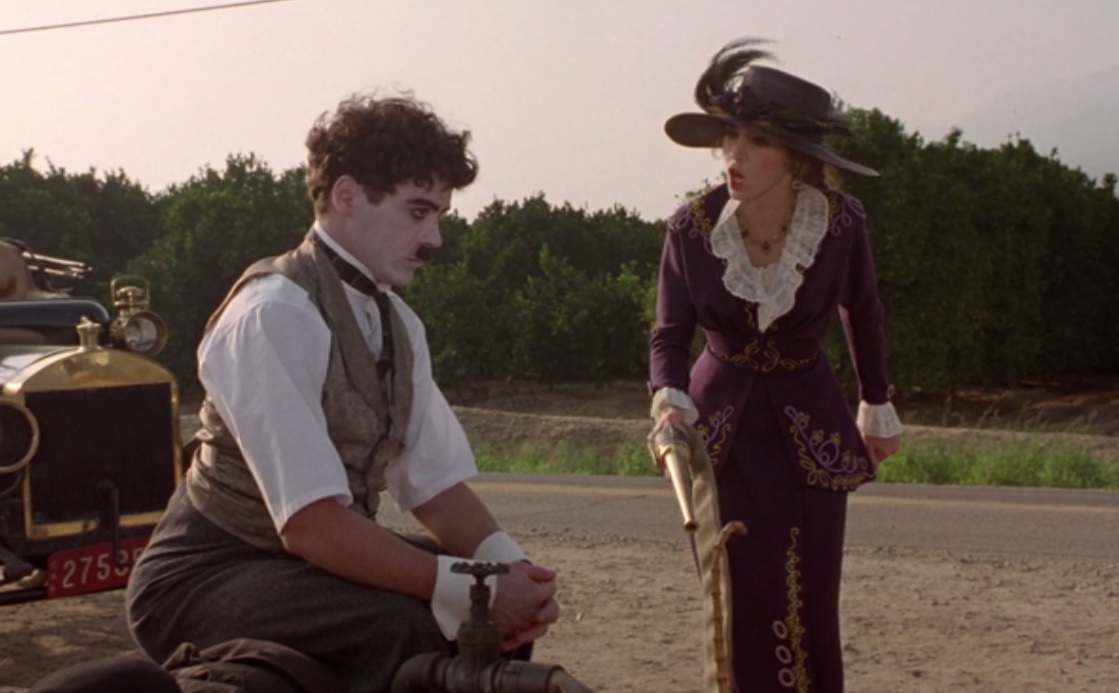
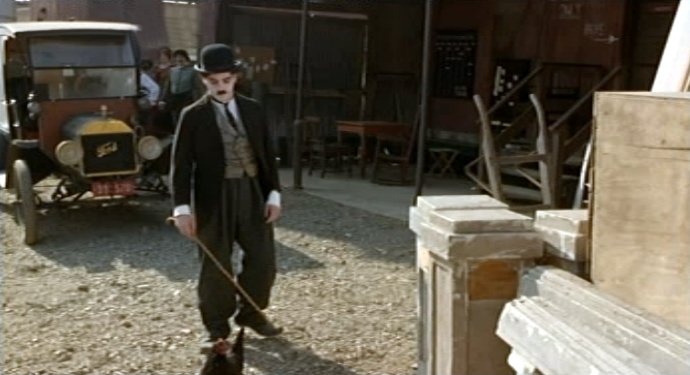
But, every dark cloud has a silver lining. In the case of Chaplin, it is its star, Robert Downey, Jr. Downey was a once-removed member of "The Brat Pack," the coterie of young actors who buzzed through Hollywood in the late 70's and 80's, appearing in ensemble pieces by John Hughes and other directors. Appearances in his father's films, a couple of featured roles and a disastrous stint on "Saturday Night Live" offer no hint of the disciplined, exemplary work he brings to the title role, eerily evoking the lookespecially the smile of Chaplinand, most amazingly, pulling off the physical comedyChaplin's particularly physical comedythe role required. He was honored with his first Oscar nomination (losing to Al Pacino's first Oscar win for Scent of a Woman.), but, after Chaplin, Downey's performances would turn more physical, quick-silvered and nuanced, paving the way for a universal respect for his craft that even an errant personal life couldn't derail. Downey's evocation is the one reason to watch Chaplin, rather than, say, reading about him...or better yet, watching the man's films.
The immigrant looks upon the Promised Land: Robert Downey Jr. as Charlie Chaplin 
looks at a strip of this new medium, film, left on the cutting room floor. 
Of course, the footage is of him.


* Gandhi beat out E.T., the Extra-Terrestrial for Best Picture that year. I understand the Academy's hesitancy to give the statue for an alien combination of Shane and Lassie, but no amount of prestige attached to a project can replace a film's status years after the fact. This one was a mistake. And short-sighted, replacing typical Awards reverence for "prestige," rather than popularity or endurance.

Friday, October 28, 2016

10 Rillington Place

10 Rillington Place (Richard Fleischer, 1971) There is a phrase "the banality of evil," which was most prominently used in the title of a book about Adolph Eichmann, describing him as not being particularly emblematic of an evil person who done evil things. He was, actually, a bit clerkish, ordinary, despite having rubber-stamped orders that led to the deaths of millions. How could someone so milquetoast, so weak be responsible for the most heinous of atrocities. Perhaps it was that very quality of insubstantiality that might have contributed—there was no will to resist, no consciousness of conscience that made it easy for him to carry out the unthinkable.

"The banality of evil" might well be the sub-title of 10 Rillington Place, the 1971 true-crime film of Richard Fleischer (who also made Compulsion and The Boston Strangler) depicting the murders perpetrated by John Christie at the titular address where he was a landlord, sub-letting his apartment to potential victims, depriving them of their lives and presumably, their damage deposit.
Christie was very ordinary, and his crimes were brutal and base. He would lure women, whether prostitutes or acquaintances to his flat, claiming that he could aid them with some ailment or other with his "special mixtures," which merely some balsam they would inhale from a jar with a tube running out of it. Christie would then introduce coal gas from the flat's heating system, and it being carbon monoxide, would knock the women unconscious. He'd then have sex with them and strangle them with his neck-tie, disposing of the body somewhere on the premises, in the flower bed, in an outdoor wash-house, in an alcove of the apartment,  and, in his wife's case, under the floorboards of their apartment.
Horrible, unspeakable and perverse crimes. But, where Christie sank to new levels of the deplorable was the destruction of the Evans family (played in the film by John Hurt and Judy Geeson) Tim and Beryl Evans moved into 10 Rillington Place in 1948. Beryl gave birth to their daughter Geraldine later that year and, while Evans tried to maintain work, the couple tried to make ends meet at 10 Rillington. The story goes that Beryl became pregnant with their second child and was considering an abortion. Christie offered assistance, murdering Beryl and her daughter using the same carbon monoxide poisoning and telling Evans that Beryl died in the attempt. Telling the bereft husband that he would be an accessory after the fact, Christie persuaded Evans to "lay low" with relatives while he handled things.
Eventually, Evans went to the police, incriminating Christie. The police did an investigation—completely missing the bodies that Christie had hidden in the place—and forced a confession out of the unstable Evans. He was arrested and convicted of the murders, one of the star prosecution witnesses against him being John Christie. Evans was hanged for the murders in 1950.
A rational murderer. having come so close to the gallows, might have left bad enough alone, but Christie was not rational despite appearances. He would murder four other women before moving out of the apartment, sub-letting it illegally. It was only when the smell of the corpses began disturbing the tenants that any further investigation was made. The bodies were discovered and soon after, Christie was arrested and charged with the murder of his wife, ignoring the evidence of eight other women he had killed. The jury deliberated only 85 minutes before finding him guilty. He was hanged in 1953, the same year as his arrest. 
Fleischer's film is perceptively short on histrionics, or of anything resembling feelings. It was filmed at the actual locations—exteriors were filmed outside 10 Rllington, but the interiors were filmed at 7 Rillington, as it was occupied...amazingly. The film benefits from the scrupulousness to the cinema verite. Richard Attenborough plays Christie, and does so as a bit of a cypher, enigmatic and pathetic; he was a very capable actor who could vacillate between psycho and cuddly. He had started his career playing the socio-pathic criminal Pinkie Brown in Graham Greene's Brighton Rock, and Attenborough took the role because he thought the story was a damning indictment of capital punishment, due to the railroading of Evans. Some might have gotten that message, but those who did see it in theaters were probably attracted to the salaciousness of the marketing (designed like a tabloid front page), rather than any higher purpose.  
10 Rillington in the film (top)
Photo of children playing outside the murder scene.