Showing posts with label Jack Hawkins. Show all posts

Wednesday, April 28, 2021

Lord Jim (1965)

Lord Jim (Richard Brooks, 1965) Orson Welles wanted to make this Joseph Conrad story about a disgraced seaman out to prove his worth to himself and the world, and he wanted to do it with Charlton Heston—they'd talked about it while making Touch of Evil together and Welles was particularly taken with Heston's vouching for him during the turbulent making of that picture. That sort of loyalty is unusual in Hollywood and Welles must have thought Heston a good match...and good box-office. 

Conrad's novel had been adapted once before—by Victor Fleming in 1925—and Brooks optioned it in 1957. His clout with such classics as Cat on a Hot Tin Roof, Elmer Gantry, and Sweet Bird of Youth allowed him to make this one, which required extensive location shooting. Acquiring Peter O'Toole, hot after Lawrence of Arabia and Becket, allowed Brooks to acquire a $9 million budget, which ballooned the scope, and Lord Jim was designed as a "roadshow attraction," complete with Overture, Intermission, and Exit Music.
The story is narrated by Marlow (Jack Hawkins)—the same Marlow of Conrad's "Heart of Darkness"—as he relates the tale of young James Burke (Peter O'Toole) merchant seaman, young, enthusiastic, obedient, resourceful, who becomes Marlow's first officer before becoming injured and left to be treated in Java. 
His next assignment is less fortuitous: he's hired as first mate on board the rickety S.S. Patna, transporting—as the novel puts it—800 "pilgrims of an exacting belief," Muslims, to Mecca, when the ship hits a storm and has a collision on the Red Sea. Checking for damage, Jim sees that they're taking on water, and, telling the captain that they should get the passengers to the lifeboats, is surprised when the captain and other crewmen are more intent on saving themselves. The film makes it debatable whether Jim jumps in with them, or is washed onto the lifeboat is a squall, but the result is Jim is on the lifeboat, the Patna and its passengers, abandoned to their fate.
Making port, they find that the Patna, having survived the journey with the help of a French ship, has arrived before them. The Captain and the other crew disappear to escape the infamy for their actions, which, by now, has gotten around throughout the port, but Jim insists on a trial to atone for his abandoning ship, and he is roundly condemned, stripped of his sailing papers, the chief judge telling him that, instead of an inquiry, he should have just buried "himself 20 feet deep."
Jim does the next best thing, becoming a drifter from port to port, losing himself and running away from his shame in anonymity. An incident where he saves a skiff loaded with beer and gunpowder from exploding in the harbor attracts the attention of a Mr. Stein (Paul Lukas), who just happened to be receiving that gun-powder. It's destined to be shipped to Patusan where the people, led by Stein's friend Du-Ramin (Tatsuo Saitō) are trying to defend themselves from a warlord, "The General" (Eli Wallach), and Stein hires Jim to accompany the shipment to make sure it reaches its destination, there having been some sabotage in the past.

There are attempts made on the journey, as the weaselly Cornelius (Curt Jurgens)—who used to work for Stein as his representative before he was caught skimming supplies—now is aiding "The General" in his attempts to overthrow the natives. Jim hides the cargo, but is captured, and although tortured for the information, does not reveal where it's hidden.
Jim is rescued by "The Girl" (Daliah Lavi)—in the book, her name is Jewell, but the movie doesn't even give her character a name!—and Jim leads the Patusans to the supplies and launch an attack on The General, killing everyone but Cornelius. Jim is welcomed by his fellow combatants and given the title "tuan" by the Chief, which means "Lord."

Intermission.
If you want a happy ending that would be where you ended it. If you wanted a happy audience you might have ended it there, as well. Reportedly (and this may be apocryphal) it was at this point at the London premier that James Mason's parents were so bored by the picture, they left, completely missing their son's performance in Part II. Maybe a bit impatient, but one does get the impression that Lord Jim will never end, so elongated and detailed is the film, with sequences running a trifle indulgently, and every line of dialogue treated as if it were precious. This becomes readily apparent after the Intermission.
Jim stays in Patusan, beloved by the people and The Girl. Unbeknownst to him, Cornelius and Schomberg have brought in the cut-throat pirate "Gentleman" Duncan Brown (James Mason)—"he's given more business to Death than the Bubonic Plague"—to raid the village of its treasures, and although their attempts fail, Jim negotiates with the blackguards that they may leave if they never return again. The villagers and Du-Ramin argue for attacking the pirates, but Jim wants no conflict and vows to the chief that if anyone dies because of his mercy, that he will sacrifice his own life in forfeit.
So, Jim trusts the pirates to just go away, huh? He also sets up contingency plans that, should the pirates attack, the natives can fight them back. Meanwhile, Jim looks moony and talks about the position he is in, given his second chance: "I've been a so-called coward and a so-called hero and there's not the thickness of a sheet of paper between them. Maybe cowards and heroes are just ordinary men who, for a split second, do something out of the ordinary. That's all." But, there is a great deal of difference between a romantic idealist and a conscienceless pragmatist, and Jim frustratingly never finds a middle ground. If you wanted a happy ending, you should have taken a cue from James Mason's parents and left at intermission.
It is a long tedious slog to come to that conclusion and although some of the dialog in the second part crackles with cynical brio and Mason's performance is worth watching, one has to spend so much time with O'Toole's doubting Jim—trying ever-so-hard to bring some internal depth to this character that you get stymied by the dependence on the fragile blue eyes shining out of the screen without any of the nuance or creativity the actor brought to his previous performances—that, ultimately, you lose faith in Jim, O'Toole, and the movie.

Brooks is no help here. His staging is perfunctory, whether in Cambodia or Shepperton Studios in Surrey and the one interesting shot is in the beginning with a weirdly evocative shot of a "lost soul"—which Jim could have become—walking like a zombie along a Malaysian pier. One wishes that same sort of frisson could have shown up a bit more...or ever...but it's just a tantalizing moment in a film so confident in its ambitions that it never tries to achieve them.

Thursday, October 1, 2020

Gideon of Scotland Yard

Gideon of Scotland Yard (aka Gideon's Day, John Ford, 1958) You think you know a guy. Take John Ford. I couldn't have been more surprised to see Ford listed as an executive producer (along with King Kong producer Merian C. Cooper) on that mixture of cowboys and "Kong" stop-motion/live action hybrid, Mighty Joe Young (with effects work done by King Kong magician Willis O'Brien and a young apprentice by the name of Ray Harryhausen). It featured Ben Johnson, one of Ford's stock company, so I shouldn't have been too surprised.

But, years after being escorted off Mister Roberts and making his masterpiece The Searchers, there is this curiosity that Ford produced and directed in Britain, far afield from his westerns and military dramas. Soon after making The Bridge on the River Kwai (and starring in Ford pal Howard Hawks' Land of the Pharoahs), Jack Hawkins was picked by Ford to play Scotland Yard sleuth George Gideon from John Creasey's series of novels starting with his "Gideon's Day," written in 1955.
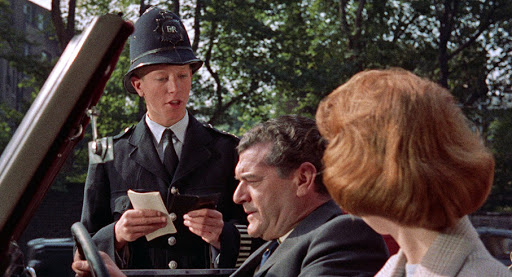
Now, Gideon is a Detective Chief Inspector and with that goes a lot of responsibility. But, that doesn't mean that you're immune from the vagaries of life, like getting enough time in the bathroom in the morning, or parking tickets from too-earnest young bobbies, family matters like making it home in time to attend your daughter's concert—her first (she's played by Anna Massey...and it was her first...film), or acquiring the salmon for the dinner you have to have with the in-law's...if you're not held up at the office by the demands of the job.
For Gideon, on this day of days, has to deal with the possible bribery charges of one of his sergeants—and that will mean personally interviewing the informant (if he can find him), the escape of a violent sex maniac rumored to be on the road to London, not to mention a couple attempted murders, bankroll robberies by a dinner-jacketed mob...and that bobby, who pops in Gideon's Day like the proverbial bad penny.
The film is an oddity, but only because it should be more well-known, as Ford, the picture-maker is working on high-gear here...with some sterling talent in the British film industry: T. E. B. Clarke (The Lavender Hill Mob) wrote the screenplay, premier art director Ken Adam designed the look, and it was photographed by master cinematographer Freddie Young. With such talent behind the scenes, the film would at least be a curiosity, but it's directed by Jack Ford, which warrants a must-see for those who "like them the way they used to make them," or need to be convinced that Ford could do more than westerns...or work with John Wayne.
Those who know Ford's work know that there is a constant struggle for the appropriate tone: Ford, especially in his later years, was fearlessly tackling darker material—making him somewhat unpopular with his studio's—while balancing it with comedy, whether it's the popping of societal balloons or muddying stuffed shirts, or merely exposing the follies of the needlessly pretentious. Characters are in constant danger of barking "Lighten up!" both to their on-screen film-peers but also to the film at large. 
Given the material, Clarke's script provides Ford an almost seamless balancing act between familial follies and often deadly serious police work, showing the pressures of maintaining a civil head while dealing with the lowest of criminal creeps. Yes, the family stuff can be a bit frothy—Anna Lee (mentioned here two days in a row!) plays Gideon's wife, hailing as she does from the county of Kent—but contrast it with the escaped rapist, which Ford films in a way eerily similar to Hitchcock's sense of dread.
Also, unusual for Ford, is a little narrative side-track of what makes a man. Now, this was something he might not have been able to try in his American Westerns...and certainly not around his apprentice, Wayne. When a vicar of a local parish is jeered by the local children for being "a sissy," he stoically turns the other cheek, refusing to talk about his commando service in order to not glorify war, but when he is attacked by a criminal, he does what he has to do to stop the violence. Both he and Gideon are appalled by violence—one preaches against it and one tries to prevent it—they face and take action when confronted by it, but, in their separate ways, avoid resorting to it.

It's a good film, by a master film-maker, but try to see it in color—that's the more complete British version. The U.S. version is in black and white.
Oh, one other thing: at the time Ford was in London filming Gideon's Day, he had the opportunity to meet one of his biggest fans, a Japanese director named Akira Kurosawa.

Wednesday, August 26, 2020

The League of Gentlemen (1960)

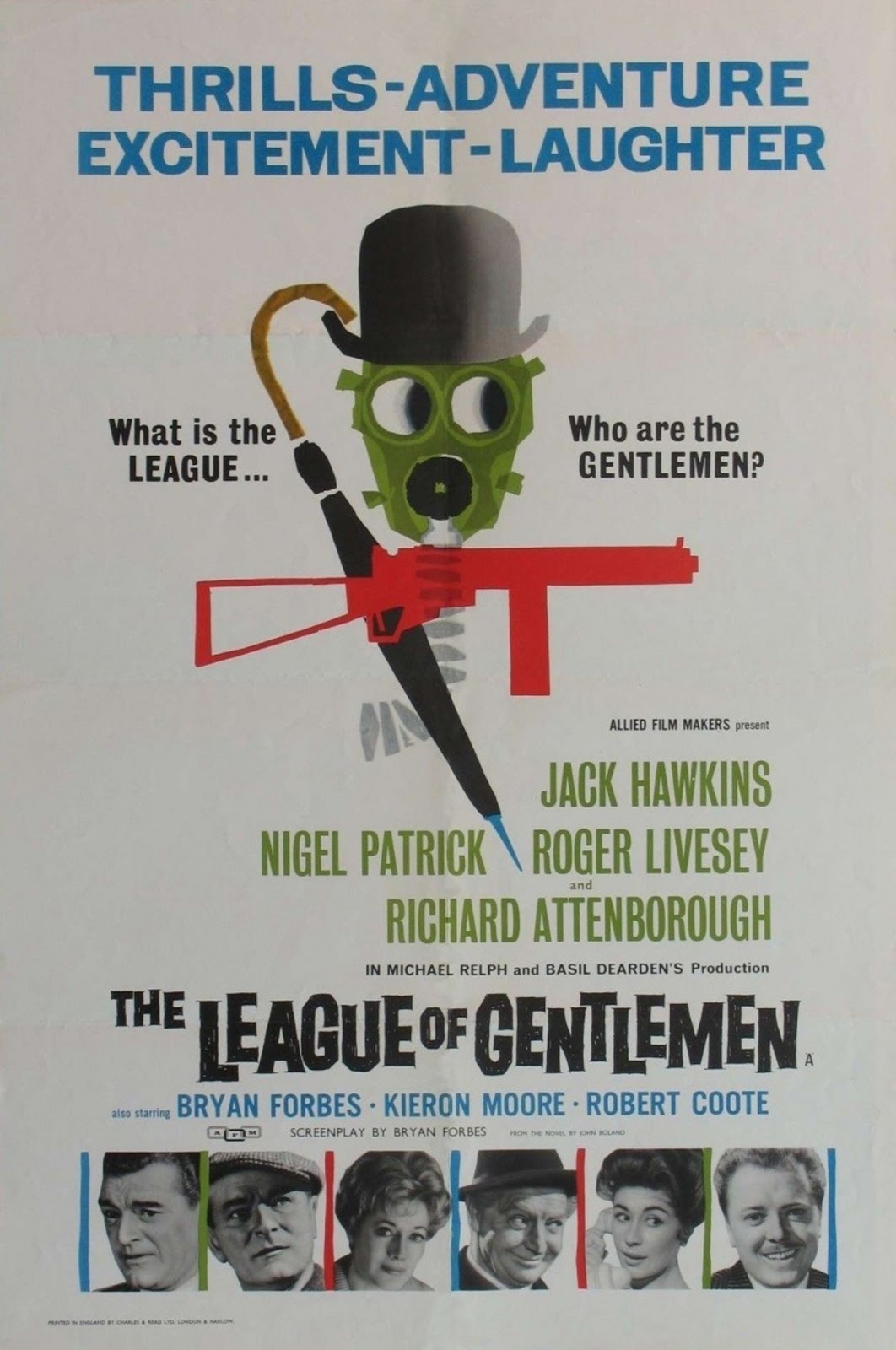
The League of Gentlemen (Basil Dearden, 1960) Basil Dearden's semi-whimsical heist film begins with a sequence that is quite out of whack with the rest of the film but gives a sense of the mind-set behind it. It is late at night on a dark noirish street, and the camera creeps up on a man-hole cover. It pops open to reveal Lt. Col. Norman Hyde (Jack Hawkins) surreptitiously looking about to see if his exit might be seen. Then he climbs out of the sewer dressed in a dinner suit. He then makes his way to a Rolls-Royce and and leaves the area.

It's a visual joke, one that would be expected—and was done—in a James Bond film. The juxtaposition of grime and well-heeled attire is a clever little summation of themes, especially in a society built on class, but except for the visual juxtaposition, it will have nothing to do with the rest of the film. In fact, the little episode is never mentioned again. The film proper begins with the next sequence.
Hyde returns to his home and cuts several £5 notes in half and inserts them, with an invitation from "Co-operative Removals, Ltd." to a lunch at the Cafe Royale, into copies of a paperback book of a crime novel entitled "The Golden Fleece."* He puts each into their separate envelopes and sends them out, seven in all. Their destinations are to seven particular men.
Their intended recipients—"all crooks of one kind of another," "all men of the world"—are disgraced military men, "trained at the public's great expense to do things with the utmost efficiency...which, frowned upon in peace-time are acclaimed in times of war." They are—in the photograph above, left to right: Captain Frank Weaver (Norman Bird), former leader of a bomb-disposal unit, drummed out for trying to defuse a bomb while drunk, which ended up killing four of his men—he now fixes time-pieces in his flat; Major Rupert Rutland-Smith (Terence Alexander), discharged "after some embarrassing mess of yours," resolved by hush-money from his rich wife which has left him hen-pecked and reluctantly accepting of her own many indiscretions; Captain Stevens (Kieron Moore), former fascist, forced out for his homosexual activities, which have made him a victim of blackmail, threatening his gymnasium; the high-toned Major Peter Race (Nigel Patrick), whose black-market activities led to his resignation, and now subsists on gambling and a room at the YMCA; Captain Martin Porthill (League screenwriter and future director Bryan Forbes) was kicked out for killing suspected Cypress terrorists and now makes his living playing the piano in dives and as a gigolo; Captain Padre Mycroft (Roger Livesey, of so many films by "The Archers"), formerly a quartermaster was convicted of "public gross indecency" and now, paradoxically, is a con-man using a contrivance of religious ordinations; finally, there's Lt. Lexy (Richard Attenborough), who sold secrets to the Russians and now runs an electronics repair shop for the lowliest of customers.
Hyde, for his part, "served my country well for 25 years and was suitably rewarded by being made redundant" and the experience has left him bitter and useless—all those skills and nothing to show for it. "The Golden Fleece" proved an inspiration on which he could hoist his revenge; he has researched and planned a bank robbery, and to accomplish he has gathered together a troop of morally compromised men with military discipline and specific skill sets to help plan and carry it out. He gives them a limited time to think things over, and, to a man, they agree ("Your presence here restores my basic disbelief in the goodness of human nature," he remarks); Hyde treats them as a military unit, barracking them in his own stately home for drills, research and to serve as a base of operations. Under the ruse of a food inspection for cover, they split off and while part distract the brass, the others steal guns, ammo, and other supplies making it look like an IRA action...when the loss is found.
Once all is arranged, they move their operations to a warehouse where the details are finalized. The goal is to rob a bank of enough resources that the men can split the money each receiving at least £100,000. Can British ingenuity and a proper military training pull off the raid despite improper motives (and the inevitable complications that pop up in these things?) All's fair in love and war...but war exercises?

Dearden, given the military nature of the heist is efficient and a bit ruthless in his direction—nothing fancy and nothing too rococo in how he plans his shots— Forbes' screenplay is witty and dry, and the actors all fill their niche-roles with Hawkins providing a commanding presence in both senses of the word, as both leader and star. The League of Gentlemen could be seen as a more austere version of such playful British heist films as The Lavender Hill Mob or The Ladykillers, but without their sense of twee or whimsy. Additionally, with such a collection of dedicated rotters, given their falls from grace in the eyes of Society, the film-makers evoke enough "sympathy-for-the-underdog" attitude that allows one to think that they just might pull the job off. 

It gives the film that added sense of suspense right up to the last minute.

* In the novel, the book is not "The Golden Fleece," but a real novel called "Clean Break' (written by Lionel White), which was filmed as The Killing by Stanley Kubrick in 1956.

Friday, August 30, 2019

The Bridge on the River Kwai

The Bridge on the River Kwai (David Lean, 1957)
One of those legendary movies that I have had ample opportunities to watch but always chose to miss for one reason or another, despite having seen many of Lean's films. It's inexplicable how I've managed to miss it over a lifetime—it premiered two years after I was born. Perhaps it was the length of the thing, clocking in at 2 hours 41 minutes. For whatever reason, I had never watched the whole thing (but I had curiously seen the ending many, many times). The multi-Oscar winning blockbuster marks the point when David Lean became more recognized as an artist than merely a capable director. It is also the point where he became less of a British director than a director of international locales.
All I'd ever seen of The Bridge on the River Kwai
Lean was not Sam Spiegel's first choice for director of an adaptation of the Pierre Boulle novel (which Spiegel had picked up in an airport book-shop)—Spiegel first thought of Fred Zinnemann and William Wyler, Howard Hawks and John Ford, even Orson Welles—he also thought of Humphrey Bogart for the role of the commando Shears (to be later played by William Holden for a million dollar salary, after the next choice, Cary Grant, whose last film that wasn't a light comedy, Crisis directed by Richard Brooks, was a box-office flop).

For the role of the persevering, but ultimately deluded Col. Nicholson, Spiegel sought out Laurence Olivier, who opted, instead to direct and co-star with Marilyn Monroe in The Prince and the Showgirl. Spencer Tracy, Charles Laughton, Ronald Colman, James Mason, Noel Coward and Ray Milland were also considered before the final brilliant (and Oscar-winning) choice of Alec Guinness.
The film begins with the arrival of British POW's (to the whistled tune of "The Colonel Bogey March" to keep regimented time) at a Japanese work camp in Burma run by Colonel Saito (Sessue Hayakawa). Saito informs the prisoners they will be assisting in the building of a railway bridge that will run weapons and supplies for the war effort between Bangkok and Rangoon. The ranking officer, Lt. Col. Nicholson quotes the Geneva Convention to Saito stating that officers are exempt from manual labor and the next day, resists the commands to go to the bridge-site. This awards Nicholson a slap across the face and the troops a day in the blistering Burmese sun...after being threatened with outright execution. 
For the veteran prisoners, like American Navy Commander Shears (William Holden)—a fixer who bribes the guards to avoid doing heavy labor—Nicholson is a bit too "regular army" for the situation and Shears continues in his efforts to escape the camp, despite Nicholson's command to his troops that no one escapes—Nicholson was commanded to surrender to the Japanese and considers escape attempts as against orders and treasonous. Shears will not entertain such distinctions; he's a prisoner of war. He plans another attempt to escape and is the only one of three to survive, washing up in a Siamese village, shot and barely alive from the ordeal. But, the village cares for him and supplies him with a canoe and after another long journey further down the river, he is picked up British forces in Ceylon.
Nicholson continues his by-the-book resistance to hard labor and Saito orders the senior officers confined and Nicholson locked up in a metal solitary shed for his defiance. For days, he bakes in the Burmese sun, surviving by the ministrations of the troop doctor, Clipton (James Donald), who is given permission to visit the prisoner only if he can persuade Nicholson to give in. Nicholson refuses.
This puts Saito in a bind. He has been tasked to build the militarily important transport bridge by a certain date, and if he cannot complete it in time, he will be forced to commit suicide for the dishonor. The Colonel must have Nicholson's men working on the bridge to ensure its completion, and so he tasks Nicholson to supervise the building of the bridge, which the Lt. Col. is all too willing to do, on the condition that it is built his way, meaning that the British will survey, design, engineer and construct the bridge. Both men get what they want—for Saito, it's the meeting of his goal, while for Nicholson, it will be occupational therapy for the men, possible better treatment, and a chance to show the Japanese the superiority of Western—and by that is meant occidental—thinking and productivity. And by that, he means that the British are more civilized than the Japanese. Whatever his high-minded ideals, the roots of the task are in prejudice.
The first half is a rough slog, split between the battle of wills between Guinness' Nicholson and Hayakawa's Saito. The atmosphere is oppressive and close-knit as Nicholson internalizes his defiance until it becomes something like compliance, while Shear's cynical American fights his way back to civilization, stripping away his veneer of crustiness along the way. One gets a good distillation of Stockholm Syndrome: Nicholson begins to see eye-to-eye with his captor, and Holden's defiance grows stronger the farther he gets from the camp.
The movie turns on its ear while re-tracing steps in the film's second half: Shears is convalescing in Ceylon, and enjoying it, but he is persuaded—it wouldn't be very British to say "blackmailed"—to retrace his steps and go back to the camp—the last thing he wants to do—in order to take out the bridge that, unbeknownst to him or British Special Forces, Nicholson and the prisoners are building to improve their conditions and to prove the vainglorious point that they are better than their captors—a point that might be better made if they attempted escape. But, by this time, Nicholson is so committed to the bridge that he doesn't even consider that he is aiding and abetting the Japanese war effort.
That point, out of captivity, is only too evident to the Special Forces commandos—Shears, Major Warden (Jack Hawkins), and Lt. Joyce (Geoffrey Horne), another is killed in the parachute drop—sent to destroy the bridge before it can become useful. They painfully make the trip with the help of Burmese natives, as Nicholson and his men re-double their efforts to meet the deadline for the bridge to be used for a train carrying soldiers and officials—the first true successful use of the bridge. For Nicholson, completion of the bridge is a personal triumph and a source of great pride.
So, imagine what he would think if he knew that his own government, his own Army, had been sent to destroy the thing. That is the tension that underscores the last half of the film and how agents from the same Army can come to cross-purposes in the madness of war. The foolhardiness comes full-circle as the mission to blow up the bridge comes to its conclusion. "Sides" and loyalties are blurred in the melee, as allies fight allies over an enemy bridge. Best intentions underline deaths and, after so much planning and work on both sides, it all comes down to a twist of Fate, as opposed to any deliberate act of sabotage or murder on the part of the combatants.
It's a masterful film under Lean's direction, though some may quibble about the length of the first part of the film—one has to light the fuse no matter its length—and once out of the camp area, Lean's freedom to shoot beautiful jungle vistas in all manner of light gives the film grace notes of beauty no matter how down, dirty and gritty the action on-screen gets. 
It's as if Lean is looking for anything to off-set the mixed loyalties and complexities of the plots of men knotted up in the situation. Those beauty shots and the quick cut-away reactions of the Burmese women to the deaths in the final scene are practically essential as some sort of respite from the quagmire that is played out in the shadow of that bridge, as if there has to be shown something natural and decent still remaining, despite all.
The Bridge on the River Kwai is paved with good intentions. Like all roads to Hell.

Wednesday, March 7, 2018

Land of the Pharoahs

Land of the Pharoahs (Howard Hawks, 1955) Director Fritz Lang once said famously that Cinemascope—a popular widescreen movie format in one of the studios' experiments to lure people away from their televisions and back into theaters—was only good for shooting "a funeral, or for snakes, but not for human beings; you have a close-up and on either side, there's just superfluous space." 

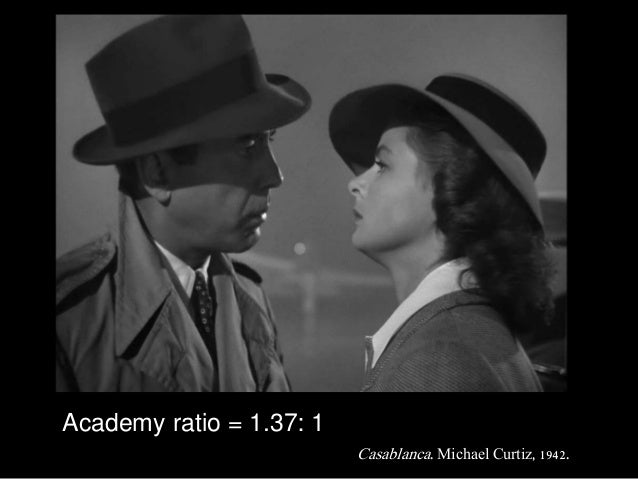
The aspect ratio of 2.66:1 proved a challenge for film-makers and one determined to solve it was Howard Hawks, one of the least "showy" of directors when it came to camera-angles and presentation. Hawks' formula up until that time had been the standard boxy Academy ratio (1.37:1) in an unpretentious un-fussy style, shooting at mid-height and without a lot of distracting camera movement. The focus was actors and performances; you showed off in front of the camera, never behind.
But Cinemascope was a challenge for any film-maker and Hawks began to design a movie that might showcase the format's strengths by story, and chose the building of the pyramids as its theme (after all it was a great source for snakes and funerals). 
And parades...lots of parades. For the story, Hawks turned to his frequent collaborator, the acclaimed author William Faulkner (Hawks' brother was his Hollywood agent). Faulkner had worked wonders "breaking" problematic stories for the screen (including Hemingway's self-admitted "worst story" To Have and Have Not). To flesh out the story, Harry Kurnitz—who could be counted on to lighten up entertainments and would write Hawks' Hatari!—and Harold Jack Bloom (who had just won an Oscar for his first screenplay, Anthony Mann's The Naked Spur) were brought in to make something more of a movie about the construction of the pyramids.
What they came up with somewhat ingenious, mixing elements of biblical tales with soapy melodrama. In ancient Egypt, the conquering Pharoah, Khufu (Jack Hawkins), decides that the world is not enough and decides that he must make a place for himself in the after-life. He decides that he will create a great tomb for himself, using the labor garnered from all the civilizations that he has under his thumb. Knowing full well that he is approaching the end of his life and that the project may take years (if not decades), he begins the process of making his final kingdom. He begins by taxing all of the territories of his empire to pay for it (government is government), and to take as many treasures with him to impress the many kings and queens and gods that have gone before him.
From one of the kingdoms, he enlists the aid of the greatest architect, Vashtar (James Robertson Justice), but like any construction project there is a "punch list": the tomb must be vast to hold Khufu and his treasures and impressive in its scope; it must be impenetrable, unable to be entered or exited, in order to discourage any would-be grave-robbers attracted to the treasures within; to make sure that its secrets will never be disclosed, Vashtar must die upon the pyramid's completion—an extreme example of termination after work is finished. In return, Khufu will free Vashtar's people...the ones that survive building the thing, of course. No such concept as worker's comp in the slave trade. Vashtar agrees, and, with his son (Dewey Martin) Senta's assistance, begins the plans for the intricate tomb.
But, he's not the only one doing any planning, as the relationships plotline starts to get rather soapy ("like sand through the pyramid run the days of our lives..."). Cyprus, pleading poverty, instead sends its Princess Nellifer (Joan Collins) as tribute. She's haughty and gives Khufu so much attitude that he decides to have her whipped. Then, just to show how stable Pharoahs could be back in that day and age, Khufu takes her as his second wife over the objections of Queen Nailia (Kerima) and his old friend, confidante and High Priest, Hamar (Alexis Minotis). Sounds healthy...
Joan being Joan, she immediately starts to make big trouble in little Egypt: she begins by challenging just how much gold Khufu is amassing (since her kingdom contributed none of it), and demands to see it for herself. Khufu thinks she's being a little impudent, but, being Khufu, he has to prove his worth to the woman from the country that pled poverty. Nellifer is impressed and decides to take a necklace for herself, which really pisses off Khufu, who removes it forcibly and throws it back in the pile. But (Joan being Joan) all that does is to light the fire of some serious plotting, first seducing Khufu's captain of the guard (Sydney Chaplin) and plotting with him to kill Queen Nailia, her son, and Khufu himself, so that she can rule Egypt and keep all that gold for herself. She's just a bad person...
The project takes decades to complete, and Hawks keeps track with slave-working montages, the graying of characters' hair and Senta's growth from child to young hunk. It is an engineering marvel, but anyone who enters must be blindfolded, lest they betray the secrets of the tomb and be killed for it. Vashtar hedges the bet, though, for Senta, who his father tasks with completing the Pyramid should he die. Senta's knowledge is kept secret for the plan to work.
It's a good thing, too. On an inspection tour of the work, Khufu is injured by a falling beam and Senta reveals to him that he can prevent any premature burial by helping the Pharoah out of the complicated interior. Khufu, having better taste in friends than he does in wives, gratefully thanks Senta but refuses to forestall his death for knowing the secret of the Pyramid, but offers the young man anything in return for his help. Senta chooses to free Nellifer's slave-girl Kyra, who he's sweet on and who risks being punished with the lash by the evil Queen.
The plot is far less intricate than the tomb itself (which is something of a sand-powered marvel and would whip Indiana Jones), and turns out being the most effective thing in the script, becoming something truly sought after by all parties and a way to resolve all conflicts. For all the machinations in the court, it's the grave that...appropriately...settles all accounts in a very satisfying way. It just takes a long time to get there and tries the patience and nerves while the House of Pharoah unravels and the audience waits for anything that seems noble happens.
And that's unusual for Hawks. His films, at their most entertaining and thoughtful, feature disparate individuals forming a working unit, a clan, a force to be reckoned with. Land of the Pharoahs has disparate tribes and peoples working to build a pyramid, yes, but they're doing it as slaves, not by choice, which is a perversion of the Hawks paradigm. The lead figure is a complete narcissist, no matter how accomplished he may be, and a bit of a fool. The closest comparison Land of the Pharoahs comes to in previous Hawks films is, unusually, Scarface, where another "Kingpin" is undone by his weaknesses and passions. But, where Hawks could work contemporaneously with a gangster, the Pharoah left the filmmakers...and audiences...high and dry.
The film was a box-office failure, a rarity in Hawks' career and costly in both time and money—two years and 3 million dollars. Years later, he would offer up that he "should have had someone in there that you were rooting for. Everybody was a son of a bitch." Not exactly true, as Vashtar and Senta are at least noble people and competent, as well. But, it was missing Hawks' banter that generated wit and humor—Hawks told Peter Bogdanovich "we didn't know how a Pharoah talked." He did, however, make a picturesque film filled with crisp detail and thousands of extras that filled that daunting Cinemascope frame almost to bursting.*

The film's failure weighed on Hawks and he spent the next years travelling in Europe and when he came back, he came all the way back—to the western genre (he hadn't made one in ten years) and that film's star John Wayne, making Rio Bravo, which was a box office smash.


* Interesting about the old directors—they could figure out what to do with those unusual fame aspect ratios—John Ford was surprisingly adept using Cinerama during How the West Was Won.