Showing posts with label Nigel Bruce. Show all posts

Wednesday, August 26, 2020

The League of Gentlemen (1960)

The League of Gentlemen (Basil Dearden, 1960) Basil Dearden's semi-whimsical heist film begins with a sequence that is quite out of whack with the rest of the film but gives a sense of the mind-set behind it. It is late at night on a dark noirish street, and the camera creeps up on a man-hole cover. It pops open to reveal Lt. Col. Norman Hyde (Jack Hawkins) surreptitiously looking about to see if his exit might be seen. Then he climbs out of the sewer dressed in a dinner suit. He then makes his way to a Rolls-Royce and and leaves the area.

It's a visual joke, one that would be expected—and was done—in a James Bond film. The juxtaposition of grime and well-heeled attire is a clever little summation of themes, especially in a society built on class, but except for the visual juxtaposition, it will have nothing to do with the rest of the film. In fact, the little episode is never mentioned again. The film proper begins with the next sequence.
Hyde returns to his home and cuts several £5 notes in half and inserts them, with an invitation from "Co-operative Removals, Ltd." to a lunch at the Cafe Royale, into copies of a paperback book of a crime novel entitled "The Golden Fleece."* He puts each into their separate envelopes and sends them out, seven in all. Their destinations are to seven particular men.
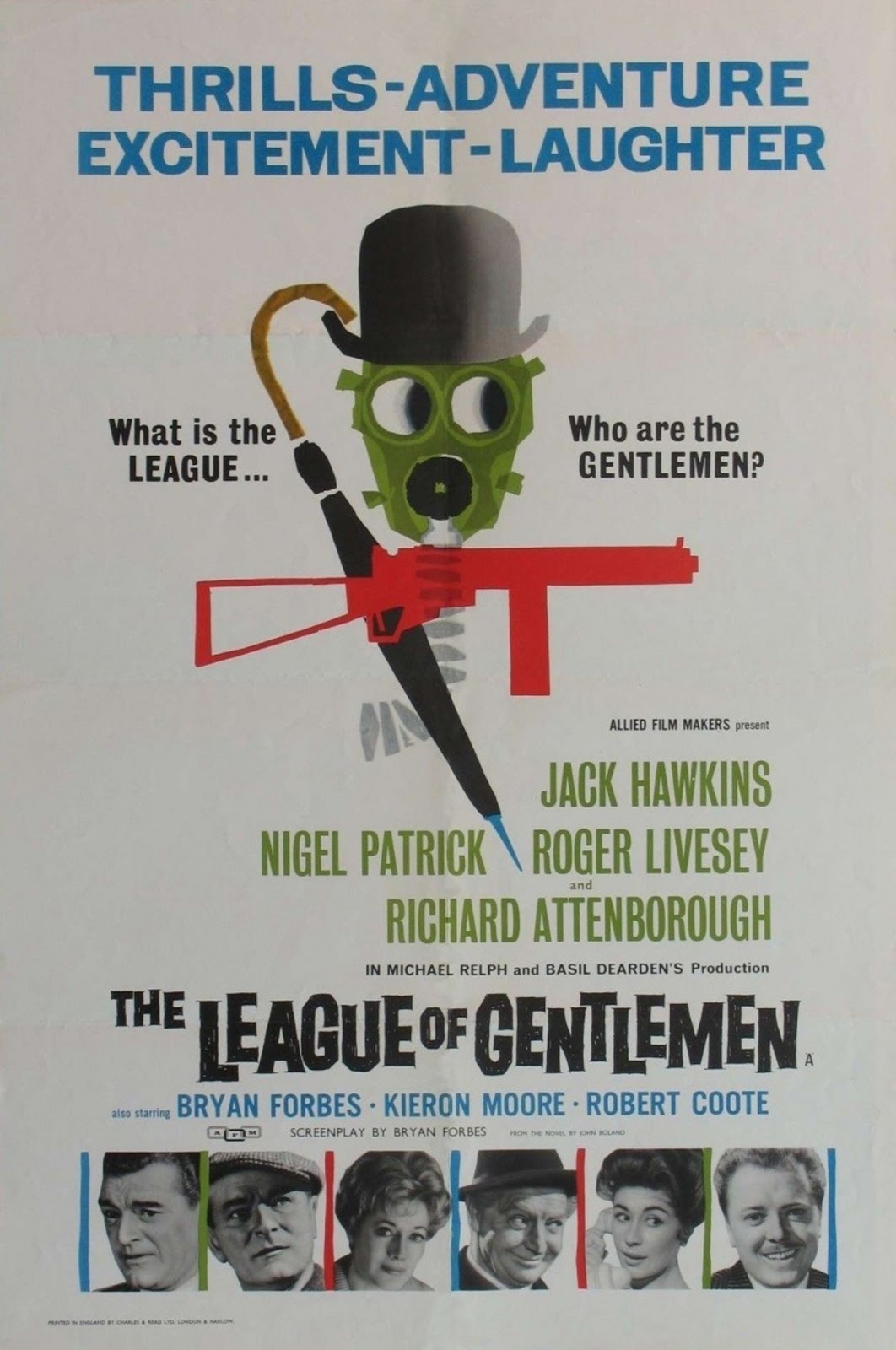
Their intended recipients—"all crooks of one kind of another," "all men of the world"—are disgraced military men, "trained at the public's great expense to do things with the utmost efficiency...which, frowned upon in peace-time are acclaimed in times of war." They are—in the photograph above, left to right: Captain Frank Weaver (Norman Bird), former leader of a bomb-disposal unit, drummed out for trying to defuse a bomb while drunk, which ended up killing four of his men—he now fixes time-pieces in his flat; Major Rupert Rutland-Smith (Terence Alexander), discharged "after some embarrassing mess of yours," resolved by hush-money from his rich wife which has left him hen-pecked and reluctantly accepting of her own many indiscretions; Captain Stevens (Kieron Moore), former fascist, forced out for his homosexual activities, which have made him a victim of blackmail, threatening his gymnasium; the high-toned Major Peter Race (Nigel Patrick), whose black-market activities led to his resignation, and now subsists on gambling and a room at the YMCA; Captain Martin Porthill (League screenwriter and future director Bryan Forbes) was kicked out for killing suspected Cypress terrorists and now makes his living playing the piano in dives and as a gigolo; Captain Padre Mycroft (Roger Livesey, of so many films by "The Archers"), formerly a quartermaster was convicted of "public gross indecency" and now, paradoxically, is a con-man using a contrivance of religious ordinations; finally, there's Lt. Lexy (Richard Attenborough), who sold secrets to the Russians and now runs an electronics repair shop for the lowliest of customers.
Hyde, for his part, "served my country well for 25 years and was suitably rewarded by being made redundant" and the experience has left him bitter and useless—all those skills and nothing to show for it. "The Golden Fleece" proved an inspiration on which he could hoist his revenge; he has researched and planned a bank robbery, and to accomplish he has gathered together a troop of morally compromised men with military discipline and specific skill sets to help plan and carry it out. He gives them a limited time to think things over, and, to a man, they agree ("Your presence here restores my basic disbelief in the goodness of human nature," he remarks); Hyde treats them as a military unit, barracking them in his own stately home for drills, research and to serve as a base of operations. Under the ruse of a food inspection for cover, they split off and while part distract the brass, the others steal guns, ammo, and other supplies making it look like an IRA action...when the loss is found.
Once all is arranged, they move their operations to a warehouse where the details are finalized. The goal is to rob a bank of enough resources that the men can split the money each receiving at least £100,000. Can British ingenuity and a proper military training pull off the raid despite improper motives (and the inevitable complications that pop up in these things?) All's fair in love and war...but war exercises?

Dearden, given the military nature of the heist is efficient and a bit ruthless in his direction—nothing fancy and nothing too rococo in how he plans his shots— Forbes' screenplay is witty and dry, and the actors all fill their niche-roles with Hawkins providing a commanding presence in both senses of the word, as both leader and star. The League of Gentlemen could be seen as a more austere version of such playful British heist films as The Lavender Hill Mob or The Ladykillers, but without their sense of twee or whimsy. Additionally, with such a collection of dedicated rotters, given their falls from grace in the eyes of Society, the film-makers evoke enough "sympathy-for-the-underdog" attitude that allows one to think that they just might pull the job off. 

It gives the film that added sense of suspense right up to the last minute.

* In the novel, the book is not "The Golden Fleece," but a real novel called "Clean Break' (written by Lionel White), which was filmed as The Killing by Stanley Kubrick in 1956.

Thursday, September 6, 2018

The Scarlet Pimpernel (1934)

The Scarlet Pimpernel (Harold Young, 1934) The classic tale of the foppish member of the elite aristocracy who disguises himself to fight the despotic powers for the good of all. No, it's not Don Diego or Bruce Wayne. It's Sir Percy Blakeney, aka the Scarlet Pimpernel (Leslie Howard), master of disguise and master tactician, who, with his loyal League of the Pimpernel, in the case of this film, frees French noblemen from the ruffians of Robespierre during the French Revolution, circa 1792.  

Waitaminnit! Attendre! The ruffians of Robespierre WERE the common people! All too common as it turns out, as director Young and scripters Robert Sherwood, Lajos Biro and S.N. Behrman would have you believe, demonstrated by the common cruelty of the throng awaiting noble be-headings at the guillotine, distracting themselves with knitting, stuffing their faces, and the things most people do during opening acts at a country fair. Such very public gatherings—and executions—make it very difficult to do any serious rescuing, especially when you have the evil Chauvelin (Raymond Massey), the new ambassador to Britain and enforcer for Robespierre (Ernest Milton) himself, breathing down your neck. And necks were very fragile things during the Reign of Terror.
In other words, it's hard out there for a pimpernel.

But, wait, wait, wait. Hold on there, citizens. The Pimpernel isn't Batman. He isn't Zorro or Robin Hood. He's a member of the aristocracy fighting for the aristocracy. Those other guys are examples of the privileged fighting for the common man. The pimpernel doesn't give a pinch of snuff for them. Nope, he's protecting elites who've been caught up in the Revolution against monarchy, authoritarianism by both aristocracy and clergy, as well as against slavery. He's on the wrong side of History, but I suppose when allies, friends and relatives are facing a blade in the village square, higher ideals and an Age of Reason seem a little dull by comparison.

This is because the stories of The Scarlet Pimpernel were written by the Baroness Emmuska Orczy, who knew something of revolutions, he family having fled their native Hungary in 1868, fearing a peasant uprising. The Baroness settled in London, and married an artist named Montague MacLean Barstow, and although it was a happy marriage, Barstow's career as an illustrator did not keep the Baroness in the manner to which she had grown up accustomed. She began to write, somewhat successfully, but she didn't achieve any real success until the two collaborated on a play about the Pimpernel, based on one of her short stories. That play ran for four years, and her novelization of it became a best-seller, inspiring a continuing series of books, and allowed her to buy a villa in Monte Carlo, where she spent most of the remainder of her life.
So, the Baroness' sympathies weren't exactly with democratic ideals, preferring the joys of imperialism and militarism. So, of course, (given her history) she would side with the aristocracy, rather than with the peasants. After all, they can always eat cake. It's just that a guillotine is rather impractical to slice it with. So, no, the Pimpernel is not for the common good unless it's to preserve the status quo. He wouldn't do well in America.

But, then again, these days, he might.
But, where the Baroness did have a good idea was an invention that might have been partially inspired by the works of Edmond Rostan and Alexandre Dumas, that of the "secret identity" (that is taken for granted in today's super-suffused culture). In order to do "what must be done," the hero operates outside the law, which has every inclination to suppress him for their survival. And so, he must operate in disguise, live a double life, so that his actions cannot be detected by the behavior of his "other life." It is also to protect friends, family, and lovers from being used as pawns against him.
But, even here, the Baroness has an odd wrinkle—for Percy Blakeney, English baronet, is married to the Lady Marguerite (the spectacularly photogenic Merle Oberon), both French and aristocratic by birth, and even though her brother is suspected of being in the Pimpernel's infernal "League," she has no idea that her foppish husband could be the daring Pimpernel (doesn't she wonder about any unexplained absences? Could she be suffering from "Lois Lane blindness?"). Her suspected ties to the Pimpernel (oh, if they only knew) makes her just the sort of weapon that can be used against him, and so her friend, the Chauvelin coerces her to try and find out the true identity of his nemesis. At one point, she actually sends her husband into a trap and only realizes the truth and what she's done in time to warn him.
Of course, there wouldn't be a series of books if he got caught, and the black hat/white hat dichotomy is so starkly presented that no one in their right mind would favor Raymond Massey's fortunes over Leslie Howard's. And so, the Pimpernel persists into legend.

We seek him here, we seek him there, 
Those Frenchies seek him everywhere. 
Is he in heaven? — Is he in hell? 
That damned, elusive Pimpernel 
Wednesday, July 27, 2016

Roxie Hart

Roxie Hart (William Wellman, 1942) Think of it as Chicago without the music and dancing (except for a couple numbers), because that's exactly what it is. This version, adapted (by Nunnally Johnson and Ben Hecht,) from the play and 1927 movie version called Chicagotells the same story of a dancer, Roxie Hart (Ginger Rogers) near the end of her career, who decides to take the rap for the murder of booking agent Fred Casely, found dead in Roxie's apartment. Roxie didn't do it (a difference from the other versions, thanks to the Production Code), but like a certain hotel developer, when things are sagging somewhat, you should do something really crazy to get attention.

The movie is done in flashback in a bar (one run by William Frawley) that's a hangout for newsies. "The new kid" (Ted North) is working a murder investigation and is full of stories. In an ink-stained version of "Can You Top This?" veteran newsman Homer Howard (George Montgomery) tells him the story to end all bets—a murder case he covered in 1927.

George Montgomery serves as the Teller of the Tale at a bar frequented by newsies.
He tells the story of Roxie Hart and how, when the agent is murdered in the Hart apartment (presumably by her husband as the police suspect), she is persuaded to "takes the fall" because a woman would never be convicted of murder in Chicago. Besides, any publicity is good publicity. Her husband, Amos (George Chandler) hires courtroom sheister Billy Flynn (Adolphe Menjou) to defend Roxie by using the press to gain sympathy, depict her as a weak woman who acted in self-defense...and show a lot of leg to the all-male jury.
Roxie enjoys the headlines and the attention, confident that she'll never hang. But, then disaster strikes—another woman is convicted of a horrible crime and calls are made to be less lenient on female criminals and it knocks Roxie out of the headlines. The only thing to do is up the ante with more salaciousness and hearts and flowers.
For Rogers, who, after letting Astaire lead for most of her career, it was another opportunity to do something a little different and show off her comedy and acting gifts. With Roxie Hart, she takes a big gamble—looking unsympathetic to the audience. Roxie Hart is a deeply, cynical black comedy with a lot of laughs (it made Stanley Kubrick's "Top Ten Favorite Films" in 1963) and an assured directorial hand by veteran director William "Wild Bill" Wellman (who'd already straddled many genres with The Public Enemy, Nothing Sacred, A Star is BornBeau Geste, and the first "Best Picture" Oscar winner, Wings). Its stinging farcical tone still resonates—enough for Bob Fosse to update it in 1975, where the unholy marriage of justice, news-mongering, and fame felt remarkably contemporary.
But, even the resultant musical doesn't diminish the sense of raucous, crass fun in this film version of Roxie Hart.


In 1963, when asked by Cinema Magazine what his favorite films were, director Stanley Kubrick chose these:

I Vitelloni (Federico Fellini, 1953) 
Wild Strawberries (Ingmar Bergman, 1958) 
Citizen Kane (Orson Welles, 1941) 
The Treasure of the Sierra Madre (John Huston, 1948)
City Lights (Charles Chaplin, 1931)
Henry V (Laurence Olivier, 1945)
La Notte (Michelangelo Antonioni, 1961)
The Bank Dick (W.C. Fields, 1940)
Roxie Hart (William Wellman, 1942) Note: at one point, he said this was his favorite film
Hell’s Angels (Howard Hughes, 1930)

Thursday, June 30, 2016

The Two Mrs. Carrolls (1947)

The Two Mrs. Carrolls (Peter Godfrey, 1947) Fans of Humphrey Bogart don't often mention this dark guignol of a thriller that marks the only pairing of Bogart with the considerable presence of Barbara Stanwyck, an actor as unafraid of projecting a dark side as he is, even if this particular film doesn't exploit it, as it fits in the mold of Stanwyck's other "women in peril" films. Stanwyck always managed to straddle the line between naturalism and theatricality, while Bogart was always uniquely Bogart, self-aware enough to know both his strengths and weaknesses as an actor (and a man) and call them up, albeit with a veneer of artificiality that passed for theatricality and artifice.

At the start of the film, everything is rosy, full of natural light fresh air and pristine waters as painter Geoffrey Carroll (Bogart) and his new love, Sally Morton (Stanwyck) are vacationing in the mountains on a fishing vacation. It's all hearts and flowers and the two are very much in love, Gerry paying less attention to the fish than in sketching Sally. But, a sudden squall puts a damper on things when, while giving Sally a protecting coat, a letter falls out of his pocket, addressed to Gerry's wife. Sally is shocked and breaks off the affair.
Gerry explains the situation. The letter is to ask his wife for a divorce. She has been an invalid since the birth of their child, and her estate will supply all the care she needs. But, when the first Mrs. Carroll dies, Gerry continues to pursue Sally, they marry and she moves in with Gerry and his daughter from his late wife, Beatrice.

Gerry is distant, locking himself in his studio to paint for hours on end. They argue about sending Gerry's daughter to a boarding school, which the kid does not want to go to, preferring to stay at home with Gerry and Sally. Sally talks to Beatrice (Ann Carter), who reveals that the first Mrs. Caroll was hardly an invalid, but actually quite healthy and died suddenly after Gerry had returned from a fishing trip (DUN-dun-dunnn) and finished his portrait of her as an angel of death.
This naturally freaks Sally out, especially after finding the key to Gerry's studio and seeing that he's working on a portrait of her...as an angel of death. Plus, Gerry is acting very interested in a vampiric young socialite (Alexis Smith), who has commissioned Gerry to paint her portrait—maybe she should just wait a while.
The director, Peter Godfrey, was a director-friend of Stanwyck's, and he has a stagey directorial style that is sunny and bright at the beginning of the film and becomes gradually more stage-bound, darker and more closed-in as the film progresses and the second Mrs. Carroll's suspicions become more real. The film has a couple of bizarre touches on top of Bogart's increasingly paranoid and— eventually—deranged performance: one is Gerry's truly horrific artistic style and the other is his means of dispatching his wives—by providing a helpful glass of warm milk before bed...to help them sleep, of course. They obviously haven't seen Hitchcock's Suspicion. Or Hitchcock's Notorious.
The chief enjoyments of The Two Mrs. Carrolls is the pairing of Bogart and Stanwyck, a truly unhinged performance by Bogart—he has a wonderful final line—and the generally creepy air permeating the film, even when it becomes ludicrous. Beyond that, there's not much there.

Tuesday, June 21, 2016

The Last of Mrs. Cheyney (1937)

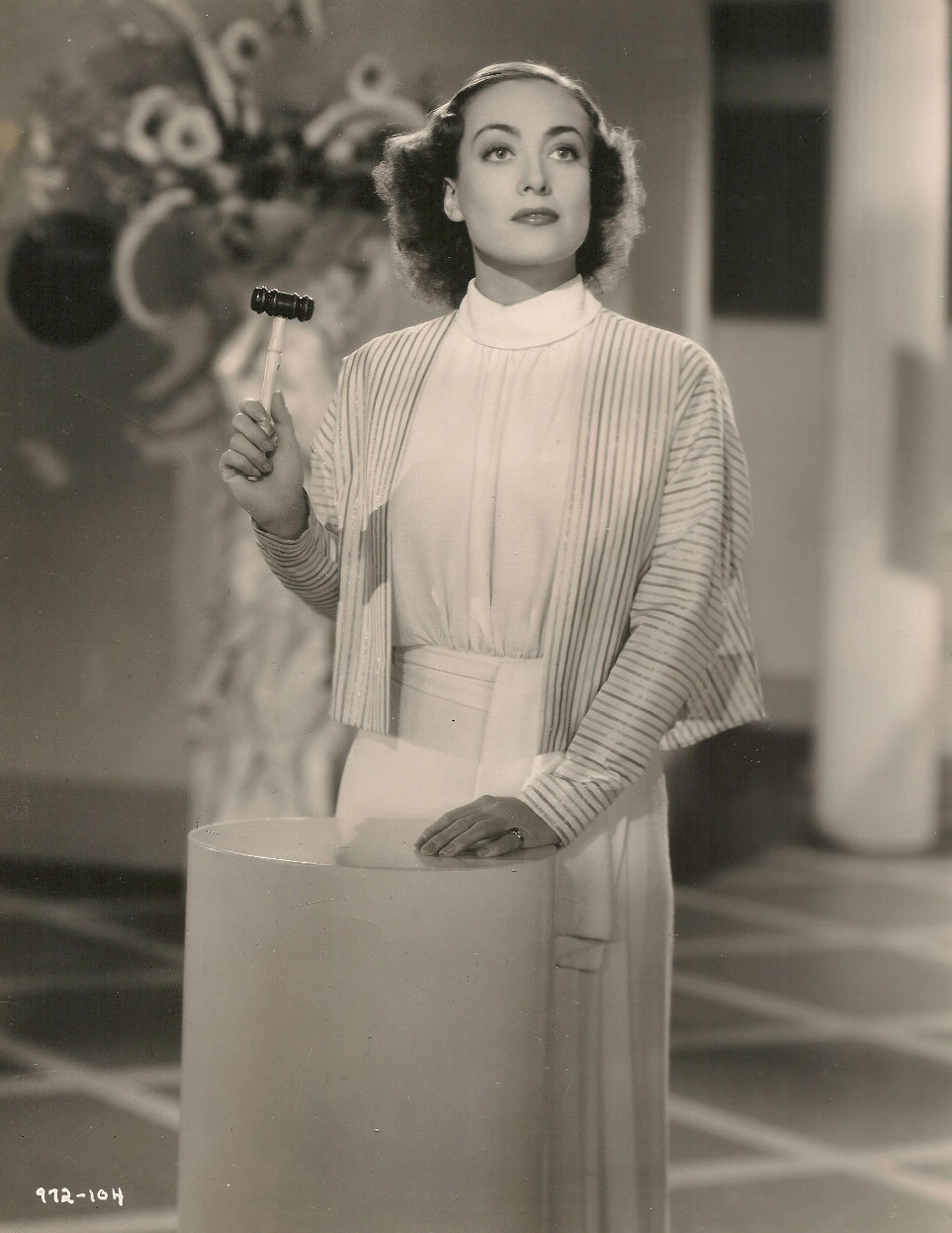
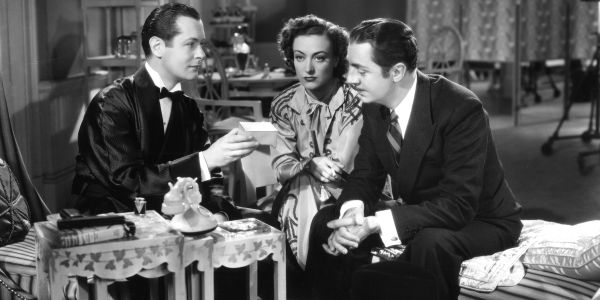
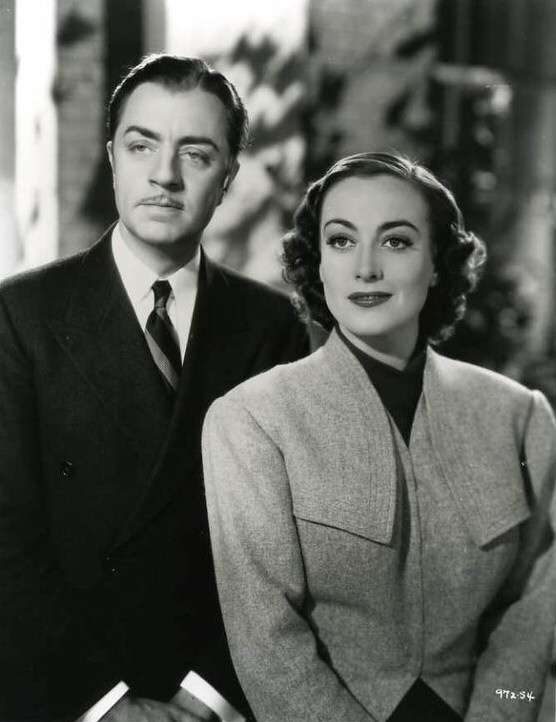
The Last of Mrs. Cheyney (Richard Boleslawksi and Dorothy Arzner, 1937) Remake of the 1928 stage adaptation with Norma Shearer and Basil Rathbone, this one has a little bit more of the star-wattage of M-G-M behind it with Joan Crawford (rarely better) as well as William Powell, Robert Montgomery, Frank Morgan, Nigel Bruce and Jessie Ralph. 

The movie starts stodgily with Montgomery's Lord Arthur Dilling meeting and becoming entranced with widower Mrs. Fay Cheyney (Crawford) on a transatlantic sail. He's intrigued that she takes a fancy to the equally rich, more elderly (and more susceptible) Lord Francis Kelton (Morgan), and keeps an eye on her when they disembark, for though he's smitten, he's curious to see if she might be a gold-digger.

She's not. She's an international jewel-thief in cahoots with Charles (William Powell), the man posing as her butler.  
It's hard to pin-point, but around the time the cast all gets together at the estate of Lady Embley (Ralph) after a charity event, the tone suddenly lightens and everybody, especially Montgomery, get several notches better. Now, at some point, the original assigned director Richard Boleslawski died of a heart attack, to be replaced by Hollywood's only working female director at the time, Dorothy Arzner, and while one is hesitant to say this is entirely due to a change in directors, it is unarguable that the film starts to take off, whereas before it has a strained and stuffy feeling to it. Maybe, it's the presence of Powell—though it's doubtful because Crawford starts to light up, too—maybe because the entire cast is pinging off each other, there's more cross-talk between them and more energy zapping between each and every player. Maybe it's the script because the last half is where the change-up's, turn-around's and surprises in character and situations are clustered, a perfect case of the tail wagging the dog (without a chase, explosion or clinch to be seen). But it makes one want to check out Dorothy Arzner, the lone woman in the field (besides Leni Riefenstahl) to be making films at the time. Not to be sexist or anything, but it does make a difference.