Showing posts with label Raymond Massey. Show all posts

Friday, July 22, 2022

H.G.Wells' Things To Come

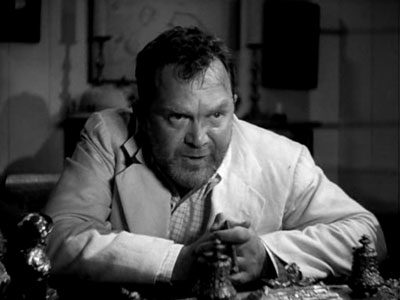
They (Stanley Kubrick and Arthur C. Clarke) also screened many films, including Destination Moon, The Day the Earth Stood Still, and Forbidden Planet. Kubrick soon discovered that Clarke was far too forgiving of material he found embarrassingly shallow and badly made. When the author insisted he screen the 1936 British science fiction classic Things to Come, written by H.G. Wells and based on a number of his stories, Kubrick "exclaimed in anguish, 'What are you trying to do to me? I'll never see anything you recommend again!'" Clarke remembered in 1972.
Space Odyssey, Michael Benson © 2018
I cannot imagine Stanley Kubrick "exclaiming in anguish" so much as mocking testily. But, if the director did indeed say that, he did have a point. Wells' later science fiction work in light of "The War That Ends All Wars" casts its eye less on the fantastical and more on the sociological, with the world's fate hanging on the desires of the gifted and the merely covetous. It may sound fine in the abstract, but Wells seems to forget that History is the slaughterhouse registry of the Powerful against the power-less.
It is 1940, and a Christmas party is being thrown by scientist John Cabal (Raymond Massey). But the festivities are overshadowed by the fear of an imminent war being radioed on the news. Cabal's fellow guest Harding (Maurice Braddell) is also glum, but Pippa Passworthy (Edward Chapman) is not so pessimistic, and looks on the bright side—even if it happens, it will spur technological progress, which is a good thing, right? Cabal sticks to the basics: "If we don't end war, war will end us." And, as if to mock everyone's sentiments, the attacks begin that night.
It turns out that everybody is right. The war does advance technology, at least in the sort of armored vehicles and flying battalions that reign terror. As for the people, they are literally bombed into the stone age, fleeing to underground bunkers and sewers for protection from the devastation, and, in their struggle to survive, allow themselves to be ruled by autocratic strong men—their proverbial man on a white horse—who fill the vacuum and their pockets as those craving power always do. In this case, it's "The Boss" Rudolph (Ralph Richardson), who has taken over the management of "Everytown" since the end of the war in 1966. But, the conditions have led to a pandemic of a final biological tactic, "the wandering sickness," and "The Boss" ignores the efforts of Dr. Harding (Maurice Braddell) with his own solution—shoot the sick down in the street, and expands his plans by ordering his mechanic, Richard Gordon (Derrick De Marney) to try to fix the remaining planes to bomb the outliers beyond his control in "The Floss Valley" and take over their deposits of oil and shale to turn into oil for the planes.
But, in 1970, an answer arrives from the skies. John Cabal arrives on a newly designed airplane and informs Harding and Gordon that he has come from Basra, Iran, where survivors of the war have established a new government, World Communications, where mechanics and engineers have formed The Brotherhood of Efficiency to bring new technology to the survivors to rebuild civilization and join the new government in banning war and advancing mankind. Sounds good, except to the guy in charge. Following the maxim that "Equality is seen by the privileged as oppression," Rudolph captures Cabal and forces him to work with Gordon on the old planes, but his plans are thwarted when the "Wings Over the World" contingent of World Communications is alerted to, and they fly over, releasing their "peace gas," which sounds like a bad euphemism, but merely gives the citizens a good night's sleep.
All except for Rudolph, who has a bad reaction to the "peace gas"—a fatal conflict of interest, maybe—and dies. It's a little convenient, but metaphorically apt, it seems. It allows Cabal to announce that old autocracies are as dead as Rudolph, allowing a new world to start, allowing "a new life for mankind." No one mentions that it also means no technological solution can be perfect.
 
And...scene.
There follows another montage of the building of that "new life" as the world's population moves underground and start building new bright and shiny civilization-cities, where people are able to progress and live in peace. So much so, that Cabal's grandson Oswald (Massey again) looks to conquering new worlds and expanding our horizons off the Earth with a planned moon-shot. But...there's always gotta be a critic. "Sure, you can Build Back Better," but how are ya gonna pay for it? In this case, it's the sculptor Theotocopulus (
Cedric Hardwicke), who's pissed because he's lost an art grant of something because of all the money spent on Cabal's space-cannon, or something. 
Actually, no. His argument is less practical. He believes that humanity is tired of progress. "All sorts of people" are saying it, I guess. Enough so that he forms a mob to try and storm the space-cannon to try and stop it from launching (wouldn't you volunteer to stop a rocket launch...like one of those Saturn 5's that turn the surrounding acreage crispy?). But, Cabal, having seen the rise of petty autocrats before, decides he's going to ignore the mob (in all his Randian objectivism) and is able to send the manned probe into space, despite the Luddite uprising, and looks to the audience and intones "All the Universe, or nothing? Which will it be? Which will it be?"
Me? I'd look for a third option.

I gently mock, but Wells' story is all vague philosophizing without any practical demonstrations or innovations. Things look nice, and all, in that futuristic Fritz Lang Metropolis kind of way.* But, is everybody benefiting from the new technology? Is everybody housed and fed? Is everybody working...or do they need to work? And if they're working, are they working for bad bosses? And this "Brotherhood of Efficiency"...if they're using "metrics", you can count me out. There's no details here, just a sleek gloss-over. And the black and white of it isn't just in the photography, but in the binariness of choices. Is it always just a choice between progress and...(oh, what's the opposite of "pro?" Oh, yes) "congress?" And Wells' thinking seems to be that all the world needs to get along in technological advancement (if, of course, everyone advances equally regardless of class or income—if, indeed, there are such concepts in his utopia). One would argue that television, the computer, and the internet all have negative consequences, despite the best of intentions. Maybe even enough to tilt things out of balance. There's a limitation to what you can convey with a monolithic society...as opposed to extra-terrestrial monoliths
Kubrick did take something from Things to Come, though, and that is in the use of long stretches of montage, not to convey the passage of time (he did that in a single famous edit), but, rather, as a visual instruction manual on how things have changed and have become in the film (despite the technological advancements and accomplishments) every-day and banal. As a result, there are less moments of upturned faces and speechifying in grandiloquent tones. That seems less human to me and more autocratic, which, if I'm reading the film correctly, is just the sort of Coming Things Wells cautions against.

* One should put out that Things to Come is probably most influenced by Metropolis, which was made just nine years earlier, right down to the binary philosophical arguments, although Lang (and his scenarist Thea von Harbour) did come up with that third option. Mind? Heart? How about working in conjunction?

Wednesday, September 2, 2020

Action in the North Atlantic

Tom Hanks has a movie out on AppleTV+ called Greyhound, based on C.S. Forester's "The Good Shepherd." For the similar scenario from the time-frame in which it occurred, there was this movie...

Action in the North Atlantic (Lloyd Bacon, 1943) Rousing war-time propaganda film about the Merchant Marines and their attempts to distribute supplies for the war effort while fighting off Nazi air and sub attacks. Directed by Lloyd Bacon whose experience in the WWI Navy lends an undisputed air of authenticity to the scenario, if the visuals don't exactly hold up due to some sub-par model work mixed with chock-a-block stock footage (expertly shuffled by soon-to-be director Don Siegel). Still, the opening sub attack on the vessel Northern Star is impressive for its brutality and its dangerous looking fire work. The actors look convincingly too close for comfort, and the sense of peril is very real. And that's just the beginning of the film. After that first explosive set-piece, there is a lull as the survivors get back to the home front (Skipper Raymond Massey goes home to a young Ruth Gordon, who's a treat to watch). Then it's back to sea as part of an intricately planned flotilla, delivering supplies to...Murmansk, Russia. We're all in this together, comrade.
Massey's the skipper, but the star is Humphrey Bogart, two steps away from gangsterism, and cracking wise. He's First Mate Rossi, whose "too easy-going to be a skipper," but given a chance could be a cracker-jack commander. Bacon sets up the rules and procedures for the vast convoy, but an attack in the mid-Atlantic separates the "Sea Witch" from the rest of the ships, and the rule-book goes overboard as the ship plays a cat-and-mouse game with a lone sub determined to sink it. 
While the flotilla attack is dependent on that unconvincing model-work, there's a later Luftwaffe attack on the ship that features amazing wire-work effects, not only on the planes maneuvering through the clouds, but also of bodies being blown from their stations when the ship takes a direct hit. There's no sugar-coating the dangers of war, but the difference between the sides seem to be that the Nazi's scream when they go their watery grave, while the Americans merely have their quips halted. Various strategies are employed to evade the sub, including "going quiet," thanks to the Scottish engine-man who will remind any watcher of a certain star-ship engineer willing to eke out "a wee bit more."
The action doesn't slacken as Bogart's Rossi makes a bold move setting the "Sea Witch" on fire to draw in the sub, and the film ends with a Rooseveltian declaration of solidarity (probably voiced by Stan Freberg), which would prove to be problematic in the 50's when McCarthy went after Hollywood. All in all, an interesting film for all sorts of historical reasons beyond the propaganda factor.
Bogart has a great speech about bravery mid-way through the flick that's worth noting:
"Let me tell ya something about my "iron nerve," son. It's made of rubber, just like everybody else's, so it'll stretch when you need it. Ya know, people got a funny idea that being brave is not being scared. I dunno, I always figured if ya weren't scared, there's nothin' to be brave about. The trick is...how much scarin' you can take?"

Sunday, October 20, 2019

The Old Dark House (1932)

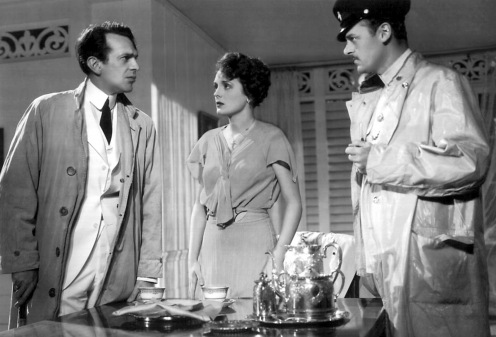
The Old Dark House (James Whale, 1932) It is a dark and stormy—one might say "dreadful"—night. Trying to negotiate the way to Shrewesbury amidst a blinding rain on a road prone to crippling muddiness and threatening landslides are Philip Waverton (Raymond Massey), his wife Margaret (Gloria Stuart...from Titanic?) and friend Roger Penerel (Melvyn Douglas), slap-dasherly young people without a care in the world, except for what little irritations cross their bourgeois path—like how full is the whiskey flask? On such a night, maps and directional instincts can become stymied. Finding a large, sturdy house (more importantly, the lights are on), they pull up and knock on the large and imposing door. They are allowed entrance by the master of the house, Horace Femm (Ernest Thesiger), self-described as "rather a nervous man" who allows his hulking man-servant, Morgan (Boris Karloff) to give them access from the deluge outside, although he is less welcoming than one might wish.
If he is reluctant, his sister Rebecca (Eva Moore) is even less so. A bit of a religious-hysteric, she is more than a little bitter at her treatment within the family, feeling persecuted, and if her perception of her family is skewed, her reaction to outsiders, and, worse, these particularly un-devout young people is openly hostile. She has one bottom-line: "No BEDS!" She's probably fearing orgies under her roof.                                                          
The guests will have to be comfortable in the drawing room, although Margaret is soaked to the skin and insists on changing clothes, which she is allowed to do in one of the Femm bedrooms under Rebecca's watchful, judgmental eye, who tells a brief history of her treatment within the "sinful and godless" Femm family*, and revealing that the father of the Fenn's, 102 year-old Roderick Femm, is still alive and living in the house. Despite this one consideration, the Femm's are determined to keep the Waverton's and Penerel in the drawing room and discourage them from trying to access any other part of the house for their safety. They are particularly warned about Morgan, whom Horace describes as an "uncivilized brute" and "rather dangerous"—he has a tendency to drink a little and molest a lot. Femm fortunes evidently preclude them from hiring a replacement.
Just as the first guests are getting comfortable being uncomfortable at the Femm's, they are joined by two others: Sir William Porterhouse (Charles Laughton), a genial and bellicose bloke, with his evening companion "Ducane"—a chorine whose real name is Sophie Perkins (Lillian Bond), who are far more free-spirited and liven things up a bit, but create a bit more frisson, adding a little more chaos in the mix bottled up in the barely-contained Femm house. Libations are provided and a dinner served, But on such a night, things can not go smoothly. The electricity goes out in the storm, and when Philip goes to retrieve an oil lamp from upstairs—Horace, it seems, is too scared to go—and he notices a couple of locked rooms, one of which has a voice coming from inside it.
Penerel and the chorus-girl start to get chummy, and the brute Morgan (it seems) has gotten into the liquor and he attacks poor Margaret the first chance she is alone. At this point, lines are drawn in the wood floors and the night becomes one of survival and the discovery of secrets that have been hidden away for years. And although it has all the trappings and tropes of a horror film, under Whale's direction there is a giddy, giggling sense of humor bubbling just under the surface that is campy and knows just how far to push the material as far as commentary and suggestiveness.
Whale is clearly having fun with the project (based on J.B. Priestly's 1927 novel "Benighted"), the second project he made after his success with Frankenstein, and although he turns down the German Expressionism he wrought in that film, the film is richly textured, not only between levels of light and dark in subject and dialogue, but also pictorially, thanks to his Frankenstein cinematographer Arthur Edeson, who would move from Universal to the Warner Brothers and make his mark on such films as The Maltese Falcon and Casablanca. It appears to be a stepping-stone to the extreme arch-tone he took in his subsequent The Bride of Frankenstein.

The Old Dark House also marked the Hollywood debut of actor Charles Laughton, who would quite quickly rise in the ranks from talented character actor to star and eventually director. 
The Old Dark House is one of those wonders of the pre-Code era, where the subject matter could be broadened (as well as the moral implications of characters' actions), leaving audiences with endings with moral ambiguities, and troubling implications, rather than satiate them with happy endings. You could almost look at The Old Dark House as a hybrid of the horror, Romantic Gothic, and even noir genres to create an unsettling thrill-ride that leave one disturbed even after one has exited the theater.
The trouble with those pre-Code films, however, was that once the Hays Code came into play, many films, to ensure further booking into theaters, were censored, or even re-shot to meet the new stringent standards placed on movie entertainment. The ones which could not be "rehabilitated" were confined behind locked doors in the vaults of the studio and, in many cases, forgotten and abandoned.

The Old Dark House was considered a lost film until it was dug up from the Universal racks in 1968 and restored, saved from the depredations that time and its storage on flammable nitrate film would inflict on it. Rather than left to rot, it was exhumed, and another classic Horror film, one of its most curious and perverse entries, was saved from the grave.
*
"They were all godless here. They used to bring their women here - brazen, lolling creatures in silks and satins. They filled the house with laughter and sin, laughter and sin. And if I ever went down among them, my own father and brothers - they would tell me to go away and pray, and I prayed - and left them with their lustful red and white women!"
Director Whale goes to town during this sequence—probably because it's so talky—with distorted mirror and lens effects to disorient the viewer, and to add his own visual commentary on sister Rebecca's rant.

Tuesday, February 12, 2019

The Woman in the Window (1944)

The Woman in the Window (Fritz Lang, 1944) The ex-patriate German film-stylist (Metropolis) makes the first of his "love-is-a-trap" film noirs with Edward G. Robinson, Joan Bennett, and Dan Duryea. The second, Scarlet Street (Lang's next film) will be a nightmarish tale of lust, betrayal and greed that will skirt the Hays Code of having one of the triangle getting away with murder, but The Woman in the Window will be a bit more sedate...almost text-book.

Richard Wanley (
Robinson) is a professor of criminal psychology, so you'd think he'd knows his stuff, but it seems he's only good at the theory. While his wife and kids are out of town for the Summer, Wanley becomes enamored with a portrait of a young woman in a store window (theory), and after a club-night with the boys (among whom is detective Raymond Massey), he comes across the woman in the flesh and accepts an invitation to her apartment. Turns out she's the moll of a notorious money-changer, see? And N.M.C. shows up at the apartment, looking to serve Wanley a Harvey Wallbanger.

Things get ugly and somebody gets dead. It's up to the Good Professor to do some Bad Things to keep his reputation intacto, not to mention his corpus.
The wonderful thing about Lang is he kept making his scary German films (like M, his "Mabuse" spy-fantasies) in Hollywood, with a budget that would make glossier his mouse-trap films. Lang knew how to tell his stories in shadow, and even include the vast area outside the frame in the mix to keep audiences guessing as to what would happen next—his protagonists (and they're not always heroes) have to run his maze of ever-tightening traps that will mean loss of freedom or death ("or worse!" as they used to say on the "Batman" TV show—which employed some Lang techniques—with this director you couldn't be sure if Death was the end of it).
Here, Lang dips his toe into the dark murky water that he will dive in head-first with Scarlet Street, sketching a nightmare scenario and cautionary tale, preparing for the final deadly masterpiece of his next film.
Provocative, stylish and downright cruel, the cinema of Fritz Lang spoke of high themes and low instincts and if he's not the father of "film-noir," he's certainly a very close uncle.*

* According to Wikipedia the term "film noir"—"black cinema"—was coined by the French Press—they also make damn fine coffee—in 1946, after the post-war arrival of American films The Maltese FalconDouble IndemnityLauraMurder, My Sweet," and...The Woman in the Window. So, the five fathers of "Noir" are John Huston, Billy Wilder, Otto Preminger, Edward Dmytryk, and Fritz Lang—three Germans and two Americans (shudder!)

Thursday, September 6, 2018

The Scarlet Pimpernel (1934)

The Scarlet Pimpernel (Harold Young, 1934) The classic tale of the foppish member of the elite aristocracy who disguises himself to fight the despotic powers for the good of all. No, it's not Don Diego or Bruce Wayne. It's Sir Percy Blakeney, aka the Scarlet Pimpernel (Leslie Howard), master of disguise and master tactician, who, with his loyal League of the Pimpernel, in the case of this film, frees French noblemen from the ruffians of Robespierre during the French Revolution, circa 1792.  

Waitaminnit! Attendre! The ruffians of Robespierre WERE the common people! All too common as it turns out, as director Young and scripters Robert Sherwood, Lajos Biro and S.N. Behrman would have you believe, demonstrated by the common cruelty of the throng awaiting noble be-headings at the guillotine, distracting themselves with knitting, stuffing their faces, and the things most people do during opening acts at a country fair. Such very public gatherings—and executions—make it very difficult to do any serious rescuing, especially when you have the evil Chauvelin (Raymond Massey), the new ambassador to Britain and enforcer for Robespierre (Ernest Milton) himself, breathing down your neck. And necks were very fragile things during the Reign of Terror.
In other words, it's hard out there for a pimpernel.

But, wait, wait, wait. Hold on there, citizens. The Pimpernel isn't Batman. He isn't Zorro or Robin Hood. He's a member of the aristocracy fighting for the aristocracy. Those other guys are examples of the privileged fighting for the common man. The pimpernel doesn't give a pinch of snuff for them. Nope, he's protecting elites who've been caught up in the Revolution against monarchy, authoritarianism by both aristocracy and clergy, as well as against slavery. He's on the wrong side of History, but I suppose when allies, friends and relatives are facing a blade in the village square, higher ideals and an Age of Reason seem a little dull by comparison.

This is because the stories of The Scarlet Pimpernel were written by the Baroness Emmuska Orczy, who knew something of revolutions, he family having fled their native Hungary in 1868, fearing a peasant uprising. The Baroness settled in London, and married an artist named Montague MacLean Barstow, and although it was a happy marriage, Barstow's career as an illustrator did not keep the Baroness in the manner to which she had grown up accustomed. She began to write, somewhat successfully, but she didn't achieve any real success until the two collaborated on a play about the Pimpernel, based on one of her short stories. That play ran for four years, and her novelization of it became a best-seller, inspiring a continuing series of books, and allowed her to buy a villa in Monte Carlo, where she spent most of the remainder of her life.
So, the Baroness' sympathies weren't exactly with democratic ideals, preferring the joys of imperialism and militarism. So, of course, (given her history) she would side with the aristocracy, rather than with the peasants. After all, they can always eat cake. It's just that a guillotine is rather impractical to slice it with. So, no, the Pimpernel is not for the common good unless it's to preserve the status quo. He wouldn't do well in America.

But, then again, these days, he might.
But, where the Baroness did have a good idea was an invention that might have been partially inspired by the works of Edmond Rostan and Alexandre Dumas, that of the "secret identity" (that is taken for granted in today's super-suffused culture). In order to do "what must be done," the hero operates outside the law, which has every inclination to suppress him for their survival. And so, he must operate in disguise, live a double life, so that his actions cannot be detected by the behavior of his "other life." It is also to protect friends, family, and lovers from being used as pawns against him.
But, even here, the Baroness has an odd wrinkle—for Percy Blakeney, English baronet, is married to the Lady Marguerite (the spectacularly photogenic Merle Oberon), both French and aristocratic by birth, and even though her brother is suspected of being in the Pimpernel's infernal "League," she has no idea that her foppish husband could be the daring Pimpernel (doesn't she wonder about any unexplained absences? Could she be suffering from "Lois Lane blindness?"). Her suspected ties to the Pimpernel (oh, if they only knew) makes her just the sort of weapon that can be used against him, and so her friend, the Chauvelin coerces her to try and find out the true identity of his nemesis. At one point, she actually sends her husband into a trap and only realizes the truth and what she's done in time to warn him.
Of course, there wouldn't be a series of books if he got caught, and the black hat/white hat dichotomy is so starkly presented that no one in their right mind would favor Raymond Massey's fortunes over Leslie Howard's. And so, the Pimpernel persists into legend.

We seek him here, we seek him there, 
Those Frenchies seek him everywhere. 
Is he in heaven? — Is he in hell? 
That damned, elusive Pimpernel 

Tuesday, May 3, 2016

The Hurricane (1937)

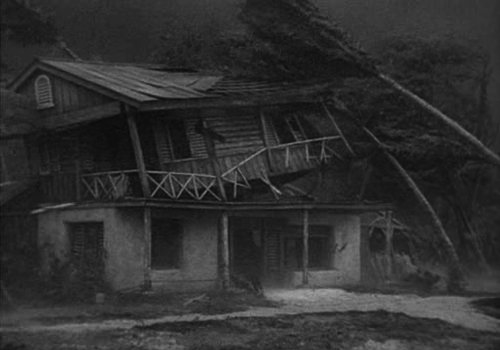
The Hurricane (John Ford, Stuart Heisler, 1937) On a ship sailing through the South Seas, Dr. Kersaint (Thomas Mitchell) waxes nostalgic on the submerged ruins of a building the ship passes, blows it a kiss, and informs a fellow passenger that what they are seeing was what remains of the island of Manukura, where he once lived as a doctor in Paradise, in a time when the Governor was the stuffy bureaucrat DeLaage (Raymond Massey), who was in marked (and doomed) contrast to the freer native people who once occupied the island before it was overtaken by Europeans (one must remind oneself of the times, this was produced in 1937, more than 20 years before Hawaii became part of the United States, and only 44 years since it lost its sovereignty in a coup d'etat engineered by land-barons and plantation owners—at the time of The Hurricane, the memory still stings). 
Among the natives is Terangi (Jon Hall), newlywed to Marama (Dorothy Lamour), and who works as first mate of the tradeship Katopua, making a regular run to Tahiti. On one of those trips Terangi is ordered to leave a bar by a drunk Frenchman and the resulting fight lands him in jail for six months, unable to return to his new family. The unyielding French governor refuses to pardon him, and Turangi makes one unsuccessful escape attempt after another, only increasing his sentence and his exile.
It's a cautionary tale of race prejudice and imperialism that can only be rectified by an Act of God, and at that point second unit director Stuart Heisler takes over with a sequence of live-action, studio-bound mayhem that's horrific to watch, and head-rattlingly impressive. It's also acres above the usual "disaster movie" formula in that Ford and screenwriter Dudley Nichols take the time to actually have the audience familiar with the characters in danger, and place them in the absolute worst situation for their survival, given their traits and prejudices. It's one thing to be wary of an arbitrary natural disaster, but one should always avoid one with a sense of irony (and a sense of reckoning, as well).
Kudos to Ford for actually casting Polynesians as the natives (with the exception of Lamour—who was anything but—and Hall, who was, splitting heirs, half-Tahitian), but the rest of the cast is top-notch with Ford regular John Carradine as a sadistic guard, and an early role for the soon-to-be ubiquitous Thomas Mitchell, who makes an impression with every role. It's not Ford at his most artistic—nor, frankly, did he need to be, but he manages to make the drama on both sides of the cultural divide matter—and letting God sort it out.

Wednesday, March 2, 2016

49th Parallel

49th Parallel (aka The Invaders) (Michael Powell, 1941)
Interesting propaganda film to promote the war effort by the British government, made by "The Archers" (Emeric Pressburger and Michael Powell) before they became "The Archers" and combining the writer-director credits together. More than anything, it was designed to influence isolationist American minds about the threat of the Nazis, by presenting a story where they arrive on our shores.

It is 1941 and a German sub is prowling Canadian waters, sinking any transport they can. Detected, they make a run for Hudson's Bay and the sub commander orders a landing party to capture an outpost in the area. But, soon after leaving the sub, the men see it attacked and sunk by a bomber, sent by the Canadian air force, alerted to their presence. The Commander, Hirth (Eric Portman) continues to land to complete the mission, hoping that they can make their way eventually to the United States which is (gulp!) famously neutral in order to get back to Germany.

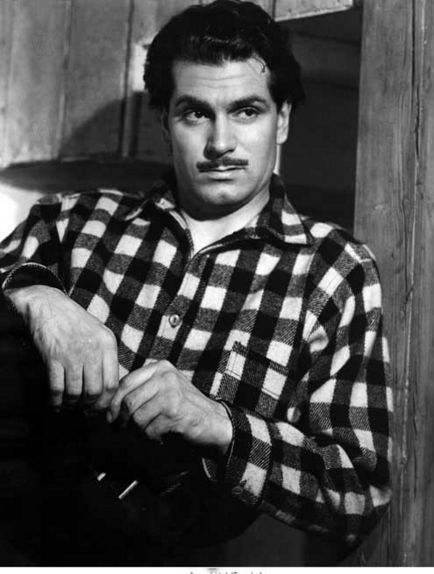
But, first they have to get through Canada.  First stop, a trading post, where Finley Currie and Eskimo guide Ley On are welcoming back French trapper Johnnie (Laurence Olivierwith the wildest accent you've ever heard, eh?) after being up north for eleven months. The Nazi's take over the trading post, hoping to entice and hijack a plane to get them across the border. But, it goes badly leading to a skirmish, which barely has the Nazis escaping with their lives. They then make their way to a German Hutterite community led by Anton Walbrook, who first welcomes the visitors to their peaceful enclave, then when the Nazis' arrogance get the better of them and try to teach the community about their "better" way, Hirth and the community leader engage in a lively debate over the merits of each other's systems. The Germans are kicked out, making their way to the wilderness where they are captured by the RCMP, but make their escape using an eccentric writer (Leslie Howard) as a hostage, but even that plan does not go as planned.  
Each encounter has reduced their numbers, and, at the last, only Hirth remains free and on the run.  He hops a freight to try and make it across the 49th parallel into the States, but riding the car with him is AWOL soldier Andy Brock (Raymond Massey), whose sympathies are still with Canada, despite being reluctant to fight, and he makes things very complicated.
It is a propaganda piece, after all, and if the various episodes seem a bit far-fetched and feel like a tortured demonstration on the length and breadth of Canadian diversity ("Meet the Canadians! Even OUR Germans don't like THEIR Germans"), it is with the intent of contrasting that diversity with the sameness of the Aryan lineage and autocratic group-think of the sub crew. If the thing gets a little pedantic, it was to educate reluctant Americans about Nazi philosophy in a dramatic fashion and inspire a feeling of "It CAN happen to YOU" to the "American Firster's." It's a bit clumsy and the fisticuffs are a might ham-fisted, but it's positively sub-tle when you put it up against the thousand goose-stepping hosers of Triumph des Willens.  And Powell and Pressburger were just getting started.
Eric Portman's Commandant wants things a little
more orderly in 49th Parallel