The Palm Beach Story (Preston Sturges, 1942) Why did the maid scream and faint? Why is the bride trying to hail a taxi? Why did the maid scream and faint-again? Why is there a woman bound and gagged in the closet? Why are both the bride and groom late for the wedding? Why did the maid faint--again?
And that's just what happens in the credits!
Director Preston Sturges is having fun with movie conventions, that is the conventions of screwball romantic comedies that involve the idle rich, the ones that George Cukor liked to direct and Katherine Hepburn liked to star in, where the couple getting married at the beginning of the movie might not be the the couple connecting at the end...or will they? Maybe they'll get back together. Don't like the answer? Wait two hours. It will probably change.
Sturges thinks (rightfully) that if such capricious creatures did hook up, their eccentric screwballishness would self-destruct their union within a matter of months, in which case this is Preston Sturges is making a sequel to The Graduate twenty-four years before The Graduate. Such pairings can't work for love or money: when the money runs out the love goes out the window, and the love isn't enough to sustain a relationship under such pressures.

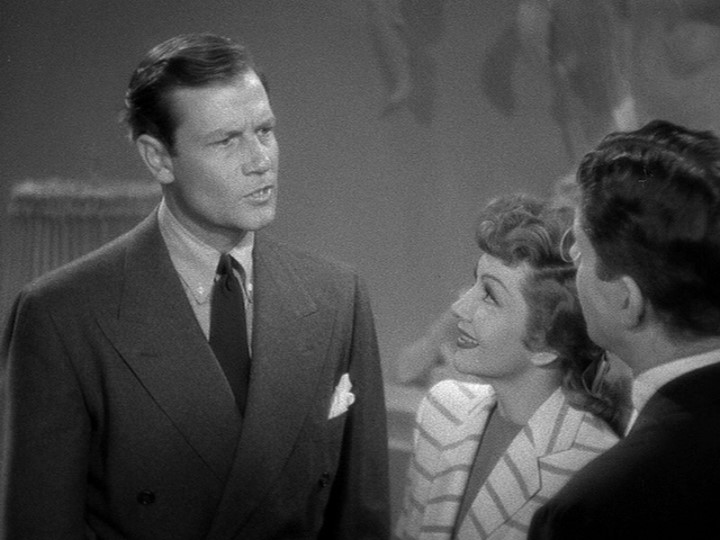
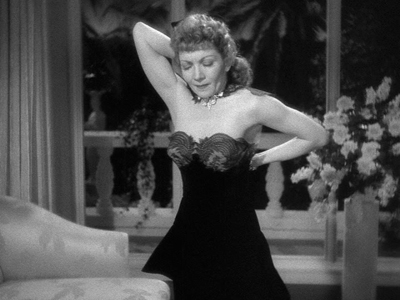
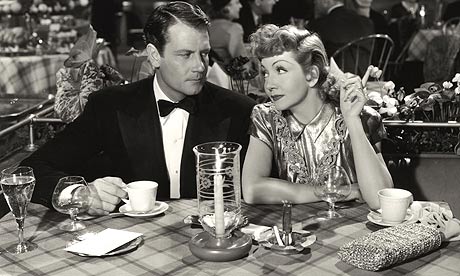
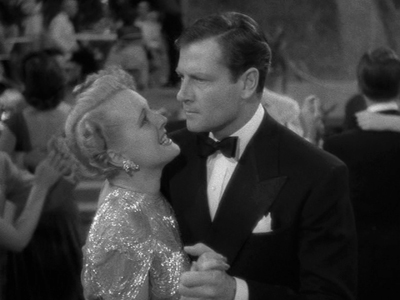
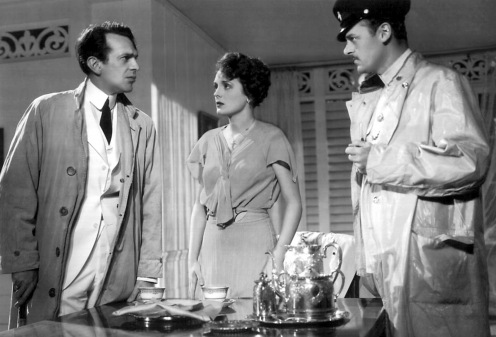
Meet Tom (Joel McCrea) and Gerry (Claudette Colbert), a cute movie couple who fight like cats and mice. We meet them in the kerfluffle that is the Opening Credits, and when next we see them five years later, they're splitting up. She's an eccentric heiress with a taste for the High Life and has this knack for attracting men—this could be the further adventures of Colbert's character in It Happened One Night—and he's an eccentric dreamer who can't make a nickel selling his "Big Idea" of taking those camouflage nets they build over airplane plants and reversing the idea by putting airstrips across the building tops of cities. The kids are broke, and she knows she can always attract some guy lousy with money and relieve him of trying to keep her in the tyle to which she is accustomed. So, because they're both so headstrong, she leaves and he pursues, all the way to Palm Beach, Florida, where the two (now posing as brother and sister) hook up with two rich-nicks in the Hackensacker clan, played by Rudy Vallée and Mary Astor. The Hackensackers are two of the oddest peas growing up in a single pod: he's bookish and wormy and has never been married, she's flighty and flirty and been married five times. Neither one seems to have a brain in their heads and are all-surface. He's careless with money; she's careless with love. They were made for Gerry and Tom.

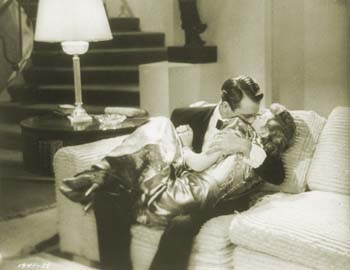
But, this is still a screwball comedy, so complications arise, such as the married couple still being a married couple; "This is going to cost us millions," groans Gerry as they go into a clinch.
Sturges is already busting through the movie-screen to hold a fun-house mirror to those romantic comedies. But he still has one or two aces up his sleeve that manages to resolve the situation and still remain true to the "Anything Goes" spirit of them, the "Love is Anarchy" and Convention Be Damned attitude that keeps digging pot-holes into the Path of True Love. By the end, he's created a scenario as convoluted as a Shakespeare play in the classical comedy sense.

The principals are all having fun. Colbert and Astor frolic with their images and McCrea gets to perfect his slow burn. The only dirt in the gears of the fun machine is Rudy Vallée, who plays his role of dunderhead John D. Hackensacker III, as if he was playing it for real. His funny lines are brushed aside, his physical comedy made minor annoyances: one wonders exactly what Sturges saw that he would cast the 20's crooner in such a role—after having guided Henry Fonda expertly in such a role in The Lady Eve—and then have the man get a contract from the studio as a result of it. Vallée was a phenomenon not unlike "Pee-wee Herman"—a little goes a long way— and his fame having ebbed to be re-discovered here, he would again fade until the 1960's and How To Succeed in Business (Without Really Trying). One wonders where Ralph Bellamy was—he could play guilelessness without sliding into cluelessness. But then, Sturges would often hire dull actors to play the dull love interest.
He's the only fly in this ointment to film comedy conventions. Funny and absurd and a bit surreal at the beginning and end, The Palm Beach Story is a fine film to enjoy pre-, post-and during a love affair.