Showing posts with label Basil Dearden. Show all posts

Wednesday, August 26, 2020

The League of Gentlemen (1960)

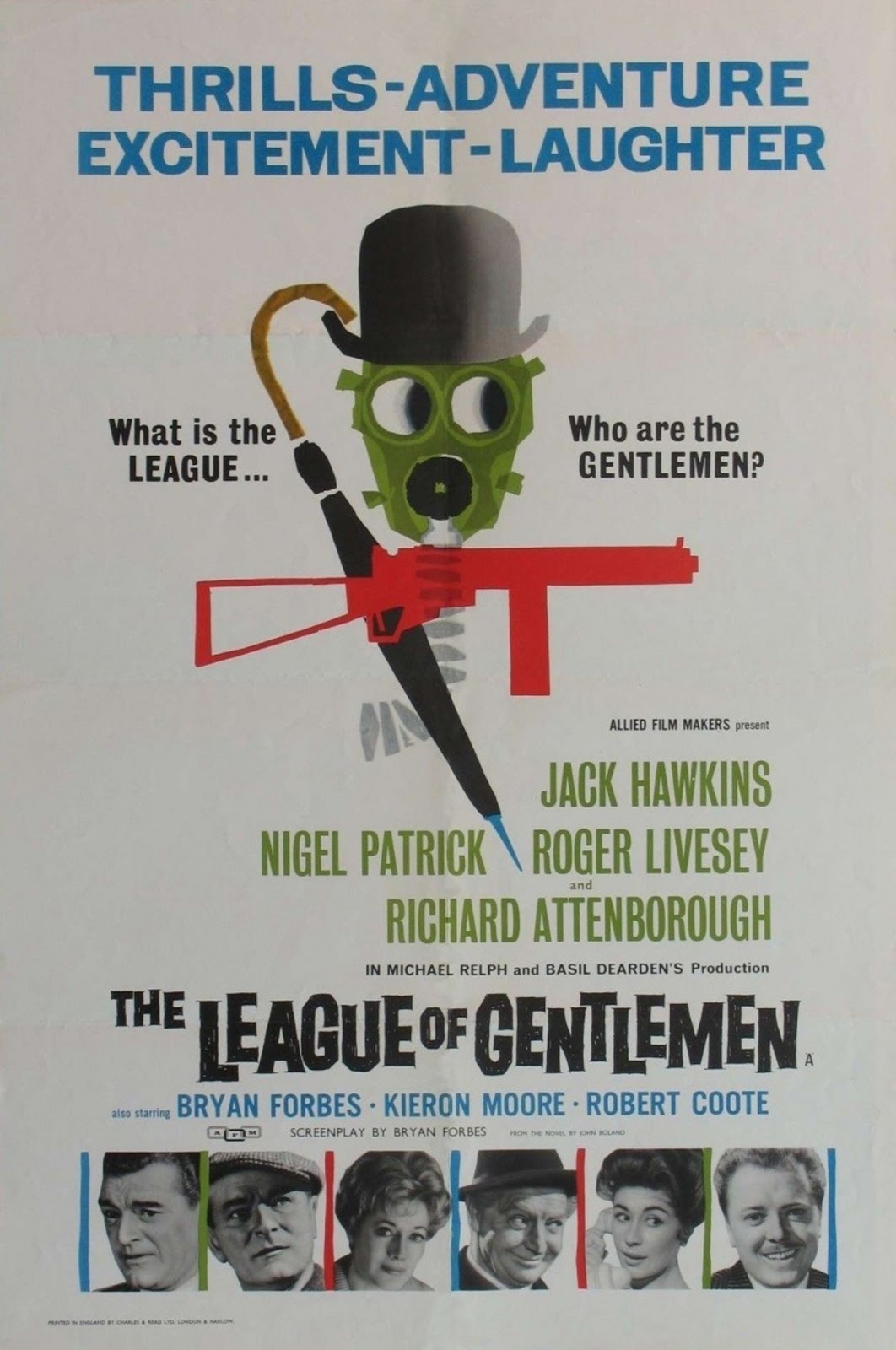
The League of Gentlemen (Basil Dearden, 1960) Basil Dearden's semi-whimsical heist film begins with a sequence that is quite out of whack with the rest of the film but gives a sense of the mind-set behind it. It is late at night on a dark noirish street, and the camera creeps up on a man-hole cover. It pops open to reveal Lt. Col. Norman Hyde (Jack Hawkins) surreptitiously looking about to see if his exit might be seen. Then he climbs out of the sewer dressed in a dinner suit. He then makes his way to a Rolls-Royce and and leaves the area.

It's a visual joke, one that would be expected—and was done—in a James Bond film. The juxtaposition of grime and well-heeled attire is a clever little summation of themes, especially in a society built on class, but except for the visual juxtaposition, it will have nothing to do with the rest of the film. In fact, the little episode is never mentioned again. The film proper begins with the next sequence.
Hyde returns to his home and cuts several £5 notes in half and inserts them, with an invitation from "Co-operative Removals, Ltd." to a lunch at the Cafe Royale, into copies of a paperback book of a crime novel entitled "The Golden Fleece."* He puts each into their separate envelopes and sends them out, seven in all. Their destinations are to seven particular men.
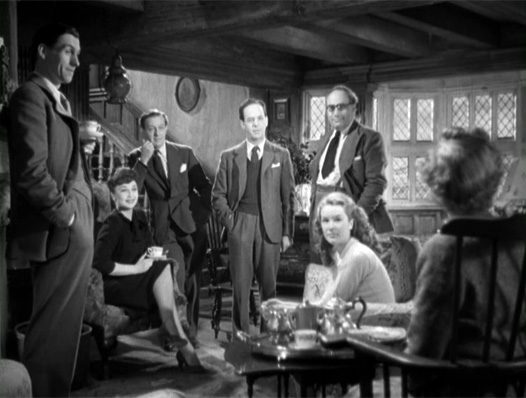
Their intended recipients—"all crooks of one kind of another," "all men of the world"—are disgraced military men, "trained at the public's great expense to do things with the utmost efficiency...which, frowned upon in peace-time are acclaimed in times of war." They are—in the photograph above, left to right: Captain Frank Weaver (Norman Bird), former leader of a bomb-disposal unit, drummed out for trying to defuse a bomb while drunk, which ended up killing four of his men—he now fixes time-pieces in his flat; Major Rupert Rutland-Smith (Terence Alexander), discharged "after some embarrassing mess of yours," resolved by hush-money from his rich wife which has left him hen-pecked and reluctantly accepting of her own many indiscretions; Captain Stevens (Kieron Moore), former fascist, forced out for his homosexual activities, which have made him a victim of blackmail, threatening his gymnasium; the high-toned Major Peter Race (Nigel Patrick), whose black-market activities led to his resignation, and now subsists on gambling and a room at the YMCA; Captain Martin Porthill (League screenwriter and future director Bryan Forbes) was kicked out for killing suspected Cypress terrorists and now makes his living playing the piano in dives and as a gigolo; Captain Padre Mycroft (Roger Livesey, of so many films by "The Archers"), formerly a quartermaster was convicted of "public gross indecency" and now, paradoxically, is a con-man using a contrivance of religious ordinations; finally, there's Lt. Lexy (Richard Attenborough), who sold secrets to the Russians and now runs an electronics repair shop for the lowliest of customers.
Hyde, for his part, "served my country well for 25 years and was suitably rewarded by being made redundant" and the experience has left him bitter and useless—all those skills and nothing to show for it. "The Golden Fleece" proved an inspiration on which he could hoist his revenge; he has researched and planned a bank robbery, and to accomplish he has gathered together a troop of morally compromised men with military discipline and specific skill sets to help plan and carry it out. He gives them a limited time to think things over, and, to a man, they agree ("Your presence here restores my basic disbelief in the goodness of human nature," he remarks); Hyde treats them as a military unit, barracking them in his own stately home for drills, research and to serve as a base of operations. Under the ruse of a food inspection for cover, they split off and while part distract the brass, the others steal guns, ammo, and other supplies making it look like an IRA action...when the loss is found.
Once all is arranged, they move their operations to a warehouse where the details are finalized. The goal is to rob a bank of enough resources that the men can split the money each receiving at least £100,000. Can British ingenuity and a proper military training pull off the raid despite improper motives (and the inevitable complications that pop up in these things?) All's fair in love and war...but war exercises?

Dearden, given the military nature of the heist is efficient and a bit ruthless in his direction—nothing fancy and nothing too rococo in how he plans his shots— Forbes' screenplay is witty and dry, and the actors all fill their niche-roles with Hawkins providing a commanding presence in both senses of the word, as both leader and star. The League of Gentlemen could be seen as a more austere version of such playful British heist films as The Lavender Hill Mob or The Ladykillers, but without their sense of twee or whimsy. Additionally, with such a collection of dedicated rotters, given their falls from grace in the eyes of Society, the film-makers evoke enough "sympathy-for-the-underdog" attitude that allows one to think that they just might pull the job off. 

It gives the film that added sense of suspense right up to the last minute.

* In the novel, the book is not "The Golden Fleece," but a real novel called "Clean Break' (written by Lionel White), which was filmed as The Killing by Stanley Kubrick in 1956.

Wednesday, July 15, 2020

Woman of Straw

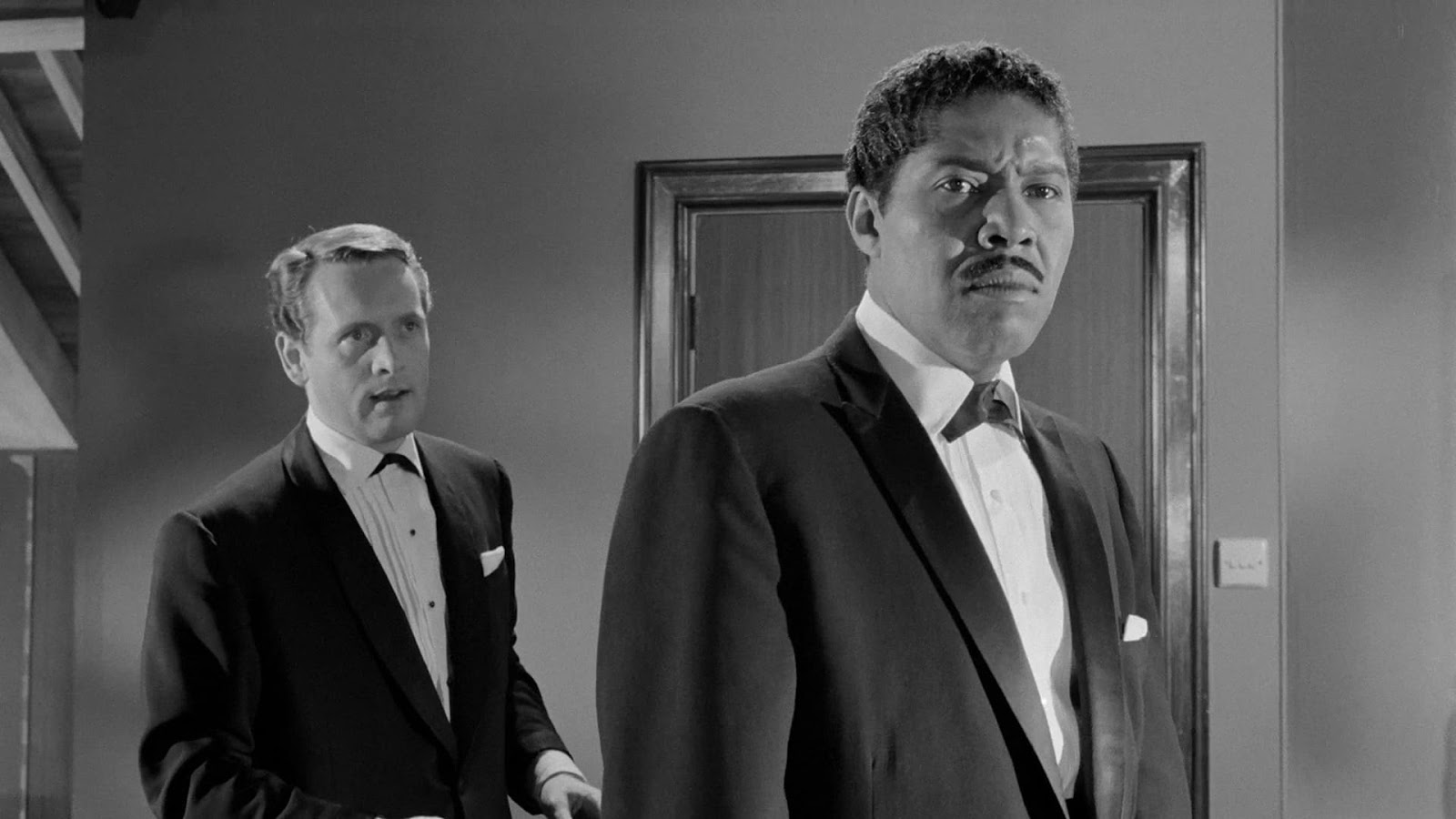
Woman of Straw (Basil Dearden, 1964) It wasn't much of a stretch for Sean Connery, in a filming break between From Russia With Love and Goldfinger, to play the cad Anthony Richmond in Woman of Straw (he also filmed Alfred Hitchcock's Marnie in the same period). His speaking voice is still "posh," the toupee is slightly fluffy (using the "drama" one, not the "action" one) and even the suits he wears would be reused in the third Ian Fleming adaptation. One who had seen Goldfinger first—a good bet as Woman of Straw did not do well at the box-office—could be forgiven for have a sense of deja vu watching him in this film and thinking he'd be drawing a Walther PPK and making a quip at any moment.

There is the added atmosphere provided by the sets of Ken Adam, which give the film added size and sheen—they even reuse the ridiculously long dining table for an intimate dinner joke.
So, there's a distracting shadow of Bond throughout the film, even though it's a different boiling pot of intrigue throughout. Richmond is the nephew and prince-in-impatient-waiting to kingpin Charles Richmond (Ralph Richardson), an irritable man of means, bitter due to the death of his wife and his confinement to a wheelchair. Charles is in constant need of care, but keeping a nurse around, given his cantankerousness is a problem. His home staff (Johnny Sekka, Danny Daniels) are only consistent because they are minorities and lower class—they have no other option than to put up with his obstinance and impotent sadism.
So "Tony"—acting as his uncle's solicitor—brings in a new nurse, Maria Marcello (Gina Lollobrigida), and she's a bit different. She's "foreign"—Italian, to be blunt about it—attractive, and a bit more assertive than the home-grown "angels of mercy" who have been dispatched, no doubt under emotional duress, from the old tycoon's employ. And this angel has a bit of a devil to her. She won't put up with Charles' guff and is just about to walk out of the situation when Anthony makes a proposal. 
What he proposes is this: stay in their employ, as "the old man" is less of an ogre with her, and maybe they both can profit by it. Tony's father was cut out of the family business by Charles and Tony knows that when the old man dies, he'll only inherit £20,000. But, if Maria marries the old man...and he dies...she'll inherit his fortune. The only thing Tony asks is £1M for providing the opportunity. Maria is attracted to Tony and her mother lives a poor existence in Italy and the money would certainly benefit her. So, she agrees to the plot.
Being a nurse is tough duty, even if one is a nurse in a gilded cage, but Maria sticks it out, doing battle with Uncle Charles about diet, exercise and medicine, while Tony purrs in her ear about the end-game. But, at one point, Maria decides that she's had enough and returns to Italy...only to be surprised that Uncle Charles travels there to ask her to come back. The old man evidently has a soft spot for her and so Tony's plan might actually work, so she relents, and Uncle Charles soon finds her to be indispensable. An extended yacht holiday cements their relationship, and Tony is pleased when Charles asks him to change his will—Tony will get £40,000 now—but Maria will become the new beneficiary, as he intends to marry her.

But, she'll only become the beneficiary...if he dies.
That's when the complications ensue and the film becomes one of small details and intricacies as opposed to personalities. The film falls off somewhat, despite adding a couple more characters—police investigators and such—and a murder plot that needs a bit too much suspension of belief to pull off.

And—spoiler alert (but is it really?)—the victim is actually the most interesting character—and player—in the movie. Richardson's thorny old coot is such an irascible sort that once he warms up, you miss him when he goes, leaving you with two conspirators, neither of whom you know too well and neither of whom are entirely trustworthy. 
What's an audience to do?

The filmmakers clearly intend sympathies to go with Lollobrigida's Maria, who is set up to "take the fall" for Charles' demise, but the collapse of the previously strong woman we witnessed—and Lollobrigida's playing of it—leave one a bit suspended (with very little suspense) and leaves her a woman in peril with only the actions of people we don't know to get her out of it. That third act weakness is an issue with other Dearden films I've seen, which can have terrific set-up's but unsatisfying (no, that's too strong a word—let's say "troubling") resolutions.
Now, back to Connery. Turns out his Tony Richmond is the dark side of Hamlet—taking revenge against his Uncle who ruined and cuckolded his father—but is in no way a hero. In fact, although Connery, once "established" in his career, played killers, cads, and cons throughout, he very rarely played the traditional villain role—the only other I can recall post-50's is the movie version of The Avengers. That his "bad guy" is only a shade more serious than his portrayal of his James Bond says a lot about the actor...and that particular character.*
On the whole, Woman of Straw, is a slightly better film than a "for completist's only" watch. It may interest those who like their Hitchcock-type films with a froth of soap opera.
* This is so "inside" that it only rates an asterisk: Connery's villain meets his well-deserved demise by a stunt contrivance that would be echoed in a not-too-believable method of tripping up Bond's fight-partner in the opening of Thunderball.  Deliberate? Like his mentioning of another of his films—Another Time, Another Place—later in that film? 
Thursday, July 9, 2020

All Night Long (1962)

All Night Long (Basil Dearden, 1962) I've been watching a lot of Basil Dearden movies lately—the only ones already on the site, reviewed, are Khartoum and a horror anthology he'd participated early on in his career, Dead of Night—and they're pulpy but intelligently produced with an underlying social concern, interestingly framed, and with a sometimes perverse energy designed to take the audience slightly to the edge of their seats. They're at least designed to produce a nervous tick in the leg.

All Night Long, though, is more designed to keep a steady beat of foot-tapping, based as it is in the jazz idiom. In fact, for aficionado's, it's a bit of a must-see for performances by some "legends" (a much used word, but actually appropriate here), such as Charles Mingus (he gets lines to say!—"Hi, thanks for inviting me!"), Dave Brubeck, John Scott, John Dankworth, Tubby Hayes, Bert Courtley and Keith Christie. That's a great joy to the film, but I imagine it's frustrating for the very people who would want to see this for that purpose because it has a story and actors who distract from the performances and from the music for whole minutes at a time (I imagine that the first frenetic Beatles fans were frustrated with A Hard Day's Night for that same reason). On the other hand, for those folks into narrative in their films, they might be stymied by the story being stopped dead by performance drops. These people have never heard of or seen musicals.
The story is basically the story of Othello brought up to a jazz-beat (a bit uncomfortably) and a jazz-idiom. Entrepreneur and impresario Rod Hamilton (Richard Attenborough) goes to his club where he has prepared a very special night—a party celebrating the first anniversary of jazz King and Queen Aurelius Rex (Paul Harris) and wife Delia Lane (Marti Stevens), jazz pianist and songstress (retired), respectively. Guests are band-mates, acquaintances, and some notables in the industry and Hamilton has designed it to be a night of celebration and song for the happy couple. He should have checked the guest-list.
Brubeck and Scott and Dankworth are fine, of course—they're providing music. But along with Aurelius' inner-circle of Cass Michaels (Keith Michell) and his girl Benny (Maria Velasco), there is also drummer Johnny Cousin (Patrick McGoohan) and his wife, Emily (Betsy Blair). Cass is Aurelius' manager and completely loyal to him and a confidante to Delia. That relationship will become critical to the machinations of Cousin, who has been promised a side-deal for his own band by another manager, but only if he can persuade Delia to come out of retirement and join his band as vocalist. If he is to have any chance at success, he must drive a wedge into the happy marriage between Aurelius and Delia before she could even entertain fronting his group. And for that, he works on Cass.
He needs in-for-ma-tion. So, he invites Aurelius' manager to a private meeting on an outside landing and cozies up to Cass (who's been clean and on the straight and narrow for years and a dependable business partner) and plies him with some reefer, relaxing Cass enough to give Johnny inside intel on any weaknesses in the Rex-Lane marriage, which is (for him) disappointingly stable. But, he knows that Cass and Delia are close, so he devises a plan to make Aurelius suspect that the two are actually closer than her husband suspects. So, Johnny does a solo performance with everybody at the party, sewing doubts and intrigues and creating tensions where there are none.
It becomes apparent that Johnny Cousin is Shakespeare's Iago (and Cass is Cassio, which is not much of a name-stretch). But, where the bard's version goes through the play without any rationalization or motive for his actions (other than "I hate the Moor"), Johnny is totally and completely about getting his "gig" and, if a little chicanery and a marriage-split will advance it, then so be it. Suspicions are communicated between parties (at the party), but that can only go so far. And Johnny has a technological ally for fabricating proof.
Hamilton is a huge jazz fan, and part of his plans are to record a couple of sessions using a tape recorder (an EMI TR90 for you gear-heads), which Johnny uses to make recordings of some conversation. With that, he can take desired bits of conversation, and record his own voice for insinuating connections between the juicy bits to make it all seem like there's an affair going on between Delia and Cass to inflame Aurelius' jealousy. Anybody who's tinkered with tape will know that such an operation takes split-second timing (lest you erase the original) and you've got to have a stop-watch handy to be able to do it without editing—and in those days, you'd need a razor blade and tape, which is pretty obvious evidence of tampering. But, Johnny must be very good because his evidence doesn't even contain any electronic evidence that a tape has been started or stopped.
Technical quibbles aside, his gambit works—at least for a little while—and there is a real danger that he might get away with it, but not with the results he might want (this is based on "Othello," after all). There will be distrust and dust-up's, enough to ruin any high-class party, and certainly enough to interrupt any of the jazz interludes that pop up for the aficionado's. 
It is a thrill to watch Mingus and Brubeck jam in one of the pieces, particularly to watch the effortless fingering on strings and keyboard. That comes early on in the film, but there's enough good material throughout to keep folks who just came for the music to enjoy. And stick around: McGoohan learned to play drums for the film and he has a frenetic solo towards the end that looks damned convincing, even if—as I suspect—he's just playing to a tracked music piece. He's an intense actor—around this time, he was right in the middle of doing the "Danger Man" series (it played in the U.S. as "Secret Agent" with a Johnny Rivers title song)—and the same intensity is born out in that solo.
This came out in 1962—1963 in America—and at that time, what was called "mixed marriages" were illegal in one-third of the States. It was an issue here and might have had a hand in the film's limited distribution and it's somewhat rare availability. It is refreshingly not an issue in this British-based film where nothing—absolutely nothing—is made of it. It's not even mentioned, other than the marriage is one for celebration...and strong enough not to be rent asunder by the conniving of an ambitious narcissist. 
Another aspect that might have been controversial in the States is the on-camera portrayal of marijuana use. Even though the Hayes Code was dying of purposeful neglect during this period of film-making, drug use and distribution was prohibited under its strictures. Come to think of it, so was "mixed race" relationships. Something to consider while you're "bogarting" and considering the ash-bin of History and how time inevitably leaves prejudice there.
For whatever reason you come to it, for the music, or for the Shakespeare link, or you're a McGoohan fan/completist (or Attenborough...or Betsy Blair...or whoever), or if you're looking at the films when Dearden was telegraphing social messages and conspicuously pushing the barriers of what got on film—as Preminger was trying to do in the States—you come away with respect for this little doorway in the alleyway of film-noir sticking its neck out that although the world can be a nasty place, it's lit by the idea that the important things are devotion. And trust. 

And all that jazz.


Wednesday, October 5, 2016

Dead of Night (1945)

Dead of Night (Alberto Cavalcanti, Basil Dearden, Charles Crichton, Robert Hamer, 1945) British omnibus film from Ealing Studios where four stories of the bizarre are buttressed by a framing device of an architect (Mervyn Jones) invited to a country house that evokes an inescapable sense of déjà vu. 

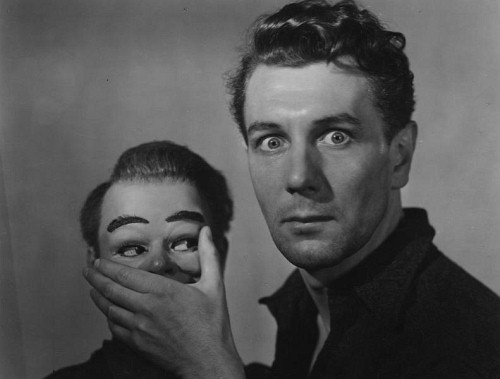
At the house is a collection of strangers with odd stories: a race car driver who barely survives a crash and during a recovery has a strange dream involving a beckoning hearse and driver who says "just room for inside, sir"—a dream that has fateful repercussions later on; a girl (Sally Ann Howes) who recounts a strange encounter at a Christmas party; a woman who buys her fiancé an antiquated mirror with a mind—and a room—of its own; a whimsical tale of of two obsessed golf duffers (Basil Radford and Naunton Wayne) who wager for the affections of a woman over a match; and the last, featuring a ventriloquist (a bravura performance by Michael Redgrave) whose dummy wants to change the act's billing.
Anyone familiar with "The Twilight Zone" will have their own distinct sense of déjà vu watching Dead of Night—the race-driving story is remarkably similar to a Bennet Cerf story that was adapted by Serling as "Twenty Two;" the Christmas story echoes others; the ventriloquist story has been dummied about several times and not just on TZ. The stories have their own specific atmospheres that cling to their stories like shrouds, and Ealing proudly displays the collection of sets and artistry that made it one of the preeminent studios in Great Britain.
The stories are all decidedly set-bound with some quick outdoor scenes—it was wartime when the film was made and although the tone is fairly nightmarish (pluckily nightmarish), escapism from the rubble and the war news was the intent, and maybe a little tonic from "boogey-man-isms" by having a psychiatrist (Viennese, of course, played by Frederick Valk) popping the bubble of the story-tellers by trying to clinically explain things away. It provides a fine counter-balance (and a bit of straight-faced comic relief) to the tales of the supernatural, with their underpinnings of hysteria and mental imbalance. Fun, unsettling and meticulously done.

Tuesday, September 13, 2016

Khartoum

Khartoum (Basil Dearden, Eliot Elisofon, 1966) The Middle East has long been a daunting prospect, like the desert terrain that makes up so much of it. If the world's problems stem from an innate tribalism, the most embedded, ancient forms of it come from there for the longest time. And, hey, if they've lasted that long with it, how bad can it be? 

Pretty bad. Tribalism, in all its forms, be they religious, political, affillial or other origin, comes from the innate need to no longer be alone and gain strength through numbers, while simultaneously separating ourselves into camps or sects, creating that bond of community and distancing ourselves from that "other." "I am this, and 'they' are that." And if "they" are "that" then they are not me. Tribalism simultaneously bonds and divides, whether you're a Muslim (Sunni or Shia) or a Jew (Orthodox or Reform), Democrat or Republican, Conservative or Liberal, Communist, Socialist, "John Bircher" or "Tea Party", Union, Confederate, Army, Navy, Freudian or Jungian, Creationist or Evolutionist, Freemason or Elk, Black Lives Matter and IUPA. "Liberté, égalité, fraternité?" One of these things don't belong with the other. But, seemingly, the world starts to look a bit less complicated when it's "us" versus "them." It makes it a lot easier to not think for ourselves and submit to the dictates of mob rule. How bad can it be?


For myself, I subscribe to the Marxist philosophy (Groucho): "I don't care to belong to any club that will have me as its member."

Khartoum was written by Robert Ardrey, the author of "African Genesis" and "The Territorial Imperative" and is a somewhat Hollywood-ized version of the Siege of Khartoum in the mid-1880's. At the time Egypt controlled Sudan and the British Empire claimed Egypt as "a protectorate." Muslim extremists, jihadists, followers of Muhammad Ahmad, the self-proclaimed Mahdi and "redeemer" of the Muslim nation, were determined to wrest Sudan from Egyptian rule and set himself up as leader of Sudan and of all the Muslim nations (he eventually did take over Sudan, imposing Shariah law, and eventually dying of typhus six months into his rule*). 
When the film starts (in 1883) England is reacting to the killing of 10,000 Egyptian troops by Ahmad's supporters, who are on track to take on the capital of Khartoum. The Prime Minister, William Gladstone (Ralph Richardson) is reluctant to send "boots on the ground," and at an impasse as to how to proceed, not commit and still appease the Queen and the British public. The British foreign secretary (Michael Hordern) suggests an alternative: send in one particular man, Major General Charles George "Chinese" Gordon (Charlton Heston), the former governor of Sudan, whose popularity in Britain is widespread. He is given one task—evacuate the civilians and troops from Khartoum and that is all. He is told that he is going in by himself, without the sanction of the British government, who will deny any knowledge of his efforts if he fails. Gordon, who suffers from hubris, has an impatience with authority other than his own, and a paternalistic leaning toward the people of Sudan based on his past work, agrees to the assignment.
The British politico's know that, Gordon being Gordon, he will overstep his mission, and they want to see what will come of that, without risking British lives and without direct accountability. Gordon, confident, travels to the Sudan.
He is greeted in the Sudan as a hero, and immediately begins organizing the Egyptian forces for defending the city. His is reminded by his aide, Col. John Stewart (Richard Johnson) that he is already overstepping his bounds. But, Gordon pays no heed. He will not "cut and run," he's going to go to the root of the conflict.
The movie-Gordon decides that he must pay a visit to Ahmad (Laurence Olivier) himself. This never happened, and is probably as ludicrous as going to talk to Usama bin Laden over tea. But, it does afford Heston the opportunity to do a couple of scenes with Olivier, who is heavily swathed in a make-up merely a few shades lighter than his "Othello" was, and employs an accent that is high-ly "rimi-NI-scint" of Leo McKern's Clang from Help!**

That aside, the scenes between Heston and Olivier are the highlights of the film, besides the battles that play out impressively in the Ultra-Panavision format (the film was released in Cinerama) and if the two directors can't be said to be especially "impressive" in how they put the film together (Dearden directed the least effective parts of the Ealing horror anthology Dead of Night), at least they fill the screen with detail to take advantage of the widescreen format.
When Ahmad makes it clear to Gordon that he will not stop his jihad until he has prayed in every mosqueall the way through to Constantinople, overrunning cities if he has to, in an effort to solidify his position as the appointed instrument of Mohammad on Earth among the Islamic people. If Gordon has any doubts as to his intentions, he shows Gordon the heads and hands of English (including the war correspondent of The Times) and French who have been slain in his battles. Gordon leaves, alarmed, but not before assuring the self-described Mahdi that, as a religious man, he sees the battle as one between competing Gods.
"Is it not your own ring?"
Gordon, rather than evacuating Khartoum, begins to set up defenses, digging deep trenches between the Mahdi's forces and the city, allowing the Nile itself to fill the trench and create a discouraging moat for the jihadists. At the same time, he arms the city and trains forces in the hopes that he can stay the Sudanese until reinforcements are sent from England, something Gladstone is reluctant to do.
Inevitably, time works against Gordon and when the Nile recedes, his moat dries up and the city is overwhelmed by 100,000 jihadists in an assault from the front and from the Nile. Accounts vary, but Gordon was killed in the attack—the movie's version of it has Gordon dying as a martyr as was presented in the painting by George W. Joy—the first of quite a few spears that Charlton Heston would take throughout the rest of his career.
The film was relatively successful and earned Ardrey an Academy Award nomination for best screenplay. Heston, who had hoped for better known British directors—like Lewis Gilbert, Guy Hamilton, or Guy Green—to oversee the project, was only relatively satisfied with the results.

What Khartoum does do, no matter the results of the film, is to provide a bit of historical perspective in light of recent events in history. There is nothing new under the sun, even the one that beats down on the desert. These conflicts will arise as long as humans insist on creating borders, imaginary or otherwise, to emphasize what divides us, rather than what unites us. You'd think in a desert, one of Nature's harshest environments, there'd be more of a collective effort to conquer it, rather than each other. 

إن الله لا يغير ما بقوم حتى يغيروا ما بأنفسهم

On the technical side, it is interesting to note that Khartoum was the last film photographed in "Ultra-Panavision 70" until Quentin Tarantino made The Hateful Eight 49 years later. So, Khartoum still holds the title of being the last good film photographed in Ultra-Panavision and making the format worth it.
Frank McCarthy's key art for Khartoum featuring one version with Olivier and the other without.

* Or did he? Sounds like we've got another bogus Bill O' Reilly book in the making.
**