Showing posts with label Alec Guinness. Show all posts

Thursday, March 27, 2025

The Detective (1954)

The Detective
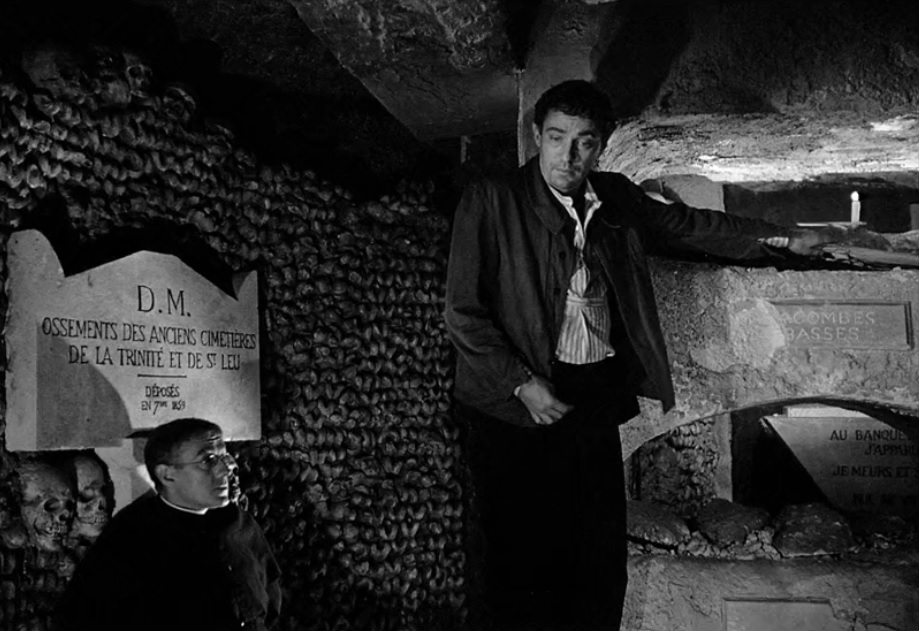
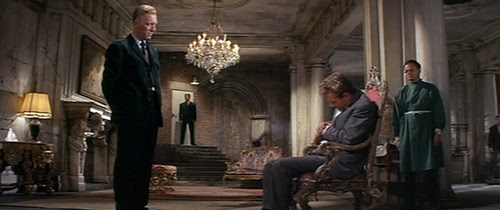
(aka Father Brown)(Robert Hamer, 1954) It's quite the scandal when Father Brown (Alec Guinness) is arrested by the local constabulary when he is caught in the act of "burglarious purposes" in front of an open safe. At police headquarters, the humble English vicker tries to explain that he was only trying to return the "swag" ("I believe that's what it's called—'swag'") for one of his parishioners (he admonishes him for being "an incompetent thief...clearly incapable of earning a dishonest living") whom he had convinced to forego a life of petty thievery and, in return, Brown would return the stolen good to the rightful place. That's when the police arrived.
 
A night in the hoosegow (which he finds "most interesting" and thanks the police for their "hospitality") and he's identified by the church authorities and sprung. So, of course, when he's hauled before the Bishop, he assumes it's for the arrest—he having a reputation in the diocese as "an odd one". But, it's of another matter entirely: it's seems that the Eucharistic Congress is soon to be held in Rome. And the Bishop has decided to send the Holy Cross of St. Augustine, which is twelve centuries old and currently resides in Father Brown's parish church. Father Brown considers the cross "not valuable...priceless," so he's alarmed when informed by a local Inspector than an "imminent criminal is intent to intercept the cross en route." The criminal's name is Gustav Flambeau* (Peter Finch) and Father Brown is only too aware of the master-thief's reputation—"a human chameleon" such an expert of disguise that no one knows what he looks like.
When Brown is informed of the precautions, the father-detective goes into a sort of distracted trance—in his mind, he's figured out three different way that the cross could be stolen. "So, if I, an amateur, can steal the cross in
three ways , one can only think what Flambeau will do!" Brown volunteers to take the cross himself—"one priest indistinguishable from hundreds carrying one cross undetectable from hundreds" But, the inspector and the Bishop are in agreement: they will have undercover men make their way to Rome in the hopes of intercepting the wiley thief. To Brown, this is "lunacy!" He makes his own arrangements to carry out his conception of a plan.
Now, as a recovering Catholic, I must confess that the closest I get to religion these days is through Father Brown, the sleuthing priest created by author G.K.Chesterton in 1910 (predating Agatha Christie's sleuths by a decade). I've watched the Mark Williams series, having seen nearly every episode, and read a few of the stories and have always found a kind of solace in the character's rock-solid faith and his unorthodox application of it when dealing with the near-occasion of sinners. He does not judge, believing not that people are good or evil, but merely people, and those that have strayed can always be moved on to the better path. He is not naive, or a cross-eyed optimist, but will argue that his faith is even more pertinent in a world where virtue is challenged. At one point in The Detective, he says: "
My son, you think that you are a man of the world and that I am not. But I assure you, my 'innocent' ears encounter every day stories of a horror that would make your sophisticated hair stand on end. Although I wear funny clothes, and have taken certain vows, I live far more in the world than you do." It's a world where his ability to pick locks, or judo-wrestle are useful tools, particularly when employed for good. He'll even pick a pocket (but only to prove a point when he returns the "swag").
When I found that there was a "Father Brown" movie, particularly to my delight that Alec Guinness played the part, I began an exhaustive search to find it. It took years, but it can now be found** And it exceeded my expectations. I've never been disappointed by a Guinness performance*** and his Brown is very much a sheep in wolfs clothing. He's as sharp as they come, if a bit idiosyncratic, and when called upon Guinness overplays the "twee" nature of Brown, his awkwardness hiding a quick-wittedness—although his humility will never allow him to admit it.
The Detective also has two of my favorite British performers: the ever-beguiling 
Joan Greenwood, (who'd starred with Guinness in a couple of his comedies) as one of Father Brown's more well-off parishioners and confidantes; and Bernard Lee (who would go on to play MI6 head "M" in the first 16 films of the Bond series) as an undercover police officer doggedly pursuing Flambeau, and who finds Brown's deft interference almost in itself criminal.
But, the surprise is Peter Finch as master-thief Flambeau. Up to this point, Finch could be rather stiff in his roles, but, here, he's light-hearted and charming, pulling off the character-work in disguise, and, when unmasked, giving off the air of a bon-vivant, quite happy in his mis-deeds. Guinness and he have a lot of dialog together and they spar winningly.
Based rather loosely on Chesterton's first Father Brown story "The Blue Cross," It's absolutely delightful and was well worth the wait.

* Interesting that they call him "Gustav" Flambeau as Chesterton gave him the christian name of "Hercule"—perhaps to not confuse him with Christie's Poirot, who debuted 10 years later—and the character is supposed to be French, and Gustav is considered a Swedish or German name.
 
** On the streaming service Tubi, but the Lord only knows how long it will remain there. 

*** Okay, there is one. It is Hitler: The Last Ten Days where I found his performance as The Führer rather dull. Time Magazine's critic said it was only useful in showing "the banality of evil." Curiously, IMDB says it's the only performance Guinness was completely happy with, having campaigned actively to play it.

Thursday, October 13, 2022

Murder By Death

Murder By Death
(
Robert Moore, 1976) Neil Simon was busy in 1976. He'd seen a successful film made of his The Sunshine Boys, his play "California Suite" was opening on Broadway, and he was re-tooling an earlier scrapped screenplay "Bogart Slept Here" (that was to star Marsha Mason and Robert De Niro and be directed by Mike Nichols) to ultimately be released as The Good-bye Girl.
 
Why, in God's name, he would write a parody of the typical country house mystery during this time is a mystery in and of itself.
 
However, I suspect the motive was money. Not only that, fellow comedy writer Mel Brooks was making a mint with genre parodies (such as Young Frankenstein), so why not? And if could it generate income as an original work, all the better.
 
The material is a bit weak, the jokes sometimes thudding, and Simon is at his best doing observational comedy as opposed to sketch-writing, which this essentially is. But, he does have a fine time making fun of some basic mystery tropes, characters and mystery writers, specifically Agatha Christie and Dashiell Hammett.
"You are cordially invited to Dinner and a Murder at 22 Lola Lane, Saturday evening 7 P.M." says the invitation sent to many prominent detectives. The host is millionaire Lionel Twain (Truman Capote). Using the photo above as reference, the invited guests are socialites Dick and Dora Charleston (David Niven and Maggie Smith), P.I. Sam Diamond and his secretary Tess Skeffington (Peter Falk and Eileen Brennan), amateur detective Jessica Marbles (Elsa Lanchester), Belgian detective Milo Perrier (James Coco)—with chauffeur Cassette (James Cromwell's first movie!)—and Inspector Sidney Wang (Peter Sellers).* The blind butler, Jamessir Bensonmum (Alec Guinness) assists with the help of deaf and dumb kitchen-maid Yetta (Nancy Walker).
It's a wonderful cast. One wishes it was just a better movie, starting with the premise: at dinner (after various attempts on their lives) Twain appears and challenges the detectives to a sort of duel: he has come up with a mystery that he believes they cannot solve—a murder is going to occur in the house at midnight and both the killer and the victim are in that room. If the mystery is solved, that sleuth wins $1 million. The group then finds a couple of victims, disappearing bodies, disappearing rooms, and many courses of unchewable dialog and rather stale jokes.
But, it also has conflicting stories, made-up alibi's, mutually exclusive excuses, and a double-cross that should have been clever, but is only saved by Alec Guinness' sheer brio in his willingness to get laughs.
Oh, there's a couple of things that work. The mansion's door-bell is Fay Wray's scream from King Kong and that manages to be a consistent laugh just as the horse-scream whenever "Frau Blücher's" name is mentioned worked in Young Frankenstein. There's a nice gag when Nancy Walker's deaf-mute maid runs into the dining room and screams...in total silence. And the cast is uniformly game, but the stand-out is Peter Falk's Sam Diamond, evoking Bogart's gumshoes to a tee.**
 
Ultimately, Murder By Death merely kills a couple of hours.

* The inspirations for these characters are (of course) Nick and Nora Charles from Hammett's "The Thin Man", Sam Spade from Hammett's "The Maltese Falcon," Agatha Christie's Miss Marple and Hercule Poirot, and Earl Derr Biggers' Charlie Chan.
 
** Falk would get his own sequel of sorts—The Cheap Detective—from the same writer-director team.


Saturday, May 16, 2020

The Quiller Memorandum

In these days of communicable diseases and precautionary measures for the greater good, folks on both sides of the aisle and of every color-stripe are being a little flippant with the "N"-word—"Nazi." 

So, just for a refresher course, we are going to sub-set the "Spies" series we're doing with movies where there are Nazi's (you know, "the bad guys"—Indiana Jones fought them in Raiders of the Lost Ark!) 

And we're going to call it "Nazi's...Nazi's everywhere."

Oh. And "Saturday is "Take Out the Trash" Day...

The Quiller Memorandum (Michael Anderson, 1966) This low-key spy film came out in the Christmas glut of 1966, competing with two other spy films released at the same time: Funeral in Berlin, the second Harry Palmer film to star Michael Caine and Murderer's Row, the second of the "Matt Helm" films starring Dean Martin

Blame Bond.

The success of the James Bond series in the 1960's overwhelmed the movie marketplace with secret agents in plain sight, a rolodex of acronymically named organizations, disposable starlets, and a fawning desire to seem "hip" while toeing the party-line during the Cold War. It was a very odd time. 


The Quiller Memorandum slotted somewhere in between the two films, both in temperament and quality. Funeral was a typical spy film that took itself very seriously, while the Dean Martin picture was a parody of the Bond series (which itself is a bit of a parody) that took nothing seriously. And Quiller, which had an estimable cast and boasted a screenplay by Harold Pinter, should have been the best of the lot, but has a lackluster quality despite key ingredients. 
The film begins with the late-night murder of a man in a phone booth in Berlin, the consequences of which inspire a breakfast meeting between two British functionaries (played by George Sanders and Robert Flemyng), who supercilliously discuss the next person to take over the assignment that got the man killed—making him the second—with as much import given to the quality of the meal as to the matter of men's lives. Pinter's dialogue is circuitous, ambiguous and names are not used, merely initials.

Quiller (George Segal) is "on holiday" after an assignment in the Middle East and has been tapped for the assignment, the third man, and he is briefed on his task ("this is not an order...more of a request...") by Pol (Alec Guinness) in Berlin's Olympiastadiom ("...certain well-known personalities used to stand right up there" Pol deadpans). Quiller knew the other agents, knows that they refused cover on their assignments and that he will be watched for his protection. "The request" is to get a handle on the base of a strong Nazi element in Berlin, a new guard, "Youth...Nazi from top to toe_in the classic tradition...difficult to pinpoint. No one wears a brown shirt anymore, you see. No banners. Consequently, they're difficult to recognize—they look like everybody else."
Quiller begins by losing a company-man tailing him, then doubling back and finding what he wants. It's his contact who gives him research papers from the previous attempts. It's not promising: a receipt from a bowling alley and a swimming center, and an article about a teacher who has committed suicide after being accused of war crimes. He checks each location, glibly giving different covers, and blithely acting the fool, but finds nothing of interest other than the dead teacher's replacement, Inge Lindt (Senta Berger), but his interest is not particularly professional.
Quiller knows he's being watched, but his plan to let "the other side" know he's in town seems to be working only too well—the number of people matching his moves is starting to increase, but it is only when he is drugged*, kidnapped and interrogated by head-man Oktober (Max von Sydow) that his suspicions solidify. Perhaps his playfully losing his body-man speeding on the highway wasn't such a good strategy.
"You must be lonely sitting here among strangers." "No...I like meeting people.."
When the drugs wear off, Oktober begins the interrogation: "My name is Oktober. What's yours?" Quiller deflects, lies, makes up fanciful stories ("They call me 'Spike'"), moving around Oktober's direct questions and attempts to appeal to the hopelessness of his situation—he already knows who Quiller is and what his past assignments are, so Quiller's cheeky replies that he's a rare book purchaser at Doubleday's named O'Reilly-Kennety ("a double barreled name I found kind of weighty"), but this gets Oktober nowhere, so he zeroes in on his specific wants.

"You got a telephone around here? I should call my lawyer in New York, a guy called Kaspensky...
I'll make it collect so don't worry about that."
Oktober seeks "the exact location of your local Control in Berlin. We would like to know a little more about your current code-systems. We would like to be able to appreciate the extent of your knowledge about us. And also, what information, if any, your predecessor managed to pass to your Control. We would like to know the exact nature of your present mission in Berlin. You're a sensible man. You know perfectly well, you must give us this information since you have no alternative." Quiller considers this, looks a bit sheepish for a few beats then asks for a telephone to call his lawyer.
Sydow goose-steps a very fine line between menace and amusement during the sequence, cracking his knuckles and speaking in a cooing, clipped German accent, cajoling, seducing, grasping at straws of information that Segal babbles under further drug injections. But, Segal, try as he might, doesn't quite sell his struggles during the interrogation, except for a weak desperation. Perhaps it's because he's previously been so cocky and glib—but not in the manner of his minders with their noblesse oblique—he's a bit of a smart-ass, and if Segal was looking to inject some comedy in a straight-ahead thriller (that everyone else is treating satirically), it's at the cost of caring what he goes through and his competence at his job.
Oktober finally tires of his efforts and gives orders for another injection and when Quiller is out cold to kill him. But, Quiller wakes up on a half-submerged pier, shoe-less and groggy, but competent enough to hijack a taxi and escape pursuers. But, the point is: he's alive when he should be dead. The Nazi's want to use him as his Division does—to lead them to the opposition. At his next meeting with Pol—far less in the open that their previous one—Guinness' spy-master spells it out, using muffins: 
"Let me put it this way. There are two opposing armies drawn up on the field but there's a heavy fog-
they can't see each other. Oh, they want to, of course, very much. You are in the gap between them.
You can just see us, you can just see them. Your mission is to get near enough to see them, to signal their
 position to us so giving us the advantage. But if, in signaling their position to us, you inadvertently signal
 our position to them it is they who will gain a very considerable advantage.
That's where you are, Quiller. In the gap."
It's the most obtuse of missions without an end-game. Find out where they are, but don't tell them where we are. And Quiller, not sure of either side—having been set up as bait—and being used by friend and foe alike for the exact same purpose, becomes what he babbled under narcotics—"I am my own master." He'll do the job—give them the address of the Nazi base—but will do it his way, not telling them how, lest he be betrayed.
The film is so subtle for most of its length that when the film attempts to do something big, it comes off as ham-fisted, a bit like Segal's choice of mannerisms, played for comedy and without a lot of nuance. One wonders why he makes the choices he did, but one also wonders what would have happened to the overall tone of the film if the first choice, Charlton Heston had managed to secure the deal. One does not think it would be for the better.

Anderson's direction is better with location than people. Every so often, one gets a good composition with a cluster of actors in it, but most of the time, the shots are perfunctory and sometimes a bit clumsy, as with the shot of Senta Berger below. So much wasted space there, when he could have shown the gulf existing between Quiller and Ilsa—both kept alive as useful tools of the new Nazi's—by careful use of the widescreen format (even if subsequent versions have been cropped).
What does benefit the film is the odd score by Bond-composer John Barry, who abandons the Kentonesque jazz he'd employed in other thrillers and built his themes around a childish-tune played on a cymbalon, with an off-key whistling melody buried underneath that gets under one's skin, leaving an unsettling feeling of menace. It's not a soundtrack that would "chart," necessarily, (and has always made for an agitated listen) but it certainly works better at conveying the ambiguous ending.

It's a last-minute "save" that communicates a wistful dread at what the future will hold, the battle being won but the war being lost.

* The weaknesses of Pinter's script and Anderson's direction is on display right there. Quiller is knocked in the leg by a suitcase as he's leaving his hotel, turns around and demands "What's your name?" of the clumsy man, then walks to his car and flies on the Autobahn for several minutes to lose his handler. At a stop-light, the picture tilts and goes out of focus and one may wonder why Quiller is acting a bit stupid that he gets snatched. When he's strapped down by his inquisitors, he puts two and two together, and turns and looks at the man who bumped him (separate close-up of the man). "He did it!" he says almost happily. "Oh, hi, hello!" One is in danger of missing the whole thing if one has fallen asleep waiting for something to happen...which is a danger.

Friday, August 30, 2019

The Bridge on the River Kwai

The Bridge on the River Kwai (David Lean, 1957)
One of those legendary movies that I have had ample opportunities to watch but always chose to miss for one reason or another, despite having seen many of Lean's films. It's inexplicable how I've managed to miss it over a lifetime—it premiered two years after I was born. Perhaps it was the length of the thing, clocking in at 2 hours 41 minutes. For whatever reason, I had never watched the whole thing (but I had curiously seen the ending many, many times). The multi-Oscar winning blockbuster marks the point when David Lean became more recognized as an artist than merely a capable director. It is also the point where he became less of a British director than a director of international locales.
All I'd ever seen of The Bridge on the River Kwai
Lean was not Sam Spiegel's first choice for director of an adaptation of the Pierre Boulle novel (which Spiegel had picked up in an airport book-shop)—Spiegel first thought of Fred Zinnemann and William Wyler, Howard Hawks and John Ford, even Orson Welles—he also thought of Humphrey Bogart for the role of the commando Shears (to be later played by William Holden for a million dollar salary, after the next choice, Cary Grant, whose last film that wasn't a light comedy, Crisis directed by Richard Brooks, was a box-office flop).

For the role of the persevering, but ultimately deluded Col. Nicholson, Spiegel sought out Laurence Olivier, who opted, instead to direct and co-star with Marilyn Monroe in The Prince and the Showgirl. Spencer Tracy, Charles Laughton, Ronald Colman, James Mason, Noel Coward and Ray Milland were also considered before the final brilliant (and Oscar-winning) choice of Alec Guinness.
The film begins with the arrival of British POW's (to the whistled tune of "The Colonel Bogey March" to keep regimented time) at a Japanese work camp in Burma run by Colonel Saito (Sessue Hayakawa). Saito informs the prisoners they will be assisting in the building of a railway bridge that will run weapons and supplies for the war effort between Bangkok and Rangoon. The ranking officer, Lt. Col. Nicholson quotes the Geneva Convention to Saito stating that officers are exempt from manual labor and the next day, resists the commands to go to the bridge-site. This awards Nicholson a slap across the face and the troops a day in the blistering Burmese sun...after being threatened with outright execution. 
For the veteran prisoners, like American Navy Commander Shears (William Holden)—a fixer who bribes the guards to avoid doing heavy labor—Nicholson is a bit too "regular army" for the situation and Shears continues in his efforts to escape the camp, despite Nicholson's command to his troops that no one escapes—Nicholson was commanded to surrender to the Japanese and considers escape attempts as against orders and treasonous. Shears will not entertain such distinctions; he's a prisoner of war. He plans another attempt to escape and is the only one of three to survive, washing up in a Siamese village, shot and barely alive from the ordeal. But, the village cares for him and supplies him with a canoe and after another long journey further down the river, he is picked up British forces in Ceylon.
Nicholson continues his by-the-book resistance to hard labor and Saito orders the senior officers confined and Nicholson locked up in a metal solitary shed for his defiance. For days, he bakes in the Burmese sun, surviving by the ministrations of the troop doctor, Clipton (James Donald), who is given permission to visit the prisoner only if he can persuade Nicholson to give in. Nicholson refuses.
This puts Saito in a bind. He has been tasked to build the militarily important transport bridge by a certain date, and if he cannot complete it in time, he will be forced to commit suicide for the dishonor. The Colonel must have Nicholson's men working on the bridge to ensure its completion, and so he tasks Nicholson to supervise the building of the bridge, which the Lt. Col. is all too willing to do, on the condition that it is built his way, meaning that the British will survey, design, engineer and construct the bridge. Both men get what they want—for Saito, it's the meeting of his goal, while for Nicholson, it will be occupational therapy for the men, possible better treatment, and a chance to show the Japanese the superiority of Western—and by that is meant occidental—thinking and productivity. And by that, he means that the British are more civilized than the Japanese. Whatever his high-minded ideals, the roots of the task are in prejudice.
The first half is a rough slog, split between the battle of wills between Guinness' Nicholson and Hayakawa's Saito. The atmosphere is oppressive and close-knit as Nicholson internalizes his defiance until it becomes something like compliance, while Shear's cynical American fights his way back to civilization, stripping away his veneer of crustiness along the way. One gets a good distillation of Stockholm Syndrome: Nicholson begins to see eye-to-eye with his captor, and Holden's defiance grows stronger the farther he gets from the camp.
The movie turns on its ear while re-tracing steps in the film's second half: Shears is convalescing in Ceylon, and enjoying it, but he is persuaded—it wouldn't be very British to say "blackmailed"—to retrace his steps and go back to the camp—the last thing he wants to do—in order to take out the bridge that, unbeknownst to him or British Special Forces, Nicholson and the prisoners are building to improve their conditions and to prove the vainglorious point that they are better than their captors—a point that might be better made if they attempted escape. But, by this time, Nicholson is so committed to the bridge that he doesn't even consider that he is aiding and abetting the Japanese war effort.
That point, out of captivity, is only too evident to the Special Forces commandos—Shears, Major Warden (Jack Hawkins), and Lt. Joyce (Geoffrey Horne), another is killed in the parachute drop—sent to destroy the bridge before it can become useful. They painfully make the trip with the help of Burmese natives, as Nicholson and his men re-double their efforts to meet the deadline for the bridge to be used for a train carrying soldiers and officials—the first true successful use of the bridge. For Nicholson, completion of the bridge is a personal triumph and a source of great pride.
So, imagine what he would think if he knew that his own government, his own Army, had been sent to destroy the thing. That is the tension that underscores the last half of the film and how agents from the same Army can come to cross-purposes in the madness of war. The foolhardiness comes full-circle as the mission to blow up the bridge comes to its conclusion. "Sides" and loyalties are blurred in the melee, as allies fight allies over an enemy bridge. Best intentions underline deaths and, after so much planning and work on both sides, it all comes down to a twist of Fate, as opposed to any deliberate act of sabotage or murder on the part of the combatants.
It's a masterful film under Lean's direction, though some may quibble about the length of the first part of the film—one has to light the fuse no matter its length—and once out of the camp area, Lean's freedom to shoot beautiful jungle vistas in all manner of light gives the film grace notes of beauty no matter how down, dirty and gritty the action on-screen gets. 
It's as if Lean is looking for anything to off-set the mixed loyalties and complexities of the plots of men knotted up in the situation. Those beauty shots and the quick cut-away reactions of the Burmese women to the deaths in the final scene are practically essential as some sort of respite from the quagmire that is played out in the shadow of that bridge, as if there has to be shown something natural and decent still remaining, despite all.
The Bridge on the River Kwai is paved with good intentions. Like all roads to Hell.

Friday, July 6, 2018

The Swan (1956)

The Swan (Charles Vidor, 1956) Based on a play by Ferenc Molnár and filmed twice previously—once in 1925 and in 1930—this M-G-M produced version of The Swan is historically notable in film history as being Alec Guinness' first American film and Grace Kelly's last released before marrying Prince Rainier of Monaco (her last filmed role was in High Society).

Curiously, It is a movie remake of an Actor's Studio production aired on CBS television June 9, 1950, which featured an early starring performance by the same Grace Kelly, effectively book-marking her career.

And that's about it. The Swan is a bit of a trifle, if not a truffle, of how tough the privileged have it, if only to reassure us commoners that they are as capable of having complicated, melancholy lives as we are. Poor dears.
The Swan tells the story of Princess Alexandra (Kelly, naturally) who is the "of-marrying-age" daughter of a once-powerful family of a European patriarchy (the closest we get to specifics is an opening legend: "The Place—Central Europe...The Time—1910"). To fortify their fortunes, they take advantage of an impending visit by the Crown Prince Albert (Guinness) to try to match the two and retake the crown. Chief conspirator is Alexandra's mother Beatrix (Jesse Royce Landis, who played Kelly's mother in the previous year's To Catch a Thief). But, although she's a bit late to the proceedings (only showing up towards the film's end), it appears Albert's mother Dominika (Agnes Moorehead) is thinking along the same lines.
All well and good. Except Alexandra is an independent sort, very much involved with her books and her fencing to be too giddy about becoming an arm-ornament to an arranged suitor. What about love, for instance? It also doesn't help that because her mind's in the wrong place, the usually quite competent and confident princess comes off being something of a goof. And not a particularly charming goof, at that.
The Crown Prince is conveniently scheduled to visit the family on a ceremonial visit. The family pills out all their best finery to impress the Prince, who, upon his arrival, is quite a bit different from what the old family is expecting.
The prince is a bit of a cold fish, and calling him "eccentric" would be kind. Albert is more interested in band music than matrimony, and, as his interests seem decidedly puerile, he's a bit more of a man-child, which, to him, is only natural—he's on vacation, after all. He can let his hair down and he wants to do what he enjoys, as opposed to his job being "the prince."
Although his behavior slightly ruffles the fine feathers of the family, it does not deter them from pushing the two together. Alexandra is torn: she is not impressed with Guinness' prince, and a bit irked that he isn't more awestruck by her, and she's actually a bit more attracted to her tutor, Dr. Nicholas Agi (Louis Jourdan, not at his best), who is worldly, charming, a heck of a dancer, and interested in her, as well. But, he's also conflicted: he knows that a future with a commoner like him will not improve her standing, or that of her family. So, as much as the prospect of running off with Alexandra is attractive, his sense of duty overrides his feelings.
So, as she leans towards Agi and away from the prince, Agi leans away, which confuses and disappoints Alexandra. This only makes her want to pursue him more, beyond what family and tradition might consider seemly. Plus, she has to be feeling a bit worthless, with everybody making a fuss over her, but both her potential suitors being less than interested.
So, what does she want? She is pre-disposed, given the example of her uncle (Brian Aherne) to become a monk to choose her heart over duty (which is apparently what Prince Albert does, too) and she begins to rebel, pursuing Agi, even if he chooses to rebuff her. What's a princess to do? If you're to believe The Swan, it is absolutely no fun to be a princess, no matter what Disney—or the Princess Diana Story—says.
What the movie seems to promote is contrary behavior: Prince Albert is more interested in the double bass and football than being regal, and the antics of Landis, Moorehead, Estelle Winwood and butler Leo G. Carroll seem much more entertaining than the concerns of the love-birds portrayed.
Ultimately, the movie is a downer, as Alexandra seems consigned to a life of artifice and keeping up appearances, rather than getting a life she might actually enjoy. One comes away wondering why, after this movie, Grace went ahead with her storybook wedding.