Showing posts with label Martin Sheen. Show all posts

Tuesday, January 2, 2024

The Amazing Spider-Man

Written at the time of the film's release.

Don't worry. New stuff tomorrow....


Spider-man v. 2.0
or
"With Great Power Comes Sequels, Re-Boots, Etc....(A Spider-man's Work is Never Done)"

It may be a web-strand too soon to be doing a re-boot of the "Spider-man" franchise, but The Amazing Spider-man does do one thing that justifies its existence—it's better than the Tobey McGuire/Sam Raimi first film in the original trilogy, and right off the ledge manages to have the fun, energy, pop-soapishness, and inventiveness of the second film in that series, the one with Dr. Octopus. We have to go through the origin story again (but that's okay, we seem to have to with every "Superman" film, and evidently will with the next one).

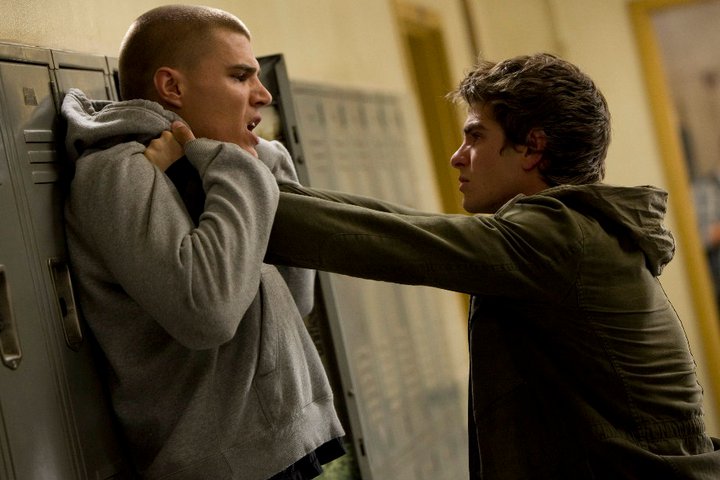
The story is basically the same—Peter Parker (Andrew Garfield) is a smart high school geek with a photog' hobby, and his first encounter with an industrial science lab manages to put the bite on him, arachnidally-speaking, then strange things start happening as he does whatever a spider can, conflicts, conflicts, conflicts (of the physical and angst variety), "with great power comes great responsibility," yadda yadda yadda. But there's a lot of "Spidey"-history to draw on, and the writers (James Vanderbilt, Alvin Sargent—who added a lot to Spiderman 2—and Steve Kloves—who mentored Harry Potter) have tinkered and brought a lot of missing pieces to the table. 
This time the love interest is Gwen Stacy (Emma Stone, who appears to be the oldest person in school, but that may be part of the appeal of the character, certainly to Parker), daughter of an NYPD captain (Denis Leary, who plays it straight, tough, and with impeccable comic timing), and bowing to the fan-boyish, his web-powers are not so organiche's got the little web-shooters now, although interestingly, he doesn't develop the web-goo. Oscorp is still around, although we never see its CEO (or do we?), so's the Daily Bugle—but Parker doesn't have a job there yet, so there's no J. Jonah Jameson (how could replace or improve on J.K. Simmons' interpretation?). The villain is another industrial bio-scientist, Curt Connors (played as if was Peter O'Toole by Rhys Ifans and he's terrific), who—not giving anything away here—eventually turns into the Lizard.

What's different is motivation and sub-text. Echoing the Potter series, attention and emphasis is paid to what happened to Peter's parents (Campbell Scott and Embeth Davidtz) that put him in the care of Uncle Ben and Aunt May (Martin Sheen and Sally Field, both extraordinarily good) and indications are that is the story which will run throughout this movie-arc (as well, I suspect, as the consequences of keeping secrets (as I said, there's a lot of history to drawn on).
 

What's also different and good is how everybody's perfected the formula, including director Marc Webb (who made the, to me, extraordinarily fine
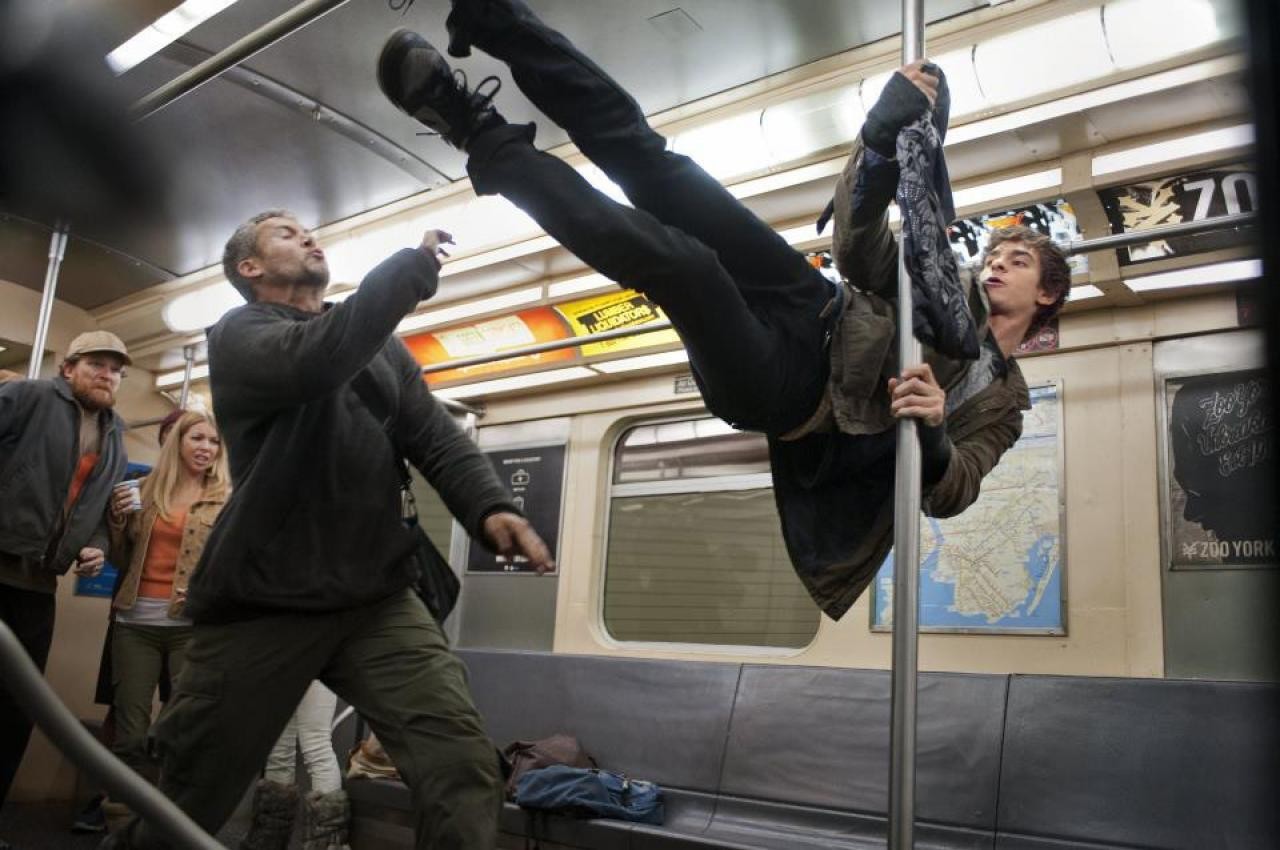
(500) Days of Summer): Garfield's Parker is more in line with the comic character, mood-swinging as well as web-slinging, and his Parker is awkward, stammering, frequently inarticulate and perceived outwardly as something of a jerk, a simp, or worthless* (hey, wow, they got the character of a misunderstood teenager down), and the fights, which in the past have been rushed and often unfollowable, now flow and, frequently—thanks to CGI—in one continuous shot that swoops, loops and parallels Spider-man's flight patterns.
The pace is still there, but thanks to stunt arranger and second-unit director Vic Armstrong (a few of the Bonds and Indiana Jones), it's not all a blur. Also, under Raimi, some of these fights were brutal and sadistic, and, don't get me wrong, these are no less savage, and take more of a toll on the participants.
** But the desperation is there, and the "wrong-ness" of the abuse of power, which kept my moral compass (or is it "Spidey"-sense?) from peaking out in the red zone.  

So, yes, it's the same story, but more sure-footed (by having its hero less so), and also intriguing for what it might hold in the future. The first trilogy seemed to be a little wobbly as it went along, searching for story. This one already feels like it knows where its going, and will find the best and most opportune path to get there.
***

* And—a nice touch—he's thin and ungainly, not buffed-out, like the typical "strong-man" super-hero, which is the way he was when Steve Ditko first drew him.  Nice.

** This does bring up something that will be difficult to sustain: Parker is frequently shown battered, bruised, and slashed from these fights, which makes his encounters post-fight with Aunt May a little illogical.  And at some point, when will she clamp down on him, or child-protective services step in? 

*** A couple more things: there's no interpretation of the "Spider-man" theme from the 60's cartoon ("Hey there, there goes the Spider-man!") but James Horner's score is his most inventive in a long time—if a little needlessly bombastic in rare instances; there is a "coda" of sorts, but early in the credits (so you won't be missing anything if you don't stay for the full credit roll); and the Stan Lee cameo actually made me smile and feel affectionate towards the man.  Now, that's amazing.

Wednesday, May 3, 2023

Seeking a Friend For the End of the World

Doing my Index for the site, I've stumbled across all sorts of reviews for films I have fondly remembered, but never pulled over here. This is is one of them—a film in a very similar vein to Don't Look Up, but with less of the focus on obstinate deniability.

I Got Stoned and I Missed It
or
"As Well as All Your Favorite Classic Hits..."

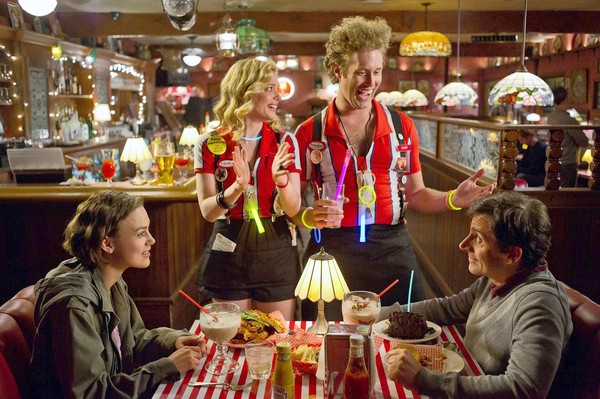
Right off the bat, Seeking a Friend for the End of the World, starts with a great joke. Dodge (Steve Carell) and his wife Linda (Nancy Carell-heh—how "inside") are sitting in the car, listening to the news on the radio. It's not good. The space shuttle Deliverance has not been able to destroy or even divert the asteroid "Matilda" that is headed for Earth and will bring all life to an end. "Stay tuned for all the latest developments on this ongoing story, as well as all your favorite classic hits."

There's silence in the car. Then, husband and wife look at each other. Wife opens the car door. And runs as fast as she can...away, into the night, leaving hubby gaping. "What just happened?"
That's the tenor of the humor of SAFFEOW—a kind of horrific slapstick that feels frightening, as well as inevitable, like a Blake Edwards comedy. You know a radio station would end a horrific story...even of Armaggeddon...with a reassuring tag-line. And the wife's reaction? Without a word of explanation, escaping her settled life? Eh, that one feels real, too.
Dodge is the calm of the storm for all this chaos
. Where his friends are freaking out along with the rest of society, he is quietly considering his fate and deciding what he can do with his time, rather than quickly self-destructing. The first part of the film is full of dark humor as Dodge goes to work as an insurance broker ("No, sir, it isn't covered in your policy"), botches a suicide attempt that only garners more responsibility, and everything and everybody systematically shuts down. The skein of traffic comes unraveled, TV reporters freak out ("We're f@&%ed, Bob...") and the lack of consequence—or a future—bring out the worst in people.

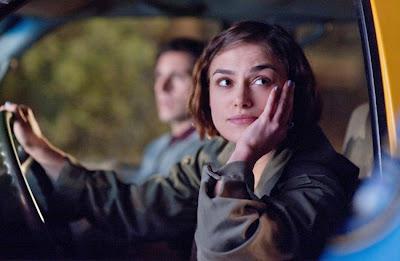
Dodge reflects, and as circumstances happen, he decides to seek out "the girl who got away," along with "the girl along for the ride" (Keira Knightley) who has a similar quest—finding a plane to get her back to her parents in England. She's got a car. He says he knows somebody with a plane, so the two contract to maneuver through the chaos to achieve their very short-term goals.
It turns into a road-trip movie
, without "the light at the end of the tunnel" and the two may be the last two sane people on Earth. Just when you think someone along the way is normal...or at last coping...there's a surprise. It all plays out in the way that you think it might—circumstances soften the resolve and their zeal for their goals and their attitudes towards each other. Even if the world has an expiration date, there's still enough room to change your mind (in much the same way that Dodge's wife does at the beginning).

Knightley's fine in this
, still determined to not let her looks get in the way of an idiosyncratic performance. She is one odd goose, as long as she's not standing still on a runway. Carell's just the opposite here—an internalized performance that maintains a simmering calm. The face changes expression constantly, but the brow is always furrowed, like it's reflecting the first shock-wave that hits Earth. He wouldn't betray any unnecessary emotion, even if the world IS coming to an end, and there are nice turns by William Petersen and Martin Sheen, and bombastic ones by Rob Corddry and Patton Oswalt (and though it might not be fair) acting the way I think they'd act if they knew the world was coming to an end.


It's a neat trick Lorene Scafaria (she made Nick and Nora's infinite Playlist) pulls off here: the idea couldn't be more "high-concept" and in the hands of, say, Mike Bay, or Mimi Leder, or Roland Emmerich it would be more parts spectacle and surviving than anything having to do with as universal a thing as "coping." The only "high ground" to be found in those films is the one everybody's running to, while the pixel-people to the rear are never seen or heard from again (and never really mattered enough to be portrayed by actors, anyway). Scafaria provides no high ground of safety, but only the artistic high ground of keeping the scale human, the emotions raw, and running the risk of turning sentimental or, worse, encouraging the audience's wrath (being hit with an asteroid would be more humane). She doesn't cheat, keeps it edgy, and allows things to play out...tidily.


And her musical taste? Spending the last night of your life before the power goes out listening to The Walker Brothers? Brilliant.

Tuesday, September 20, 2022

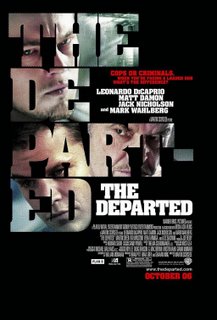
The Departed

Written at the time of the film's release...

Institutionalized Ball-Busting  
 
Call it the Scorsese Thesis: First a guy tells you what he's gonna tell ya, then Marty shows ya, then you're on your own. 
 
In the case of The Departed "the Guy" is Jack Nicholson's Frank Costello, a seedy Boston crime-lord from "some years ago." "I don't want to be a product of my environment," says the shadowy Frank (Scorsese's way of showing Frank as a younger man). "I want my environment to be a product of me."
 
Nicholson's Costello makes good on that promise on two fronts—in the scenario of The Departed, and the movie, itself.  Costello's control over his Boston turf (or, using the accent Martin Sheen employs here, "too-urf") is so absolute, his reach extends from his surly band of criminals to the police department, culminating in one of his own crew (Matt Damon) infiltrating the very task force investigating his activities. Simultaneously, the player on the other side, Captain Queenan (Sheen) has trolled the new recruits to find his own mole (Leonardo DiCaprio) to infiltrate Costello's crew. 
It turns into a complicated
Spy Vs. Spy with both moles straddling the moral fence, while completely unsure of their footing on either side. And while trying to rat out their suspected counter-part while not drawing attention to their own treacheries. They're mutually duplicitous. As Costello says in the Thesis: "When I was growing up, they would say you could become cops or criminals. But what I'm saying is this. When you're facing a loaded gun, what's the difference?"
It's a complicated game of
Jack's Straws...set in a house of mirrors. Drop Nicholson's weight into the middle of it, and the whole thing threatens to pancake...much like the movie. This first collaboration with Scorsese is similar to
Marlon Brando's eccentric performance in The Missouri Breaks, where an actor so drapes himself in business that he attracts the eye in the same way as a car-wreck—you wonder what in Hell this crime-clown (it is much like Nicholson's Joker in Batman without the make-up) is going to do next. Damon and DiCaprio were not clued into his on-set antics and so their scenes are played with the right touch of paranoid hesitancy. There's a strained wariness behind their eyes and they've rarely been better.
As good as they are (and excessive as Nicholson is) best among the cast is
Alec Baldwin as a fast-talking division head, but the real revelation here is Mark Wahlberg. Marky-Mark walks away with the picture and dominates every scene he is in, no matter who's in it with him. In fact, in the one scene Baldwin and Wahlberg share, Scorsese throws in a couple of Raging Bull camera moves for a verbal feint and parry between the two. It's a director's nod to two extraordinary actors doing solid work, free of gimmicks.
As for Scorsese, if you're looking for a return to his greatest efforts, this isn't it. It makes you wonder what he's up to. This story is nothing new, and is in fact based on a Chinese film (and its two sequels, actually) that owes more to the early personal style that he fails to deliver on here. What's the fascination? We've seen the cop/criminal discotomy, as well as the conflicts of working undercover in better films. He's doing program work, not personal work. This isn't Raging Bull or Mean Streets or KunDun or Goodfellas. This is Alice Doesn't Live Here Anymore. Or New York New York. Or The Aviator. One senses he's pacing himself, keeping his hand in the game doing agency "package" movies until the next inspiration comes along. Perhaps he should ditch DeCaprio, and find that last, good DeNiro project. He's too good a film-maker to waste on remakes and empty biographies. Maybe after the struggles he went through to bring his last personal project to the screen he's asking himself at this point in his career "What's the difference?"

Saturday, January 29, 2022

Rage (1972)

Saturday is traditionally "Take Out the Trash" Day.

Rage
(
George C. Scott, 1972) Actor George C. Scott has only three directing credits for film: his TV-movie of "The Andersonville Trial" (a play in which he starred on Broadway), the controversial 1974 The Savage is Loose (which he ended up distributing himself), and this film—the only one he directed for a major distributor (in this case, Warner Brothers). All of his work behind the camera occurred in the period between 1970 and 1974, the time when he was most associated with the film Patton, for which he won the Best Actor Oscar (which he famously refused to accept).
 
Those who admired his Patton work with its strong military theme, must have subsequently been surprised when encountering this film, as it's decidedly anti-military and anti-medical establishment, and then ups the ante on its revenge scenario plot until its protagonist fits the definition of "terrorist." So, how does all this start?
Rancher Dan Logan (Scott) and his son (Nicolas Beauvy) are sleeping outside watching their sheep-herds when a helicopter passes over their location. There's a military base near-by and Logan doesn't think anything of it—as long as the craft isn't flying so low it doesn't scatter the flocks. That night, Logan sleeps in the tent, while his son sleeps outside to watch the stars. It is a calm night, but, with the dawn, comes the nightmare.
The sheep in the field are all dead and his son is unconscious and bleeding from the nose. Logan gathers up his son and makes a mad dash to the local hospital, where the two are separated and emergency techs start working on his son. Logan's doctor, Caldwell (
Richard Basehart) is called, and finds that the hospital is buying time while they try to diagnose what's wrong with the Logan kid. Logan himself is confused, as he's being held at the hospital, won't be allowed to see his son or go home, and is getting no information other than a "be patient" dismissal. He tells Caldwell to find out what he can.
That's not going to happen. The truth is Logan's son is dead, killed by an accidental release of a nerve agent from one of those passing military helicopters. The military, for their part, regret it happened, but—making lemonade out of nerve gas—see it is as an opportunity to study its effects on humans, under the supervision of Drs. Spencer (
Barnard Hughes) and Holliford (Martin Sheen). Logan is being watched and will never be released from the hospital. But, his frustration grows, and before long, he starts to take action on his own.
His first act is to find his son, but can't find him in any of the rooms, but ultimately ends his search where all searches end—in the morgue. Logan is devastated, and he escapes from the hospital, vowing revenge. First, he goes to a military hardware store to buy a gun.
For the most part, Scott's movie is competent, but problematic. The acting is all fine. Most of the actors have worked with Scott before, whether he was directing or co-acting with them—Basehart and Sheen from "Andersonville" and
Paul Stevens and Stephen Young from Patton, and Hughes and Robert Walden from The Hospital. It does have some peculiarities to the early 70's that were "of the time" and are not so much in evidence today. The most prominent of which is the use of slow-motion. Sam Peckinpah rather artfully brought it to the fore with The Wild Bunch (and subsequent films), with which he would tweak action sequences by putting in frames to call attention to something that might be missed in frenetic multi-camera set-ups—sometimes, things just happen to fast in those action sequences, and Peckinpah knew when to just take a moment and focus on an aspect.
Scott is not so subtle a film-maker, and his choices to call attention to are off. An early shot of Logan spitting a loooong stream is a case in point. Sure, it's a fast action that a normal 24 frames per second shooting speed might not do "justice" to, but...an entire shot of it? He might be technically proud of either 1) the expectoration, or 2) the cinematographer (
Fred J. Koenekamp—from Patton) being able to track it, but as far as importance to the story, it's just not important. Likewise, a shot of a soon-to-be-a-distraction cat jumping onto a sofa might be too quick to notice with slo-mo, but it takes away from the pace of a very tense scene. Peckinpah would have given it a few frames and dumped the rest. Scott gives us the whole thing.
 
It's always interesting to see what fine actors will do behind the camera for good (George Clooney, Kevin Costner, Robert Redford) or ill (Gene Wilder, Walter Matthau, Marlon Brando) whether they'll be genuine story communicators, or merely an extension of the "look-at-me" aspect of their careers. Scott was great with actors. His story-telling left something to be desired.

Wednesday, March 31, 2021

Judas and the Black Messiah

99 to 1
or
Crouching Panther, Hidden Agenda

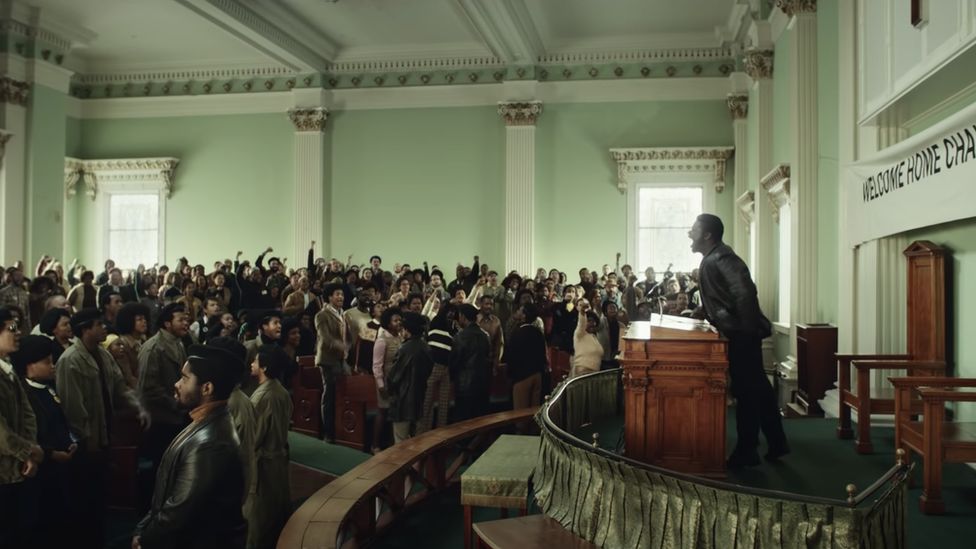
Judas and the Black Messiah is "based on a true story", which immediately sets one's Truth Squad into overdrive to see just how far afield the fiction is from reality. Such cynicism is matched, but then surpassed, when one learns that the movie is pretty much true, and that it happened very nearly exactly how it's depicted, just as the more pessimistic among us might suspect it did. One takes no joy in this, no sense of triumph that "they did it right for once," but only the despairing attitude that the truth of it is not stranger than an audience might accept (the standard trope for altering a story), but that it is altogether what they've become accustomed to accept.

That's a tellingly depressing bar to admit. But, we're a nation that excels at complacency when it's not in our immediate backyard.

Further still, the truth is actually more stunning than what is portrayed in the movie, and we'll address that fact at the end, because it weighs on the incidents like a stone, evoking feelings of amazement, pride, and shame.
Judas...tells the story of Bill O'Neill (Lakeith Stanfield, who has the toughest but least showy role in the film), a Chicago grifter, caught one night in an unsuccessful car-jacking (the incident didn't happen exactly as portrayed, as O'Neill was probably pulled over for a DWB), with a fake FBI badge on his person. It's one to two in prison for the auto theft, but five years for impersonating a federal officer, so the local FBI guy (Jesse Plemons) makes a deal: go to prison for possibly seven years, or help out the FBI and walk out free. O'Neill can only marvel at his luck, due to his lack of knowing anything about "Faust."
The devil he owes comes in the form of J. Edgar Hoover (Martin Sheen, who, despite being encased in even more makeup than Leonardo Di Caprio had to endure, is still unconvincing), who, in what should have been his gay, twilight years as head of the FBI, is seeing his black-and-white world of gangsters, racketeers and "Reds" become a bit more nuanced in the form of generations of "Boomers" becoming disenchanted with the "System," the "bread and circuses" not seeming to be enough to distract them. It runs afoul of his agency, which is comprised of white, crew-cut (and presumably straight) men in business suits—but we see them drinking on the job in their offices (would that pass Hoover's scrutiny?).His concern, right now, is black nationalist groups, like the NAACP, the SCLC, the Nation of Islam, and the Black Panthers—not only due to their threat to the white status quo, but also for relations to communist and socialist causes.*
Their target is Fred Hampton (Daniel Kaluuya), who has become the leader of the Illinois chapter of the Black Panthers, after studying pre-law and serving as a Youth Council leader of the NAACP. Naturally charismatic, a powerful speaker, and a student of revolutionary technique, Hampton began by organizing political classrooms, a civilian program for supervising police activity as well as a Free Breakfast Program. But, his biggest achievement—one which surely must not have escaped the notice of the FBI—is that he has organized what he called a "Rainbow Coalition," uniting the Panthers, the disparate Chicago street gangs, the White Southern Young Patriots Organization, and the Puerto Rican Young Lords. Nothing scares an established authority more than a united coalition of dissidents. 
The FBI will begin their own disinformation campaign to splinter the Coalition, but their ace is Bill O'Neill, who will infiltrate the Panthers, and winning the begrudging trust of Hampton, eventually become the Security Captain of the Chicago chapter. He will maintain his hustler's stance, only going so far as until his life is at risk, but even then, when the FBI puts the pressure on him between doing something he's loathe to do and spending time in prison, he will do as ordered. It's just that he has no idea the limits the FBI will go to, whereas he might feel unironically safer under the umbrella of Hampton and the Panthers.
The history is well-documented and the official record simultaneously white-washed and tainted—Hampton was killed in a raid on his apartment. At the time of the raid he was unconscious from a dose of secobarbitol, slipped into a drink by O'Neill on FBI orders. Despite his condition, Hampton did not survive the raid and died from two gunshot wounds delivered hitman style to the head. Court records would indicate that Hampton died of plausible deniability. It was a "hit", carried out by the FBI in the tradition of the gangsters they once hunted.

All this is laid out by King in as unobtrusive a way as possible, getting the details right, making his shots as if a documentary filmmaker with extraordinary access, with a cutting style that favors reaction shots and a gradual acceleration of tension. The cast is amazing: Stanfield has the wary look of someone being continually hunted; Kaluuya is always amazing to watch because his choices catch you by surprise—his Hampton is charismatic, but the way Pacino's early days as Michael Corleone are charismatic, walking into every room, surveying it, and then taking it over by sheer force of personality, even cunning; and Dominique Fishback is all knowing-eyes as Panther volunteer Deborah Johnson, who starts out questioning Hampton's rhetorical skills and ends up becoming his muse and lover. 
One fact haunts: at the time of his death, Fred Hampton was 21 years old. Bill O'Neil had been recruited at the age of 17; he was 20 at the time of Hampton's assassination. There is no other way to look at the story than as a tragedy, of potential, unused and misdirected. Of lives wasted and power corrupted.

Judas and the Black Messiah is a devastating indictment.


* But, it's also personal for the FBI's director: In one scene, one of the few featuring the FBI director that has any resonance, director King has Hoover sanctimoniously ask Plemons' agent "How would you fee-el...if your daughter brought home her black boyfriend?" The agent can only stammer back at him: "She's eight months OLD!"

Tuesday, December 13, 2016

Rules Don't Apply

Never Check an Interesting Fact*
or
Hughes Kissing Her Now?

Warren Beatty's tall-tale about Howard Hughes, Rules Don't Apply, is about as ungainly as The Spruce Goose, but like the idea behind that aeronautical white elephant, it is not without its charms. 

For one thing, it's not done with any malice aforethought. Beatty's been trying to make a movie about Hughes since the 1970's, and they've started it up and shut it down at various times, the timing never seeming right. After Scorsese made The Aviator, I'm surprised this was made at all, but one can see why Beatty still forged ahead with his story that he wrote with Bo Goldman (who also touched on Hughes in his original screenplay Melvin and Howard) and came out of self-imposed domestic bliss (Beatty wanted to raise the kids he had with wife Annette Bening, for God's sake!) to make it. He's managed to make a somewhat racy Disney fairy tale out of Hughes' life, complete with princess, Prince Charming, and even a happy ending for all involved. And that takes some doing, even if it takes a lot of liberties with the timeline and history.

It starts in 1964, where Hughes (Beatty) is a recluse who has not been seen in years, and an elaborate phone hook-up has been set up with Hughes for experts from the press who are awaiting a call from the man, who is only speaking due to an unauthorized biography that a ne'er-do-well (Paul Schneider) has penned claiming it as a genuine autobiography.** His aides, Frank Forbes (Alden Ehrenreich) and Levar Mathis (Mathew Broderick) are trying to convince the reluctant Hughes to go through with it, as his reputation is on the line. But, the fire's gone out of Hughes, who couldn't care less and would just as soon be left alone. How he got here and how it gets resolved takes some back-story.
It's six years previous. 1956, to be exact, in this movie's version. Hughes is head of RKO Pictures where he fiddles with movies and has big aviation dreams, still designing aircraft and leading a lifestyle that goes beyond reclusive. Frank Forbes is a driver for RKO, specifically for the bevy of starlets Hughes has under exclusive contract, all hoping to make it big in movies...or to, at least, meet Mr. Hughes personally. Frank and his immediate superior Levar are part of the motor pool for the RKO hopefuls—because the girls can't have their own cars, so as best to keep an eye on them (who knows how much trouble they could get into?) and the Hughes iron-clad contract guarantees that no Hughes employee is going to fraternize with them; the drivers stay in the front seats while the girls are completely safe and unmolested in the back-seats.
It's one of Frank's jobs today to pick up Marla Mabry (Lily Collins, who's presented as something like the love-child of Audrey Hepburn and Elizabeth Taylor), RKO's latest recruit, escorted by her mother Lucy (Bening), who's there to make sure that Marla doesn't stray far from her Baptist upbringing (at one point, Levar, observing them says: "You know why Baptists are afraid of sex? They're afraid it will lead to DANCING!") and that things are on the up-and-up, especially with regards to meeting Mr. Hughes. 
They're going to have to wait awhile, as nobody sees Mr. Hughes except for a select few in his daily flight-path. In fact, his way to pay the starlets is to lower checks from a clipboard attached to a string from his second floor window. Weird, yes, but Hughes is a busy man with a lot on his mind besides merely the RKO lot. There's his aerodynamic firm, his Daddy's tool company—of paramount importance—his studio, his investments—he's interested in birth control advancements, the recent discovery of DNA, and what appears to be an attempt at a clinch is merely his noticing that the fabric of an actress' blouse is rayon—but also, he's concerned with Congress breathing down his neck about his recent plane plans, questions of his competency and possible incarceration into a "looney bin," his abhorrence of appearing in public (leading him to supervise the casting of "doubles"), and then, of course, there's "The Spruce Goose"—the HK Hercules—the wooden behemoth of a plane that has not yet flown (actually, Hughes flew it in 1947). It was built as an experiment to see if a transport could be built without commodities that might be in short ration supply during wartime, like aluminum.
A lot on his mind. Probably too much. Beatty plays Hughes in a hyper-scattershot style (which he excels at, and is always Beatty as his most interesting as an actor), usually obscured by shadow, often at a loss about what people are talking about when they're not talking about something that interests him. At this point, he's a man of reputation, which he keeps up by not being seen. A late night liaison arranged for Miss Mabry turns into a dinner where the two dine on TV trays with freshly warmed TV-dinners in tidy aluminum trays (which Hughes eats with gusto), a brief musical interlude where he plays the saxophone, and a lot of awkward silences.
The movie's at its best when Hughes is in the picture, although one wonders where it's all going when he doesn't show up for 45 minutes. At least, that early part of the picture is breezily, almost brutally, edited (Beatty has been known to turn in long edits of his movies, but this one clips along at just under 2 hours), and the director delights in period detail and idiosyncratic music choices for background—"Rockin' Robin," a Lawrence Welk tune—that entertain while teeing up the conflicts that will beset the young lovers from that first act as the movie progresses. The movie says something about breaking away from the constraints that hold us back, with Hughes as prime example, cautionary tale, and inconvenient road-bump on the path to true happiness. That's a lot of duty for the "Magical Helper" on a hero's journey, but Hughes was always an iconoclast.
Maybe too much. Around about the time Beatty's movie-Hughes starts making demands for a particular flavor of ice-cream, then flipping to another, the movie starts to sag away from that hyper first section and lose interest in the romance, losing its heart, but ultimately tying all loose ends together for a melancholy ending in which everybody seems to be getting what they want. It's a deft conceit and an odd unconventional addition to Beatty's short list of odd, sometimes unsettling, but always rather interesting films that linger in the memory far fonder than they do in the watching.
* Ascribed in the film as being said by Hughes, but I can't verify that.

** Anyone who's been alive as long as I have knows that phone conference didn't occur until 1971, when Clifford Irving published his bogus "autobiography" of Hughes that contained all sorts of wild speculations about Hughes' aversion to germs (not exactly false), and his dietary and personal habits, including growing out his fingernails—Hughes quipped during the call "Yeah, I was thinking how do I write checks?" As Beatty notes after that opening Hughes quote "Names and Dates Don't Apply."

*** One of my favorite films involving Hughes is Orson Welles F for Fake, which takes on the rather daunting subject of the worth of art, with amusing anecdotes about a particular art forger, who became friends with, and was subsequently, biographied by...Clifford Irving. 

Tuesday, November 1, 2016

The Dead Zone (1983)

The Dead Zone (David Cronenberg, 1983)  Stephen King's "The Dead Zone" was written as a defense of assassination as a preventive measure for disaster (No, really...what if you could go back in time and kill Hitler as a child?*). What if you had the power of foreknowledge and did nothing to prevent something catastrophic?

It may be, indeed, a sin to kill, but
the Catholic Curch also warns of sins of omission—NOT doing something that might prevent the suffering of others (and for a historical example that hits you right in the Vatican, hello there, Pope Pius XII!!).

The extraordinary circumstances of a psychic being able to see the future and acting to prevent it is the stuff of philosophy, morality and science-fiction.
** But King, who took horror tropes and turned them on their pointed ears wasn't writing science-fiction. His brand of personal horror turned this cautionary tale into one of tragedy.

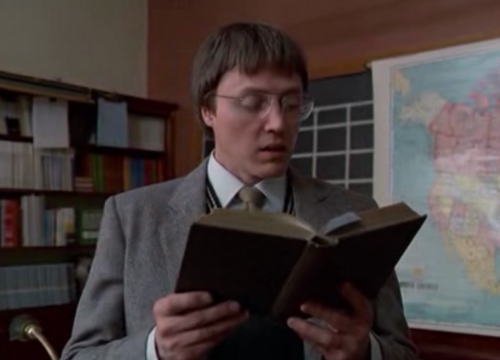
Up to that time, David Cronenberg was known for viscerally-filmed Grade-Z horror films with an emphasis on the squishy, but his film of The Dead Zone (one of the early King adaptations after De Palma's Carrie, Kubrick's version of The Shining, and the Tobe Hooper-directed TV version of 'Salem's Lot) was one of the strongest of the bunch. Cronenberg (and screenwriter Jeffrey Boam) took the larky good-nature out of the initial character of Johnny Smith (played in the film by Christopher Walken, but King thought it better suited for Bill Murray) and boiled the story down to essentials. Smith (as anonymous a name as you'd want) goes on a date with Sarah Bracknell (Brooke Adams) and things are going alright—he's fallen in love, in fact—when Fate raises its Huge Hand in the form of a near-fatal traffic accident that puts Johnny into a coma for five years (Cronenberg, perversely, has the collision occur with a milk tanker—as in "no use crying over..."***). Waking up, he finds that life is completely different—Mom's become unhinged, Sarah's up-and-married, he's semi-crippled, even after severe rehabilitation, and he can't find a job as a teacher of English Lit anywhere.
Oh, yes. Then there's "the power." By merely touching another human being, Johnny can see into that person's future, seeing their possible destiny and maybe death. He wants to live a "normal" life, a life of obscurity and happiness, but this "gift" is more of a curse, throwing him into the limelight, giving him responsibilities that he can't want or need. But, a man of conscience, Johnny can't keep his visions to himself—he has to warn people. He can't merely witness, as an innocent by-channeller, he has to act to prevent the tragedies he sees and insert himself between those he touches and their Fates.
A social man, his gift makes him increasingly isolated, trying to hide his abilities, and avoiding people and touching them to keep from seeing those visions. But, as much as he tries to quash his ability to see the future, he is always confronted by it and must come out of his obscurity to prevent them from occurring.

Sounds like classic tragedy to me. With biblical, even apocalyptic echoes.
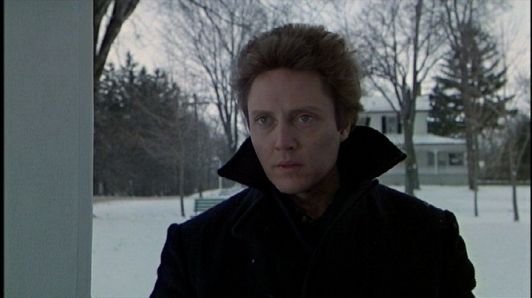
Cronenberg keeps the tone of the film oppressively heavy (Michael Kamen's score is particularly down-beat) and the Canadian locations have a dull, overcast, obliquely lit feel to them, like every moment is a late afternoon threatening to snow. Smith is a particularly sepulchral figure, Walken's tall frame shrouded by a long black overcoat, hobbling stiff-leggedly with a cane, like a harbinger of doom, his eyes haunted, but Walken's hooded eyes grow wide, when he touches someone or an object they possess, as if grabbing a live electrical wire as he goes into his vision.  Before long, he is perpetually wearing black gloves.
But, on one of his rare excursions out he manages to take the hand of one Gregg Stillson (Martin Sheen), a Senator with eyes towards the presidency, and what he sees is Stillson launching a nuclear attack, ensuring Mutually Assured Destruction, and he becomes obsessed with stopping it
Screenwriter Jeffrey Boam does some compression and simplification of the novel that emphasizes coincidence for the sake of a romantically resonant ending, but all in all, it is one of the best of the King screen adaptations (you've got to be careful with King—if you boil down his stories too much and take out too many of his incidents, you can sometimes see that the skeleton of his writing is calcium-deficient). The cast is amazing—Walken, Adams, Lom, but also Tom Skerritt, Anthony Zerbe (playing a strong character for once), Colleen Dewhurst, and the wonderful Jackie Burroughs—and they keep things playing out naturally, with only Sheen veering into a kind of caricature. 
It's one of Cronenberg's tamer, more straightforward early films (relatively, although there's some gut-churning violence), but it's one of his great ones.
Cronenberg gives Smith's visions a perverse power.


Pre-election post-script: early on in the "Trump-How-Low-Can-You-Go-Limbo-to-Electoral-Humiliation," an image showed up on the wires that truly startled me as it was almost a perfect match of the scene where, to prevent himself from being shot by Johnny, Martin Sheen's Stillson shields himself with an infant, the photos of which destroy his campaign and he eventually commits suicide, his ego-driven, rambling, vague-generalities-with-no-substance ambitions having collapsed.

I've been having a private little chuckle about that ever since. Life DOES imitate art.


* It's been years since I've read the book or seen the movie, and I'd forgotten that very question is asked by Smith in both: in the novel to a WWI veteran, and in the movie to his neurologist Dr. Weizack (Herbert Lom). After some serious discussion, Weizack concludes "Yeah, I'd kill the sunovabitch."

** King's next book "11-22-63" is about a man who travels back in time to prevent the Kennedy assassination.  I'm going to write one called "The Well" about an author who goes back to it one too many times.  (Note: There was a "The Twilight Zone" episode called "Back There"—great score by Jerry Goldsmith, btw—about a man who goes back in time and—unsuccessfully—tries to prevent Lincoln's assassination. It starred Russell Johnson, who, whenever he came into the studio I worked at, I'd make sure that his reading copy had nice big bold type on it as his vision was declining. He appreciated it, and I had a standard exit line for his thanks: "Well, after all, you went back in time to save Lincoln...")

*** In the novel, the accident Johnny is in is caused by drag-racers.