Showing posts with label Candice Bergen. Show all posts

Tuesday, December 13, 2016

Rules Don't Apply

Never Check an Interesting Fact*
or
Hughes Kissing Her Now?

Warren Beatty's tall-tale about Howard Hughes, Rules Don't Apply, is about as ungainly as The Spruce Goose, but like the idea behind that aeronautical white elephant, it is not without its charms. 

For one thing, it's not done with any malice aforethought. Beatty's been trying to make a movie about Hughes since the 1970's, and they've started it up and shut it down at various times, the timing never seeming right. After Scorsese made The Aviator, I'm surprised this was made at all, but one can see why Beatty still forged ahead with his story that he wrote with Bo Goldman (who also touched on Hughes in his original screenplay Melvin and Howard) and came out of self-imposed domestic bliss (Beatty wanted to raise the kids he had with wife Annette Bening, for God's sake!) to make it. He's managed to make a somewhat racy Disney fairy tale out of Hughes' life, complete with princess, Prince Charming, and even a happy ending for all involved. And that takes some doing, even if it takes a lot of liberties with the timeline and history.

It starts in 1964, where Hughes (Beatty) is a recluse who has not been seen in years, and an elaborate phone hook-up has been set up with Hughes for experts from the press who are awaiting a call from the man, who is only speaking due to an unauthorized biography that a ne'er-do-well (Paul Schneider) has penned claiming it as a genuine autobiography.** His aides, Frank Forbes (Alden Ehrenreich) and Levar Mathis (Mathew Broderick) are trying to convince the reluctant Hughes to go through with it, as his reputation is on the line. But, the fire's gone out of Hughes, who couldn't care less and would just as soon be left alone. How he got here and how it gets resolved takes some back-story.
It's six years previous. 1956, to be exact, in this movie's version. Hughes is head of RKO Pictures where he fiddles with movies and has big aviation dreams, still designing aircraft and leading a lifestyle that goes beyond reclusive. Frank Forbes is a driver for RKO, specifically for the bevy of starlets Hughes has under exclusive contract, all hoping to make it big in movies...or to, at least, meet Mr. Hughes personally. Frank and his immediate superior Levar are part of the motor pool for the RKO hopefuls—because the girls can't have their own cars, so as best to keep an eye on them (who knows how much trouble they could get into?) and the Hughes iron-clad contract guarantees that no Hughes employee is going to fraternize with them; the drivers stay in the front seats while the girls are completely safe and unmolested in the back-seats.
It's one of Frank's jobs today to pick up Marla Mabry (Lily Collins, who's presented as something like the love-child of Audrey Hepburn and Elizabeth Taylor), RKO's latest recruit, escorted by her mother Lucy (Bening), who's there to make sure that Marla doesn't stray far from her Baptist upbringing (at one point, Levar, observing them says: "You know why Baptists are afraid of sex? They're afraid it will lead to DANCING!") and that things are on the up-and-up, especially with regards to meeting Mr. Hughes. 
They're going to have to wait awhile, as nobody sees Mr. Hughes except for a select few in his daily flight-path. In fact, his way to pay the starlets is to lower checks from a clipboard attached to a string from his second floor window. Weird, yes, but Hughes is a busy man with a lot on his mind besides merely the RKO lot. There's his aerodynamic firm, his Daddy's tool company—of paramount importance—his studio, his investments—he's interested in birth control advancements, the recent discovery of DNA, and what appears to be an attempt at a clinch is merely his noticing that the fabric of an actress' blouse is rayon—but also, he's concerned with Congress breathing down his neck about his recent plane plans, questions of his competency and possible incarceration into a "looney bin," his abhorrence of appearing in public (leading him to supervise the casting of "doubles"), and then, of course, there's "The Spruce Goose"—the HK Hercules—the wooden behemoth of a plane that has not yet flown (actually, Hughes flew it in 1947). It was built as an experiment to see if a transport could be built without commodities that might be in short ration supply during wartime, like aluminum.
A lot on his mind. Probably too much. Beatty plays Hughes in a hyper-scattershot style (which he excels at, and is always Beatty as his most interesting as an actor), usually obscured by shadow, often at a loss about what people are talking about when they're not talking about something that interests him. At this point, he's a man of reputation, which he keeps up by not being seen. A late night liaison arranged for Miss Mabry turns into a dinner where the two dine on TV trays with freshly warmed TV-dinners in tidy aluminum trays (which Hughes eats with gusto), a brief musical interlude where he plays the saxophone, and a lot of awkward silences.
The movie's at its best when Hughes is in the picture, although one wonders where it's all going when he doesn't show up for 45 minutes. At least, that early part of the picture is breezily, almost brutally, edited (Beatty has been known to turn in long edits of his movies, but this one clips along at just under 2 hours), and the director delights in period detail and idiosyncratic music choices for background—"Rockin' Robin," a Lawrence Welk tune—that entertain while teeing up the conflicts that will beset the young lovers from that first act as the movie progresses. The movie says something about breaking away from the constraints that hold us back, with Hughes as prime example, cautionary tale, and inconvenient road-bump on the path to true happiness. That's a lot of duty for the "Magical Helper" on a hero's journey, but Hughes was always an iconoclast.
Maybe too much. Around about the time Beatty's movie-Hughes starts making demands for a particular flavor of ice-cream, then flipping to another, the movie starts to sag away from that hyper first section and lose interest in the romance, losing its heart, but ultimately tying all loose ends together for a melancholy ending in which everybody seems to be getting what they want. It's a deft conceit and an odd unconventional addition to Beatty's short list of odd, sometimes unsettling, but always rather interesting films that linger in the memory far fonder than they do in the watching.
* Ascribed in the film as being said by Hughes, but I can't verify that.

** Anyone who's been alive as long as I have knows that phone conference didn't occur until 1971, when Clifford Irving published his bogus "autobiography" of Hughes that contained all sorts of wild speculations about Hughes' aversion to germs (not exactly false), and his dietary and personal habits, including growing out his fingernails—Hughes quipped during the call "Yeah, I was thinking how do I write checks?" As Beatty notes after that opening Hughes quote "Names and Dates Don't Apply."

*** One of my favorite films involving Hughes is Orson Welles F for Fake, which takes on the rather daunting subject of the worth of art, with amusing anecdotes about a particular art forger, who became friends with, and was subsequently, biographied by...Clifford Irving. 

Saturday, July 4, 2015

Olde Review: The Wind and the Lion

Written November 7th, 1975

The Wind and the Lion  (John Milius, 1975) I avoid seeing films twice unless I really, really love the film (due to a lack of funds).* When I saw The Wind and the Lion the first time, it was as if I was seeing two movies at a time. The dialog was really wretched ("Mulay--that's a nice name"), but at the same time the photography, direction and editing were all fabulous. It was a film that had "sweep" (I assume that when a film has "sweep," the camera tends to move along a field, up a wall, through a street, "sweep" through the visual plane of the camera. Oh, but does this movie do that!) The Wind and the Lion just swells with movement of all kinds--inside the frame and the frame outside itself.

John Milius is a director I don't tend to think much of. I wasn't too fond of his Dillinger film, some good things, but not wholly satisfying.** But his direction in Wind & Lion is just marvelous. Some of the shots combined with Jerry Goldsmith's score*** are just chillingly beautiful: The trucking shot along a line of berbers silhouetted against a sunset; A diagonally rising crane-shot that drifts over a dune as an entire army of berbers move down a road while a dark, cloudy sky presses down on the whole scene; After the Raisuli (Sean Connery) has killed off the final horseman at the leper colony (that was the impression I got anyway) Milius cuts to a stunning shot of Eden Pedecaris (Candice Bergen) watching behind a net in the right foreground, while against a low sun on the ocean-tide, the Raisuli slows his horse and the now-riderless horse of his opponent still charges across the screen; Theodore Roosevelt (Brian Keith) and "his" bear towering over him, as he reads the "Wind and the Lion" letter.
The Letter: To Theodore Roosevelt - you are like the Wind and I like the Lion.
You form the Tempest. The sand stings my eyes and the ground is parched.
I roar in defiance but you do not hear. But between us there is a difference.
I, like the lion, must remain in my place.
While you, like the wind, will never know yours. -
Mulay Ahmed El Raisuli, Lord of the Riff, Sultan to the Berbers, Last of the Barbary Pirates.

The second time around, my appreciation of the Milius direction grew. It was what I concentrated on throughout and because of it, the dialog that I was uneasy about went down easier and (My God!) some of that dialog was downright poetic. Roosevelt's speech about the bear as the U.S, symbol, his getting on his desk and growling at the camera for the Smithsonian--things that made me squirm in my seat before--I enjoyed this time around.

This movie is flawed to be sure. Some of the writing is still bad. There are inaccuracies in technique and in history. **** The fellow I went to see it with thought there were too many "riding-in-the desert" shots for his taste, but not for mine. And I heartily enjoyed myself and the film.
I still enjoy it (now that I own it) and all qualms that I had about it are gone, and a lot of the things that I found a bit over-dramatic and even eye-roll-provoking are things that I now dearly love about it. I mean, the outlandishness is part of the appeal of the movie: who, for instance, would cast Sean Connery—with Scottish accent in full bloom*****—as an Arab chieftain? Somebody crazy enough to look past the piddly details and go for "what works"—and Connery is gloriously powerful and over-the-top in this.  
Candice Bergen, who I found annoying the first go-'round, is perfect—she's supposed to be a burr under the Raisuli's saddle, like a grown-up Mattie Ross in True Grit—but she's also a very strong character in a movie that oozes testosterone.  Faye Dunaway was supposed to play this and begged off—and Bergen more than manages and has a timeless look that's an improvement over Dunaway.  
And Brian Keith—never better.  The perfect actor to play TR in a performance that is winning, knowing and has more than a bit of "arena" in it, and the toll it takes on one when given a moment's privacy.
I neglected to mention the huge contribution that cinematographer Billy Williams brings to this movie.  It is gorgeous, almost 3-D in it's compositions and depths of colors, as he carried out some of the beautifully outlandish shots Milius came up with. 
I wish Milius was allowed to make more films (he's certainly been allowed to doctor scripts most of his career, and Turner gives him a mini-series or TV movie to do once in awhile). His is a singular voice in Hollywood, conservative, smart, and with an eye towards irony and a disdain for inaction and dithering. Along with his love of history and the U.S. (perhaps because of its flaws, rather in spite of them), his love of film is obvious,  he's smart with what he does on film. One would wish.
Milius' cameo as a one-armed munitions dealer.

* This was 1975. It would be another five years before the video-tape boom that allowed folks to watch films in their own home, and even own media of that film. Seems like such a long time ago. Now, if one likes a film, one can buy it, and watch it as many times as they want. That's a great convenience--but it tends to make people cluster to stuff they like, rather than explore and take a chance on a new film.

** Again, this was 1975 and from the perspective of someone who, as yet, hadn't had to sit through Public Enemies which, by comparison, makes Dillinger look brilliant.  I have to watch it again soon, because my memories of it—Ben Johnson's and Warren Oates' comfortable-shoe playing of their roles, Richard Dreyfuss' freak-out scene as "Pretty Boy" Floyd, the thread-bare look of the film because there was little money in the budget, but also, because it was the Depression—far outweigh any things I didn't like (which I no longer remember). 


*** An aside from this review here: "Goldsmith just happens to be one of my favorite film scorers. I snap up one of his albums as soon as it appears in the racks, and seldom am I ever disappointed with what I hear. However, one of Goldsmith's pieces doesn't seem to mesh correctly with the visuals--the Raisuli's initial ride on a horse gone hay-wire." Um--that was the composer's point, I think.
**** For instance, an incident like this DID take place during the Roosevelt administration. Ion Pedecaris WAS kidnapped by the Raisuli, in 1904. Ion was male. I'm sure it matters to history buffs and the sex-changing is probably sacrilege, but changing Pedecaris to a woman raises the stakes of the story, and provides a whiff of romance and exoticism. Without The Wind and The Lion that incident would have been lost in the sands of time.

***** My favorite line of the movie (and still produces a too-loud roar of laughter out of me) is a lovely panning shot of the desert and Connery's dreamy voice-over: "This is the Rif...I am Mulay Ahmed Muhamed Raisuli the Magnificent...sherif of the Riffian Berbers. I am the true defender of the faithful...the blood of the prophet runs through me and I...am but an instrument of His will." The cameras settle on Connery as he finishes his little resume to Mrs. Pedecaris, looking at her expecting some sort of reaction or acknowledgment, his horse restless beneath him.  And when there is only silence, there is an exquisite pause, and in full Scot, barks: "You have nothing to say?"

Saturday, May 9, 2015

2010: The Year We Make Contact

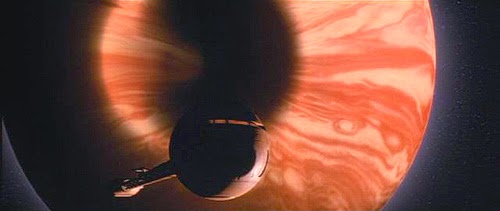
2010: The Year We Make Contact (Peter Hyams, 1984) 2001: A Space Odyssey took scientific precepts and used them as a launching pad for a philosophical adventure about humans and their place in the Universe in a suggestive and non-narrative way. It's "official" follow-up, 2010, however, tells you what it's going to show ya—then it shows ya—then it tells ya what it showed ya, thanks to a narration by Roy Scheider's character that explains everything but what he had for dinner. It's as far afield in style from its cinematic prequel as it could be—so much so that they feel like they've come from two different galaxies, or as one IMDB poster put it, "it's like comparing apples and concrete."

Based on
Arthur C. Clarke's "romp around the Solar System" ("2010: Odyssey Two"), it proposes a fact-finding mission by Dr. Heywood Floyd (Roy Scheider in this one, rather then the original's William Sylvester) to attempt to discover precisely what happened to the Discovery Mission to Jupiter and its crew. By hitching a ride on a Soviet space-craft (commanded by er, Tanya Kirbuk*Helen Mirren) that just happens to be passing by, Floyd and his crew—Discovery engineer Dr. Walter Curnow (John Lithgow) and Dr. R. Chandra (Bob Balaban), the computer scientist who developed the Hal 9000 and its twin in Urbana, Illinois—attempt to find out what went wrong with the mission that ended up with a dead crew and no information on where the signal sent by the un-mooned TMA-1 anomaly led. Where the first film revels in the leaps of evolution foisted on Man by "the Zarathustrians" (as I call them), Hyams' film is stuck with the earth-men and women merely trying to crack "what-done-it." 


Frankly, they should have just re-played the first film.
Kirbuk...uh...Kubrick stayed away from the machinations, unless it was visually arresting or amusing—like the zero-gravity-walking up walls, or the gravity-making squirrel-cage aboard Discovery— but Hyams, like Clarke, is only too happy to show the nuts-and-bolts of dropping into orbit with ablating bags, the stress it has on the crew by shaking the camera, the spark-emitting panels (straight out of Irwin Allen shows), and the requisite astronaut who flies across the control center in zero-g. This is the stuff of sci-fi melodrama in all its cheapness, precisely what Kubrick was trying to avoid in his film.
An interesting thing about the films of Peter Hyams: no matter the genre or concepts that he chose to direct, his films appear essentially flat—that's a weird result from a director who also chose to be the cinematographer on so many of his films (he shot 2010). Even when he chooses to shoot with some depth of field, his films feel like television productions, with a strong central object, and rarely little else of consequence (Kubrick did essentially the same thing, but his shot-compositions tended to be more vertiginous with a purposeful one-point perspecti
While everybody is fussing about the flight-mechanics of the rendezvous' with the Jupiter system and the now-tumbling-in-orbit Discovery, the Zarathustrians choose that moment to pull off a Solar System-affecting gambit, using the missing-in-action Bowman (Keir Dullea returning to his earlier role) as a secret agent appearing everywhere (now?) to pull off something spectacular—one shouldn't call it terra-forming so much as solar-forming—gravity manipulation, while Bowman runs interference, squandering the mystery of that omnipotent-seeming Star-Child (the next leap in human evolution seen at the end of 2001), to serve as a planet-skipping/morphing errand-boy who, it would appear, is discarded as soon as he accomplishes his final mission. 
Clarke's ultimate Big Surprise is a nifty one—educational, too, about the configuration of Jupiter—but by granting the unseen architects in both films motivations that seem like cosmic buttinski's very much cheapens the first film and its scope (much like the sublimation of Bowman's potential), making man's Creation merely all in a monolith's day's work. And the cosmic consequence of 2010 feels like a convenient after-thought, easing tensions of a U.S./Russian nuclear conflict (even though they seem to get along enough to launch a joint space mission together). 
It is eerie to hear the voice of HAL again (Douglas Rain) and to see Keir Dullea, through some artful make-up, look as young (and as old, unnecessarily) as he once was. And working from mere screen-captures, Hyams and his art department did a meticulous job recreating the Discovery sectionsthey can't keep the ships from looking like models in the FX sections, however, which is curious for a more late-model movie. So meticulous is their work that it seems bizarre that the Russian ship would look so different in its interior, than what the Americans had come up with by that time. Again, apples and concrete.
One wonders, ultimately, if it was worth doing: it was a toe-splash for M-G-M to explore the possibilities of one of its core properties, but its utter conventionality only points to the other film's complete unconventionality in terms of belaying cheap dramatic tricks and the standard "science fiction" obsession with mechanics (Kubrick turned all that rendezvousing into a dance). It is the only sense of wonder 2010 allows, where its progenitor was far more about wonder than the why's and wherefore's.

2010 serves as a Reader's Digest version of the original, a blunted, condensed presentation of a larger, more sophisticated work. It has highlights, sure, but there's nothing transcendent about it; it's a blue-print, a schematic of ideas, rather than a fully-formed work of art and expression. It's like a hack-magician, who can only keep an audience's interest by revealing how the tricks are done.

But, as Raymond Chandler noted with inferior movies made from his books, the originals are still there to be appreciated on their own. The creation of 2010 really doesn't diminish the work of 2001—it's still there to be seen and appreciated.
The final message to Earth is in English...and reads like a Hallmark card.

A couple of in-jokey cameo's
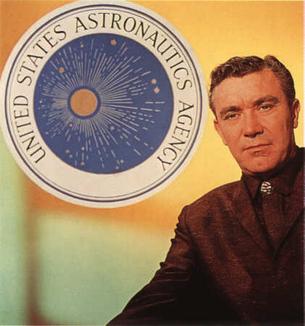
Pithy cover of Time: the U.S. President is Arthur C. Clarke/
The Russian Premier is Stanley Kubrick
Arthur Clarke (left) sits on a park-bench outside the White House
(Wait a minute—isn't he the President?)
* Read the last name backwards...