Showing posts with label Lily Collins. Show all posts

Wednesday, January 17, 2024

Mirror, Mirror

Don't Trust Anyone Over Four Feet
or
"No, Snow!  Don't Mess with Traditional Story-Telling!  It's Been Focus-Grouped, and It Works!!"

I approached Mirror Mirror with some trepidation. It's the sort of movie that curdles my gray matter—taking a traditional fairy-tale and updating it for modern audiences, with anachronisms, modern slang and catch-phrases, a fractured fairy-tale denying its origins and playing "hip." Also, it's a Julia Roberts vehicle and I don't "buy" Roberts in anything but comedic roles (which this one is).

But the other choice was to see Wrath of the Titans, for which I had no desire (Really? They're trying to make a franchise out of that one?) and so it was the "Snow White" knock-off, even though the prospect seemed rather Grimm.
It did have one thing going for it, however. Even though produced by Brett Ratner, it was being directed by an inspired choice—Tarsem, who vaulted from R.E.M. music videos to
The Cell
,* then rebounded with a fine film no one bothered to see, The Fall. I'd passed on his Immortals last year (though I plan to watch it on video sometime soon, now that it's out), but, as Tarsem can do some visionary work, he just might be able to pull it off.
It might well have been lame in any other hands, but the director's spectacular design sense, not only for sets and costumes, but also how to frame them for maximum effect is combined with a breezy comedy style that is never idle, and never hangs for a laugh, so that not only is the frame full, but the soundtrack as well, with one overhanging punch-line that crowds through before each cut.

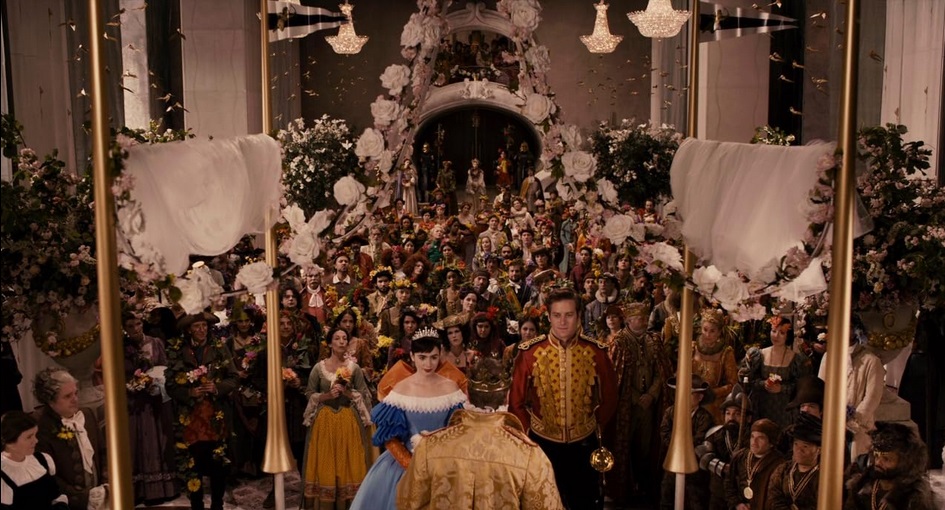
And yes, it's anachronistic, with such a polyglot of styles that it goes beyond, say, Terry Gilliam-madness into a Moulin Rouge!-ish goofy slap-dashery in which nothing is sacred except the movie's own internal rules of play, stopping just short of the Python-line of anarchy.  There is no single accent in place to latch onto geographically, except for some Anglo-Saxonisms—indeed, Arnie Hammer's Prince Alcott of Valencia, is pure American, but does it with such Ivy-League bravado that you accept he's a prince.

And this variation of the story has just enough "Hamlet" mixed in—Ms. White (an Audrey Hepburn-esque 
Lily CollinsPhil's kid) is the daughter of The King (Sean Bean
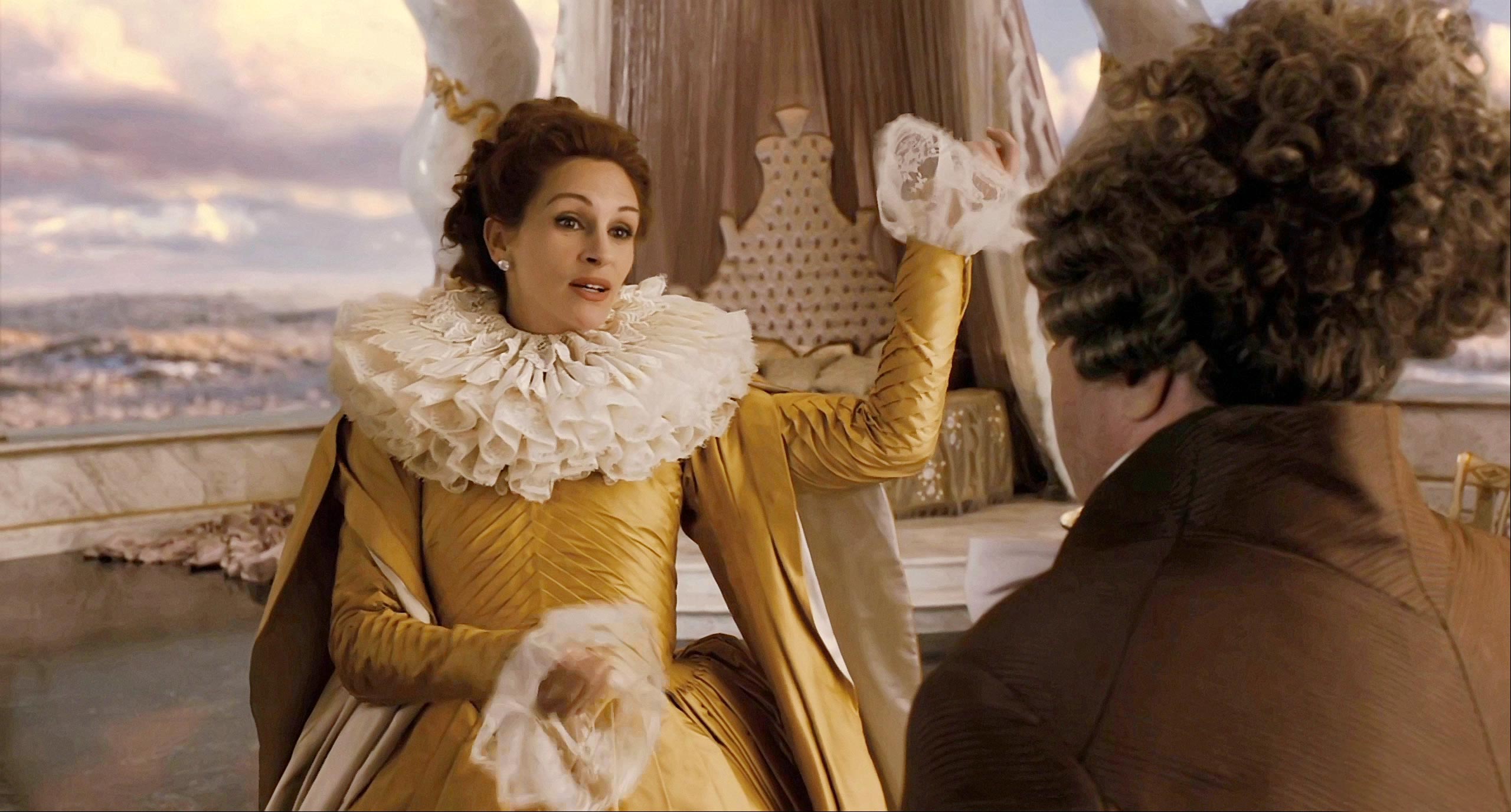
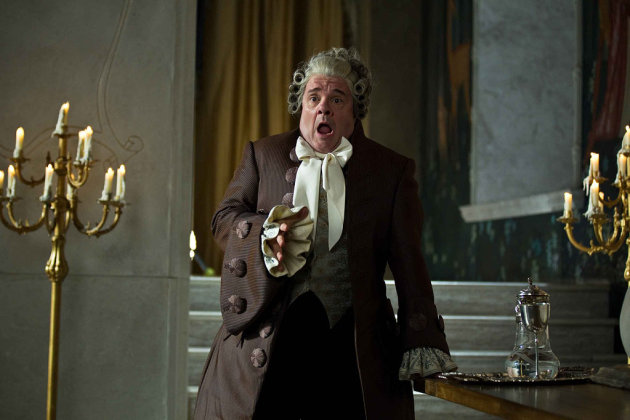
**), who is murdered (unbeknownst to all) by his new step-wife The Queen (Roberts), who then rules the Kingdom into the ground, while White awaits taking the throne on her 18th birthday (that is, if the Queen ever permits it). Instead, she spends it going out to see what's become of her Father's legacy and is distressed to learn there's no singing and dancing in the streets (as she remembers) but begging and poverty instead. This causes a political debate in the family, leading to Snow being banished by The Queen to be dispatched by her lackey Brighton (played with Costello-ish consternation by Nathan Lane).
Along the way, we meet the handsome Prince (Hammer, who is aggressively great here, better than his Winklevoss twins in 
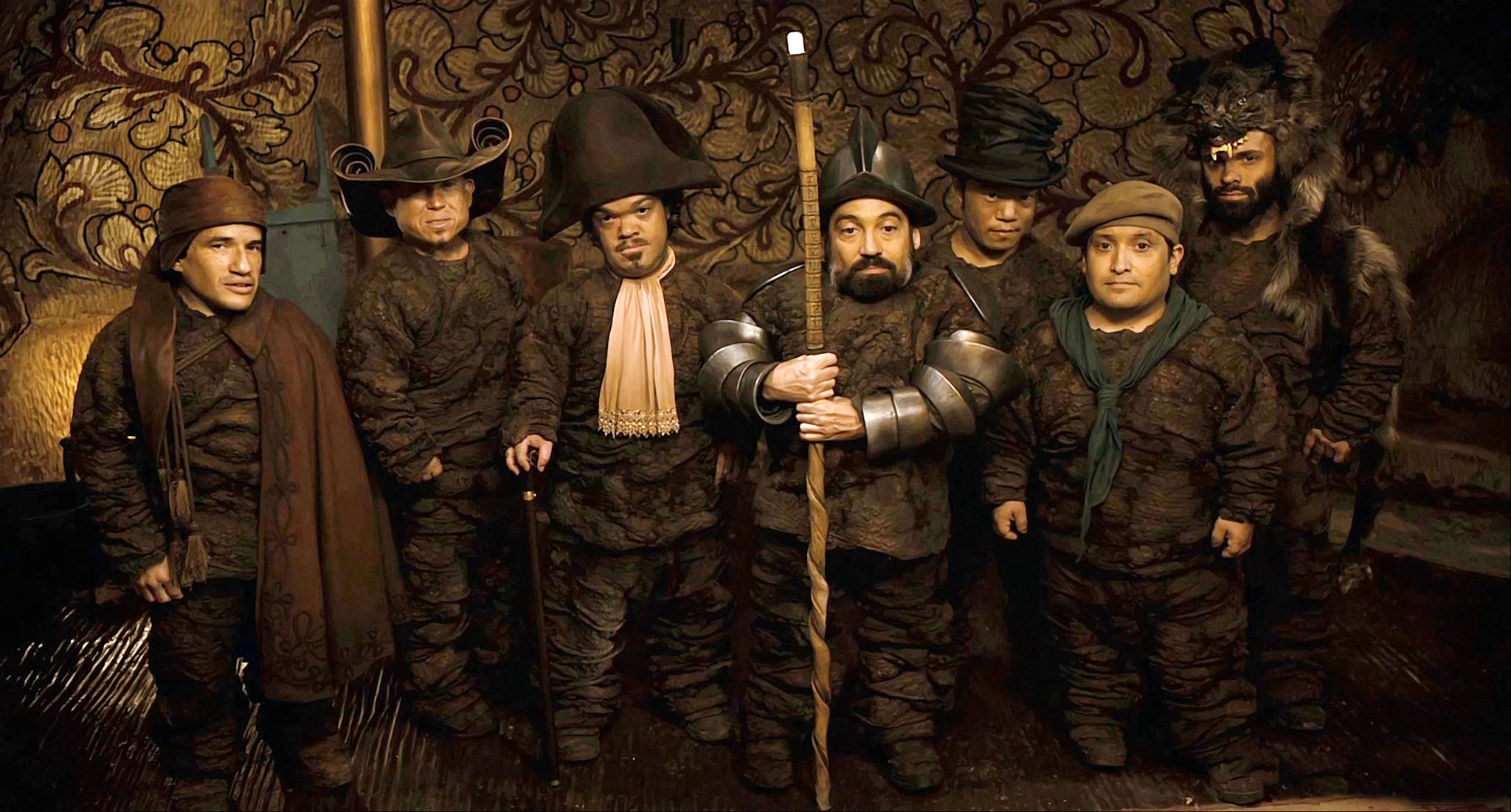
The Social Network, and decidedly better than being cocooned in make-up for J. Edgar, one thinks though that he is doomed to play scions), who is accosted by highwaymen...who just happen to be The Seven politically incorrect Dwarves (Napoleon, Half-pint, Grub, Grimm, Wolf, Butcher, and...Chuck, played with gruff zeal distinctively, by Jordan Prentice,Mark Povinelli, Joe Gnoffo, Danny Woodburn, Sebastian Saraceno, Martin Klebba,and...Ronald Lee Clark, all threatening to steal the show, as well—"beats workin' in a mine," as one of them says).  Before long, everybody's path is crossed once or twice, along with swords and stars in lovers' eyes.

Thing is, in its cartoonish way, it works in live-action, as well as when Disney goes sassy these days with classic tales, and, given the edge by Tarsem's crack sense of timing and way of knowing no bounds in design and camera moves (and Alan Menken's Mickey-Mousing
*** score doesn't hurt in that regard, either) the effect is somewhat the same.

Walked in loathing the idea and walked out kinda lovin' it. Pretty happy about that, given the Grimm prospects. Seems fair, if not the fairest of them all.
The music video in the End Credits, which shows how Tarsem throws things 
in from left field, as in this "Bollywood" style sequence.

*
Another example of Tarsem's work—a cheeky gladiator themed Pepsi commercial, 
featuring Enrique Eglesias, Beyonce, Britney Spears and Pink, with the music of Queen.

** Is there something in Sean Bean's contracts that stipulates that any character he plays not make it to the last reel? The last movie I saw where one of his characters survived was The Martian.

*** © Disney Corporation. I use this in the musical definition of the term (not in its "common, inferior" usage) where the music follows the action on-screen precisely, as in notes that follow foot-steps, say. And now this joke is a bit ironic as, this year, Mr. Mouse is in the public domain. So, now, I can make that animated cartoon of "Maus" starring Mickey.

Wednesday, June 7, 2023

The Blind Side

"98% Protective Instincts

The true story of All-American Michael Oher is the very stuff of feel-good uplifting movies. Impoverished son of a crack-addict mother and disappearing father gets a break by being so damned good at sports that a religious prep school is willing to look past his abysmal GPA (0.6 in the movie, 0.4 in real life). While attending, the homeless kid is given a place to flop for the night by Leigh Anne and Sean Tuohey, and, basically, stays on, becomes family, and with their tutorship and support, gets his grades up enough to join sports, and the opportunities fall from the sky like linebackers.

The ads and the poster make it look icky, like Oher is the stray dog who just needs love from the do-gooder white folk, or worse, one of those "reverse Oreo" movies where the compelling stories of minority struggles are overshadowed by the white stars playing earnest observers.
*
Fortunately, the movie is written and directed by John Lee Hancock, who made one of the best sports movies a few years back—The Rookie—and managed to salvage a bit of the abandoned Alamo project. As screenwriter of Midnight in the Garden of Good and Evil, and A Perfect World (both for Clint Eastwood), he's shown himself to be a writer who embraced quirk, then moved on to write compelling characters rather than walking exploited stereotypes. You like his unsentimental people and root for them no matter their hurdles.
It comes in handy in
The Blind Side
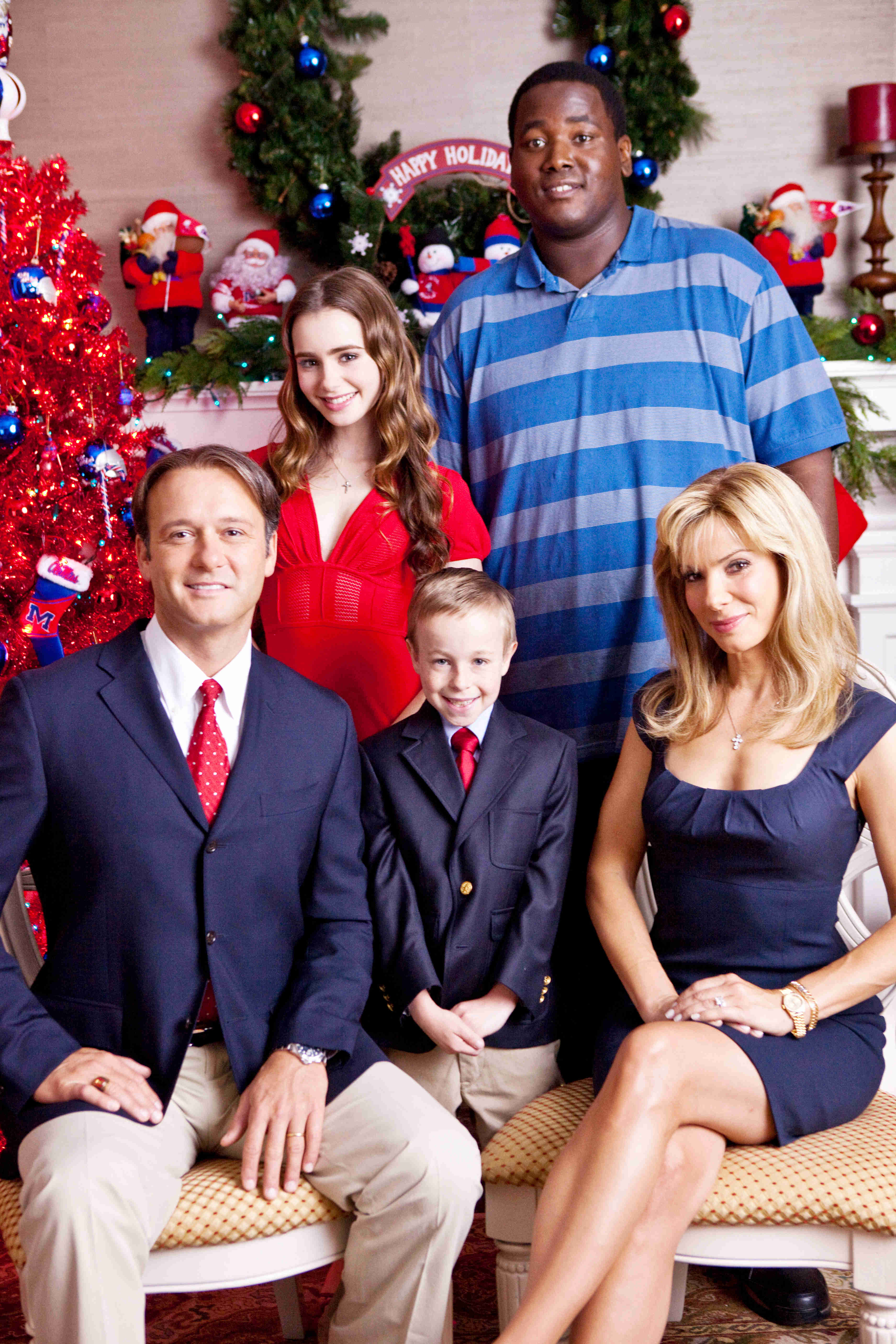
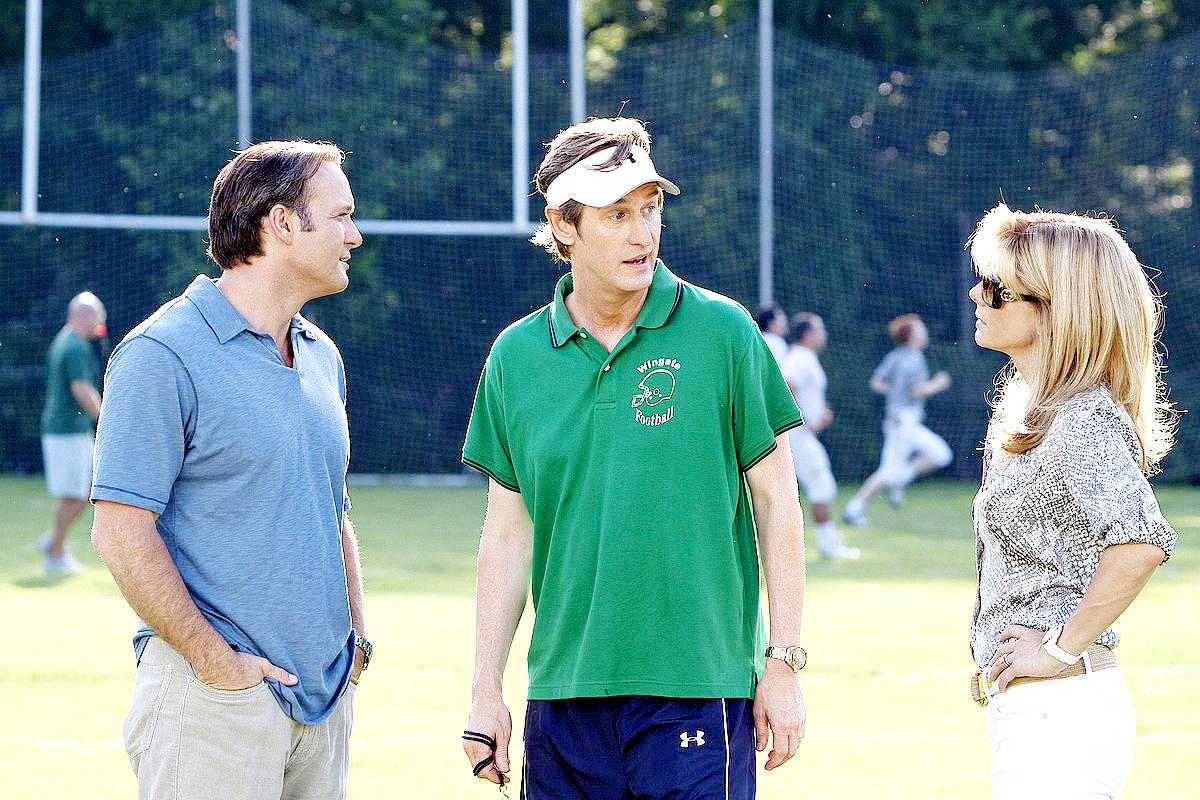
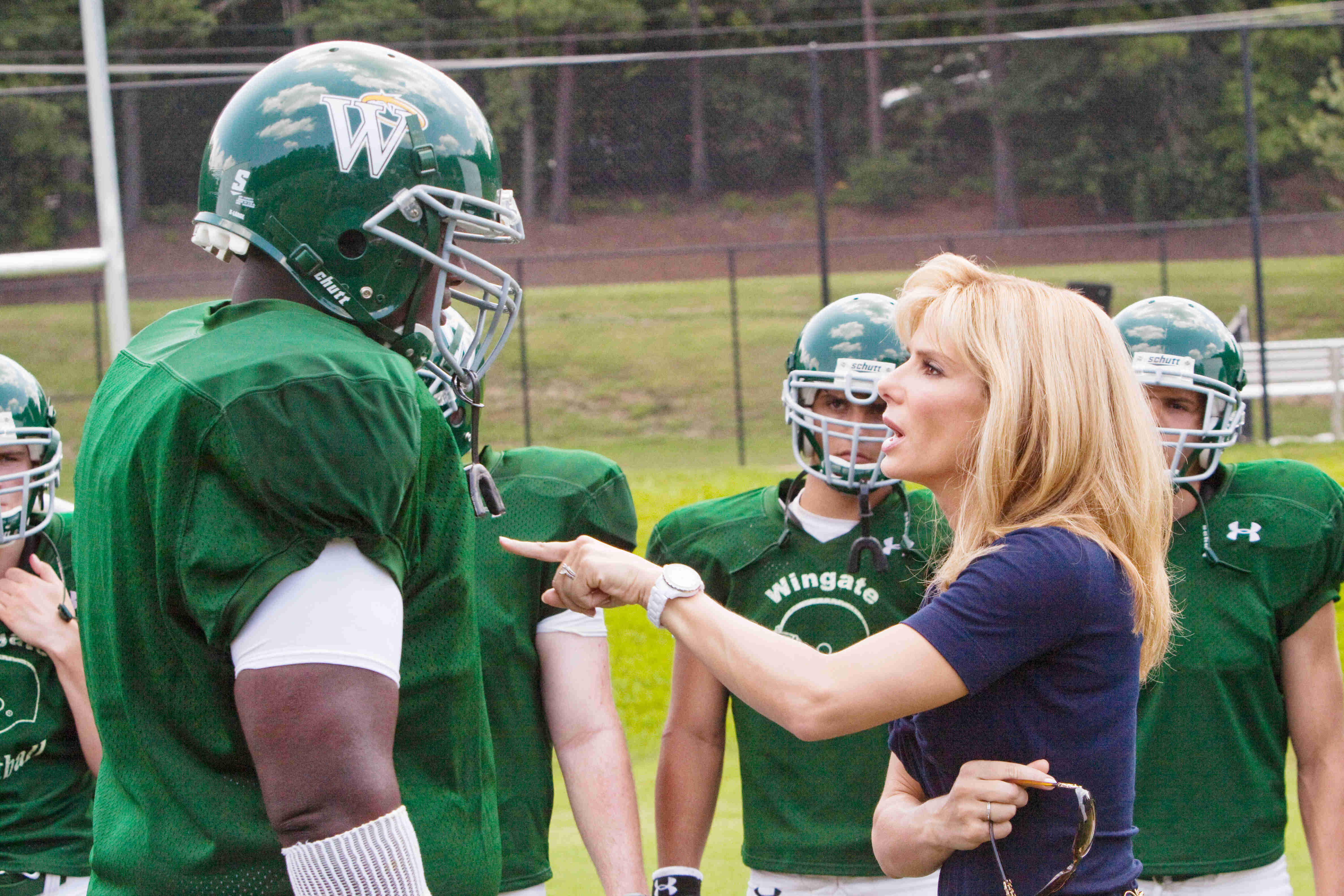
. Once Oher (Quinton Aaron) sleeps over one night, that's it, he's a part of the Tuohey family, no if's, and's and but's, and the matriarch, Leigh Anne (played by Sandra Bullock like a Kathy Lee Gifford with sass and a laser-eyes—she's what y'all call a "spit-fire"), walks the talk of her Christian upbringing in providing a practical resource for his needs. No argument is broached, no catty remark is left unchallenged, and schmaltz avoided at all costs. Bullock's Leigh Anne Tuohey is a Mama Tiger, the like not seen since Susan Sarandon's "Michaela Odone" in Lorenzo's Oil, to the point where all Hancock has to do is keep her in frame when she walks up to her kid's coach from the background and one begins to feel genuine fear. A revelation of the extent of Oher's poverty elicits a polite "Excuse me," a walk down the hall to her room, shutting the door and an erect sitting posture to indicate that no amount of bad news is going to get to her or deter her. Bullock isn't afraid to make her character cold or a bitch. She just is, take it or leave it.
But it's Oher's story, his character has more screen-time than Bullock, though far less dialogue, and
Hancock found a god-send in Aron, who has a face the camera loves. Since he has to carry a hefty amount of the drama silent, it serves him well, and is a nice fit with Bullock's all-talk, but reserved expression, counter-point.
At passing glance, it looks awful, but in its straight-forward, unpretentious and un-preachy style, The Blind Side wins over any cynicism.


* I'm sure you can name one—Mississippi Burning, Glory, Amistad, Come See the Paradise, Snow Falling on Cedars ... the list goes on, ad nauseum.

Wednesday, January 27, 2021

Mank

The Tale of the Organ-Grinder's Monkey
or
"I built him a water-tight narrative and a suggested destination. Where he takes it, that's his job."

The film Citizen Kane has held such a reputation over the years of being an iron-clad masterpiece and possibly "the greatest film ever made" that, of course, people are going to fight over it. One can't dispute its brio and artistry, especially in comparing it to what had come before. So, the alternative is to fight about something else. Tone problems, maybe? (in a film that centers on child abandonment, it's remarkably free of sentiment and thus—it is argued—"cold").

But, no. The big argument is usually "credit." Who did what (and to whom?). And the history of Citizen Kane has been continually squabbled over in a snow-storm of exhumed scripts, continuity pages, notes, and interviews (usually accompanied by a background whine of axes grinding). It's all such flotsam in a snow-globe, shaken up with little purpose or permanence. Time would have been better spent watching the movie because, like the poster tag-line said, "It's terrific!" 

People are just trying to determine "why" that is.
Fincher not using depth-of-field; the looming shadow is that of Orson Welles

Now comes Mank, directed by David Fincher from a script by his late father (and tinkered-with by Eric Roth, who gets a producer credit in lieu of a writing one, ironically enough) and it's a deliciously inventive stirring of the pot, going maybe a bit too "inside" of Hollywood and the games people play to get work and the compromises they make to keep getting it. It is less about the making of Citizen Kane than the writing of it* and it takes the structure of Kane to tell it, weaving back and forth between screenwriter Herman J. Mankiewicz (Gary Oldman), bed-ridden from an auto accident, holed up in working convalescence in Victorville, California, and his memories—some fueled by alcohol—of his years in Hollywood, when he wrote with the best of them and circled among the powerful, like William Randolph Hearst (Charles Dance) and his mistress, Marion Davies (Amanda Seyfried).
Reaction in the various corners has been predictable. The Welles loyalists  think it's a smear job and "Paulettes" (writers mentored by—or apologists for—Pauline Kael), and the Mankiewicz relations are reserved in their praise. Nobody in the Mank scenario gets out unscathed...or alive (or they couldn't have made the picture). So, if anybody "wins" it would be merely on points, no knock-out. The character assassinations are done in a circular firing squad, but no one's legacy is left un-besmirched. Credit where credit is due.
But, credit is like Truth in Hollywood. If you got it in writing, the odds are in your favor, but Hollywood is filled with myth-makers; how are you going to know if it's true...or just makes a good story. Mank takes the position that Mankiewicz, having proved his worth in Hollywood, started to take his position for granted—he was an alcoholic and a gambler, so someone for whom consequences come later. His work and his attitudes toward his bosses and his worth changed and he saw himself tolerated rather than cherished and so began to pay less fealty to his overlords. He didn't play politics with California power; politics was too important to waste on film studio's.
Burke as Orson Welles

All of this he recounts to himself, both in his proudest moments and in his weakest, as he dictates the promised screenplay "American" for the New Kid on the Block, the Wunderkind with the Iron-Clad Contract, Orson Welles (Tom Burke). Mankiewicz is writing "American" as work-for-hire, so he's getting paid but that's it. He's being overseen by Welles major domo John Houseman (Sam Troughton)—who drops by, fusses and leaves—but the work is done by Mank dictating, which gets typed up by assistant Rita (Lily Collins), whose husband is lost in the opening fires of WWII, while a nurse Freda (Monika Gossmann) handles medical attention.
Oldman's Mankiewicz with Sam Troughton as John Houseman

We talked about truth, earlier. Among other things, Mank is a movie about conspiracy. Everything about it is under the table and understood between friends. No one knows that Mankiewicz is working on a screenplay, Welles—absent while working at RKO on a planned "Heart of Darkness" movie—is kept vague about work accomplished, Houseman doesn't know that Mankiewicz has smuggled in liquor ("exercise equipment" Mankiewicz calls it), although both Freda and Rita know it and aren't disclosing—the work flows with the liquor and progress is being made.
Writers' meeting

Mankiewicz is not shown to be above this sort of "nudge-nuge, wink-wink" flummery in the past as, in flashback, he and an all-star group of studio scribes—like Ben Hecht, S. J. Perlman, George S. Kaufman, Charles McArthur and Ben Hecht go into a script meeting with David O. Selznick and "Joe" Von Sternberg and hash out the progress of an entirely fictional script that they're ad-libbing on the spot; they have been playing cards and other non-writerly things on the studio's dime. It's an intellectual game played on the "rubes" running the studio, a little arrogant "up you" from the smart guys to the dumb, unsuspecting bosses. This mutual loathing/self-loathing society will be Mankiewicz's play-book negotiating around Hollywood.
At San Simeon with Mayer (Howard) and Thalberg (Kingsley)

At parties he's invited to (thank you very much, old sport), he'll always drink too much and talk too loud and be too indiscreet around the likes of the Louis B. Mayer's (Arliss Howard) and Irving Thalberg's (Ferdinand Kingsley) because everyone knows he's clever and he's amusing and a bit of a cheeky sort good for a laugh to fill up uncomfortable party-pauses. It's what brings him to the grounds of San Simeon and the world of William Randolph Hearst, a king-maker as well, but with far more reach than over just stars and starlets. The studio heads are all about fantasy; Hearst makes it real.
Which is fine as long as the liquor is flowing and everybody laughs at—or at least tolerates—your jokes. But, when Hearst and Mayer and Thalberg collude on their own little machinations to influence the vote on the up-coming governor's race (using the M-G-M dream machine to concoct footage to promote fear of a wave of socialism taking people's jobs) that's when Mankiewicz sobers up and loses his sense of humor—and nobody likes that at a Hollywood party. Republican or Democrat.
It spells Mankiewicz's down-fall as a "trustee" and "good ol' boy" and the jobs dry up—without filmed trainloads of migrants having to take them. That and a few other ramifications of the Governor's race gives Mankiewicz the need for the Welles job, the justification for taking it, and the opportunity—and ammunition—to pay back some debts by doing what a writer does best—writing what he knows. Despite having the semblance of a happy ending (wherein Mankiewicz raises another clever middle digit), Mank is a movie that doesn't make him look good. In fact, with the exception of the character of his wife and nurses (and sympathy for the character of Marion Davies), nobody "looks good" in the film. 

But, then, nobody did in Citizen Kane, either.
Mankiewicz's triangulation by Houseman and Welles

The movie certainly looks good, though, even resplendent. Shot in high-res black-and-white that fairly vibrates on the screen, Mank is, in all ways, a labor of love for Fincher. Beyond the parental connection, he revels in the deep-focus compositions and the chiaroscuro lighting pallets in monochrome duly recorded by DP Erik Messerschmidt. Fincher has always been a stickler for composition, but combining the "old movie" format with wide-screen—and the inspiration inherent in the subject, he's like Welles' proverbial "kid in a candy store" even going so far as to include "cigarette burns"—those corner spots indicating reel changes?** (Well, maybe if you're young enough, you don't)—totally unnecessary in a streaming presentation—but here, popping up every 14 minutes or so.*** The projectionist in me was always waiting for the second one and was not disappointed. (No "jump" on the next scene, though).
Although I wasn't exactly the choir Mank was preaching to, I did watch it with a perpetual, appreciative smile on my face. It's great to see this sort of artfulness being festooned over something that merely recreates the past, rather than create a whole new reality. More risk to this, especially for those who'll twitch if they see a flaw in period or manner. 
"...she was carrying a white parasol."

The only caveat I had was one lasting thought on my brain's back-burner almost the entire picture: If Mankiewicz is so much the driving force of the finished work, why then does Fincher follow the visual language and the look of Kane...which was the work of the director?  

Because Kane wouldn't be Kane without it?
"A far too-long screenplay for the ages...John Houseman"


* There are two other films if you want to see vague watered-down versions of that, 1996's "The Battle Over Citizen Kane," an episode of PBS's documentary series "The American Experience"(which seemed to come to the conclusion that Welles and Hearst had a lot in common, which is bosh—other than ego) and RKO 281, a fictionalized account based on that documentary produced by ScottFree Productions and directed by Benjamin Ross for HBO, which is even worse. 

The best place to start is reading Pauline Kael's "Raising Kane"--which appeared in The New Yorker and accompanied Mankiewicz's (and Welles') published shooting script in "The Citizen Kane Book" (Bantam Books, October 1971). Using another scholar's work, Kael built her article on the thesis that whatever is great about Citizen Kane is presaged in the screenplay rather than Welles' interpretation of it. 

Kael was a hell of a writer but a lousy researcher—once she had what she wanted to say on her mind nothing could refute it—nor would she seek out information refuting it. On top of that, she had a running feud with fellow-critic Andrew Sarris who took up the mantle of the French "auteur theory"—that the director is the true author of a film—of which Orson Welles was considered a prime example. The article raised all sorts of holy hell, dented her reputation a tad, but she remained unapologetic. Like most of her writing, it came from her heart, not necessarily any research.

** Fincher used the joke earlier in his career with Fight Club:

*** Reels were traditionally 10 minutes in length.

"Forgive us our trespasses"

Tuesday, December 13, 2016

Rules Don't Apply

Never Check an Interesting Fact*
or
Hughes Kissing Her Now?

Warren Beatty's tall-tale about Howard Hughes, Rules Don't Apply, is about as ungainly as The Spruce Goose, but like the idea behind that aeronautical white elephant, it is not without its charms. 

For one thing, it's not done with any malice aforethought. Beatty's been trying to make a movie about Hughes since the 1970's, and they've started it up and shut it down at various times, the timing never seeming right. After Scorsese made The Aviator, I'm surprised this was made at all, but one can see why Beatty still forged ahead with his story that he wrote with Bo Goldman (who also touched on Hughes in his original screenplay Melvin and Howard) and came out of self-imposed domestic bliss (Beatty wanted to raise the kids he had with wife Annette Bening, for God's sake!) to make it. He's managed to make a somewhat racy Disney fairy tale out of Hughes' life, complete with princess, Prince Charming, and even a happy ending for all involved. And that takes some doing, even if it takes a lot of liberties with the timeline and history.

It starts in 1964, where Hughes (Beatty) is a recluse who has not been seen in years, and an elaborate phone hook-up has been set up with Hughes for experts from the press who are awaiting a call from the man, who is only speaking due to an unauthorized biography that a ne'er-do-well (Paul Schneider) has penned claiming it as a genuine autobiography.** His aides, Frank Forbes (Alden Ehrenreich) and Levar Mathis (Mathew Broderick) are trying to convince the reluctant Hughes to go through with it, as his reputation is on the line. But, the fire's gone out of Hughes, who couldn't care less and would just as soon be left alone. How he got here and how it gets resolved takes some back-story.
It's six years previous. 1956, to be exact, in this movie's version. Hughes is head of RKO Pictures where he fiddles with movies and has big aviation dreams, still designing aircraft and leading a lifestyle that goes beyond reclusive. Frank Forbes is a driver for RKO, specifically for the bevy of starlets Hughes has under exclusive contract, all hoping to make it big in movies...or to, at least, meet Mr. Hughes personally. Frank and his immediate superior Levar are part of the motor pool for the RKO hopefuls—because the girls can't have their own cars, so as best to keep an eye on them (who knows how much trouble they could get into?) and the Hughes iron-clad contract guarantees that no Hughes employee is going to fraternize with them; the drivers stay in the front seats while the girls are completely safe and unmolested in the back-seats.
It's one of Frank's jobs today to pick up Marla Mabry (Lily Collins, who's presented as something like the love-child of Audrey Hepburn and Elizabeth Taylor), RKO's latest recruit, escorted by her mother Lucy (Bening), who's there to make sure that Marla doesn't stray far from her Baptist upbringing (at one point, Levar, observing them says: "You know why Baptists are afraid of sex? They're afraid it will lead to DANCING!") and that things are on the up-and-up, especially with regards to meeting Mr. Hughes. 
They're going to have to wait awhile, as nobody sees Mr. Hughes except for a select few in his daily flight-path. In fact, his way to pay the starlets is to lower checks from a clipboard attached to a string from his second floor window. Weird, yes, but Hughes is a busy man with a lot on his mind besides merely the RKO lot. There's his aerodynamic firm, his Daddy's tool company—of paramount importance—his studio, his investments—he's interested in birth control advancements, the recent discovery of DNA, and what appears to be an attempt at a clinch is merely his noticing that the fabric of an actress' blouse is rayon—but also, he's concerned with Congress breathing down his neck about his recent plane plans, questions of his competency and possible incarceration into a "looney bin," his abhorrence of appearing in public (leading him to supervise the casting of "doubles"), and then, of course, there's "The Spruce Goose"—the HK Hercules—the wooden behemoth of a plane that has not yet flown (actually, Hughes flew it in 1947). It was built as an experiment to see if a transport could be built without commodities that might be in short ration supply during wartime, like aluminum.
A lot on his mind. Probably too much. Beatty plays Hughes in a hyper-scattershot style (which he excels at, and is always Beatty as his most interesting as an actor), usually obscured by shadow, often at a loss about what people are talking about when they're not talking about something that interests him. At this point, he's a man of reputation, which he keeps up by not being seen. A late night liaison arranged for Miss Mabry turns into a dinner where the two dine on TV trays with freshly warmed TV-dinners in tidy aluminum trays (which Hughes eats with gusto), a brief musical interlude where he plays the saxophone, and a lot of awkward silences.
The movie's at its best when Hughes is in the picture, although one wonders where it's all going when he doesn't show up for 45 minutes. At least, that early part of the picture is breezily, almost brutally, edited (Beatty has been known to turn in long edits of his movies, but this one clips along at just under 2 hours), and the director delights in period detail and idiosyncratic music choices for background—"Rockin' Robin," a Lawrence Welk tune—that entertain while teeing up the conflicts that will beset the young lovers from that first act as the movie progresses. The movie says something about breaking away from the constraints that hold us back, with Hughes as prime example, cautionary tale, and inconvenient road-bump on the path to true happiness. That's a lot of duty for the "Magical Helper" on a hero's journey, but Hughes was always an iconoclast.
Maybe too much. Around about the time Beatty's movie-Hughes starts making demands for a particular flavor of ice-cream, then flipping to another, the movie starts to sag away from that hyper first section and lose interest in the romance, losing its heart, but ultimately tying all loose ends together for a melancholy ending in which everybody seems to be getting what they want. It's a deft conceit and an odd unconventional addition to Beatty's short list of odd, sometimes unsettling, but always rather interesting films that linger in the memory far fonder than they do in the watching.
* Ascribed in the film as being said by Hughes, but I can't verify that.

** Anyone who's been alive as long as I have knows that phone conference didn't occur until 1971, when Clifford Irving published his bogus "autobiography" of Hughes that contained all sorts of wild speculations about Hughes' aversion to germs (not exactly false), and his dietary and personal habits, including growing out his fingernails—Hughes quipped during the call "Yeah, I was thinking how do I write checks?" As Beatty notes after that opening Hughes quote "Names and Dates Don't Apply."

*** One of my favorite films involving Hughes is Orson Welles F for Fake, which takes on the rather daunting subject of the worth of art, with amusing anecdotes about a particular art forger, who became friends with, and was subsequently, biographied by...Clifford Irving.