"Math is HARD! Let's Study Art as Social Commentary 101, Instead!"
When Greta Gerwig guested on NPR's "Wait, Wait, Don't Tell Me!" she was asked this by the host, Peter Sagal: "Do you know—one of the things that happens, it seems, is that young, talented independent directors who make a successful movie on a low budget are immediately handed enormous Hollywood blockbusters. Have you picked yours?"
"Oh!" she gasped."A Hollywood blockbuster? No, I have not picked my blockbuster yet. But, when I do...get ready..."
This is not much to base a movie on. And Barbie is, after all, merchandise. My prejudice—and I confess I went in prejudiced—was this: Barbie is as important to the art of cinema as the Transformers series is. As the recent Super Mario Brothers Movie is. As important as the Lego movies are. Bottom-line, it's the bottom-line: Selling product, and Barbie the movie will push kids pushing parents into the toy-aisles at far greater numbers then before its premiere.
I just didn't think it would satiric to the point of seditious, which I must confess warmed my guiltily paternalistic, capitalist-suspicious heart.
Narrator Helen Mirren explains things to us as she relates the relationship between the Real World and the Barbie Merchi-verse. In a sequence that compares to the morning rituals of Pee-Wee's Big Adventure, Barbie (Margot Robbie) wakes up perfectly in her Dream-House, takes a shower (there's no water, of course, as Dream-Houses didn't), mimes brushing her teeth, has a plasticized breakfast, dresses, and floats down to her car as if being carried by an invisible hand, to greet the day and the many varying Barbies, Skippers and Midge (the discontinued pregnant one), before spending the day at The Beach, where she plays with her friends, under the ever-watchful, ever-worshipful gaze of Ken (Ryan Gosling, in a lighter mood than of late), who, as they say, covets. He has no idea why as he's a toy and has no chromosomes or hormones.
After another in a perpetual string of "girls' nights", Barbie starts noticing that things aren't so perfect: she wakes up with morning breath, the water that still doesn't come out of the shower is cold, the plastic breakfast is burned, and when she steps off her balcony to get to her car, she lands with a splat. No broken parts or joints, but when she gets to the beach, things get really "off the shelf"--taking off her high heels, instead of remaining walking on tippy-toes, her HEELS touch the ground...she has FLAT FEET!
What is happening? Barbie is supposedly perfect—she is, self-admittedly, "the original stereotypical Barbie"—and suddenly things are going wrong—"I feel sad, and mushy, and complicated"—and she even has thoughts about death. The other Barbies (and Kens) are totally grossed-out (totally!) and advise Barbie to go visit "Weird Barbie" (Kate McKinnon)—she's the one that was played with a little too hard and a little too long—because she's seen things...and she might know what is happening to our doll.
She does, of course, speculating that somehow a portal has opened up between Barbieland and the Real World*, and it has (no doubt) been caused by the Real World person playing with this Barbie, after all, "it takes two to rip a portal." Truer words were never said.
She sends Barbie on a mission to the Real World to find the little girl playing with her and existence as she knows it, and fix the rift, while also being showered with thanks by all those women who owe their wonderful lives to Barbie.
Oh, dear, this will not go well. And, she is figuratively and literally in for a world of hurt. To make matters worse, Ken has stowed-away in Barbie's C4 Barbie Corvette for the trip, although he doesn't know why, just that he has to, despite the fact that she is capable and talented and pretty enough to handle the assignment on her own. "You'll just slow me down!" she yells at Ken, without even bothering to mention that he might cause her to "settle" and derail a budding career in just about anything you can imagine for domestic bliss. Barbie's, after all, live in their own little world of accomplishment—and the movie makes the point that they don't even know where the Kens live.
But, it's a different story in The Real World, where men rule everything, can be anything they want—and women can be anything they want...at 60% the pay, and the thermostats in offices are always set for men's comfort, not women's. There's no day-care, and no parental leave, and, heck, women don't even have control of their own bodies in the eyes of the legal system, and heck, it's like they're just dolls whose job it is to please no matter the mood, and have no agency...and wait a minute, Barbie really IS in the real world!
Okay. Enough of the scenario, you might know where this is going. It's a polemic on the aspirational aspects of Barbie's play-world and the ways it differs from the reality into which those playing children will grow up. It's a satire with one eye on the world of imagination and potential and what happens when play-time is over and responsibility and irresponsibility go hand-in-fist, and life is a lot less fun. Just as hedonistic and materialistic, sure, but a lot less fun.
Credit Gerwig and Baumbach for threading the needle to make this laugh-out-loud funny and entertaining, while also making it smart, and almost too smart. There's a lot of talk of existential crises, depression-era Barbies, and prescient flashbacks ("Remember 'Proust Barbie?' Didn't sell well!") that are going to sail right over kids' heads (and some adults'), but hits a lot of sophisticated points. It tells you the Barbie movie is more aspirational in its own goals than your standard kids' movie that gets by with Saturday morning "don't be mean" social lessons. Here, it skewers stereotypical patriarchy and male egotism--which will make some adults and Ron DeSantis squirm--but, the kids will like the bright colors and the fashions and the sparkling gayness of it all (which will also make DeSantis squirm) while the parents worry about questions they'll be asked later ("I'll tell ya when yer older!").
Hey, parents, be glad there's no mention of "Barbie-heads"!
In the same way that "Rocky and Bullwinkle" skewered the Cold War 1960's while mixing in the most childish of jokes, Barbie treads (on tippy-toes!) the highly-charged issues of gender inequities and sexual politics in our "Old Man" Society, and doing it cheekily, with the knowledge that by aiming high, the kids will eventually catch up while giving the oldsters something to chew on during the ride home. Anyone wondering what audience the filmmakers were aiming for can be answered with the simple "Everyone...eventually."
And in so doing, it gives one more aspiration for little girls to fantasize about becoming: block-busting director.
Billie Eilish and Finneas do the final credits song and once again nail it.
Somehow...after the movie, that wink seems a lot more conspiratorial....
* I would point out that there is a natural barrier between Barbie-land and The Real World called the "checkout counter"...with uniformed guards!...but that would only complicate things in an already complicated scenario,
It's International Dog Day...and we're in kind of "dog days" at movie theaters...so...this...
The Secret Life of Secret Identity Pets (They Wear Masks...and They Fight Crime!!!)
or
"You Know Nothing Until You've Drunk From the Cold Steel Tube of POWER!"
So, discriminating comic-book readers—and I mean DISCRIMINATING comic-book readers—fall into the Marvel camp and the DC camp (All the others don't matter because we're talking about "discriminating"). They are COMIC-BOOKS, but the "truefans" treat them very seriously. Deadly seriously. Because they're guys...and they're TOUGH guys who wouldn't be caught DEAD reading the rival company comic book. So, they don't want to hear that Marvel comics are soap-operas with powers and tights—not too far afield from Stan Lee's True Romance writing (did you ever stop to think that Peter Parker having two girlfriends fighting over him was basically "Archie"?). And DC Comics are wimpy because, well, they're more adolescent (until Frank Miller showed up) and because they have things like super-pets.*
And Batman had Ace, the Bat-hound. Who used to wear a mask. Because he had a secret identity or something. Oh, you laugh now. But, hipster British writer Grant Morrison topped that when he created a character called "Bat-cow."
Bat-cow does not appear inDC League of Super-Pets.** Nor does Beppo, or Streaky, or Comet (or Cupid), or Topo, or Storm...not even Detective Chimp. But, Ch'p does. You know. Ch'p, the squirrel Green Lantern—he's called "Chip" now (and voiced by Diego Luna). And "Merton" (voiced by Natasha Lyonne!) the speedster turtle from the Zoo Crew, a "funny animal" version of DC heroes, that starred Captain Carrot. I am not making this up.
But, the leads for DCLOSP are Krypto (Dwayne Johnson) and Ace (Kevin Hart), the World's Furriest (re-teaming from Central Intelligence). Plus, there's a pig (Vanessa Bayer), who for some sexist misogynist reason is associated with Wonder Woman (Jameela Jamil). What, we're looking for logic here? It's a cartoon about super-animals, fer Rao's sake! And it's not canon! In fact, it's a toy commercial.
But, I digress...
DCLOSP picks up where every good's children's cartoon should start—with the destruction of an entire planet and race of people. Yeah, they "do" Krypton again, and it's amusing that Superman's parents, Jor-El (Alfred Molina, not even attempting Brando...that's restraint) and Lara (Lena Headey), wear glowing white suits like the first Christopher Reeve movie (they even use John Williams' "Krypton Theme" here). It seems that Jor-el's dog Krypto hitched a ride in that Krypton arc and, like his master Clark Kent (John Krasinski), gained super-powers (I live under a yellow sun and I never got super-powers...not even a lousy "S" t-shirt!).
And they're the best of buddies...except for one nagging detail—I use the word "nagging" because it's Lois Lane (Olivia Wilde). Jor-el didn't like her in "The Donner Cut" of Superman II, and Krypto IS his dog, after all, loyal way past death. Well, Clark and Lois are getting kind of serious, and Krypto, in his doggy way, knows that three's a crowd (if not a kennel) and he won't be getting bed-privileges anymore. Naturally, he's ready to concede that pecking orders are overrated and he will be happy to have Lois in his life because...two masters, right?
Not!
Where's a super-villain when you need him to upset the status quo? Fortunately, Lex Luthor—while not busy "fixing" voting machines and stacking the courts and raising pharmaceutical prices...and...lobbying—is working on a nefarious plot: to use his ultra-powerful tractor beam to capture an asteroid made of (wait for it) "orange kryptonite." "Orange kryptonite?" What does that do? Turn you into a pillar of granules like "Tang?" No, Lex has it in his follicle-disadvantaged head—Chris Rock, don't make a joke!—that orange kryptonite gives you Earth-folks super-powers (maybe because of all that Vitamin-C!) and is determined to capture it. Well, the Justice League—Keanu Reeves voices Batman, which is just precious—prevents it, but it doesn't stop a former LexCorps test-animal, a guinea-pig named Lulu (Kate McKinnon, having a good, manic time)—now relegated to an animal shelter because of her bad attitude—from capturing a shard of orange K with her own tractor beam, thus giving her (bwa-ha-ha) super-powers.
It also affects that list of shelter animals mentioned previously and they all pack-up with a de-powered Krypto (someone put green kryptonite in his flea-and-tick collar) to make everything all right for Truth, Justice, and The Never-Ending Battle Against Dander. Nothing to sneeze at! By the end, all the super-powered pets have teamed up with super-humans and everybody lives fuzzily ever after. Even Wonder Woman and her pig.
Look, I wasn't fond of The Secret Life of Pets, and this is merely that movie with super-powers although some of the "in" jokes are kinda funny. The meta-acknowledgment of a required "training montage" is a nice touch (although it's not that prevalent). At one point, Lex Luthor crows to the captive Justice League: "I had my office turned into a rocket-ship! All the billionaires have one!" To which Batman replies "It's true. They do." That's almost as good as the pregnant pause in the middle of a confrontation where Batman blurts "I miss my parents..." or when he rejects having a canine partner by growling "I always work alone...except for Robin. And Alfred. And Commissioner Gordon. And that guy Morgan Freeman plays." This Batman isn't very self-aware.
My favorite joke comes when Ace (the Bat-hound with a mask, remember) trying to take the starch out of Krypto's cape supposes that his "dooky" doesn't stink. "My dooky doesn't stink," replies Krypto. "It smells more like sandalwood." Which, when your Master is The Big Blue Boy Scout, of course it does!
Those moments created some respite. But, don't take my opinion. The true test if an animated film works is with an audience of children (which is how I saw it). These kids could not keep still, running up and down the aisle, changing seats, running up and down the aisle, asking for a sugar IV drip, running up and down the aisle. It's like they wanted to do anything else than watch this movie and I couldn't blame them. I have scene films where the kids sat in rapt attention and didn't want to leave even when the film ended—E.T. and The Black Stallion come to mind—but this discriminating nest of rugrats wasn't "buying" any of it.
Personally, I blame the Snyderverse. This is why we can't have nice superheroes anymore...
"C'mon, Krypto," says Zack. "Let's see more of a snarl."
* We don't talk about Groot and Rocket Raccoon because they're soo bad-ass.
The Most Complicated Joke I've Ever Heard
or Suddenly/There's No Beatles Iconography
OR Drinking From the Poisoned Chalice(To Lead a Better Life/I Need My Love To Be Here) I'll be hitting 64 (as in "Will You Still Need Me/Will You Still Feed Me...") in another week or so, and, having been born in 1955, I am very familiar with The Beatles ("for you youngsters out there"—as Ed Sullivan used to patronize—their Beatlemania hey-day was between 1962 and 1970, my adolescent-teen years). For me, the experiences of my parents during The Great Depression (1929-??) and World War II (1940-1945—we used to have shorter, more efficient wars back then, and a citizenry who weren't complacent with the practice) seemed "of the past" and ancient history. So, I imagine talking about "The Beatles" will seem, to a contemporary audience, like my folks talking about Rudy Vallee. Well, tough. The Beatles were a "Big Deal." Revolutionary to those of us who were used to hearing Elvis and The Four Seasons on the radio. That The Beatles built their music on American rockabilly and their version—"skiffle"—didn't make them any less revolutionary. What seems revolutionary is often, upon examination, merely evolutionary—built on what came before. But, the group then took it and changed music, changed what "pop" was, expanding it, twisting it, experimenting with it and going from "Yeah, yeah, yeah" to "Goo-goo-ga-joob."
The new film by director Danny Boyle and screenwriter Richard Curtis (there's an oil-and-water combination for ya), Yesterday proposes a big "What If?" story: what if The Beatles never existed? It's easy to imagine—it's easy if you try—what if John Lennon, Paul McCartney, George Harrison, and Richard Starkey never hooked up. I once had a conversation with a radio host of a Beatles program where we concluded that that particular combination of kids with their personalities, interests, drives and talents created what amounted to a "perfect storm" of musical creativity. But, perfect storms are rare. The conditions and factors have to be just right. What if original drummer Pete Best stayed with the group? Would they have been as good, as popular, would they have achieved the original nexus they had and the hysterical acclaim they generated if any of the elements were missing? Probably not. The world would be a different place slightly, as The Beatles influenced music, ideas, fashion and culture. Boyle and Curtis could not have made a film of all the possible ramifications. So, they have a sliver of the possibilities for their rom-com/musical.
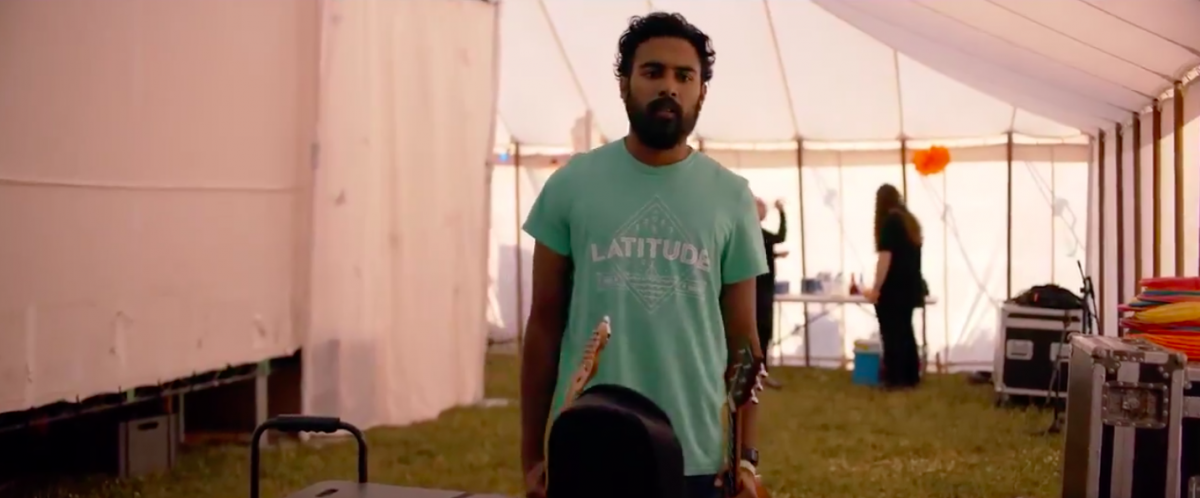
Jack Malek (Himesh Patel) is a busker. It's his hobby as it really doesn't supplement his income as a warehouse-stocker at PriceStar. It's a bit of a dream-chase—he was considered musically talented at the age of 9, the performance which brought him together with his long-time platonic companion/roadie/manager Elly (Lilly James). But Jack is at the end of his guitar-string. A chance to play at the Latitude Festival in Suffolk results in his playing in a thinly-occupied tent. "Great day," encourages Elly. "Yeah!" Jack agrees, sarcastically "I really can't take much more of this."
But, driving him home—she teaches "maths" and has a car and he rides a bike—Elly tries to be encouraging: "Miracles can happen! Like Benedict Cumberbatch becoming a sex symbol!" True dat. But, Jack can't be consoled. "This was my last gig." He bicycles away, accepting his fate. But, fate can change. As he's biking home in the rain, the entire world experiences a 12 second blackout. And in those 12 seconds, Jack is hit by an SUV, upending his life, giving him a concussion, knocking out two of his front teeth, smashing his guitar and bicycle, and creating a huge opportunity. When he wakes up in hospital, diligent Elly is there to tell him the bad news—bad accident, lost the teeth, lost the beard. She fusses over him, then must leave for her job. "Will you still feed me when I'm 64?" Jack sings after her. She dead-stops in the door-way. "Why 64?" "Well, it's the song, you know..." She doesn't. it's the tip of the iceberg.
At a party upon Jack's release, his friends throw a party and gift him with a new guitar, encouraging him to play again, but he demurs: "If God had been remotely interested in my stuff, somebody would have written me a fan letter besides my mum." But, he will play. "A great gift deserves a great song," and he begins the chords to McCartney's "Yesterday." Finishing it, eyebrows are raised, emotions are moved, and jaws are dropped (and this..."well, it's not Coldplay It's not "Fix You"). "What the hell was that?" It was "Yesterday." "When did you write that?" "I didn't write it. Paul McCartney wrote it! The Beatles!" "Who?" Jack is incredulous...and a bit miffed, thinking that his friends are having fun at his expense.
But, no, instead of it being "the most complicated joke I've ever heard," a Google search reveals only the bug, not the band. The Rolling Stones are there (wait, their first hit "I Wanna Be Your Man" was written by Lennon and McCartney...but...okay), but no third-letter-"a" "Beatles." They've been Thanos-snapped out of existence. So have a few other things, but I won't spoil it.
"Don't you realize you're the first three people on Earth to hear 'Let It Be?'" "That's nice, sun..."
He tries other songs. People don't know them. He barely knows them-what are the lyrics to "Elanor Rigby?" "I Wanna Hold Your Hand." "I Saw Her Standing There." "Let It Be." All draw a blank. Performing in coffee houses doesn't turn it into The Cavern Club and his close acquaintances are supportive, but think he's getting a bit of a head when he takes offense at them not realizing the greatness of the songs. Seems a bit stuck on himself, really. But only Malek knows the songs are iconic...or would be if they'd been written. And if people assume he's the author...well, what can he do about it?
An engineer at a low-rent recording studio offers to record him (it's gotta be low-rent because it's built on the side of a rail-road track--interference and low-end rumble, much?). But, the tracks attract attention—Malek gives them away at the PriceStar and it gets him an interview on the PriceStar channel, where he's called "The Singing Wholesaler"...even after he's debuted "In My Life" on the program! What is wrong with these people?
But, one person notices the interview—Ed Sheeran (my response was "who?" and after I read about him and listened to a couple of his songs, I repeated "who??"*) and he pops over to Malek's place (actually Malek's parents' place) and asks him to open for him at a concert in Moscow. Opening for Ed Sheeran? Da-ah! What does he open with? "Back in the USSR," of course. Du-uh! And he makes a sensation, and Sheeran is mystified. When did he find the time to write the song? It was only a three hour flight (brilliant touch to call it the old name of USSR, though...but still).
The viral videos out of Russia (they DO get around, don't they?) of Malek's performance attracts the attention of Sheeran's agent, Debra Hammer (a scary and hilarious Kate McKinnon at full satirical strength—be afraid) and she signs Malek on, prompting—Hammer doesn't prompt, exactly—a trip to Los Angeles for a career make-over and "mind-bending meeting of all meetings" to make him The new sensation.
But, Malek is worried. The marketing emphasis is on his song-writing ability—the debut album is titled "A Man Alone"—and he knows the songs he's acclaimed for are not his own. He fears being exposed world-wide as a fraud and the guilt and shame are starting to make him crack. Plus, Elly has taken up with that recording engineer a long, long time ago (I can tell you from personal experience that THAT doesn't happen...). It begins to feel that the life he's always wanted isn't the life he actually wants. Life's what happens to you when you're busy making other plans (who wrote that? Actually, more to the point, who DID write that?)
"Can we change 'Hey, Jude' to 'Hey, Dude?' Makes more sense, doesn't it?"
Those conflicts, those issues, are what Yesterday is all about, rather than making some grand sci-fi epic about "The Day the Music Disappeared." It is still a "What if..." story, but a more relatable "What if," about choices, career and happiness...and fulfillment. How does it get resolved? If you have to ask, you haven't seen many movies written by Richard Curtis. Along the way, the absurdities of a public life are skewered and pilloried, as well as those of Corporate Overseers both large and small. The film also takes one very surprising chance that I did not see coming, and may make some consider some sort of heresy (he'd laugh), but I found it a lovely moment in a parallel Universe where choices are important, especially if you're making them yourself.
No Beatles lyrics for that. You can't write 'em all.
The gloriously ecstatic advice-song "She Loves You."
Now, if Jack had actually listened to this song, he wouldn't have needed the movie.