Showing posts with label Ian Holm. Show all posts

Friday, October 5, 2018

Juggernaut (1974)

Juggernaut (Richard Lester, 1974) Made in the shock-wave of such star-culling epics as Airport, The Poseidon Adventure, Earthquake, and The Towering Inferno that had the gall to ask: "Who Will Survive?" in its posters, Juggernaut played the same game. See? All the stars are lined up like ducks in a gallery reading to be pinged, just like those other all-star slaughter fests.

Juggernaut plays the game differently, though, while maintaining the conventions. This film is as soapish as the others in terms of interpersonal relationships. But in other disaster movies, people are collateral damage to the epic depiction of crumbling masonry. Lester's film is all about character—the "disaster" is man-made, the people at-risk are portrayed intimately, if not by stars, by strong character actors (
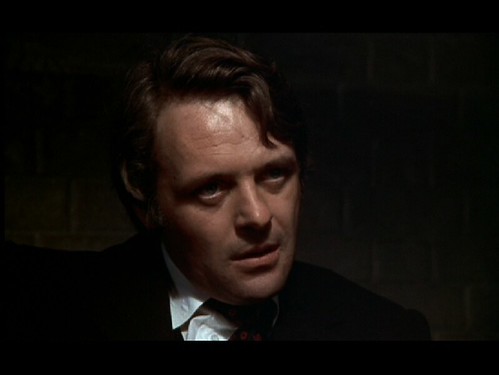
Clifton James, Shirley Knight, Michael Hordern, Cyril Cusack, Julian Glover, Roy Kinnear—Lester's favorite buffoon is given a part to shine in this film—Ian Holm, a pre-fame Anthony Hopkins) you begin to care about. 


The cast is filled with faces who would become more familiar in later roles, but the two leads are Omar Sharif at his dyspeptic best as the Captain of the threatened ship and Richard Harris, who was never better than he is in this movie.
The cruise ship SS Britannic is half-way across the Atlantic Ocean when the line's president (Holm) receives a phone call from "Juggernaut" saying there are seven barrels of high explosive rigged to go off the next day at a predetermined time. Unless a ransom is paid, the bombs will go off and the ship will sink. With the ransom, instructions to defuse the bombs will be sent. Any attempt to defuse the bombs will cause them to explode. Holm's president wants to pay the ransom quickly, but the British government threatens to pull his operating subsidy if he negotiates with terrorists. While Hopkins' Scotland Yard detective attempts to find "Juggernaut," bomb expert Tony Fallon (Harris) and his crew are sent out to the Britannic, dropped in the ocean, and clamber onto the boat.
The focus shifts to Fallon, who sees all defusing jobs as a form of psychology—he's not trying to figure out the bomb, he's trying to figure out the man who made the bomb, and the tense scenes of Fallon examining one bomb to relay instructions to his crew are a whispered monologue of a man on the edge of death attempting to read the mind of the puzzle-maker in a battle of wills.
For director Lester, who is fond of games and puzzle solving, the film is one of his obsessions brought to life with the bomb design being particularly devious. Given its nature, one is put immediately into the Fallon mind-set that he is battling a man and not a bomb. And it is this interplay, where one man must rely on his skills and his knowledge, rather than the tides of Fate, that makes Juggernaut sail past the other films in the sub-genre.

Wednesday, July 25, 2018

The Hobbit: An Unexpected Journey

Written at the time of the film's release.

Getting to Be a Hobbit With Me
or
There and Back Again...and Again...And A-GAIN.

Peter Jackson returns to Tolkien's Middle-Earth, the scene of his greatest triumphs as a film-maker. And it hasn't been easy for him. "The Lord of the Rings" trilogy took the film industry by storm, changing all sorts of accepted things, like "sittable" film length, production timetables (filming three films simultaneously), elaboration of production design, and whether a "fantasy" film can ever be taken seriously by the Oscar Academy for anything other than technical awards. In fact, when The Lord of the Rings: The Return of the King won Best Picture a few years back, more than one gossip-monger (or as they're known, "industry press") suggested it was for the entire series of films, rather than for the merits of the final one. I believe that. So, pressure immediately started to bring Tolkien's "The Hobbit" to the screen in as much the same way as possible, with Jackson producing and Guillermo del Toro directing, a good choice, actually (and the film benefits from his bizarre creature designs).  
But, "The Hobbit"'s past caught up with it, and the several (animated) versions of it came into play over who owned the film rights, and so The Hobbit: An Unexpected Journey has a complicated production titles sequence with Warner Brothers the (North American) distributor and New Line Cinema and M-G-M as the production facilities. M-G-M's financial troubles (now long forgotten in the wake of Skyfall's nearly billion dollar take) caused del Toro to drop out, leaving Jackson and his orc-army of New Zealanders to once again handle the short-duties for the assembled hobbitage.
And how is it?  Much as you'd expect. It's as if they'd never stopped production on the first series, and so sure of the continuity are they, that the moments immediately preceding the start of The Fellowship of the Ring are presented, as if it was the easiest thing in the world to do. The film's been getting lukewarm reviews, and I can't can't quite fathom why. Nothing's really different. The supporting cast is uniformly the same (there's no Viggo, but Frodo is briefly there, and Martin Freeman takes over the role of the younger Bilbo Baggins in a way that seems to suggest a more spry Ian Holm with much faster and more comedic reaction-sense), but the main criticism seems to be a more leisurely pace. This, I don't mind. Jackson has always regretted not showing more of Hobbiton, which might have given "The Lord of the Rings" more of a sense of "home," and as something worth fighting for—a theme played in spades in TH:AUJ.*
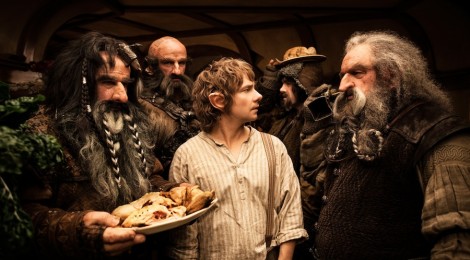
Seeing as so much of it is set in the Hobbit's land, and that the cast is dominated by a baker's dozen of knock-about dwarves (see below for a guide) that have a propensity for one-liners and malapropisms, the tone is considerably lighter and larkier (and dare I say "precious") than the Doom-laden "Rings" trilogy, and it is only once the band of adventurers get going that things change to the previous series' denatured color schemes, brooding skies, ugly thuggery and general bad-assery ensuing.** The pace may be slower, but the film is considerably richer for all of that, and with so many characters in this arc, it's rather a luxury to get to know them before they are threatened in all sorts of ghastly ways.
The other issue with this Tolkien adaptation is technological. Films, since the frame-rate has been standardized, have traditionally been projected at twenty four frames per second, the estimated time that an image is retained by the eye. Now that film is mostly passé, the video standard is 30 frames per second, but it's largely an arbitrary rate to match the traditional film experience. During the late 70's, special effects wizard Douglas Trumbull offered up something he called "Showscan" which was 70mm film projected at 60 frames per second, which produced a larger, sharper image with less "streaking" of movement, due to the higher frame rate. I saw one of these "Showscans" at the Vancouver World's Fair and the effect was like watching a richer, more beautiful version of videotape. It was still film, with its photo-chemical reaction to light, but far more relatable to a "life-image" than film.
TH:AUJ is photographed digitally, but at a frame rate of 48 frames per second (what is being called HFR, or "Higher Frame Rate"), twice that of standard film, and in 3-D (to make what Jackson calls a more "immersive" film experience). The effect, once one has adjusted to it, is quite magical. Jackson doesn't try to do the 3-D tricks that Ang Lee does in Life of Pi, but the faster frame rate does improve the effect of things moving close by in 3-D; there is no longer the "stutter" effect, if something is moving by in the "near-field" at any rate of speed, which is something of a relief. And given that Jackson employs even more helicopter shots over New Zealand terrain here than in the "Rings" trilogy (as well as parallel swooping "crane" shots during the many sequences underground), that's a big help. Where it has its drawbacks are in some scenes that make the CGI characters look like toys figures, some of the impressive building constructs look like play-sets, and a slight mismatch of CGI (particularly during flying scenes) melded with terrain.
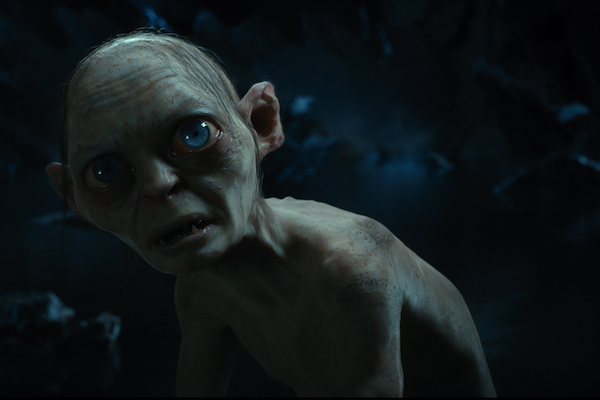
Still, it is hard to quibble when the image is so sharp, Jackson's color sense is eye-popping, and he still manages to keep a shimmering image through murky 3-D glasses. It doesn't look like videotape (as so many reviewers seem to think), as the lighting is more graded and subtle, but the movement recalls a better videotape image, and even something moving fast still has a better chance of being registered by the naked, or glasses-hampered, eye. It also allows the telling detail in even the CGI-est of images, like the moistness in Gollum's eyes, or the deep crags under Gandalf's. It is oddly transporting, and given the care that everyone has put into it, it's a very rewarding experience.

Wilhelm Scream Alert: at 02:05 and 02:35


Ya can't tell a dwarf from a halfling without a program.
* Thauj...sounds like a character name.

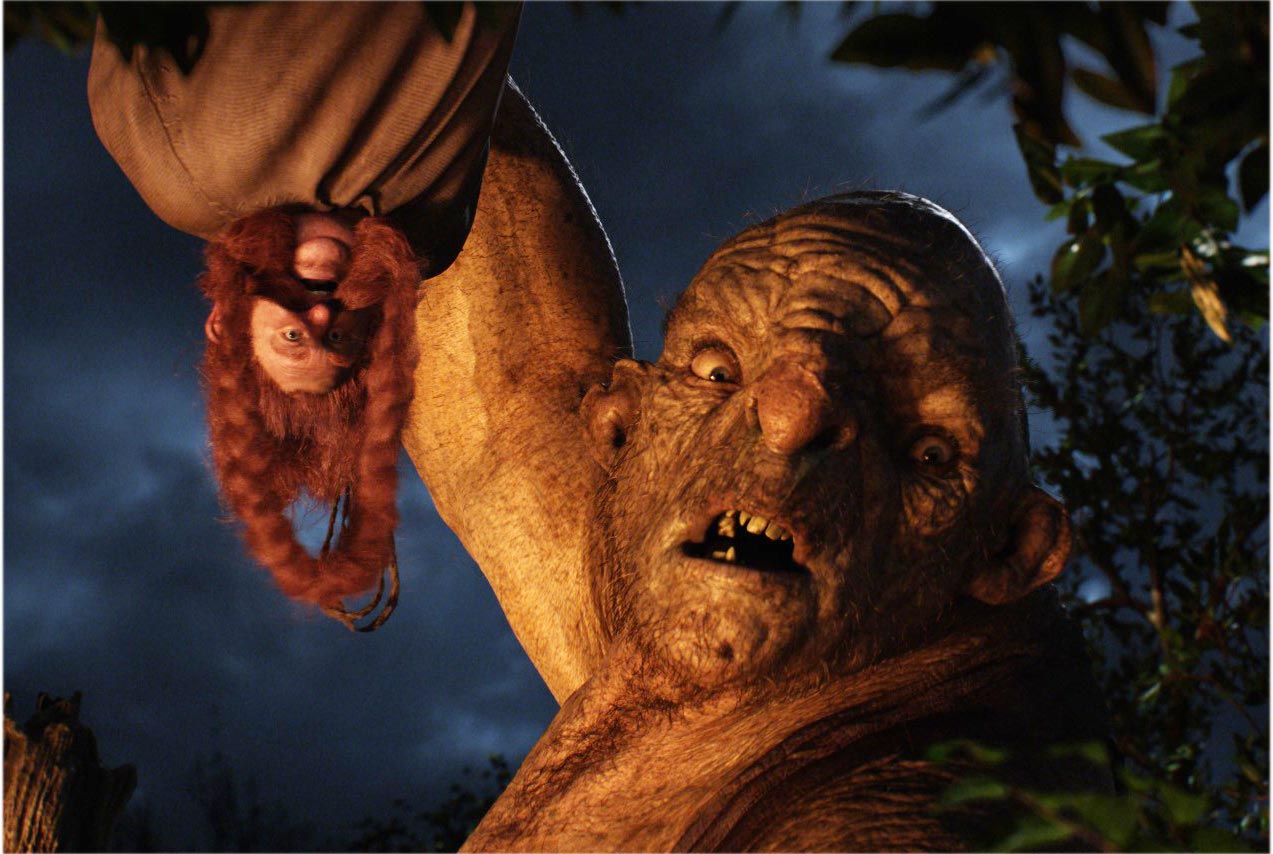
** Speaking of which, things have now approached and gone past the "Indiana Jones" threshold for physical believability here.  There's one particularly Rube Goldbergian sequence fighting trolls in an underground mine that strains credulity—but then, we're talking about a movie with dwarves, trolls, elves, ancient wizards, fire-breathing dragons, giant spiders, animated cliff-sides, and orcs riding big dogs.  That's enough to throw any griping fan-boys off their dyspepsia.  "Dude, this movie troll-kinged the bridge..."

Thursday, May 17, 2018

Robin and Marian (1976)

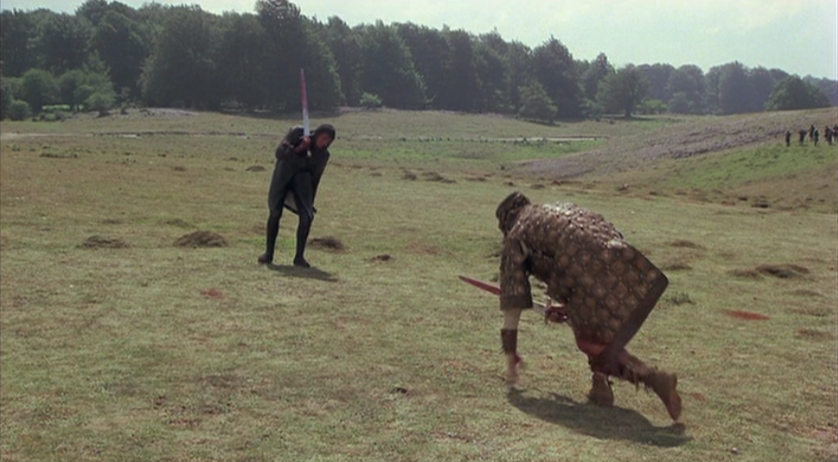
Robin and Marian (Richard Lester, 1976) On paper, it looks perfect. The author of The Lion In Winter jumping a few years ahead in the story to tell of the end of Richard the Lionheart's bloody Crusades, and the return of Robin Hood and the loyal Little John to Sherwood Forest, where they find a lot has changed. Directing would be Richard Lester, who had returned to A-list prominence with his extraordinary staging of The Three Musketeers/The Four Musketeers. He was becoming the "go-to" guy for period dramas, finding ways to bring a mature light-heartedness to any dreary point in history (or more appropriately, he would ignore Hollywood sound-stage pretense and show historical periods a bit more accurately--for example, his fly-filled Rome in the otherwise schtick-filled A Funny Thing Happened On the Way to the Forum). In the years since, his successes had been spotty: Juggernaut, his all-star take on the disaster film, sank at the box-office (never mind--watch it!), as did his dream-project Royal Flash bringing his "Musketeers" adapter George MacDonald Fraser's character to the big screen.
But Robin and Marian had that Goldman script (unfortunately, Goldman's other produced screenplay They Might Be Giants, although good for naming rock bands, also failed at the box-office despite the star-power of a post-Patton George C. Scott and Joanne Woodward) and a dream-cast. Goldman wanted Nicol Williamson as Robin and maybe Sean Connery as Little John. Lester got them, but reversed the roles, which Goldman had to admit, worked. Robert Shaw would re-unite with his From Russia With Love co-star (and golfing partner) as the Sheriff of Nottingham. Richard Harris would play King Richard, Denholm Elliott and Ronnie Barker (of "The Two Ronnies") would be Merry Men. Ian Holm would appear as the weasley King John. But, with the role of Maid Marian, they hit the mother-lode: after nearly a decade off the screen, producer Ray Stark coaxed Audrey Hepburn to play the older, wiser lost love of Robin Hood.
Filming was done in Spain (Lester's old haunt from Musketeers and A Funny Thing Happened On the Way to the Forum) and completed quickly--Lester's a "one-take" kind of director which always appealed to Connery.
Then things started to go wrong.The script by Goldman is charming, but often relies, as did The Lion in Winter on piquant anachronisms--the kind of "Isn't that funny? They talk like we do!" approach to historical drama that can be a bit cloying. "You never wrote!" complains Maid Marian at one point in the script about Robin Hood's many years away. "I don't know how!" says Robin in perplexed reply. But there are some nice things--the over-all theme of living past your prime or need, combined with Robin's nostalgia for the old days and his childish belief that he can make things right again on all fronts. 
There are some nice little cliche-bashings. I remember a couple of cut-away shots of Nicol Williamson's Little John looking pained at Robin and Marian expressing affection for each other, and thinking, "Oh Lord, they're going to make Little John gay!" which I thought was a pretty cheap way to bring in relevance to the story. But it proves to be a clever gambit. Later in the film when Marian goes to John and begs him to keep Robin out of battle, she makes the same assumption. "You've always been jealous of me! But you had him all those years!" Williamson beautifully underplays this scene "Yer Rob's lady," he mumbles. "What?" she cries. "If ye'd been mine, I'd never've left." and Williamson chucks the apple he was eating into the night where it arcs and disappears. Nice set-up. Nice turn. As is the ending, recreating the myth of Robin firing one last arrow through the window, telling John to bury Marian and he where it lands. In Lester's last shot, it never falls to earth.
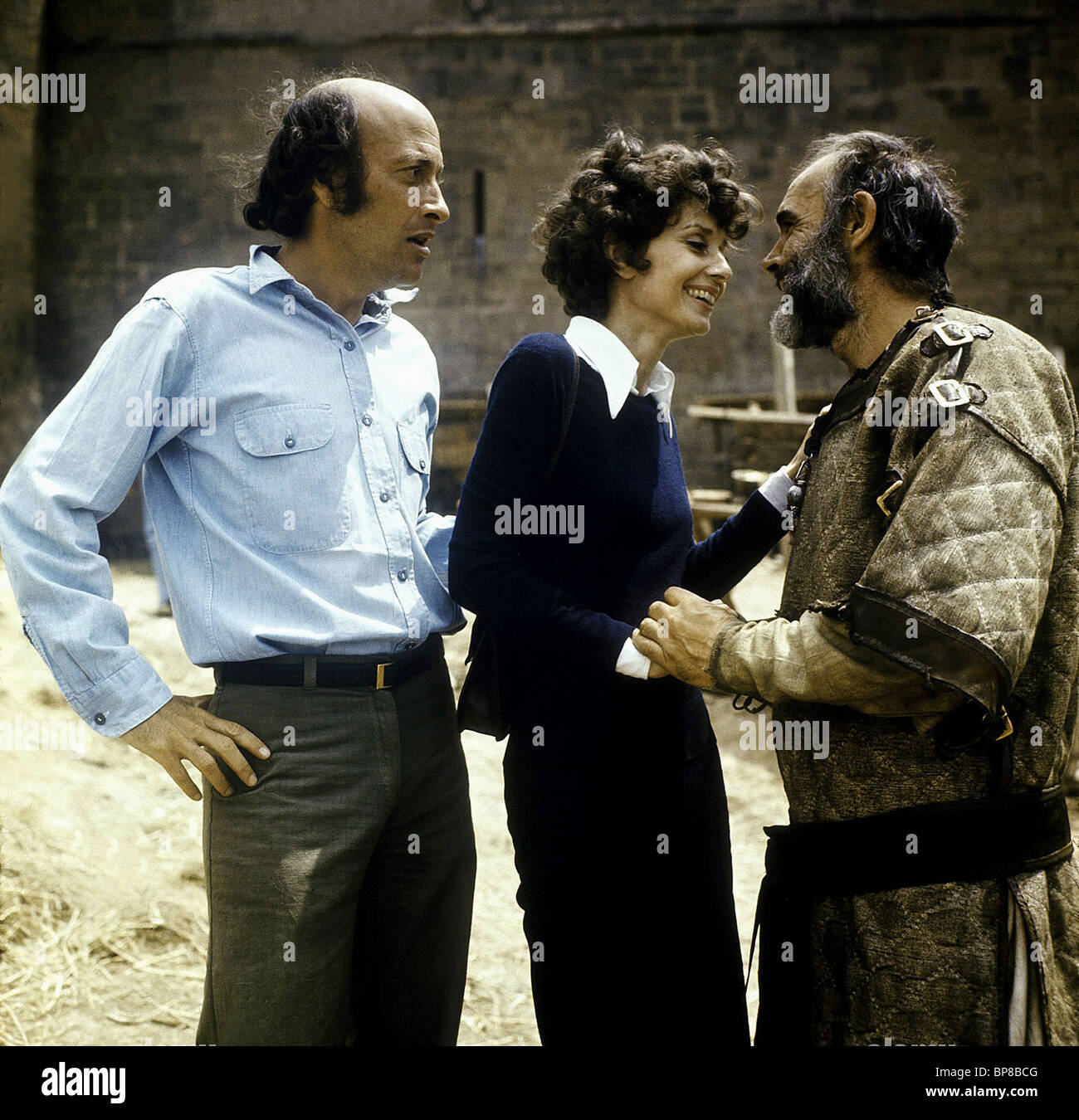
The charm of the script no doubt appealed to Hepburn--she has a speech at the end that most actresses would kill for, though, practically, it slows the film to a crawl at a very critical time. There are publicity pictures of Lester and Connery showing her around the set, but Hepburn, given Lester's directorial approach of "You act, I'll shoot" might have been a bit put off by his quick approach and lack of hand-holding. 
She made complaints about some of the gristlier aspects to Lester's cut, particularly to his opening the film with a shot of ripe fruit, and ending it, with the fruit rotting in the sun. This is a brilliant way to express an aspect of the story--that Robin, and Marian too, have overstayed their usefulness. And the film is gritty. The staging of an opening scene in a burned-out desert fortress feels more like everybody's waiting for Godot rather than King Richard. And Lester keeps his own anachronisms well-chosen, for example Robin Hood's morning routine--waking up in the forest, stretching, brushing his teeth with a fir branch, and reaching for a good ball-scratch until he sees Marian waking up--Connery's hopping attempt to be nonchalant is priceless. 
And the violence is rough stuff. People die very badly in the film despite the chain-mail and armor, and the wounds they suffer are played up. Lester seemed determined to counter-act any chirpiness in the film by bringing it down to Earth. Maybe this upset Hepburn.
But for whatever reason, producer Ray Stark chose to take control. Initially, Lester employed Michel Legrand, his composer for the Musketeers films, to write a period-appropriate score—Legrand opting, instead, to write something a bit more modern, more mature, which Lester wasn't entirely happy with. Stark, hearing the score, and not having control over much else, replaced it with a quickly put-together (two weeks, reportedly) score by John Barry, who'd worked with Lester before (on The Knack...And How to Get It and Petulia) and whose James Bond scores for Connery were well-known. He also won an Oscar for the music for Goldman's The Lion in Winter. Barry's a wonderful composer, but the main-stay of his score is a bucolic love theme that frequently bounces over the scenes and makes them too sweet for a film about the passing of youth and the end of days. It's sounds like it would be more appropriate for a film about frolicsome otters than Robin and Marian. Perhaps Stark thought that would be enough to soothe the blue-haired ladies going to see Audrey Hepburn's first film in a decade. Given her rather cute performance, maybe it would have been a good idea to re-cast her, too. Perhaps she took the role as a chance to get another Oscar (she won in 1954 for Roman Holiday--Katherine Hepburn won for her starring role in The Lion in Winter). She didn't get it. Nor did the blue-hairs show up. The film was not a major hit at the box office.
Having now heard the Legrand score (a bit of which is below), one hears a nice maturity to the score in marked contrast to Barry's. Although it might not be as up-beat, I find it preferable for the film that Lester ultimately made, despite producorial intentions. But we'll never know. Robin and Marian is locked in a bizarre nether-world where it's at once too sweet, but also stark and unsentimental. Lester could make mis-concieved films, but his approach to counter-point Goldman's sentimentality in a world of hardship was a good one. One would have liked to have seen that version of the film.


Compare and Contrast: the same section of film 
scored by Legrand (left) and Barry (right)

Wednesday, December 27, 2017

Time Bandits

Time Bandits (Terry Gilliam, 1981) As a filmmaker, Terry Gilliam grew up with the making of Time Bandits, while still maintaining the childish sense of fun and menace that permeated his work before and during his days with the Monty Python flying circus. Time Bandits is a work of pure imagination, a four-ring freak show that just might kill you, where time is the scene of the crime, and even God and Satan are susceptible to the charms of a precocious little boy with a taste for adventure and the voracious team of avaricious little people that he happens to partner up with. One's tempted to say it's Gilliam's version of Snow White or a flipped version of The Wizard of Oz, but that would be taking the piss and anarchy out of it. Those others would not have the temerity or the audacity of just leaving their tween with a heart-warming life-lesson, but actually challenge him to apply it without the benefit of having a safety net. But, in Gilliam's mind, his hero's fate is unarguably better than the unquestioning materialistic zombie-hood that he would be subjected to with his parents.
11 year old Kevin (Craig Warnock) is fascinated with Ancient Greece, which some parents might find a sign of a curious intellect but inspires nothing but neglect in his parents. One night, the wardrobe in his bedroom is shattered by a horse-bound knight who bursts through it and gallops down a forest road that has suddenly appeared—clearly something is amiss in the space-time continuum! The next night, Kevin wants to go to bed early, but instead of a knight-errant, he's visited by a crush of six thieving "little people." They're demoted employees of The Supreme Being (voiced by Tony Jay, but will appear later as a doddering Ralph Richardson)—seems their previous job of designing trees and bushes was sub-par and they're now tasked with fixing rends in the fabric of space-time. But, being particularly (how should we say?) "entrepreneurial" they've seen that their map of black holes can take them to other Earth-eras, from which they can pillage whatever they can carry in a necessarily brief time. 
"Necessarily" because they're being pursued by extremes of Good and Evil (aren't we all?), with T.S.B. wanting his map back and the personification of Evil (David Warner, clearly relishing the role) coveting the map, so that he can fix T.S.B.'s mistakes and make the Universe more to his liking.
Gilliam's film then hops and darts and falls into an episodic structure, where the diminutive fugitives "crash" various eras, including Sherwood Forest in the era of Robin Hood (John Cleese, doing a hilarious version of Prince Charles), a campaign of Napoleon Bonaparte's (a nearly incomprehensible Ian Holm), who is obsessed with puppet shows (because they're smaller than him), the HMS Titanic (served "neat"), and, to Kevin's delight, Ancient Greece, where he befriends King Agamemnon (Sean Connery*), who is first seen battling a Minotaur. 
Most of it works and works hilariously, even when Gilliam veers into the surreal...and the budgetarily spare. Still, the low-tech miracles Guillam pulls off with limited resources (5 mil' financed by George Harrison's Handmade Films) are awe-inspiring, not only for their realization on film, but also for the sheer visual splendor—and squalor—Gilliam's considerable imagination envisioned (and still does). It's an amazing spectacle, and if the film stutters a bit pace-wise (especially during the Napoleon segment), the delights to the eye tend to gloss over any story-telling problems. Gilliam's pictorial eye would become bolder and his subject matter richer, but Time Bandits was the transition-point between a sketch-comedian/animator and a true film-maker and visionary.
What all the fuss is about


* The script (by Palin and Gilliam) reads: "The warrior takes off his helmet, revealing someone that looks exactly like Sean Connery, or an actor of equal but cheaper stature." Gilliam was shocked that not only had Connery read the script, he wanted the part, and even suggested a disconcerting cameo at the end.

** Northumbrian Tin Soldiers has made sculpts of the bandits, listed as "Dwarf Robbers:"

Wednesday, July 20, 2016

Ratatouille

Written with an uncharacteristic gob-smacked brevity, at the time of the film's release.

"Eet's so, how do you say...Meekey Mouse."
*


Brad Bird may be the natural heir to the Warner Brothers group. His "Family Dog" segment was one of the few good projects created from Spielberg's "Amazing Stories," (and one of the few that broke the mold of the rather atrophied premise, as well). His The Iron Giant is one of the few cell-animation projects of the last twenty years that can genuinely be called a classic despite not having any songs, or being Disney.

When he signed on with Pixar, one worried that his odd sensibility, but impeccable story sense would fit in or get homogenized. Thankfully, his The Incredibles proved to be a winner, and completely went against the S.O.P. of the studio, creating photo-realistic backgrounds for characters who are clearly designed to be cartoon characters. Some folks quibbled that Bird might be saying something about the privileged when his superheroes were forced to suppress their powers, but that's from the crowd that hasn't read a comic in the last thirty years (or an "X-men" comic in the last forty).
Now, along comes Ratatouille, and it benefits from the advancements in digital production and rendering since The Incredibles, for if anything the backgrounds are even more sophisticated and have the feel of being filmed, while the characters are complete flights of Bird's fancy and design sense. Plus, the movements are far more complicated and fluid, the expressions more minute, and the comic timing (a lot of which is owed to Jerry Lewis) is crack. If you want to see the future of animation and how it can be driven to its full application and imagination, Ratatouille is the place to look. And one can only hope that Pixar continues in its tradition of bringing in new story-tellers in animation to stretch their capabilities for years to come (and the short that comes with it, 
Lifted written and directed by former sound designer Gary Rydstrom, is a perfect example of the possibilities**). If everything is run through the John Lasseter filter, the company could lose its potential and grow stale, but films like Ratatouille will keep it at the top of its game and the advancement of the medium for years to come.

2016 Addendum: I unearth this from the DVD pile every so often just to take a look at it to see if, after all the years and Pixar movies and technical advancements, this still holds up. It does. And not because of the animation, which hedged its bet with bipeds by going "full cartoon" with them and away from naturalism—a good choice that seems to have been adapted by every other animation studio working in three dimensions. Water depiction has improved and Nature looks natural now in Pixar movies, for which landscape artists must all applaud.
But it's not the rendering that makes a movie—rendering is important with meat. It is story and story-telling where Pixar has always excelled (with exceptions you could count on a Disneyfied one-digitless hand). Begun by director Jan Pinkava (who directed the Pixar short Geri's Game), Ratatouile ran into story development trouble and Brad Bird, fresh off The Incredibles took over supervision of the film, re-writing parts of it, and doing extensive research in Paris and in cooking classes.
Remy combining tastes with a visual representation not unlike
Disney's experimentations with jazz.
 
The result is a movie awash in good ideas emanating with a rat named Remy (voiced by Patton Oswalt) who wants something more in life than to eat garbage—a rat with good taste. He develops the dream that someday he might be able to become a great chef, which, given rats aversions to kitchens and health inspectors' aversions to rats, is an impossible dream. 
But, with the spirited inspiration of the late populist Chef Gusteau (voiced by Brad Garrett) and the opportune presence and cooperation of Gusteau's bastard child Linguini (Lou Romano) in the Gusteau's Restaurant kitchen, the little rat is given the opportunity to shine, a move that brings new interest in the restaurant, as long as the identity of the "little chef" is not found out. 
The various forms of staff at Gusteau's
There is plenty of opportunity for action of a "scurrying" variety, to keep the kids from fidgeting, but I found the characters and the dedication to concept of aspiring to be something more to be a warming theme—plus, I'll like any movie that tries to tickle one of the other senses besides sight or sound, in this case taste. Bird does some attempts at visualization to communicate the concept of taste, which I found charming, and more than a little reminiscent of the way Disney animators tried to be-bop their animation when it came to explaining jazz. That and an amazing visual representation of "comfort food" which immediately flashed the concept from screen to mind.
But, my favorite thing is its sublime ending, which, as a critic (or more appropriately, a person who appreciates such things) I found extraordinarily well-articulated and with its constantly seeking heart in the exact right place. I so impressed me that a truncated version of that monologue (beautifully played by Peter O'Toole) has a permanent place at the bottom of this blog page. It will always be there.
There have been so many great Pixar movies that continue to astonish and entertain (last year's Inside Out blew me away), but I still think Ratatouille is my personal favorite.

* A French person's reply to being asked about Euro-Disney. Apt.

** The really nifty thing about "Lifted" is that it very obviously comes from a Sound-Mixer's personality. I could relate.