Showing posts with label Denholm Elliot. Show all posts

Saturday, October 8, 2022

To the Devil a Daughter

Saturday is traditionally "Take Out the Trash" Day...
 
To the Devil a Daughter (1976) The last Hammer horror film. Would that they have gone out with something better.
 
It looks so promising, though. With a cast that features Christopher Lee, Richard Widmark, Honor Blackman, Denholm Elliott, and a pre-fame Nastassja Kinski, photographed by an A-list cinematographer, based on a novel by the same author of Hammer's The Devil Rides Out (Lee's favorite of his many Hammer films). But that 1967 film boasted a script by Richard Matheson and was directed by Hammer's most successful director, artistically and financially, Terence Fisher.
 
To the Devil a Daughter had neither of them.
 
The movie bounces back and forth in time, but the story proper begins when writer John Verney (Widmark) is on a book tour in London promoting his latest book on the occult, "The Devil Walks Among Us." At a party given by his friends Anna (Blackman) and David (Anthony Valentine), Verney is approached by Henry Beddowes (Elliott), who asks Verney a favor. Will he go to Heathrow Airport pick up his daughter Catherine (Kinski), who he believes to be in the hands of a mysterious religious sect called Children of the Lord. Why can't he go himself? Well, that's a long story to be told in flashback later.
A flashback more recent than the one that starts the movie, where Father Michael Rayner (Lee) is excommunicated from the Catholic Church for heresy. Rayner, it seems, has gone over to "the dark side" and, in Bavaria, established the Children has a satanic cult with the intention of bringing an incarnation of the demon Astaroth to Earth. And who does he plan to be the bearer of such deviltry? Why, Catherine, of course, who has been raised by the sect for just such purposes, as promised to them by her mother, a member of the Children. Henry was witness to all this and forced not to interfere lest he come to a hellish end.
Hence the machinations of putting Verney into the middle of it, as he "knows the occult" and might be able to fight off the Order. It seems a bit flimsy—Michael Crichton wrote about medicine, but I think I'd want a different doctor to operate on me—but the movie's got to start somewhere. Verney manages to fool Catherine's minders and stash her in his apartment, but Rayner and his flock use black magic and all sorts of arcana to try and find Catherine, and its up to Verney to try to save her soul.  
Despite a good cast and the photography of David Watkin (he worked on it between shooting Mahogany and Robin and Marian), To the Devil a Daughter is some of the worst kind of ghoulish tripe to come out of the post-Exorcist era, taking itself way too seriously, even while some of the instances and special effects make you want to giggle (a bloody demon puppet being the most egregious example). Despite all this, the cast remains stoic and professional, not even hinting of suppressed laughter or inordinate eye-rolling (although Widmark, reportedly, tried to quit a couple times. Damn professional, I think. The creepiest thing about it is Kinski was only fourteen when she made it—it was her second film—and a lot was asked of her. In fact, too much.
 
After the movie came out, Wheatley, who found it not only inept, but obscene, asked Hammer to never again adapt one of his novels. Now, that's saying something. But, one could hardly blame him. The only reason to see it, actually, is for Lee, who thought highly of Wheatley, and seemed to relish the chance to do a Draculish version of a cleric, combining priestly authority with malevolence.

Thursday, May 17, 2018

Robin and Marian (1976)

Robin and Marian (Richard Lester, 1976) On paper, it looks perfect. The author of The Lion In Winter jumping a few years ahead in the story to tell of the end of Richard the Lionheart's bloody Crusades, and the return of Robin Hood and the loyal Little John to Sherwood Forest, where they find a lot has changed. Directing would be Richard Lester, who had returned to A-list prominence with his extraordinary staging of The Three Musketeers/The Four Musketeers. He was becoming the "go-to" guy for period dramas, finding ways to bring a mature light-heartedness to any dreary point in history (or more appropriately, he would ignore Hollywood sound-stage pretense and show historical periods a bit more accurately--for example, his fly-filled Rome in the otherwise schtick-filled A Funny Thing Happened On the Way to the Forum). In the years since, his successes had been spotty: Juggernaut, his all-star take on the disaster film, sank at the box-office (never mind--watch it!), as did his dream-project Royal Flash bringing his "Musketeers" adapter George MacDonald Fraser's character to the big screen.
But Robin and Marian had that Goldman script (unfortunately, Goldman's other produced screenplay They Might Be Giants, although good for naming rock bands, also failed at the box-office despite the star-power of a post-Patton George C. Scott and Joanne Woodward) and a dream-cast. Goldman wanted Nicol Williamson as Robin and maybe Sean Connery as Little John. Lester got them, but reversed the roles, which Goldman had to admit, worked. Robert Shaw would re-unite with his From Russia With Love co-star (and golfing partner) as the Sheriff of Nottingham. Richard Harris would play King Richard, Denholm Elliott and Ronnie Barker (of "The Two Ronnies") would be Merry Men. Ian Holm would appear as the weasley King John. But, with the role of Maid Marian, they hit the mother-lode: after nearly a decade off the screen, producer Ray Stark coaxed Audrey Hepburn to play the older, wiser lost love of Robin Hood.
Filming was done in Spain (Lester's old haunt from Musketeers and A Funny Thing Happened On the Way to the Forum) and completed quickly--Lester's a "one-take" kind of director which always appealed to Connery.
Then things started to go wrong.The script by Goldman is charming, but often relies, as did The Lion in Winter on piquant anachronisms--the kind of "Isn't that funny? They talk like we do!" approach to historical drama that can be a bit cloying. "You never wrote!" complains Maid Marian at one point in the script about Robin Hood's many years away. "I don't know how!" says Robin in perplexed reply. But there are some nice things--the over-all theme of living past your prime or need, combined with Robin's nostalgia for the old days and his childish belief that he can make things right again on all fronts. 
There are some nice little cliche-bashings. I remember a couple of cut-away shots of Nicol Williamson's Little John looking pained at Robin and Marian expressing affection for each other, and thinking, "Oh Lord, they're going to make Little John gay!" which I thought was a pretty cheap way to bring in relevance to the story. But it proves to be a clever gambit. Later in the film when Marian goes to John and begs him to keep Robin out of battle, she makes the same assumption. "You've always been jealous of me! But you had him all those years!" Williamson beautifully underplays this scene "Yer Rob's lady," he mumbles. "What?" she cries. "If ye'd been mine, I'd never've left." and Williamson chucks the apple he was eating into the night where it arcs and disappears. Nice set-up. Nice turn. As is the ending, recreating the myth of Robin firing one last arrow through the window, telling John to bury Marian and he where it lands. In Lester's last shot, it never falls to earth.
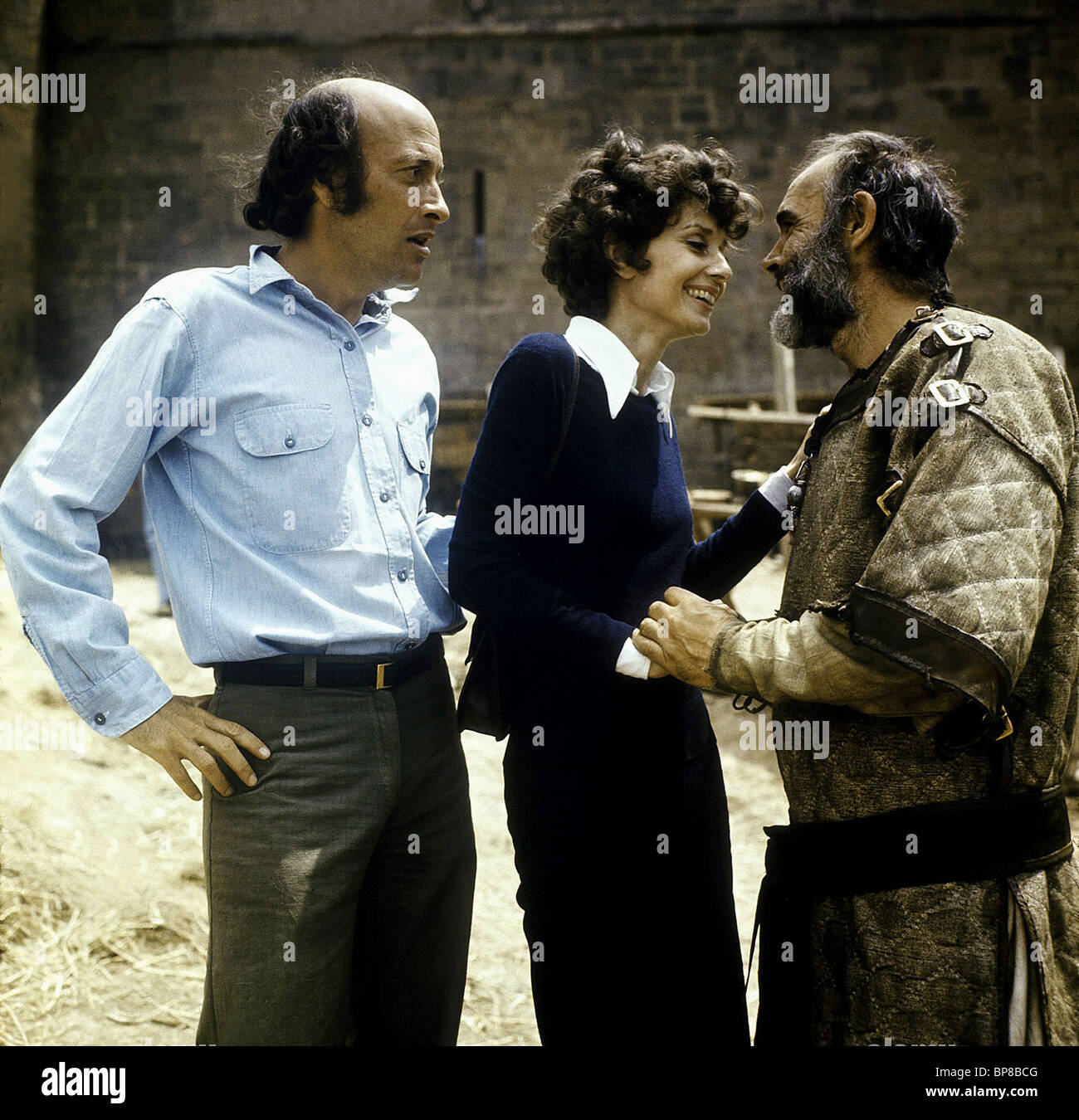
The charm of the script no doubt appealed to Hepburn--she has a speech at the end that most actresses would kill for, though, practically, it slows the film to a crawl at a very critical time. There are publicity pictures of Lester and Connery showing her around the set, but Hepburn, given Lester's directorial approach of "You act, I'll shoot" might have been a bit put off by his quick approach and lack of hand-holding. 
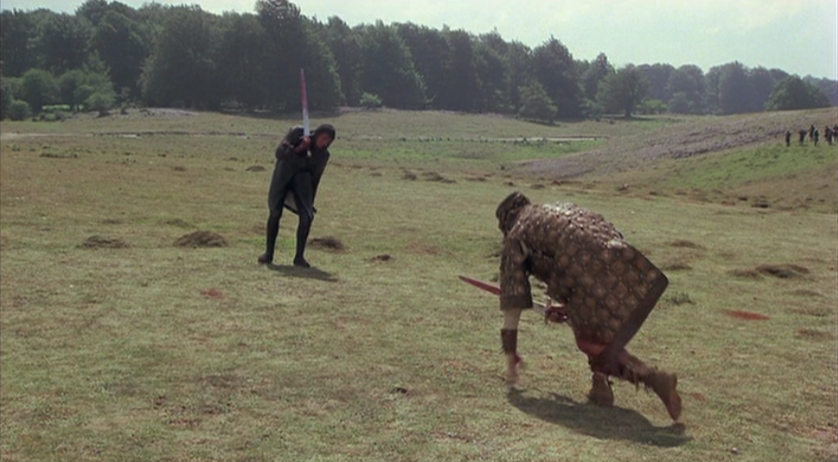
She made complaints about some of the gristlier aspects to Lester's cut, particularly to his opening the film with a shot of ripe fruit, and ending it, with the fruit rotting in the sun. This is a brilliant way to express an aspect of the story--that Robin, and Marian too, have overstayed their usefulness. And the film is gritty. The staging of an opening scene in a burned-out desert fortress feels more like everybody's waiting for Godot rather than King Richard. And Lester keeps his own anachronisms well-chosen, for example Robin Hood's morning routine--waking up in the forest, stretching, brushing his teeth with a fir branch, and reaching for a good ball-scratch until he sees Marian waking up--Connery's hopping attempt to be nonchalant is priceless. 
And the violence is rough stuff. People die very badly in the film despite the chain-mail and armor, and the wounds they suffer are played up. Lester seemed determined to counter-act any chirpiness in the film by bringing it down to Earth. Maybe this upset Hepburn.
But for whatever reason, producer Ray Stark chose to take control. Initially, Lester employed Michel Legrand, his composer for the Musketeers films, to write a period-appropriate score—Legrand opting, instead, to write something a bit more modern, more mature, which Lester wasn't entirely happy with. Stark, hearing the score, and not having control over much else, replaced it with a quickly put-together (two weeks, reportedly) score by John Barry, who'd worked with Lester before (on The Knack...And How to Get It and Petulia) and whose James Bond scores for Connery were well-known. He also won an Oscar for the music for Goldman's The Lion in Winter. Barry's a wonderful composer, but the main-stay of his score is a bucolic love theme that frequently bounces over the scenes and makes them too sweet for a film about the passing of youth and the end of days. It's sounds like it would be more appropriate for a film about frolicsome otters than Robin and Marian. Perhaps Stark thought that would be enough to soothe the blue-haired ladies going to see Audrey Hepburn's first film in a decade. Given her rather cute performance, maybe it would have been a good idea to re-cast her, too. Perhaps she took the role as a chance to get another Oscar (she won in 1954 for Roman Holiday--Katherine Hepburn won for her starring role in The Lion in Winter). She didn't get it. Nor did the blue-hairs show up. The film was not a major hit at the box office.
Having now heard the Legrand score (a bit of which is below), one hears a nice maturity to the score in marked contrast to Barry's. Although it might not be as up-beat, I find it preferable for the film that Lester ultimately made, despite producorial intentions. But we'll never know. Robin and Marian is locked in a bizarre nether-world where it's at once too sweet, but also stark and unsentimental. Lester could make mis-concieved films, but his approach to counter-point Goldman's sentimentality in a world of hardship was a good one. One would have liked to have seen that version of the film.


Compare and Contrast: the same section of film 
scored by Legrand (left) and Barry (right)