Showing posts with label Honor Blackman. Show all posts

Saturday, October 8, 2022

To the Devil a Daughter

Saturday is traditionally "Take Out the Trash" Day...
 
To the Devil a Daughter (1976) The last Hammer horror film. Would that they have gone out with something better.
 
It looks so promising, though. With a cast that features Christopher Lee, Richard Widmark, Honor Blackman, Denholm Elliott, and a pre-fame Nastassja Kinski, photographed by an A-list cinematographer, based on a novel by the same author of Hammer's The Devil Rides Out (Lee's favorite of his many Hammer films). But that 1967 film boasted a script by Richard Matheson and was directed by Hammer's most successful director, artistically and financially, Terence Fisher.
 
To the Devil a Daughter had neither of them.
 
The movie bounces back and forth in time, but the story proper begins when writer John Verney (Widmark) is on a book tour in London promoting his latest book on the occult, "The Devil Walks Among Us." At a party given by his friends Anna (Blackman) and David (Anthony Valentine), Verney is approached by Henry Beddowes (Elliott), who asks Verney a favor. Will he go to Heathrow Airport pick up his daughter Catherine (Kinski), who he believes to be in the hands of a mysterious religious sect called Children of the Lord. Why can't he go himself? Well, that's a long story to be told in flashback later.
A flashback more recent than the one that starts the movie, where Father Michael Rayner (Lee) is excommunicated from the Catholic Church for heresy. Rayner, it seems, has gone over to "the dark side" and, in Bavaria, established the Children has a satanic cult with the intention of bringing an incarnation of the demon Astaroth to Earth. And who does he plan to be the bearer of such deviltry? Why, Catherine, of course, who has been raised by the sect for just such purposes, as promised to them by her mother, a member of the Children. Henry was witness to all this and forced not to interfere lest he come to a hellish end.
Hence the machinations of putting Verney into the middle of it, as he "knows the occult" and might be able to fight off the Order. It seems a bit flimsy—Michael Crichton wrote about medicine, but I think I'd want a different doctor to operate on me—but the movie's got to start somewhere. Verney manages to fool Catherine's minders and stash her in his apartment, but Rayner and his flock use black magic and all sorts of arcana to try and find Catherine, and its up to Verney to try to save her soul.  
Despite a good cast and the photography of David Watkin (he worked on it between shooting Mahogany and Robin and Marian), To the Devil a Daughter is some of the worst kind of ghoulish tripe to come out of the post-Exorcist era, taking itself way too seriously, even while some of the instances and special effects make you want to giggle (a bloody demon puppet being the most egregious example). Despite all this, the cast remains stoic and professional, not even hinting of suppressed laughter or inordinate eye-rolling (although Widmark, reportedly, tried to quit a couple times. Damn professional, I think. The creepiest thing about it is Kinski was only fourteen when she made it—it was her second film—and a lot was asked of her. In fact, too much.
 
After the movie came out, Wheatley, who found it not only inept, but obscene, asked Hammer to never again adapt one of his novels. Now, that's saying something. But, one could hardly blame him. The only reason to see it, actually, is for Lee, who thought highly of Wheatley, and seemed to relish the chance to do a Draculish version of a cleric, combining priestly authority with malevolence.

Friday, April 23, 2021

Anytime Movies #10: Goldfinger

While I catch up on the reviews still in "Draft" phase here, I'll re-run a feature I ran when I first started this blog seven years ago,* when it was suggested I do a "Top Ten" List.

I don't like those: they're rather arbitrary; they pit films against each other, and there's always one or two that should be on the list that aren't because something better shoved it down the trash-bin.

So, I came up with this: "Anytime" Movies.


Anytime Movies are the movies I can watch anytime, anywhere. If I see a second of it, I can identify it. If it shows up on television, my attention is focused on it until the conclusion. Sometimes it’s the direction, sometimes it’s the writing, sometimes it’s the acting, sometimes it’s just the idea behind it, but these are the movies I can watch again and again (and again!) and never tire of them. There are ten (kinda). They're not in any particular order, but the #1 movie IS the #1 movie. 


I’m an unrepentant James Bond fan.


Yes, the movies are sexist and exploitive--frozen in the hardened amber of 60’s attitudes and prejudices.

They’re filled with mink-lined sadism, clueless Brit' snobbery and snarky humor only drunken frat' boys laugh at.

I love it.  And Goldfinger (1964) is the epitome of it all.

Call it a “guilty pleasure” if you must and place it at the end of this list, but homage must be paid and credit given.

There may be better films in the series (that would be its predecessor, the slightly more sober From Russia With Love- and I have warm spots in my heart for OHMSS, the nasty/silly Diamonds Are Forever, The Living Daylights and "the Craigs"). Certainly there are more elaborate and flashy ones, with more spectacle, where you walk out talking about the sets (and not much else).
But Goldfinger has it all, managing to take a middling Fleming thriller (even though Anthony Burgess listed it in his “99 Novels: The Best in English Since 1939” as representative of the Bond series) and improve on it—a rarity in the films. The screenplay (by series veteran Richard Maibaum and utility closer Paul Dehn) is an efficient series of traps and foreshadow-dropping gold nuggets of information that pay off later in the story: Bond’s improvised electrocution of an assailant in a seemingly-unrelated pre-titles sequence sets us up with information for another situation later, as does a casual conversation about discharging firearms in a pressurized airplane cabin (since disproved by the “Mythbusters”) Maibaum and Dehn toss out a group of characters early (and fittingly) to streamline the Big Set-Piece—Goldfinger’s raid on Ft. Knox—and go Fleming one better; instead of the unworkable book idea of physically stealing the gold, the screenwriters just devise a way to irradiate it, making it unexploitable, crashing the U.S. economy while increasing the worth of the villain’s holdings. Neat. They also update the book’s nasty “Perils of Pauline” sequence with a circular saw by strapping Bond to a slab of gold being bisected by the recently-developed laser beam.
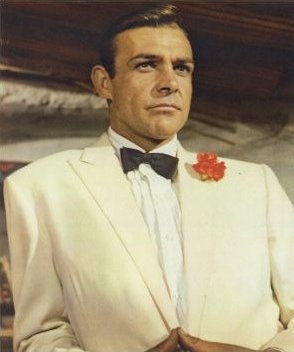
Maibaum excelled at plot and structure, but it was Dehn, a radicalized gay writer who had worked as a propaganda instructor at the OSS "Camp X" during WWII, who tossed in the more cheeky touches. There’s a cool re-appraisal of Bond as a hero in this film. He’s basically kicked between situations beyond his control, something which irked star Sean Connery who saw Bond as an active investigator. Connery was also miffed at some Bond set-ups—the seagull disguise at the very beginning of the film, although he did embrace Bond stripping off a wet-suit to reveal a white linen tuxedo jacket, which he wears to a seedy South-of-the-Border bar (The “cluelessly-overdressed Bond” joke would be done to death in the films until Timothy Dalton put an end to it --although Pierce Brosnan still had his Bond pathologically straighten his tie, even underwater).
His third time out, Connery is finally casual with Bond while tossing in odd little bits of business to suggest that Bond is inches away from being clobbered on a regular basis. The villains are memorable, and the women have defined personalities (for once) with Shirley Eaton’s “golden girl” displaying as much aggressive sexuality as Bond (Eaton, and Gert Frobe, as Goldfinger, had their vocal parts dubbed by other actors). Of course, there's also the gadgetry: the "homer," the lethal bowler hat, the hi-tech exoticism of the laser beam. 
And then, there’s the car.
John Barry’s score is the blaring frosting on the cake: repeating chimes announcing the presence of the villain or anything having to do with gold; sinuous strings, compounding like snakes, creep during the laser beam sequence and Goldfinger’s signature theme blats out in brass clusters. And although other artists’ Bond songs have topped the charts, no one’s topped its theme song (with lyrics by Leslie Bricusse and Anthony Newley) for brio and outrageousness. No one has ever “belted” a song like Shirley Bassey does this.
It also has my two favorite lines from any Bond film. The first, adapted from Fleming:
This is gold, Mr. Bond. All my life I’ve been in love with its color, its brilliance, its divine heaviness.

And from Maibaum and Dehn, a line so good, it’s amazing no thriller had used it yet:
Bond: Do you expect me to talk?
Goldfinger: No, Mr. Bond, I expect you to DIE!

At the time this film was released—1964—all of this was new and glittering like the bullion Goldfinger hoped to exploit. Now, the Bond series has passed the 50th anniversary (appropriately golden) from its first release, and has become something of an institution, spawning imitations, copies, inspirations, and parodies—the glut of "tentpole" superhero films take their playbook from the audaciousness of the Bonds. The series has had to re-invent itself several times in its history, and seems to be in a zenith with the films featuring Daniel Craig. As the line from Skyfall put it, Bond's hobby seems to be resurrection. Now, A-list directors and major stars are making the Bonds, a sign of respect and affection. And, although the prospect has seemed doubtful every now and again, "James Bond Will Return."
It's a sign of the power of the franchise that when it was announced that the latest Bond film would be delayed (just two tantalizing weeks before its opening) due to the Coronavirus pandemic, other films started falling from their scheduled dates like bad gold-plating. All of Hollywood is waiting for Bond to save the day...and the theater box-office. With any luck—and some "discipline, discipline" on the part of the populace—the latest Bond film, No Time to Die, will release in the U.S. in October 2021...

Anytime Movies
Goldfinger
Bonus: Edge of Darkness


* And, on Sunday, we'll put up a "Don't Make a Scene" feature from each week's film.

Thursday, April 17, 2014

Anytime Movies (Transplanted): Goldfinger

While I have a few reviews "in the works," It's as good a time as any to re-boot (actually transplant from the old movie blog) a feature I started years ago, when it was suggested I do a "Top Ten" List.

I don't like those: they're rather arbitrary; they pit films against each other, and there's always one or two that should be on the list that aren't because something better shoved it down the trash-bin.

So, I came up with this: "Anytime" Movies.


Anytime Movies are the movies I can watch anytime, anywhere. If I see a second of it, I can identify it. If it shows up on television, my attention is focused on it until the conclusion. Sometimes it’s the direction, sometimes it’s the writing, sometimes it’s the acting, sometimes it’s just the idea behind it, but these are the movies I can watch again and again (and again!) and never tire of them. There are ten (kinda). They're not in any particular order, but the #1 movie IS the #1 movie.


I’m an unrepentant James Bond fan.

Yes, the movies are sexist and exploitive--frozen in the hardened amber of 60’s attitudes and prejudices.

They’re filled with mink-lined sadism, clueless Brit' snobbery and snarky humor only drunken Frat' boys laugh at.

I love it.  And Goldfinger (1964) is the epitome of it all.

Call it a “guilty pleasure” if you must and place it at the end of this list, but homage must be paid and credit given.

There may be better films in the series (that would be its predecessor, the slightly more sober From Russia With Love- and I have warm spots in my heart for OHMSS, the nasty/silly Diamonds Are Forever, The Living Daylights and "the Craigs".) Certainly there are more elaborate and flashy ones, where you walk out talking about the sets (and not much else).
But Goldfinger has it all, managing to take a middling Fleming thriller (even though Anthony Burgess listed it in his “99 Novels: The Best in English Since 1939” as representative of the Bond series) and improve on it—a rarity in the films. The screenplay (by series veteran Richard Maibaum and utility closer Paul Dehn) is an efficient series of traps and foreshadow-dropping gold nuggets of information that pay off later in the story: Bond’s improvised electrocution of an assailant in a seemingly-unrelated pre-titles sequence sets us up with information for another situation later, as does a casual conversation about discharging firearms in a pressurized airplane cabin (since disproved by the “Mythbusters”) Maibaum and Dehn toss out a group of characters early (and fittingly) to streamline the Big Set-Piece—Goldfinger’s raid on Ft. Knox—and go Fleming one better; instead of the unworkable book idea of physically stealing the gold, the screenwriters just devise a way to irradiate it, making it unexploitable, crashing the U.S. economy while increasing the worth of the villain’s holdings. Neat. They also update the book’s nasty “Perils of Pauline” sequence with a circular saw by strapping Bond to a slab of gold being bisected by the recently-developed laser beam.
Maibaum excelled at plot and structure, but it was Dehn, a radicalized gay writer who had worked as a propaganda instructor at the OSS "Camp X" during WWII, who tossed in the more cheeky touches. There’s a cool re-appraisal of Bond as a hero in this film. He’s basically kicked between situations beyond his control, something which irked star Sean Connery who saw Bond as an active investigator. Connery was also miffed at some Bond set-ups—the seagull disguise at the very beginning of the film, although he did embrace Bond stripping off a wet-suit to reveal a white linen tuxedo jacket, which he wears to a seedy South-of-the-Border bar (The “cluelessly-overdressed Bond” joke would be done to death in the films until Timothy Dalton put an end to it --although Pierce Brosnan still had his Bond pathologically straighten his tie, even underwater).
His third time out, Connery is finally casual with Bond while tossing in odd little bits of business to suggest that Bond is inches away from being clobbered on a regular basis. The villains are memorable, and the women have defined personalities (for once) with Shirley Eaton’s “golden girl” displaying as much aggressive sexuality as Bond (Eaton, and Gert Frobe, as Goldfinger, had their vocal parts dubbed by other actors). Of course, there's also the gadgetry: the "homer," the lethal bowler hat, the hi-tech exoticism of the laser beam. 
And then, there’s the car.
John Barry’s score is the blaring frosting on the cake: repeating chimes announcing the presence of the villain or anything having to do with gold; sinuous strings, compounding like snakes, creep during the laser beam sequence and Goldfinger’s signature theme blats out in brass clusters. And although other artists’ Bond songs have topped the charts, no one’s topped its theme song (with lyrics by Leslie Bricusse and Anthony Newley) for brio and outrageousness. No one has ever “belted” a song like Shirley Bassey does this.
It also has my two favorite lines from any Bond film. The first, adapted from Fleming:
This is gold, Mr. Bond. All my life I’ve been in love with its color, its brilliance, its divine heaviness.

And from Maibaum and Dehn, a line so good, it’s amazing no thriller had used it yet:
Bond: Do you expect me to talk?
Goldfinger: No, Mr. Bond, I expect you to DIE!

At the time this film was released—1964—all of this was new and glittering like the bullion Goldfinger hoped to exploit. Now, the Bond series has passed the 50th anniversary (appropriately golden) from its first release, and has become something of an institution, spawning imitations, copies, inspirations, and parodies—the glut of "tentpole" superhero films take their playbook from the audaciousness of the Bonds. The series has had to re-invent itself several times in its history, and seems to be in a zenith with the films featuring Daniel Craig. As the line from Skyfall put it, Bond's hobby seems to be resurrection. Now, A-list directors and major stars are making the Bonds, a sign of respect and affection. Although the prospect has seemed doubtful every now and again, "James Bond Will Return."
Filming on "Bond 25" begins later this year.


Goldfinger
Bonus: Edge of Darkness