Showing posts with label Glenn Close. Show all posts

Thursday, September 26, 2024

Super/Man: The Christopher Reeve Story

Participant to Observer
or
"And Then She Said the Words That Saved My Life: 'You're Still You and I Love You.'"
 
I assume everybody knows the story: Christopher Reeve, Broadway actor, was picked to play "Superman" in the 1978 movie of the same name—bulked up strenuously to do it—and essayed the role through four films, while also choosing to be in other projects that were farther afield to prevent type-casting. Then, a horse-riding accident left him paralyzed from the neck down—"It's what happens when the trap-door opens and the noose tightens"—unable to breathe without assistance. The doctors gave him a 50/50 chance to live through the night. His older son says that the doctors "re-attached his head to his body."
 
And then he got to work. 
 
Reeve became the best-known advocate for spinal chord injuries and despite his touch-and-go condition, he and his wife Dana, would go anywhere, meet anyone who could write a check, provide a medical path, raise awareness. He also managed to act...and direct projects...totally confined to a wheel-chair, unable to support his neck, breathing with a respirator. 10 short months after his accident, he appeared on-stage in a wheelchair at the Oscar ceremony...and cracked jokes.
 
And the prevailing wisdom became "If he wasn't Superman before, he sure is now." 
His story, with the full cooperation of the Reeve children, his former partner Gae Exton, DC Studios, Warner Brother studios, and anyone who had footage of the man has been released as a "Fathom Event"—one of those special piped-in presentations to a theater environment—and called Super/Man: The Christopher Reeve Story. It makes use of a lot of home-movie footage, contemporary interviews with friends and family, doctors, experts, and archival footage, an amazing curating job executed by directors Ian Bonhôte and Peter Ettedgui.
Reeves' tragic accident—which, when you see it, looks so flukish—raised awareness of the quadriplegic community; if you didn't know someone who was completely paralyzed, suddenly you did. Forget that Reeve was long-past the Superman role and was in lower profile projects and TV movies that were usually seen (mostly) by the devoted, but suddenly, he was uppermost in peoples' awareness.
Bonhôte and Ettedqui take you through the whole life-story, starting on New Year's Eve 1985 with a family celebration and a post-accident Reeve saying "It seemed like my life came together. And then, in an instant, everything changed."* You see home movies of him and his kids charging though sportsy activities with his kids, yelling at them "Carpe Diem!", showing him active, but more than active, downright aggressive. He was a flyer, skier, skater, yachtsman, and as far as horses..."I've always been allergic to horses"...but, loaded up on anti-histamines he learned to ride for a film and fell in love with it. He liked aggressive sports, but insisted he was careful because "I didn't want to see a headline like 'Superman Hit By a Bus.'"
 
That produces a grisly laugh. But, it shows the honesty with which the the piece is presented. Details are presented about his condition are presented to hammer home the precariousness with which he lived through the ordeal, the things left out of the papers, the raw emotions of those going through it are not held in check, and if one comes away unmoved by the honorableness of the participants, then a trip to the ER is suggested to check for a pulse.
A couple of persistent thoughts:
 
— the devotion of Robin Williams. Williams and Reeve were fellow acting students and roommates while attending Julliard and remained steadfast friends. After the accident, if there was anything the Reeves needed, Williams would provide it. On every anniversary of the accident, Williams would host a grand party at the Reeves' place to keep the actor from dwelling on the accident.
—those kids: Reeve had two children with his partner Gae Exton, Matthew and Alexandra, and one child with wife Dana, Will. Their interviews are straight-forward, honest, passionate, and you can't not admire them, individually and together, and you have to wonder at what kind of parents Reeve and both women must have been to produce such amazing people.
 
—the steeliness of Christopher Reeve: that's not some pun. The whole movie is watching Reeve push and push and push himself to improve, whether it's weight-training for Superman or grinding through re-hab. The movie explains his up-bringing—parents divorced when he was 3, and neither parent was what one would call nurturing, but obsessively judgemental. They inscribed in his DNA a restless dissatisfaction with the status quo in order, if not to please them, the potential to please them, by pushing himself. Some of that probably saved his life initially after the accident, but it sure must not have been easy.
 
It's a wonderful tribute, as painful as it sometimes is to watch. The triumphs, the tragedies, the pain. No doubt it will be streaming on some service in the near-future.

* While paralyzed, among all the other things he did, Reeve managed to dictate and get published a couple of books. And he did the audio-books for them (which is where a lot of the narration comes from). Now, think of that: He was breathing through a tube and still managed to record the narration for his two books. I've seen perfectly healthy authors for whom that was a trial. But, Reeve....? Probably gave it his all.

Tuesday, September 22, 2020

Evening (2007)

Written at the time of the film's release...

Evening (Lajos Koltai, 2007) Okay, before we say anything about this movie, look at the cast--that'd be the reason people would be drawn to this movie: Vanessa Redgrave, Meryl Streep, Glenn Close, Eileen Atkins, Claire Danes, Natasha Richardson, Toni Collete. That is some heavy-duty fire-power and far eclipses the male contingent of Patrick Wilson, Hugh Dancy and Barry Bostwick.

Add in the stunt-casting: Natasha Richardson plays the daughter of Vanessa Redgrave's character, which should be easy to do as she's Vanessa Redgrave's daughter. Then there's Mamie Gummer, whose character's wedding is the centerpiece of the flash-backs for this film, and who is played in the present-day by Gummer's real-life mother, Meryl Streep.* All nice for a little conversation-starter at the coffee-klatsch.
But the reason to see this film is late in the proceedings: it's a scene between the two old friends played by Streep and Redgrave, both very old, and the latter, dying. And it's amazing. Redgrave is always good--surprising in how she can breathe life into any kind of scene. To see Streep and her play off of each other, is one of those rare moments of seeing two great actors at the top of their game combining their talents, even if the movie is no great shakes.** Upon finding out who her visitor is, Redgrave's arms fly out, reaching for her, a girlish gasp in delight escaping from this bed-ridden woman of no strength, but for that moment, she's young again, in memory and reality. And the two become gossipy friends again, though Streep's character is held in check somewhat by reality, and Redgrave's has no time for holding back. Great actresses. Great scene.
But the rest of the film is lacking. Whenever the film is off of Redgrave (her nurse is played by Eileen Atkins, who is Streep's counterpart in England), the film lags. Claire Danes plays the younger version in the flashbacks for the better part of the film, and though Danes can make her character dither at the drop of an impulse, that part feels soapy and over-written, and not as felt. And the present-day conflicts of the Redgrave character's children seem far less interesting than the flights of fancy of their dying mother, who flickers in and out of fantasy and reality. In the end, her obsessions are passed off as not amounting to much, though they're important to her, and the lesson of the film--there are no mistakes--comes off as hopelessly banal as saying "It is what it is."
Still, it's an impressive cast, but it's a mired chick-flick, that tested the patience of some chicks I know.

*"Nepotism," I hear you cry. And it is. Funny thing is, Gummer was cast first, and then and only then was Streep, who'd been in screenplay-writer Cunningham's The Hours, approached to play the older part. On the DVD, Gummer cracks: "Nice to be able to find my Mom a job!"

**I'm thinking here of DeNiro and Brando in The Score, or Brando and George C. Scott in The Formula, or Hepburn and Wayne in Rooster Cogburn or Hepburn and Fonda in On Golden Pond. These are events couched in humble films of limited means, and it's just fun to watch legends work together, even if you have to suffer through the rest of the movie to do it.

Friday, June 23, 2017

The Natural

The Natural (Barry Levinson, 1984) Bernard Malamud's novel "The Natural" took America's penchant for mythologizing its sports-heroes, and combined it with Arthurian legend to create one of the great sports novels of all time. 

The tale of a baseball player, Roy Hobbs (played in the movie by Robert Redford) mysteriously appearing in Major League Baseball relatively late for a career usually populated by young men, seemingly effortless of bat and glove, creating miracles in the field, has all the elements of nature and the Divine (his bat, "Wonderboy", was carved from a tree struck by lightning), the contest (he strikes out "The Whammer" (based on "Babe" Ruth), trials (his father's death, a near-fatal shooting, lost love) and battles which weaken him and threaten his reputation. Malamud completes the connection with Legend, by making Roy Hobbes vulnerable to attack from within and without, finally defeated by the passing age and his own failings.
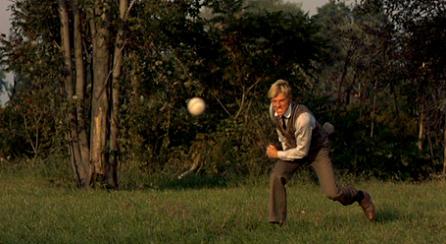
The film made of "The Natural" is all about the myth; Caleb Deschanel's pristine picture post-card cinematography, lovingly back-lit by a dying sun makes a past perfect to the eye. There are few films as lovingly shot as The Natural, and Barry Levinson, learning to be a pictorial director rather than just a shoot-and-run cast-coordinator of his own material, turns the film into an article of his devotion as a sports lover. In fact, despite the intrusion of some adult material—the hanky-panky with a team "widow" (Kim Basinger) and Hobbes' earlier indiscretions, it is a small child's view of baseball, where grown men playing a kids' game are larger-than-life heroes, miracles happen on one's own efforts and the glories last a life-time. From such a viewpoint—at about the strike-zoneeverything looks Legendary.
The cast is crowded with good actors doing some great work—not just Redford, whose own mythical presence of Aryan American brings its considerable WASP-ish weight to the story, but also Glenn Close, Wilford Brimley, Richard Farnsworth, Robert Duvall, Barbara Hershey, Joe Don Baker, Darren McGavin and Basinger. Layered over the top of the confection is Randy Newman's score—a combination of boogie-woogie, keening Americana and heraldic brass.*
Front-loaded with so much talent one would think of the natural as a grand-slam, the mythology built up to accentuate suspense** (Will Hobbs hit the game-winning home run? Will it kill him? What about his new-found family? Will the gambling interests destroy him, no matter what?) It comes down to the last pitch and a finale so overblown that the only thing that could top it would be Hobbs ascending into Heaven, forget the impossibility of the stadium-wide natural fireworks display of the type pulled off by Levinson and crew. The crowd I first saw it with burst into spontaneous applause at the denouement, so, obviously it was a hit with audiences, despite what I considered an error on the play. Me? I thought the game was rigged.
For in Malamud's novel, Hobbs strikes out, is damned by the press and public and fades away, a passing moment of the age, when miracles happened unsullied by the evils of the world like the Knights of Olde. Hobbs is defeated by the times. Not the movie-Hobbs, who is given his triumph and more, a return to simplicity, the sinking sun of previous shots now giving him a roseate glow,*** a Disneyfication of Malamud's intent.


* Redford, according to Newman, wasn't fond of the score: "I don't like horns" he was reported to have groused to the composer. Cooler heads prevailed. During an interview broadcast on Bravo, Newman said that there were half-hearted lyrics for the fanfaric Main Theme: "Look at that man/The Nat'ral/As nat'ral a man as can be/He hits the ball/And that's not all/So Na-tu-ral/Is he."

** I would put a "Spoiler Alert" on this review, but, really, the outcome is never in doubt, telegraphed by the score's hushed anticipation, and that everything joyous in the film, is presented in weighty slow-motion. Besides at that point in his career, Redford didn't want his characters to be weak—he had turned down the fallible lead character in the legal drama The Verdict, a role his pal Paul Newman snapped up and for which he won a Best Actor Nomination.


*** The term used for those hours of twilight and dawn with the sun at its lowest point, providing long shadows, and a rose-colored glow is "Magic Hour."


Friday, April 29, 2016

Hamlet (1990)

Hamlet (Franco Zeffirelli, 1990) So, the big question was NOT "to be or not to be", it was: "Mel? Mel Gibson? Hamlet?" Zeffirelli was no slouch when directing Shakespeare with The Taming of the Shrew and Romeo and Juliet already in his film-list. But Mel Gibson? Lethal Weapon/Mad Max Mel Gibson? How can this come to any good?

Turns out it can.

Seeing
Zeffirelli's Hamlet for the first time is a film-long surprise at how good Gibson is in the role--his performance of the Elizabethan verse often inspired. He's backed by a stellar cast: Glenn Close (nine years older than Gibson) as Gertrude, Alan Bates as an on-guard Claudius, Ian Holm as a much more competent, even wily, Polonius, Paul Scofield, a brilliant ghost, Stephen Dillane as Horatio, and best of all, Helena Bonham Carter's Ophelia.

A second look at the film years later shows the seams. Gibson's Hamlet is all open-mouthed "busy" acting, a bit too manic and protesting too much. But it does make the case that his Hamlet is Glenn Close's son for she does exactly the same thing, gaping for the loges in Zeffirelli's rough-hewn settings. Dillane's "trying-to-take-it-all-in" Horatio and Bates' slimy, wary Claudius come off the best. But they're blown off the screen by the radical turn of Bonham Carter:
Ophelia--From the get-go, Helena Bonham-Carter plays the daughter of Polonius (and object of Hamlet's affections/mental torture), not as a frail flower, but a practical girl, down-to-Earth and obedient to her father, and loving to her brother. Bonham-Carter's line readings of the verse are flat and conversational, not lilting. Her reaction to Hamlet's bi-polarism are confusion, and incomprehension, not histrionics, and when her psyche snaps, there's no poetry in it. You could find her Ophelia on a city street-corner--agitated, rattling, eyes darting and fingers flailing; it's a powerful performance--a radical interpretation, scary and threatening. When she hands out flowers to the royal couple and her brother, she hands them weeds...and bones.
No wonder Tim Burton fell in love with her. Bonham Carter has never steered clear of the dark waters of her characters, and, in fact, will jump into the deep-end and maybe--maybe--swim up to the light. There's never been an Ophelia like this one, and disappointingly, I haven't seen one since. This is a feminist interpretation of Ophelia, one of real power while not sacrificing Shakespeare's text or the role's tragedy. I don't know if the Bard would recognize his creation in this performance, but the actor in him would be amazed.
Here are this film's other "Hamlet" touchstones:
The Ghost--Portrayed by Paul Scofield deep in the shadows, it is a heart-breaking performance, as the grasping King begs for satisfaction from his son, damned as he is for his sins. His Old King Hamlet has all the fear of Hell in his eyes, and a quavering in his voice, a King broken by the tortures of perdition. He's not a formal apparition of the supernatural, but a ghost who is, himself, haunted, and seeks out his son for a last chance at salvation. That's quite a guilt-trip he lays of Hamlet--even more so than a revenge mission. No wonder Gibson's Hamlet looks panicky through the whole movie.
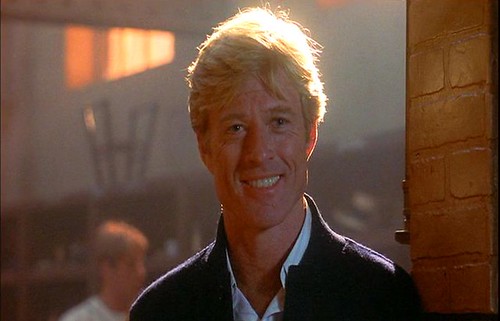
Polonius--verbose he may be, but he's no fool. In fact, as played by Ian Holm, he's a bit of a snake-in-the-grass, currying favor with a calculated duplicitousness. And quite capable of sacrificing his daughter in order to further the fortunes of his son Laertes. And he lets her know in no uncertain terms that she must perform her duties as bait for the good of her family, though not necessarily for her own. His fate seems particularly deserved, rather than an unfortunate ironic happenstance in Elsinore's machinations.
The "To Be Or Not To Be" speech--Gibson walks down stone stairs into the dark to contemplate action/inaction and life/death and does well with "the" speech. His Hamlet is usually at wit's end (heh), but here he is hushed and still, as if not to wake the dead. Apt, as the location he's chosen to do his ruminating is the burial site for old King Hamlet. That's the King's sarcophagous in the back-ground of the screen-cap. Hamlet might be in his own version of Hell during the speech.

Gritty, grimy, with the drama accentuated rather than the artifice of the verse, this Hamlet is a fine interpretation. Gibson might have been the star (and the chief draw), but the humanization of the ghost and the bodice-ripping interpretation of Ophelia make it one to remember in the further explorations of The Great Play.

Saturday, August 16, 2014

Guardians of the Galaxy

The Un--usual Suspects
or
The A-Hole Team,  ("But Not 100% a Dick")

Marvel Studios takes a side-step away from super-hero movies with Guardians of the Galaxy to try another genre of film, the space adventure (something that is somewhat tangential in the "Thor" series) with a super-toe dipped into the comedy dunk-tank. A good thing, too. The latest bunch of Marvel films (post-Avengers) seem ready to atrophy, and are beginning to feel like the same movie over and over again, concluding with a "Really Big Flying Thing smashing into a city-scape."* A little of that goes a long way. Especially after 9/11.

But, it's mixed in with the "Motley Crew" adventure film, where a disparate group of specialists from various walks of life come together as a unit for a common goal (after a requisite period of squabbling and marking each other's territory). Think Seven Samurai and its progeny, and, in comics, The Justice Society and the medium's various "team" books. For this film, Marvel decided to go with the 2008 version of GOTG (cobbled together by Dan Abnett and Andy Lanning), rather than the 1969 Arnold Drake version, set in the 31st Century—the various super-beings of that group being largely unrelatable and obscure.

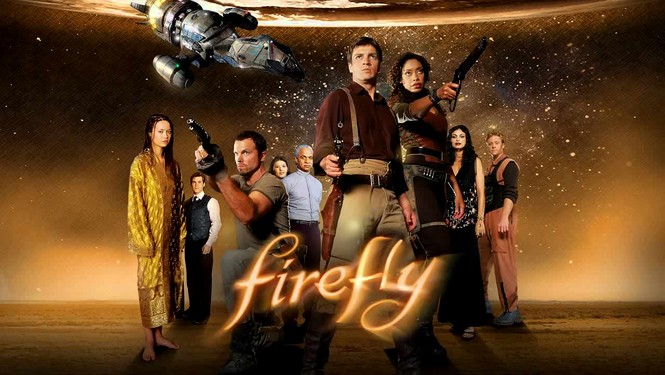
Not that the 2008 crew were any more well-known—their series lasted a mere 25 issues where the first lasted 62—but they are less cosmic in nature and more human in attributes and sensibilities. Its most famous member is probably Rocket Raccoon (who has appeared in various Marvel comics, and is voiced here by Bradley Cooper in a performance that is so distinctive, it doesn't once remind you of Bradley Cooper), because who doesn't love a a laser-blasting procyonid?**  It also has a fully-functioning human character in Peter Quill (Chris Pratt)—who calls himself "Star-Lord"—hijacked by space-pirates from Earth, as a boy.  The group feels like a more species-diverse version of Joss Whedon's "Firefly" crew—and that group's leader was played by Nathan Fillion, who appeared in Gunn's previous movie Super (which we looked at earlier this week) and who provides a vocal performance in GOTG
"Who doesn't love a laser-blasting procyonid?"
Guardians begins with the de rigeur origin story of Quill's abduction and his obsession with a mix-tape from the 70's (an "Awesome Mix Tape" which, indeed, imbues the movie with a lot of its good feelings—like the sight of Star-Lord dancing over the Main Titles to Redbone's "Come and Get Your Love" which is oddly perfect), while, Indiana Jones-ing, he grabs an orb of some significance.  It is the movie's "McGuffin" and will contain a secret "thing" that the villains of the movie want, but the heroes are unaware of its significance or worth.  

Now, stay with me here. Quill ("I'm a junker, dude!") has the orb. His pirate boss, Yondu Udonta (Michael Rooker) of the Kree wants it, too. So does Ronan (Lee Pace) "The Accuser" (not much of a nick-name, frankly) in his capacity for Thanos (Josh Brolin—the character hasn't been seen since the first "Thor" movie's post-credit sequence). Thanos' adopted daughter Gamora (Zoe Saldana—she's green this time) is after the orb for Daddy. Rocket and his pal, the tree-thing Groot (voiced by Vin Diesel, minimally) want Quill for the bounty on his head.  But they cause such a ruckus in town on the planet Xandar, they get the attention of the local constabulary, The Nova Corps (led by Glenn Close, with John C. Reilly as the corpsman with the most lines—in fact, I think that's his name in the movie).
The four are sent to prison in "The Kylin" where conflicts bring in another party to the group Drax (WWE star Dave Bautista, who's not bad, really...) a literal-minded brute ("Nothing goes over my head. My reflexes are too good") with several axes to grind with Ronan—while he was "accusing" one day, he managed to kill Drax's entire family, and Drax wants to "make his stand...though I may die" against him. The party escapes to "Knowhere" where Gamora attempts to find out the secret to the orb by contacting The Collector*** (Benicio del Toro, in a typically bizarre del Toro performance—I mean, why not, this isn't Shakespeare) who reveals that the orb is in reality...
Wait a minute. Wait. At this point, anybody who isn't in the Grootish weeds by this point must have a basement stacked with Marvel comics, all poly-bagged, in acid-free storage boxes, all neatly lined up, either by title alphabetically or by year, and has actually read them and retained all the arcana. The rest of us who don't know the difference between a Kree and a Necro-cat should probably buy a score-card or a libretto before we go in, or console ourselves with the fact that so much of this stuff has such a goofy spin, that the best thing to do is take a "just go with it" attitude and take none of it too seriously. That's easy to do, especially as the movie sails by on a series of distinctive feel-good oldies that are comically out of place in a space epic, even if they are effective in lightening the overall tone of the film.
And it's nice that the film has, as part of its structure, a desire to break the mold of Marvel movie expectations, both in tone, resolution, and in exceeding the grasp of subject matter without getting too heavy about it (as the "Thor" films perpetually do). It walks a rather ungainly tight-rope of having a good time, while raising the bar a bit to expand the playing ground of story material to include more than usual disgruntled tech-masters and villainously-empowered accident victims as antagonists for the heroes. That was wearing a bit thin, especially in the last couple years. It makes this part of the series feel less Earth-bound and thus a little lighter on its feet, paws, or roots and less bound by a force of gravitas—we're talking super-heroes, after all, no matter how dark and leathery we may dress them.

Josh Brolin voices Thanos, who might be the real "McGuffin" of the film.

* Two lines of comic dialogue always defined the rather-unspecifically cosmic Marvel Universe for me: "Look at THAT!" and "I don't know what it is but it sure is big."

** I talked to a customer in my day-job who mentioned she took her four year-old to see Guardians, and I asked "How'd she handle it?" And she laughed and said "She loved it, but all she can talk about are the raccoon and Groot." It gave me a lot of insight as to how kids might relate to the film by concentrating on the fun aspects and letting all the Marvel insidery going over their heads. "She likes to dance like Groot," she added. That scene, which is a charmer is the first of the two post-credits sequences. The other, which is a shock and a surprise, is almost not worth waiting for.
Kids love Groot.
*** The Collector was last seen in a post-credit teaser in Thor: The Dark World.