Showing posts with label David Bautista. Show all posts

Friday, March 1, 2024

Dune: Part 2

Lead Them to Paradise
or
You Can't Have a Messiah Without a Mess at the Beginning.
 
"God created Arrakis to train the faithful"
from "The Wisdom of Muad'Dib" by the Princess Irulan

When last we left Paul Atreides (Timothée Chalamet), he and his Mother Jessica (Rebecca Ferguson) were the last survivors of an attack on their new home on Arrakis by the House Harkonnen, in order to win back the all-important spice-mining business, around which the very Universe itself depends. 

The first film ended with Paul's pivotal killing of the Fremen Jamis—his first real doubter of the Arrakis indigenous tribe—in order to become part of their number and learn their ways, and Dune: Part 2 begins almost immediately after that act.

It is clear—even without a viewing of his continuation—that writer-director Denis Villeneuve dearly loves Frank Herbert's story, and, as a result, it's more faithful than the previous versions (the story is so dense, with plots, sub-plots, and arcana that is was dubbed "unfilmable"), certainly in regards to the ways of Arrakis' inhabitants, the Fremen and their relationships with water and the predatory sand-worms—the "Shai-Hulud"—while also delving a bit more into the ways of the manipulative Bene Gesserit sisterhood, of which Jessica is a part.*
So, along with the blistering action sequences, the vast desert vistas, and the Leni Riefenstahl-styled troop formations, we get a bit more of the sociology of the Fremen, their belief systems, their legends...and that, though they may be monolithic, they are not as homogeneous in their ways as in prior depictions. These Fremen actually have personalities, as opposed to the stoic stalwarts they've been portrayed as before. 
That's good. And it gives them a chance to shine (seeing as how they dominate this second act), and provide rich characters for 
Javier Bardem and Zendaya to play around with, rather than as merely devoted followers to be led. Bardem's Stilgar is shown to be a bit of a romantic zealot, but with enough years to still be suspicious of the legends coming true, while Zendaya's Chani distrusts the prophecies, knowing full well that giving in to a messianic leader is just another form of slavery.
Those are good concepts, part of a couple of the dualities that Dune: Part 2 leans in on—dualities which Herbert chose not to spell out, but merely allowed to percolate as sub-text. And it shows that Villeneuve is confident enough in his work that he complicates it even more than the original author did.
So, there was quite a death-toll among the A-listers in the first Dune, so, right off the studio logos, we start being introduced to the new cast-members, starting with 
Florence Pugh as Princess Irulan, daughter of the Emperor Shaddam IV (Christopher Walken, and it's nice that composer Han Zimmer didn't give him any background music with cow-bells), as the Princess notices the Emperor's ruminating silence over the death of Duke Leto Atreides in the previous film; she is the chronicler of the tale, and it's a good thing because there's quite a lot of catching up to do.
We also get to meet Feyd-Rautha (Austin Butler, proving he's not a one-trick-pony depending on his looks) the Baron Harkonnen's younger, more psychotic son, who is Paul's final test, and, as well, a character no one's bothered with before, Lady Margot Fenring (Léa Seydoux) who's deep in the depth's of the Bene Gesserit conspiracy.
"I'd wish you the (best of luck), but it seems you've won your battle."
Then, there's one character, who's always problematic—Paul's sister Alia (yeah, I'm not going to tell you), the last child of Duke Leto Atreides. Villeneuve eliminates the two year gap that Herbert inserted into the book, so we don't get to see a walking talking two year old, instead we see the child in Jessica's womb, talking to both mother and brother through her thoughts. Okay, weird, but not as weird as it could have been.
A lot of set up here, much like you could say Dune was merely the set-up for Part 2 (which is accurate, but there was so much of worth in the first one that it wouldn't be a fair assessment). It is nearly three hours of non-stop posturing, gritty action and a soundtrack you can feel in your ribs, with all sides circling around each other for a big pay-off that is, justifiably, a little melancholic. Think of The Godfather meeting "Game of Thrones". It certainly does the book justice, and although "Dune" devotees may quibble with a couple of changes—no two year gap, so no Alia and no Guild and the changes to Chani (which I'll get to in a second)--one can't deny that this is as close to movie-form as we're going to get. It's amazing. It's fantastic. It's a must-see. Simple as that for being as complex as that.
And I want to see where they go with the next one ("Next one?" Yeah...author Herbert wrote a few books!). They've done a very logical, character-driven change to the character of Chani...to the betterment, I'd say, as I've always had an uneasiness about her character, previously. It will add a complication, and a personal element to the road ahead (if they follow Herbert's road-map) and if Villeneuve is willing to already muddy the...er.. sand and stir things a bit, I'm all for it.
It's one of those movies that I can recommend without hesitation, and those are few and far between. And I'd love to be able to eavesdrop some of the post-viewing discussions. 
 
For me, being a fan of the book (and a couple of the others), it's nice to be able to look at these two films back-to-back and say that we finally have a "Dune" adaptation, we don't have to make excuses for.
He was warrior and mystic, ogre and saint, the fox and the innocent, chivalrous, ruthless, less than a god, more than a man was. There is no measuring Muad'Dib's motives by ordinary standards. In the moment of his triumph, he saw the death prepared for him, yet he accepted the treachery. Can you say he did this out of a sense of justice? Whose justice, then? Remember, we speak now of the Muad'Dib who ordered battle drums made from his enemies' skins, the Muad'Dib who denied the conventions of his ducal past with a wave of the hand, saying merely: "I am the Kwisatz Haderach. That is reason enough."
--from "Arrakis Awakening" by the Princess Irulan
 
* In fact, the only thing Villeneuve ignores is the Spice Guild, particularly its Navigators, spice-mutated humans who have attained the power to "bend space" and thus travel between worlds, a necessary component in a story about commerce, and the resources needed to maintain them for power. 

Friday, May 12, 2023

Guardians of the Galaxy Vol. 3

"The (10th) Greatest Marvel Film Since Avengers: Endgame!"
or
"The Ballad of Rocket Raccoon"
 
I notice an up-tick in the number of people who looked at my review of Guardians of the Galaxy Vol. 2. I've long since stopped trying to figure out the patterns of what people are looking at, but I suppose it had something to do withe the release of Guardians of the Galaxy Volume 3—the movie that James Gunn was working on when he got hired as the High Evolutionary of the DC Movie Universe.

But, there was no incentive to see it. I haven't watched the last couple of Marvel movies, as they've been sputtering as far as quality, depending on call-backs, cameos, or with no clear sense of where things are going—other than contracts need to be fulfilled, promises made must be delivered on, and a general running-in-place while Kevin Feige tries to come up with a follow-up to the colossal success that was the first batch of Marvel movies. It seemed like, at those times, they were taking chances, swinging for the fences, and hitting home-tuns. Now, it seems they're just counting the receipts, waiting for the Next Big Thing to happen.
 
Trouble is the fan-base is lying in wait. Disappointments among the "TrueFans" may collapse the enterprise like a stack of back-issues no one's bothered to box.
 
Still, folks DID look at the review. I made a point to see it. 
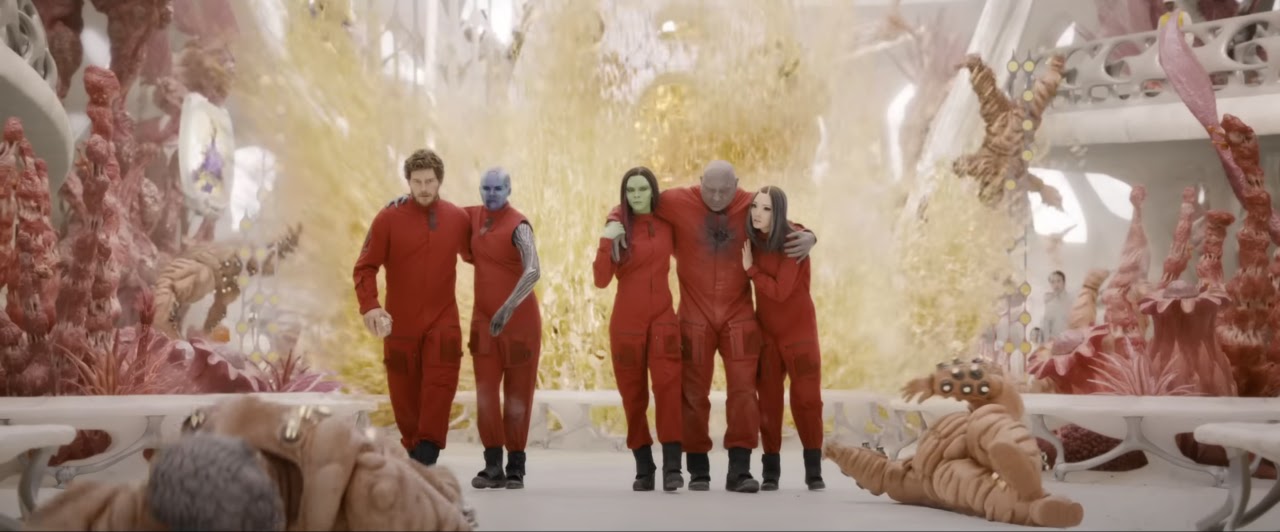
How is it? A pretty good send-off, actually, while being something different. It's an origin story of sorts—of how Rocket the Raccoon (voiced again by Bradley Cooper) came to be a wise-cracking, take-no-prisoners, but still fuzzy-funny animal came to be, mostly told in flash-back, after he is left near-death after an attack on Guardians of the Galaxy HQ (Planet Knowhere) by Adam Warlock (Will Poulter). The super-powered Warlock is on a mission to steal the mercurial mammal for his mother, Queen Ayesha (Elizabeth Debicki) of the Sovereigns at the behest of The High Evolutionary (Chukwudi Iwuji), a sort of gene-split Dr. Mengele/Dr. Moreau of Space, who's on a mission to create the perfect utopia based on his manipulating evolutionary traits.
Yeah, that trick NEVER works, but His Highness (Evolutionarily) wants Rocket—or as he designates him, Test Subject "89P13"—back, as the little varmint was the only test subject of his that displayed original thought, and may be the key to achieving his perfect utopia. Too bad that the way to get him back puts him in a coma.
The Guardians band together to try to save Rocket's life, but discover that he has an implanted kill-switch on his heart that will explode him if they trying any extraordinary efforts to save him. But, Peter "The Star-Lord" Quill (Chris Pratt), still nursing a broken heart after losing his lost love Gamora (Zoe Saldana) during the events of "The Blip"—then getting back an earlier version of her that can't stand him—determines that he's going to find the code to disable the kill-switch and save his little bandit-buddy, even if he has to travel the Galaxy, kill a bunch of multi-legged creatures and even *gulp* face his ex-girl-friend to do it.
And so, they do, over 2½ hours (which feels it, probably due to some rocky transitions that director Gunn has trouble with), meeting new friends and old friends of Gunn's in new roles (Nathan Fillion, anyone?), squeezing in Sylvester Stallone (the guy cannot handle tech-talk), Liz Debicki, and even an appearance by Howard the Duck (voiced by Seth Green, nice), and actually providing "I'm worth-being-here" arcs to Mantis (Pom Klementief) and Kraglin (Sean Gunn). Plus, we get another example of why Karen Gillan may be the most unsung-acting hero in the MCU and a "giving it 100%" performance by Pratt. Throw in a talking space-dog (voiced by Maria Bakalova—"He just called me 'a BAD DOG!'") and you have a vast cornucopia of cutesiness mixed in with Gunn's "ick" factor. Call it "Anthropro-Marvel"—the place where the studio can really get silly (even by comic-book standards).*
Take, for example, the look of the High Evolutionary's Orgosphere—an organic planet made out of meat—which is pure 20th Century Fox sci-fi tacky, ala Fantastic Voyage or Barbarella. It has the look of spareness, but the detail of something well-considered, rather than what the budget could spare. And one just knows, going along that one is missing a gazillion references stuffed into the thing with minor characters and such, but, frankly, there's enough for the non-Marvel Zombie to appreciate.
At the same time, there's a nice little message about universality and worth, where one's lab-rat could just be worth saving if only they were noticed. It's an extension of the original GotG movie, where everyone was, basically, a cast-off, but were worth more than the sum of their parts put together. Here, no one's a loser, except for the one's who never would have suspected they were in the first place. And, once again, it shows that although Gunn will always make films that feel tough-as-nails-cynical, they still have a core of sentimentality to them that puts them a notch above the usual super-hero fare.
 
It's a good movie for the series to go out on (if, indeed, it ends).

* Although judging by the Marvels trailer, they're not going to stop there.

Wednesday, February 22, 2023

Knock at the Cabin

Tied-Up in NIMBY-land
or
What Would Jesus Do?
 
One approaches a new film by M. Night Shyamalan with a sort of dread, not the sort of dread he likes to weave in to the frame so that you have to "holster" your soda and popcorn, lest there be a jump-scare. No. It's the fear of the unknown...especially given Night's track record. Will this be one of "his" good ones? Or, will it all go (as they narrate in those TrueCrime TV shows) "horribly...horribly wrong."
 
If you haven't seen the trailers for Knock at the Cabin (they seemed omnipresent), it's pretty basic "Funny Games" kind of material, but played (I guess you could say) "straight". A gay couple, Eric (Jonathan Groff) and Andrew (Ben Aldridge) and their daughter Wen (Kristen Cui) are vacationing at an isolated cabin in the woods. Four people (Dave Bautista, Rupert Grint, Nikki Amuka-Bird, and Abby Quinn) come out of those woods, ask to be let in, and when they're refused, they break into the house, concuss one of the dads and overpower another one, tie them up, and then ask them to hear them out. They have something very important to say.
Leonard (Bautista) starts with a preamble: "If you could look inside, you'd see my heart is broken because of what I have to do."
 
Doesn't. Sound. Promising. As if tying them up was going to appeal to their sympathy.
Now, straight up, before we going into anything potentially spoilerific, let me say that Dave Bautista is the Most Valuable Player in this thing. Everybody is good in this, even—and particularly little Kristen Cui—but Bautista really sells the premise. He's done very well for himself in previous films, but his Leonard is what makes you believe in the absurdity of the whole concept. His man-mountain is in agony over the role he finds himself playing and makes you believe that he HAS to play it out or the consequences will be cataclysmic. Played any differently and Leonard would have come across as just another Q-ANON supporter shooting up a pizza parlor ("The intel on this wasn't 100%"). But, Bautista's sweating, haunted Leonard, his voice soothing and breaking has just enough weird anti-energy to make you keep watching, even as your better sense or Doubting Thomas is telling you "...wait...wait..."
"What he is about to do" is warn this family that there is an apocalypse coming.  "The cities will drown. A terrible plague will descend. The sky will fall like glass and God's fingers will scorch the Earth." 7 Billion people will perish. But, this family...this family...can prevent it. All they have to do is kill one of their family-members. And it'll stop. It will all stop. There's no "agenda" here. It's not because they're a "gay couple" with an adopted child. They're not on some "anti-woke" crusade. The four were brought to this cabin...because they all saw it in their "visions." They didn't see any people. They just saw the cabin in...their "visions."
Their "visions." And then they met on the internet. And compared stories. And realized...to their horror, mind you...that everything lined up, and they had to act to prevent Armageddon. So, if you wouldn't mind, decide which of you are going to die. Or everybody dies.
At this point, I began giggling. I knew what I would do. Question everything. I wouldn't care if they showed me the coasts flooding on CNN (which, by the way, they do), I'd think these people were total nutters and do everything in my power to overcome them before they did anything to my family.
But, I really began giggling when I started thinking "What Would Jesus Do?" and the answer was "where's the cross?" The Lamb would have a better scope on what was really happening, of course—whether it was really happening—he'd probably gotten The Memo. But, what do these two guys—who already feel a little persecuted in their daily life—do when confronted with this terrible choice? What would anybody do—if they weren't "bearing crosses" from Society—when confronted by this choice-that-would've-driven-Solomon crazy? I think they'd be very un-Christ-like. I think they'd want to see the stats on "the intel."
But, who knows, really? The oceans are rising—(which has been denied, but are YOU thinking of buying ocean-front property?)—and we just went through a plague (which has also been denied). Anybody can come up with reasons why they're so damned sure about not believing the pandemic, or not wearing masks, or saying nobody's landed on the Moon, or the Earth is flat, or Donald Trump won an election that (in reality) he didn't, and even be so potent about it, they would do things that a rational, thinking person would consider "crazy." You don't need to be a "shaman", you just need to hold a grudge. And ignore "Evidence."
So, this little movie. I wouldn't ascribe it as a "woke vs. bigot" argument (although I doubt Ron de Santis would watch it)—it's far too simplistic for that. But, I will note that the screenwriters—"Night" being one of them—changed the story (which featured something pretty grim, even for a movie about The Apocalypse) to tip the scales. Some might argue on the wrong side, but they're definitely tipped, perhaps to make it more a "Night" movie, but maybe more to put it squarely in the "ambiguous" category. Hitchcock did that once—in The Birds—and folks were ready to have him plucked for it, as audiences like to have things nice and neat and explained to them.
"The book did whaaaaaaa...?!"
 
But, I found myself leaving the theater with a grudging admiration for this movie for "going there," whatever its reasons.

Friday, December 23, 2022

Glass Onion: A Knives Out Mystery

Is This Reality?
or
People Who Live in Glass Onions Shouldn't Throw Parties

When last we left renowned detective Benoit Blanc (Daniel Craig), he was solving the suspiciously unsuspicious death at the head of the Thrombey clan. In that mystery, one of the biggest puzzles was why he was there in the first place. Oh, he'd been hired, alright, he just didn't know by whom. It was just one of the intricate mysteries at the center of Catherine Wheel of Cutlery that defined that family and was—unofficially and unadmittably—its family crest.

Now, in Glass Onion (unnecessarily sub-titled "A Knives Out Mystery"*), he's inserted into a similar situation; he finds himself an uninvited guest to an improbable clique-gathering of rich-niks on an exclusive Greek island, at the behest of tech-billionaire Miles Bron (Edward Norton), who has sent mystery boxes to his clutching clutch of friends (whom he dubs "The Disruptors") that, when solved, offers an invitation to his Greek hideaway/headquarters for a weekend that promises a murder mystery and a prize to whoever solves his murder.
The guests are all old friends/associates with Miles: there's Lionel Toissant (Leslie Odom Jr.), a scientist working from Bron's company "Alpha"; there's Birdie Jay (Kate Hudson), former model, "influencer" and CEO of "Sweetypants" loungewear and her assistant Peg (Jessica Henwick)—charged with protecting the Birdie Jay "brand" due to her client's frequent faux pas; there's Duke Cody (Dave Bautista), a men's rights internet "influencer" and his girlfriend Whiskey (Madelyn Cline); there's Connecticut governor Claire Debella (Kathryn Hahn), who has been helped to office by Miles; and finally, there's Cassandra Brand (Janelle Monáe), who co-founded Alpha with Miles and who had been cut out of the company after clashing with him over a new energy fuel, "Klear."
As it's set in 2020 and there's a pandemic on, everyone is required to wear masks until spritzed with an oral COVID remedy. Once everybody's in place, everybody's happy to see each other, surprised to see Blanc, and shocked that Cassandra had "the balls" to attend. Bron is surprised to see Blanc, as well, but for a different reason—he never invited him. Who did? Along with the game that's about to be played, it is one more mystery. Everyone gets settled and gets acquainted, re- or otherwise. It becomes apparent that people are keeping secrets, and most are in some sort of debt to Bron. So, why these folks, why a murder mystery, and...why Blanc?
Why, indeed? But, to mention any more of the details will be to give away 70% of the movie. Why so much? Because you see events played out at least 2½ times. At one point, there is a cameo by Yo-Yo Ma (there are a ton of them**) where he explains what a fugue is, only to have writer-director Rian Johnson do a story version of the same concept in the very movie. Johnson is clearly having fun with the form (just as he did with the "Star Wars" universe, frustrating as it was for Orthodox Fans) and employs some of the hardest tropes in the genre in new and inventive ways. In fact, it rather reminded me of the way Robert Zemeckis capered within his Back to the Future movie in the Part II of the series (which was the one I enjoyed the most). Things are not always what they seem the first time around.
Johnson's co-conspirators in the thing are clearly enjoying themselves: Hudson has rarely been better, clearly enjoying going "all-out" in her performance, and the two actors who have the least screen-cred—Henwick and Cline—are given meaty roles to play, rather than after-thoughts. Norton is his subtly slick self. But, the stand-out (besides Craig's enjoying re-toying with the Blanc character) is Monáe, who has the toughest role, but pulls it off with what would appear to be the least amount of effort. It's part of the charm of the movie.
The other lovely thing about what Johnson is doing with the Blanc series is the sociological perspective. Just as Billy Wilder made movies that played with—and passed a sort of judgment on—the mores of their times, Johnson is making sly comments on worth and celebrity these days.
One doesn't have to make a large leap to figure out who the inspiration for Miles Bron is, but one could also make a case for a few other venture-capitalists who have a great idea but a better way to make other people pay for it. Once the money has rolled in, they can "exert influence" to buy secure the talent needed to make it work. If it doesn't work, you end up in court for fraud. If it does work, well, that was the intention, and if it works a little bit, you can spin it to say it was a complete success. This would be called "public relations."

As such, Blanc sticks out like a sore thumb in the crowd. He's not a "disrupter" (although he's better at it than anybody else on the island), but looks for truth within the bounds of "the System" among all the spinners, shakers, hangers-on, and wannabe's that surround him. Everybody talks a good game, but for Blanc it's no game. Lying is easy, but hard truths are...hard. Even when no one will admit to it. But, then, they have their reasons, and their reasons are that fame is fleeting if not buttressed with hard cash. Truth lasts.
Beneath it all, it's a fight for Truth—far beyond anything else that might be transitorially valuable. But, it's a hidden message hiding in plain sight among the cameos, trickery, feints, and revelations that Johnson delights in cramming into every frame with the hope of throwing you off the scent. My favorite example is the guy who lives on the island who wanders, drunken or high, into the frame and waves off with a "Just ignore me." But, should you? The character is named Derol, but I have a sneaking suspicion his real name might be "Red." As in the Herrings?

* Is that because no one would associate it without the allusion to Knives Out, or no one (at this point) is familiar enough with the character of Benoit Blanc? It's a mystery, itself. As such, that appendage is as irrelevant (and will be increasingly so) as the titles of the so-called "Thin Man" series.
 
**
Benoit Blanc on a Zoom call.
That would be Stephen Sondheim, Natasha Lyonne, Kareem Abdul-Jabbar and Angela Lansbury. 
 
This is just a distraction...and a nearly naked attempt to get clicks.


Tuesday, October 26, 2021

Dune (Part 1)

As the Worm Turns
or
"So, It's Done?" "It Is Done." (No, It's Not)
 
There have been two previous versions of Frank Herbert's classic novel "Dune"—the 1984 David Lynch version* which tried to be trippy and kinky and ended up looking like any other Dino DeLaurentiis sci-fi movie and the Syfy Channel did a mini-series in 2000, which had a bit more of a bead on Herbert's novel, but looked cheap and seemed mis-cast. And there's the legendary Alexandro Jonorowsky version that cost two million dollars while never getting out of the design phase. "Dune" has a considerable history in both the science-fiction and literary circles (which don't intersect too deeply) and has passed through the minds of many directors and scenarists who have considered cracking it, distilling it, trying to fold it into a manageable narrative. No one's been able to do it, especially the folks who made the ones that exist. 
 
The problem with both of them is those versions were so...white! I'm not being a Social Warrior saying this, because "Dune" was not concerned about race in the story, so much as it was with the politics of imperialism and the pivotal moment when indigenous people rise up against their occupiers. It's also concerned with taking back the resources for which that tribe's land is plundered. And it's about the pressures of a charismatic leader, especially when there is a zealotry aspect to it. And it's about evolution. And ecology. And power. And religion. And myth. And a few other things all mixed into the big sandbox. There is too much of Planet Earth in "Dune" for the cast to be solely Aryan. For it to work, there has to be a clash of textures...and I'm not talking about in the production design.
Paul Atreides (Timothée Chalamet) has been having bad dreams. He is the scion of the House of Atreides, led by Duke Leto (Oscar Isaac) and his concubine (Rebecca Ferguson), a priestess of the secretive and influential Bene Gesserit sect, which has been tasked by the Galactic Emperor to take over the fiefdom of the planet Arrakis, the source of the spice "melange", which has made its way throughout the societies as an essential mineral, allowing faster than light space-travel, hyper-sensitive senses, and higher cognitive abilities. Without melange, the gears of humans among the stars grinds to a halt. The spice must be mined, and the House of Atreides has been given the planet's charge to increase production.
Actually, the whole thing is a manipulation by the Galactic Emperor to destabilize the most powerful houses, the Atreides' and the Harkonnen's who have been the previous exploiters of Arrakis, a role they have undertaken brutally. With both houses fighting to the death, wasting their resources while doing so, the only winner would be the Emperor, who would be that much more powerful with no threats to his primacy. But, for Duke Leto it is an opportunity too tantalizing to resist—melange is the oil by which so much of the infrastructure of the Galaxy depends, and if he can successfully increase its harvest, his House will become very powerful, indeed. Possibly bigger than the powers of the Emperor to interfere with. Duke Leto is trying to buy his House's future, but even he doesn't know—couldn't fathom—that it has already been determined, pre-destined, as long as the will to sacrifice to achieve it is followed through. But, that is out of his control.
This version of Dune concentrates on the political manipulation that sets these events in motion, and it is the only failure of the movie that it decides to keep the run-time down to a hefty feature length (although one never feels it's too long). But, it is also the film's strength in that it doesn't scrimp on the detail that makes the story-telling so rich. One feels that this is the first true adaptation of Frank Herbert's vision of things (it has "'thopters"!—he said geekily) with a genuine-looking epic scale. Spaces are vast and the functionally-designed ships seem like they have weight.** At the same time, it manages to convey the vulnerability of little objects—like people—caught up in those expanses.
The cast is top-notch, putting more emphasis on the characters who will disappear (temporarily) like Josh Brolin's Gurney Halleck and Jason Momoa's Duncan Idaho, and focusing on the character of Paul (Timothée Chalamet—I've never seen him less than interesting), at first a callow youth unsure of his place in things, then becoming more of the "man of the house" when they get dicey. And for his limited time on-screen, Javier Bardem makes the most of his role as Stilgar, the leader of the indigenous Fremen (the film ends during a pivotal moment when Paul meets the tribe—a scene that wasn't even IN Lynch's theatrical cut). These flashes of characters will (hopefully) be expanded in any continuation, making one want to cross fingers in anticipation. It's a frustrating business not knowing the future.
That the actors stand out in the epic-ness of Villeneuve's frames (with the masterly expertise of DP Greig Fraser) and don't get lost in it all is a testament to their abilities. You have to be on your "A"-game to compete when Villeneuve gets caught up in his production design, leaving you strolling for minutes enjoying the sumptuousness of the scenery and lighting. He has overplayed that hand in the past, but, here, it all works and works well. No crippling exposition. No favoring the scenery over the characters. The people are figures in the director's landscape, a part of it, and not just walking through it.
And what a landscape it is. This is a beautiful film, whether it's the glittering of "spice" wafting among the grits of the Arrakis sand, or the alligator grills on the sand-worms, or the insectoid nature of some of the tools, the snap of the uniforms, or the vast horizons that bisect the screen, this is world-building and story-telling at its best and most compelling (for a nice sampler of shots check out the video below from the "Amazing Shots" channel at YouTube). 
 
This is the adaptation of "Dune" has been waiting for.


* Lynch turned down directing Return of the Jedi to make this film. Can you even imagine what that might have looked like?
 
** And if I can add an "anti-advertisement" here for HBOMax. I don't care how big your home-screen is, this film deserves to be seen in a theater!