Showing posts with label Frank Oz. Show all posts

Wednesday, August 14, 2024

Jim Henson: Idea Man

I'm Your Puppet
or
Having a Hand in Everything
 
When I was growing up, I fixated on several things to the point of obsession. One was the comic-strip Peanuts. One was America's Space Program. Howdy Doody. Looney Tunes cartoons. J.P. Patches (if you know, you know).
 
Puppets. I think I watched everything that Paul Winchell did. Kukla, Fran and Ollie, Shari Lewis.
 
And Jim Henson. This was before he became the creator of "The Muppets," and was an up-and-coming skit contributor—he'd appear on "The Ed Sullivan Show" and other variety venues, and he had a regular "gig" on "The Jimmy Dean Show" with Rowlf the Dog.
 
But, Henson did things differently. His "bits" would be his bizarre looking puppets (including one which would become well-known as "Kermit the Frog") lip-syncing to some popular record and the bit would usually end with some 90° turn, sometimes violently. They were hilarious and seemed to erupt from some fertile ground of imagination that none of the other entertainers on "The Tube" seemed to have access
.
Henson hadn't intended to become a pioneering puppeteer. He just wanted to get into television, a medium that fascinated him. Although he'd been introduced to puppetry watching the tube, he wasn't personally involved with the art until his last year at Northwestern High School in Hyattsville, Maryland, continuing to study it at The University of Maryland, College Park, where he met his "Muppets" partner and future wife, Jane Nebel.
With wife Jane, Henson devised the skits and bits that the Muppets performed on local and national television shows, as well as doing commercials. On weekends, he began experimenting with film projects, exploring stop-motion animation, rhythmic editing, and juxtaposed cross-cutting. His first, Time Piece, was Oscar-nominated for "Best Live Action Short" in 1965 (it's presented in its entirety below).
Kermit's origins began from the discarded green coat of Henson's mother.
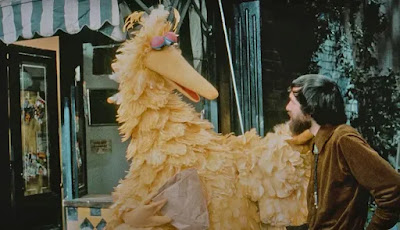
The rest you no doubt know, from Henson's work on Sesame Street—also directing many short avant-garde films for various "numbers" segments—with its vast array of puppets and full-size figures to walk on-set, "The Muppets Show" and movies, "Fraggle Rock," a brief recurring stint on the first season of "Saturday Night"—the percursor title for "SNL," the films The Dark Crystal and Labyrinth. Hundreds of hours of content for movies and television. Plus innovations in puppet-performing, animatronics, special effects, and film-making...not to mention overseeing the construction and manufacturing of building imaginative creatures.
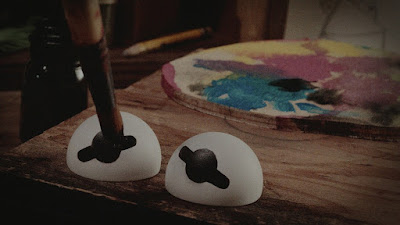
Painted halved ping-pong balls for eyes...
Now, Ron Howard just made a documentary about Henson—Jim Henson: Idea Man—and has been the case for Howard's product lately, it didn't get a theatrical release, but went straight to Disney+ for streaming (except for an appearance at the Cannes Film Festival) on May 31, 2024. So, what was it doing as an ABC special this past Sunday? Disney+, being notoriously stingy with their streaming product, put it on broadcast television within 3 months of its premiere...that's a bit unprecedented. But, follow the logic: Henson's Muppet properties (except those wholly owned by Henson) are owned by Disney. Disney also owns the ABC network, and the night it premiered NBC was airing the closing ceremonies of a much-storied Olympic Games. ABC needed to put something special up rather than roll over and die in the ratings. It's as simple as ABC. Or ABC/Disney.
The fledgling Muppet crew
Howard, who has had an illustrious career as a director—aside from his acting career—has turned in another "safe" documentary. Chapter headings, talking heads (good ones!), a smorgasbord of clips that would even please The Swedish Chef, and a design sense based on things Henson himself had innovated. It's by-the-numbers, like a Ken Burns documentary without that director's eye towards the breath-taking shot, the spurious but telling anecdote and the impeccable eye towards getting the most out of a photograph. Howard colors inside the lines.
Howard is no innovator. His films have no mystery, they never haunt, and they never linger in the mind with deeper implications. He tells the story, simply, effectively, and gets out leaving no after-image. Where a recent documentary on Fred Rogers by a great documentarian like Morgan Neville will leave you in contemplation, Howard makes you feel like you've heard the story enough to feel satisfied. It's like a bed-time story told by a competent nanny. Henson would have never done an auto-biographical film, but he would have made it a thrill-ride with thrills, near-spills and a bit of danger to it.
Those elements are best inhabited by the words of Henson's co-workers, kids, ships that passed, and stars that shined for him. Like Frank Oz, who joined Henson as a high-schooler and under his tutelage became a brilliant puppeteer, actor, personality and director and in his interview seems to share a weight of gratitude. Rita Moreno talks about guesting on "The Muppet Show" and blowing take after take because she couldn't stop laughing until the last take where she barely holds it together...and they used it! "The nostril-flares tell you I'm about to lose it." Jennifer Connelly talks about being a 14 year old on a Henson set...co-starring with David Bowie and feeling like the place was a playground.
 
And in a way, it was, one that we all had access to and could play in. We couldn't see the dollars spent, the hours of prep, the uncomfortable positions (try holding your arm up for 10 minutes!), nor could we see the actual performers, merely their avatars, hidden behind desks, tables, props, out of sight and, rather miraculously, out of mind—even to the people they were performing with. We saw the tip of the ice-berg of creativity, that by the time it appeared on-screen had been honed to a science, made easy to laugh at, without having to consider the men (and women) behind the curtain. 
 
Like Oz.

Henson never played it safe. Maybe, someday, there will be a documentary that will take his same radical tack at looking at this man perpetually behind the curtain while simultaneously so on-stage and call the man what he was: a magical genius.
 

Friday, May 17, 2024

Star Wars, Episode 1: The Phantom Menace in 3-D

Episode I: The Phantom Menace is back in theaters for a 25th Anniversary (Really? That long ago?) and it's doing really well at the box-office, beating out NEW movies. And I've been hearing "buzz"...like an NPR report on "All Things Considered Weekend" that damned with faint praise (hardly the "reconsideration it promised).

But, it did raise some issues, that led to some actual...thoughts. So, I'm re-running my review of The Phantom Menace when I viewed it in its 3-D version.


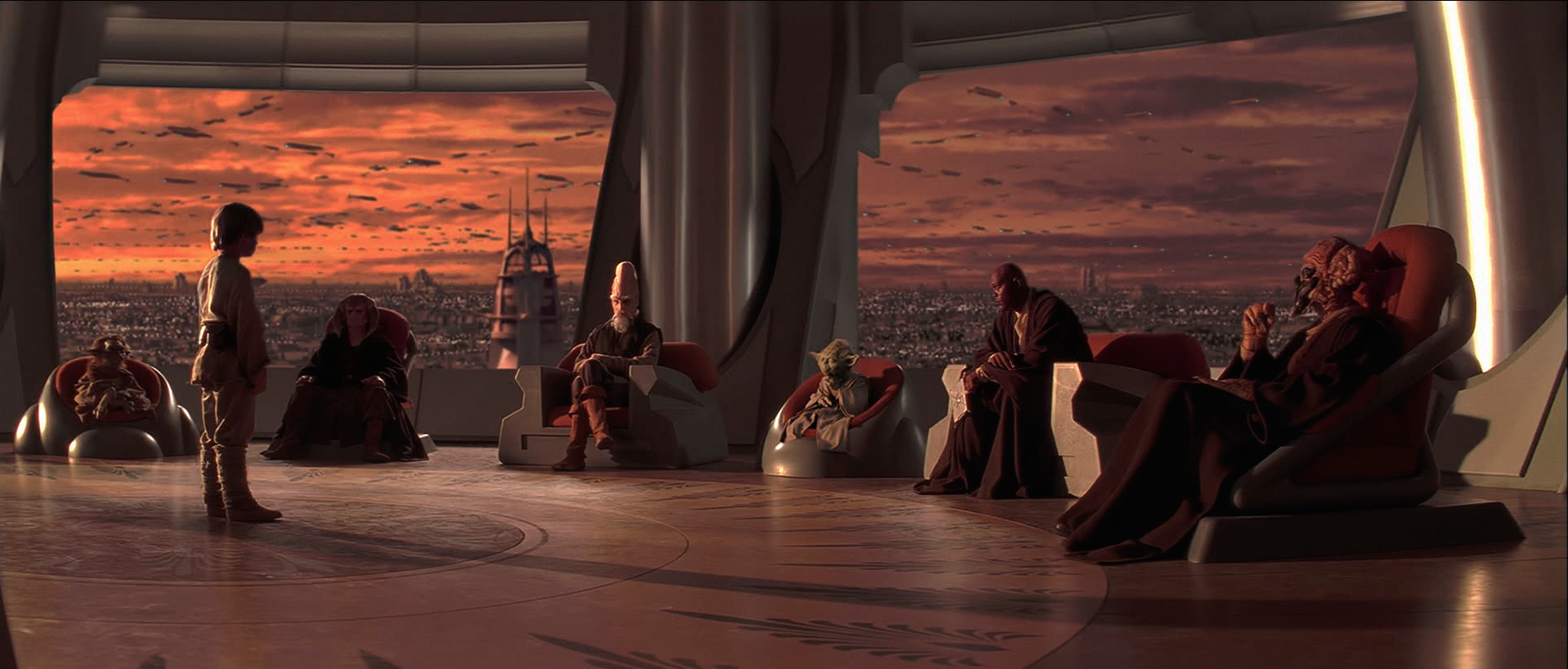
Star Wars, Episode 1: The Phantom Menace (in 3-D) (George Lucas, 1999/2012/in perpetuity) "Star Wars" is the one series I was curious to see in 3-D—the clean, simple lines of force (pardon the pun) from the first immersion into those films (a long, long time ago in 1976) was along a line that extended from behind our heads to points close to the center of the screen: the opening titles that flashed, then crept into a distant infinity; hyperspace travel that zipped into that same bulls-eye quadrant; the cavernous, warehouse spaces of the Empirical HQ's; the approaching death-spirals of various death-stars; slaloms through asteroids and skimming over ice-fields. The movies already seemed yearning to stretch 2-D images into three-dimensional spaces, and although Lucas' spacial sense and action lines became increasingly complicated, and precise cutting more extreme, he always kept that sense of background/foreground busyness that leant itself to three-dimensions without (literally) rubbing our noses in it...or poking our eyes with it.
Naturally, they'd start with Episode 1 this time. After all of Lucas' tinkering over the years, 3-D seems like a natural place to go, especially for the reasons already listed, and there's been enough time out of theaters to make projected images seem unique (plus, there's a ready-made audience already grown up on all six films, who may actually prefer the prequels to their predecessors...despite the sneering of their fathers--"Shut UP, Dad!").

But, whatever the design sense going into the films, they were still SHOT flat.  Yes, there's a lot of post-production digital imagery that can be manipulated, but the actors—the live ones, anyway—are still forever tied to the backgrounds on location, and any cutting/pasting/shifting is going to make those portions look as fake as those late-model View-master pix that weren't taken with stereo-cameras on location, and looked instead like cardboard standees in front of a shifted background.

Not sure how they did it—I suspect it's the adding of shaped shadows to facial features and bodies—but, the 3-D effects are convincing and seamless, and although the picture loses some luster due to the lower light-levels (and those damn glasses), they're the same minor annoyances one finds in any 3-D presentation-it goes with the depth-of-territory.  And, as most of the SW films, pains had already been made to make things multi-planed enough to justify the conversion. Some of the speedier foreground elements tend to go rather unmenacingly phantom-like, but those are on rare occasions. 


Some random thoughts:
—The big vista shots, especially with the Naboo city-scapes, tend to look a bit more miniaturish in 3-D—although the sky-scraping Coruscant scenes play very well.
—I also got the impression that some shots which resisted conversion were just replaced with closer shots—the main ones being
Qui-Gon Jinn (Liam Neeson, who seems to have made the best choice in underplaying his radical Jedi ideologue, although it tends to undermine the character's importance) clucking a Tatooine beast-of-burden into motion, which I was under the impression was done in a fuller shot than the close-up this has, and Obi-Wan Kenobi (Ewan McGregor, who had the best acting arc of all the actors in the prequels) doing a spinning lightsaber move seems to have been moved a bit closer than the original.
—I don't remember The Phantom Menace moving as fast as this viewing seemed to. It's still pretty amazing to see how precise the editing is, and yet manage to get all the visual information necessary to follow what's going on, something not helped by the sound mix, which tends to prefer effects impression over clarity.

—Interesting how
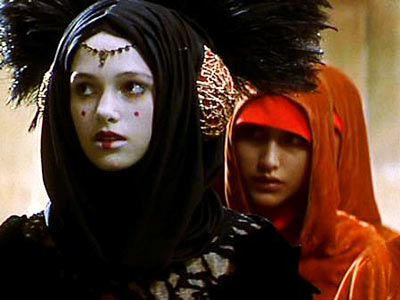
Keira Knightley blends in the role of Queen Amidala's decoy/hand-maiden with Portman's more formal Queen acting (although, considering Knightley is probably a full foot taller than the miniaturish Portman, shouldn't the instinctual Jedi have noticed the subterfuge a little earlier?).

—The last 20 minutes work like gang-busters with the cross-cutting Battle for Naboo on four fronts—
the Gungan invasion by battle-droids, the Padme-led attack on the palace, the attack on the droid-command ship, and the three-sided lightsaber duel, and it's helped immeasurably by John Williams' "Duel of the Fates," which after consisting of a subdued omnipresent sonic wallpaper for most of the film, kicks things into high-gear. 

—Haters are still going to hate it—and, indeed, the fan-boy line has been staunchly adhered to in 3-D reviews—but, the Trade Federation plot resonates a bit more after the NAFTA kerfluffle and the bank meltdowns, and I still like the midi-chlorian idea making Anakin a "virgin birth"—leading me to the thought at the time "what if Jesus Christ turned out to be an asshole?"—even if it was all revealed to be a bio-engineering project by Palpatine in Revenge of the Sith.

No, it ain't perfect—it's a little stiff, with shots of smiles for smiles' sake, and the dialogue clunks along, even if some vital bits of information are slipped in under the radar, along the way. But, as one friend remarked after seeing a student-remixed version of Episode IV, "God, I forgot it was such a cheese-fest." It is. The thing is based on old "
Flash Gordon" serials and embraces the sensibilities of that style of ham-fisted major-key film-making. It's a fantasy film, not a Guide For Living, and subtlety was never in the blue-print. It is a small, quaint little conceit-film-series made Epic by the adoration of its fans. 
Yet, for some reason, George Lucas is to blame for the pushing of "product" (I haven't read any of the 3-D reviews, but the word "greed" keeps popping up in them), when it's the marketplace that drives these things. If people stopped buying this stuff, he wouldn't keep tossing it out there, revamping, tinkering, and attempting to make the films transition across the decades and technologies. We have met the Sith, and they are Us. And, boy, are we dumb!

2024 "Reconsideration"

As Roger Ebert said in his review of The Phantom Menace, "If it were the first 'Star Wars' movie, 'The Phantom Menace' would be hailed as a visionary breakthrough. But this is the fourth movie of the famous series, and we think we know the territory."

Just so. 
But, there were a couple things that Lucas hadn't really addressed in his Universe filled with exotic creatures and wondrous sights.
One of them was fashion, not only in apparel, but also in architecture. The previous films the former was dominated by uniforms and casual wear, and for the latter—other than the cloud-city of Bespin and the militaristic gloss of the Death Stars—everything else was supposed to suggest an improvised environment cobbled together with wire and spit.
Now, there had to be vast functioning cities of well-engineered design with an established history. And the clothes, for the higher end of dignitaries and royalty, had to have an air of regality and authority, where no one was allowed to dress like a scruffy nerf-herder. Nobody really complained about that.
The other was ethnicity. In a bio-diverse Uni-sphere, it was a little improbable that everybody would sound either American of British (the only exception being Millennium Falcon co-pilot Nien Nunb, who spoke in Kenyan). And so, for the sake of diversity, understand, accents were provided for the Gungans, the Trade Federation, and for Watto, the junk dealer on Tatooine. Character accents (that is, the way they speak)—eschewing the very recognizable French, German, and Italian kind—were treated as if they were racial slurs (they are considered offensive, still, in that NPR "reconsideration" above). But, the binary Yank/Brit accents are a bit limiting for such a Universe, don't you think? Shouldn't it be a bit more diverse? To American audiences, apparently not. It's not in our comfort zone. As I said at the end of the piece above, boy, are we dumb.
But, hey, it's just a movie. It's not like anybody treats it like a religion or anything.
Right?

That's right. "We think we know the territory."
 
What we don't know is how damn sensitive we are.

Thursday, April 11, 2024

The Score (2001)

Written at the time of the film's release...

The Score (Frank Oz, 2001) This one is most notable for being the last movie Marlon Brando appeared in, and his presence is probably why DeNiro and Norton and Bassett signed on, because, really, this is no great shakes as a film. It's a rather simple "heist movie," with some interesting switch-backs along the way, which works as an effective metaphor for a bunch of people merely generating a paycheck for themselves. 
 
The first movie directed by Frank Oz that wasn't either a comedy or fantasy, the plot revolves around master-thief Nick Wells (DeNiro), who has decided to retire after a near-disaster during a routine burglary. He knows it's time to get out—he's not getting any younger or any more agile—plus, he's got a rather swanky jazz club to run and right about now would be a good time to settle down with his stewardess girlfriend (Bassett). He's smart, and lasted long enough to know enough to get out while the getting is good.
Then, his fence, Max (Brando) calls with a proposition. The proverbial "one last job" of heist movie clichés. The one to retire on. Seems there's this French scepter thingamabob that was being smuggled into the U.S. through Canada and didn't exactly pass customs. It's being held in an impenetrable safe in a security basement with extra CCTV cameras and infrared sensors at the Montréal Customs House. Everything about the job sets alarms off in Nick's head that it's too risky, from the elaborate job to the extra help he has to take on in the form of Jack Teller (Norton), who has all the details of the job from working as a mentally challenged janitor. Jack has all the details, but he's a bit headstrong, and more than a little reckless.
Of course, there are complications of extra security measures and some inconvenient timing and one twist that should be seen coming a mile away—and luckily the characters in the movie are just as prescient as the audience. It's all quite credible—Mythbusters even gave a thumbs up to the safe-cracking method—and Oz stages it elaborately, but in the end, it's just another heist movie with complications.
One can say that The Score is also notable as having three generations of the top "Method" actors—Brando, DeNiro and Norton—all in the same movie together and doing scenes with each other. But if you expect to see sparks fly between
DeNiro and Brando (The Two Don Vito Corleones) the way they did between Pacino and DeNiro in Heat, you're going to very disappointed.  
Bassett
is completely wasted in the movie as "The Girlfriend," and Norton pulls off one of his "so-good-it's-scary" impersonations, this time as a retarded kid, which borders on the cruel. No, the only sparks are the ones that happened between Brando and director Oz.
Brando didn't like the way he was being directed, so he decided he'd play games calling Oz "Miss Piggy" (of course, Oz played her in "The Muppets") It's just another indication of how far Brando was slipping—a perpetual jokester and lover of comedy, he couldn't even be charitable acknowledging Oz's gifts as a performer. The Score is not a great indicator of anyone's work (except the cinematographer's—Rob Hahn), but it's a shame that Brando went out on this one.

Wednesday, December 18, 2019

Knives Out

Thrombey-land
or
Ladies and Gentlemen Grieve in Different Ways

Mystery author Harlan Thrombey (Christopher Plumber) is celebrating his 85th birthday in a big way. His family is celebrating at the quirky family home for the old man and—as with most family-gatherings—there are issues and squabbles. They all involve money, because Thrombey has been quite a success.

The first clue to that is that he's 85 and living in his own home, as opposed to a facility no matter how healthy he is.

The family Thrombey has done very well for itself: daughter Linda (Jamie Lee Curtis) runs a real estate empire with her husband Richard (Don Johnson), but that was done with a considerable loan from Harlan—their son Hugh Ransom (Chris Evans) left the party early after a tiff; oldest son Walt (Michael Shannon) runs the successful Thrombey publishing empire, but is dissatisfied with the elder Thrombey's resistance to selling the filming rights—he's joined by his wife Donna (Riki Lindhome) and son Jacob (Jaeden Martell); daughter-in-law Joni (Toni Collette), widow of late son Neil, has a line of beauty products and her own self-help business and is paying for her daughter Meg (Katherine Langford) to go an ivy league college.

Then, there's "the help"—housekeeper Fran (Edi Patterson) views the family with a jaundiced eye and maintains her helping attitude with a hidden stash of dope; caretaker-nurse Marta (Ana de Armas) is well-regarded by the family (even if they can't remember her country of origin) and much favored by Harlan for her good heart and her proficiency with the game "Go." After the party, Harlan, after talking privately with all the family members, retires at 11:30.
When Fran brings up his coffee, she finds his bed unslept in and undisturbed. Continuing to his attic study, she finds it very much disturbed and Harlan dead from a slit throat, bled out, his dramatic knife/letter-opener still in his bloody hand. The police think it's suicide and they are in the process—in the form of Trooper Wagner (Noah Segan) and Lt. Elliott (Lakeith Stanfield)—of interviewing the family about the events of that evening, with one addition. He is Benoit Blanc (Daniel Craig, looking perpetually smug and utilizing the drawl of Shelby Foote), consulting detective of note (and "The New Yorker") who has been hired—by parties unknown—to determine if Harlan Trombley really did take his own life...or if it was done by the hand of another.
Like that double-conundrum, Knives Out is a multi-layered movie, not only in its plot, but in its timeline-juggling and presentation. There are complexities built on complexities: the mystery of Thrombey's death, which—at the beginning of the movie—is assumed to be one thing, which is called into question not once but twice for different motivations; the mystery of Benoit Blanc's benefactor as the detective is publicly seeking the truth of the first mystery, but privately is working on who hired him for the job.
He spends a lot of his time grilling the family members, not only looking for clues, but also for motivations about why he might be there. So he eyes the entire family like a smirking hawk, which, initially makes him an unwelcome guest and something of a detecting third wheel—he calms the family's fears by purring "My position here is purely ornamental."). But with the reading of Thrombey's newly-drafted will—"Think of it as a tax return by a community theater..."—the family gloms onto him to prove that Thrombey might actually have been killed, staged to look like a suicide, thus nullifying a will that would leave his family nothing.
And that's where things really get complicated. But, to say more would destroy the web of evidence, the suspicions and the dynamics going on amongst the suspected and suspecting family, as well as the timelines based on points of view that Johnson has intricately constructed like a jenga tower to tell a complicated story, while simultaneously building on it.
Now, the way Johnson has designed it, it puts some focus on the family members and the actors playing them. But, no one has more pressure put on them than the character of Thrombey's nurse, Marta Cabrera (de Armas). Of all the denizens of the Thrombey estate, she is the one closest to the old man, knowing him best and having his trust. She is also the most vulnerable—she's not family, but part of "the help." She has to be compliant and complacent, because her mother is an illegal immigrant and the Thrombey patronage keeps her employed and her mother safe. She fears any threat to that comfort, and the family, especially in the absence of the patriarch, is a hostile work-environment despite the smiles and the surface friendliness.
All the actors have a fine time chewing their respective scenery, but de Armas has the toughest role, playing someone "with a good heart" in a den of thieves while not looking like a victim but also looking competent. De Armas has to go through so many moods that swing back and forth like a pendulum, fading into the background, lest she betray something to the family. She must become simultaneously suspect and detective in order to protect herself and her family. It's a tough job, and de Armas pulls it off charmingly.
Knives Out carries out the time-honored game-plan of the mystery genre, but twists it in a gordian knot. to build audience expectations and then pulls the rug out from under them, staying ahead of the amateur sleuths who are trying to outguess the already-worked-out scenario. At the same time, it's a Christie-an exploration of the foibles and frailties of the upper crust, who are only too ready to break through and fall into the goo, and showing how far things can descend when greed is bad...not good.