Showing posts with label F. Show all posts

Tuesday, April 15, 2025

The Friend (2024)

White Ghost/Sad Pony
or
"What's Going To Happen To The Dog?"

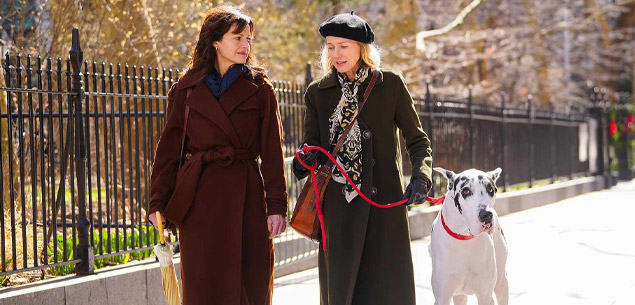
As soon as it's over, you want to watch The Friend again. It's that good, with a literate script, masterful performances (from everybody, not just Naomi Watts and Bill Murray...or the dog, Bing), New York as a background, an intricately selected soundtrack, and the least anthropomorphic animal performance I've seen in a long time.

And, it's a "dog" movie.

I hate "dog" movies, usually. You know why. The dog always seems to die at the end, usually in the dramatic interest of teaching the film's protagonist a life-lesson of great import. Like "life is a gift" or "appreciate what you've got when you've got it." Blah-de-blah-de-blah. I'm cynical of the form because I hate to cry in theaters and beating me with a dead dog turns me into a blubbering wreck and I hate to throw away all the soggy popcorn. The one time I didn't was when John Wick's dog was murdered and that it inspired him to come out of assassination retirement (which I giggled at, finding it perversely ludicrous).
But, this one I rushed to see because, well, 
Naomi Watts and Bill Murray are in it and their taste in parts alone should sell it, some laudatory words online were mentioned, and it's based on a Booker prize-winning novel by Sigrid Nunez. All indications were for some good breeding of a project that was low-key and mildly amusing. I wasn't prepared for a great movie, but I got it in spades.
It starts with a moment of inspiration, which we're not privy to: successful author-teacher Walter Mitchell (Murray) is out on his morning "Two Bridges" jog when he sees something that delights him, but we cut away before we see what has animated him so. We see him at a dinner party where he is holding court, volubly telling the story of his discovery. By the next scene, he is dead—by his own hand, they say*—and the survivors are left wondering how such a thing could happen. What would the world be without Walter? There were so many projects in the air, so many things left undone, and he'd just met his grown daughter whom he—or any of his wives, past or present—never knew existed.

But, hardest hit seems to be Iris (Watts), ostensibly his best friend. Walter was her mentor (currently she's working on a book of his correspondence) and she, in turn, is mentoring his new/old daughter, collaborating on the book. Progress on it has been slow but, now, work on it—like Walter—has come to a screeching halt.
Walter's widow (Noma Dumezweni) has asked Iris to come see her and she has a request. Well, more of a bequest—Walter had asked that if anything happened to him that Iris should take care of his dog, Apollo, the creature that he encountered on that morning run.
"Apollo" is a 150 lb. Great Dane and Iris weighs quite a bit less and is only half-again taller. Plus, Iris' apartment is, what they call in New York, a "studio" but it could be a "prewar", but anywhere else it would be called "cramped" and if you were selling it you'd mention "simplicity" and "ease of maintenance". In no way would it be considered a kennel, and—besides—it's in a "No Pets Allowed" building. Iris is not keen on the idea and her "go-to" is to avoid the Super as long as she can and find a place to "re-home" Apollo. But, in the meantime, she picks up the dog at its temporary kennel to take to what she hopes is its temporary home in her apartment only to find that the brute jumps on her bed and spreads out, despite her protests. His forlorn look prompts Iris' neighbor to remark "There's a PONY on your bed! A SAD pony!"
A sad pony to be sure, but also the elephant in the room. Apollo is just too big to fit into her apartment without obstructing Iris' every movement. She capitulated by pulling an air mattress out of her closet and sleeping on the floor, Apollo's sad eyes never leaving her through the night. But, the two are bonded, despite the separate bed-places in that they're both grieving—she for her mentor, he for his master. One's a human, one's a dog; she's a loner, he's a pack animal, so they're both approaching each other from separate corners. And with all the inconvenience this big white ghost causes in her life, some accommodation needs to be reached, some compromise between these two living beings who've been left behind.
And, ultimately, value.
The Friend, unlike so many "dog movies", is what the AARP magazine likes to call 
"Movies for Grownups". The emotions are complicated and recognizable, and maybe over some folks' heads. But, a New Yorker will recognize the panic of possibly losing a rent-controlled apartment; an older person will recognize the paralysis of grief; a real dog-owner will understand the inconvenience of pet-ownership** ...beyond the dog-movie-cliché antics of four-legged tornado-damage to the feng shui. There are no easy-laugh slobber jokes. This one is about loss, responsibility, and mutual need. And a bit about survivor's guilt. And the usual "taking care of others is more fulfilling than taking care of yourself." And Watts and Murray are brilliant in this.
It's so good and funny and wise that you immediately want to see it again. Or, better yet, read the book to get all the good stuff they couldn't make room for. Sometimes, that's the best part.

* I suppose with the mention of it, I should give the number of the Suicide and Crisis Hotline—If you or a loved one are having emotional distress or thoughts of suicide, call 988 to connect with a lifeline specialist for support.but DOGE only knows if it still exists. From what I've been able to access online, it does. 
 
** The other day something popped up in my news-feed that still makes me laugh: "Nobody has ever said 'What this house needs is a box-full of shit. Let's get a cat!'"

Wednesday, January 8, 2025

Flaming Star

Today would have been Elvis Presley's 90th birthday.

Flaming Star
(Don Siegel, 1960) So, not seeing many Elvis Presley movies—a fan of his music, and his stage performance, but not so much of the "programmers" that Col. Parker insisted he make—I've always wondered about his potential as an actor. He was a great admirer of James Dean, and there's "talk" about how good he was, but there isn't much proof of that in his movies, where he's given songs to sing every ten minutes or so and he's given a persona that comes down to "Elvis with a job," merely. Not much to work with, and certainly no room to grow beyond the parameters of what was expected, and though he kept working on them (at the Colonel's insistence), he grew tired of them—they weren't challenging and were basically fluff for fans. They still have fans to this day—those movies crop up on "Elvis festivals" all the time—but nobody (except those same fans) would consider them great films. What's great about them is Presley and frequently the only reason to see them. Him and the songs.
But, Flaming Star was a chance to break the mold. Elvis sings a couple songs at the beginning and that's it—they're disposed of quickly. This one has a story, a good "theme" backing that story, and a terrific director, Don Siegel, who was still making B-pictures, but good ones that would become classics like Invasion of the Body Snatchers, and he would make The Killers, Coogan's Bluff, Madigan, The Beguiled, Dirty Harry, Escape from Alcatraz, The Shootist. He was a quick filmmaker and "cut in his head," imagining just the camera-angles and enough footage to make the splices go by unnoticed (a skill he'd honed working for the Warner studio in the editing department—you can see his name in the credits for "montage" on Casablanca, Now, Voyager, They Drive By Night and Edge of Darkness). 
The setting is Texas in 1878 and two brothers, Clint (
Steve Forrest) and Pacer Burton (Elvis Presley) are approaching their family cabin warily as all is quiet and dark even though it is still evening. There is tension in the air as the nearby Kiowa tribe has a new chief, Buffalo Horn (Rodolfo Acosta), having replaced the old chief of the tribe, and there have been aggressive attacks to take back their traditional hunting grounds, now "settled" by whites. But, despite drawn guns and quickening pulses, they find that the lights are out for a surprise birthday party for Clint (belated though it is).
Of course, the party is hosted by Clint's father Sam (John McIntire) and his step-mother Neddy (Dolores Del Río), a Kiowa woman and mother of Pacer, but also in attendance are Clint's fancier (Barbara Eden replacing a dismissed Barbara Steele), as well as characters played by Richard Jaeckel
and L.Q. Jones (briefly).
Briefly, because after the party breaks up for the night, three of the returning party are killed by Kiowa warriors when "the Howard place" is attacked in the middle of the night. Being isolated, the Burtons don't hear of it until Clint and Pacer ride into town for supplies and are nearly set upon by the Pierces (Jaeckel and Eden) for even setting foot in their place—Pacer being half-Kiowa. They manage to get what they need, but the hatred towards Pacer by association lets them know that the entire Burton clan is not going to have an easy time of it, from the settlers in town or from the Kiowas (Buffalo Horn already having made a nighttime visit to their homestead to palaver with Pacer).
It's only emphasized when a posse hunting Buffalo Horn visit the Burtons with one question—whose side are they on? Tempers are high with the men referring to Clint as "the only white man in the family" and shots are fired when things get too heated. The next morning, Pa and Clint find that the posse has stampeded their cattle and shot them all down out of spite, prompting Clint to vent that the white are worse than the Kiowas—"An Indian will rob you blind if he can but this is all waste and meanness." The Burtons are in an extreme situation, but where Pa says they've always been, "folks in the middle."
This is an atypical Elvis vehicle (which were basic celebrity vehicles) but not an atypical Western for the time in which it was made, on the cusp of a society-changing civil rights movement, where hearts and minds were in a process of retrospection of the country and what it's ideals really meant. Considerate directors who had moved beyond the early tropes of "cowboy movies" and considered not only the challenges of the European western expansion, but also its costs...and it's crimes. History is more complex than the dictates of a popular entertainment, and Flaming Star slots perfectly well in the genre's still-early reappraisal.
But not for an Elvis vehicle. But, Presley, fresh out of his military service, rises to the challenge. In his previous movies...and future ones...he wasn't required to do much but be a version of his star persona. If anything the range only required a befuddlement over who his next dance-partner would be.
But, this role requires a stretch, far beyond the dictates of a musical format...he's embattled, hated, conflicted, and constantly challenged, all of which comes through without an audience having to compensate for his celebrity. And, although helped by a fine crew of stuntman, he's also good in the action sequences (especially in a vigorous and violent third act). It's a terrific performance, far beyond what you'd come to expect from one of his similarly mononomic contemporaries. For a similar performance, look at the best movie-work of Dean Martin, Bobby Darin, or Sinatra. It was what he aspired to, and though he may be best remembered for his rock n' rollin' higher profile films, this was him at his dramatic best.

Wednesday, December 18, 2024

Flow

Time and Tide
or
"Never Get Outta the Boat!"
 
It's a late entry, but I wouldn't be surprised if the Oscar for Best Animated Film goes to an obscure little film from Latvia, instead of the very well-funded projects out of Pixar, Disney, Dreamworks or other cartoon shops. Considering that it's been a very strong year for animation with Inside Out 2, Moana 2, The Wild Robot, and Robot Dreams, Flow, that film from Latvia stands a good chance of blowing those other films to pixelated smithereens.
 
One may initially be confused about the film because it begins with an almost ludicrous number of producing logos, which is more of a statement of how difficult it is to get a movie of this type funded (certainly harder than the other films mentioned above!). But the movie proper begins with a quiet image—a sable cat looks in a pool of water at its own reflection and ponders. One doesn't know how old the cat is—it looks and frequently acts young, but it has the instincts of a slightly more experienced older cat. It certainly doesn't stick around when it perceives a threat. But, here, it is looking and...reflecting.
Even in that first moment of story, the image impresses. Not so much photo-realistic, it gives the impression of reality with multiple planes of image—the water, what's under its surface, the reflection of the cat, and the canopy of foliage above it, slightly fading away with distance. It's impressive. One will get used to this level of detail, but every so often, one shakes one's head at the enormity of the world-building, complicated and verdant, that is going on by the animators.
The story is simple, conveyed with images and no anthropomorphized dialogue or clarifying narration, of a collection of animals trying to survive on a post-apocalyptic Earth (or is it?) as it convulses with tidal shifts and unsure landscapes, with no clear goals other than existence. Maybe there's a shared understanding among the denizens of "we're all in this together" but it's of varying degree depending on the species and its instincts. There is not a human being to be seen, except in what they've left behind—like an abandoned house that the cat takes shelter in, drawn by the many carved cat statues that stand mid-caper in the yard.
There are other animals, of course. The river is teaming with fish. There are dogs of various breeds roaming in packs, wild deer—which the cat associates with impending disaster—birds, lemurs, capybaras. And a very large, almost prehistoric whale, which figures significantly. The cat has encounters with them—being a cat it has more to do with choice and tolerance than anything—and the wider scope of the story involves a journey, but one without any ultimate, agreed-upon destination, on a boat—another indication of previous human activity.
The boat provides some stability, the land and water being in a state of flux, and something of a safe harbor from the surrounding convulsions, and the encounters along the way with other animals, whether fellow passengers or fellow travelers, are new experiences which reveal character but makes no judgments. They are what they are, just as the landscape is what it is, which, in the animators' tools, is beautiful and wondrous, whether adhering to a slightly impressionistic realism or, as it does once, bordering on the surreal.
If one was crossing their arms and harrumphing about plausibilities, one might grump about an animal's (or bird's) ability to navigate with a rudder or figure out a life-saving mechanical maneuver, but for all the overwhelming evidence of behavioral realism, this is negligible. Nor is the messaging so precious that it can be seen as "Animal House"-lite; when the cat hurks up a hair-ball in front of an acquisitive lemur, I don't think of it as an anti-capitalist statement.
No, the story is pushed by behavior in the moment, simply, delicately, and subtley, reactive to the challenges of close-quarters and an evolving landscape.
I don't want to get too "The Theory of Everything" about this movie—everything does not need to be explained away or justified—however it's also a movie about learning, about process, about inter-connectedness, and ultimately, it's a picture about you and your reactions to it. How you respond and what story you see and what you take away from it (as such, I should say that to get the complete picture—literally—you need to stay through the credits as there's a last scene at the very tail end). Is there a journey's end? Not really. Not one that we're privy to, anyway.
 
As such, it's a film that makes you reflect and ponder.

Friday, October 11, 2024

Frankenweenie (2012)

In this recycled review, I spend a lot of time complaining about Tim Burton recycling material...("...the nerve!")

Speaking of nerves and things, this was written at the time of the film's exhumation....

Recycled Material From the Grave
or
"I Can Fix This..."

Really, it's a little soon for Tim Burton to be re-making one of his own films—albeit his first live-action short for Disney. One worries that maybe he's run out of ideas, or that he's simply doing what he's always done—take a property and combine it with that goofy blend of the kinky and ghoulish that he has made his own...it's just that this time the property is his...and he's already made it his own once. Maybe, he looked at this product of his younger self with limited resources and thought "I can do better. I can do more." Or along the lines of young Victor Frankenstein, he looked at it his earlier creation and vowed "I can fix this."
At the time of the live-action short, Disney looked at the product of their young animator...and promptly dumped it...only acknowledging it when Burton became an A-list director (with some studio hesitancy) with the first "Batman" film.
* Now, Disney is crowing about its brand new Burton movie, and one can only imagine the wry smile that must produce for the director. It was natural for Disney to want an expansion—they owned the property—and although this new version of Frankenweenie has a lot of (dare I say) re-animation of material, it did give Burton a chance to give it a little more depth and play around without the inhibitions of live action.
I say inhibitions rather than limitations because the differences are exhibited in a weird and rather contrary way, given that the film is done with puppet figures: emotion. The character of
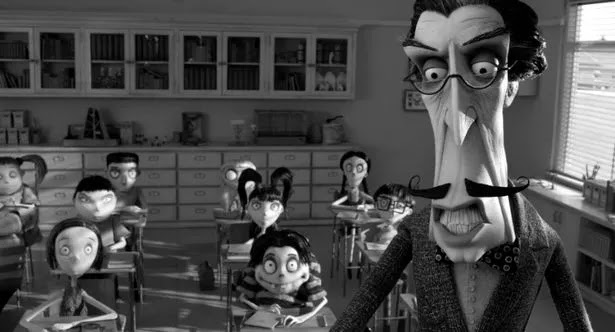
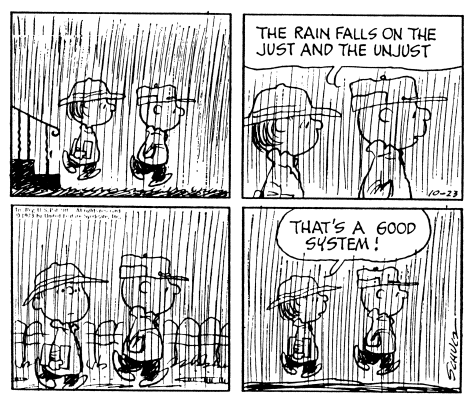
Sparky exhibits a far greater depth of moods than a trained pit-bull terrier could exhibit in live action, not only in its darker moments, but especially in moments of joy—the animation of the dog running elicits fond feelings immediately, as the puppet is rarely touching the ground in motion, not unlike Charles Schulz's "Peanuts" kids who hover over the ground in transit. And although the human figures are Burton cyphers (resembling the human character designs of his first film Vincent) they are still soulful, their eyes expressing more emotions than their faces will betray.
Given that the subject matter is about a mad scientist of a little boy who runs the parallel path of his literary namesake to re-animate his beloved dog, killed in a traffic mishap, there's a lot of room for high emotion there, and far more than in the motivations of the original story.

But, Burton takes it further and makes it more than about young Victor. Taking pages from The Nightmare Before Christmas and Batman Returns, he stages the denouement at a city festival that brings all parties together in one spot, the communal experience gone awry.
Seems that Victor's work has attracted a lot of attention among his classmates, and as there's a science fair going on, all the kid's are doing the same thing—literally, the same thing, bringing to life their dead pets with very mixed results, and providing Burton a chance to explore other species of monster movies (and recreating scenes from them) than just the one, paying tribute to each, just as he does by including a scene from friend Christopher Lee's turn as "Dracula."
Like Victor's experiment, this is a labor of love as Burton—just as with the earlier short—resurrects the movies he loved as a kid, long-buried memories that never really leave, and have influenced Burton throughout his career. It's a fun, resonant electrification of his earlier work, with just enough fresh in it to make it worth the effort and bring it back to new life in leeched black-and-white (which Burton always manages to make look sumptuous). Now, if only we could see something wholly new and original from him, that would be some experiment.

The original Frankenweenie


Brad Bird's "Family Dog" (from Steven Spielberg's "Amazing Stories") based on animation designs by Tim Burton

* It did find it's way to Paul Reubens who'd been trying to find a suitable director to collaborate on his long-in-the planning Pee-Wee Herman movie he'd been dreaming about.  Frankenweenie convinced him to contact Burton.


Tuesday, July 16, 2024

Fly Me to the Moon (2024)

Today is the 55th Anniversary of the launch of Apollo 11—the NASA space mission that did, indeed, land the first Earth-people on another world.

A Lie's Still a Lie If Everybody Believes It
or  
"Actually...Leave Them Up. Let Them Think About What They Did."
 
Fly Me to the Moon—which was saved from going straight to streaming by audience surveys—already has a couple strikes against it for me before I even see the movie.
 
1) It's a rom-com, a genre that leaves me cold for its predictability and formulaic structure: Meet Cute; Get Involved; Get Closer; Complications and Misunderstandings; Split Up and Simmer; Coming to Terms—Sacrifice; Ride Off into the Sunset. Two-step drama, with a mere distraction in the middle.
 
2) It floats that old chestnut of conspiracy theorists—the Apollo 11 moon landing in 1969 was faked. I hate that crap. I wasted too many hours online debunking them that I just gave up with some useful links to YouTube people using "facts" and not "feelings" against the absurdist arguments thrown up by others. The best reply is Buzz Aldrin's; he punched one of these nuts in the nose.* I won't waste time on it here, but a lot of the explanation for the origins of this vacuousness (and arguments against) are displayed here and here.  
 
Of course, this isn't the way things should be; one should go into a movie without prejudice, without expectations. I couldn't do that. Bear that in mind.
For the most part, Fly Me To the Moon gets its facts right ("with a lie or two"): there's the standard run-down of what set "The Space Race" up—Russia's Sputnik launch in 1957, America's fears leading to its fast ramp-up and militarization of a space program, and just as we were getting to the stage of moving out of Earth-orbit flights, there was a horrific fire on the launch-pad of Apollo 1 during a test exercise killing the astronauts and causing a significant pause to "get it right." A revamped Apollo capsule was tested, re-tested, and fire-proofed and missions were done to test it, the lunar landing craft (or LEM) and a sortee made around the Moon on Apollo 8. There was a lot of prep, a lot of testing, with the Apollo 1 fire reminding everyone that the mission was "to land a man on the moon and return him safely to Earth."
That's top of mind to Cole Davis (Channing Tatum), flight director at Kennedy Space Center—the place where they assembled the rocket and launched it—Fly Me to the Moon bases the fictional character on Deke Slayton, one of the original Mercury astronauts, who was not allowed to fly because of an atrial fibrillation—"an a-fib" they call it in the movie—a heart murmur. Slayton did not become "Flight Director of Kennedy Space Center" but managed "The Astronaut Office" until he flew on the Apollo-Soyuz joint mission. He is "gung-ho" on the Mission as he was present at the time of the Apollo fire and he takes everything, every nut, bolt, and screw, seriously. And semi-seriously as he's superstitious of the feral black cat that hangs around KSC.
Then there's Kelly Jones (
Scarlett Johansson), of "Kelly Jones Advertising." Her job has less to do with reality than it is does with "feelings" and the manipulation of same to win clients and thus, their customers. Like Cole, she's a problem solver, but with a different bent. Her area of expertise isn't science or engineering but psychology—Cole doesn't like weak spots; Kelly loves them. She'll use them to her advantage and if it's a little dishonest, the ends always justify the means. That's how it works in advertising and she sails through her territory friction-less and A-OK.
But, when she's approached by a Man in Black (
Woody Harrelson) from the Nixon Administration to "sell" the Moon landing to the American public, she can't resist—it's a government job! And she begins setting up interviews for the press (against NASA regulations but she hires actors to get around that little detail), selling space ad campaigns to willing clients (NASA didn't "do" ad campaigns, but a lot of their contractors were all too willing to crow about it), and doing a little influence-peddling with congressmen voting on funding bills (which certainly happened and is happening today).
For Cole, this is like sticking corporate logos on a capsule to make it look like a NASCAR. It's disrespectful, unnecessary to the program and...just dishonest. It's only when Harrelson's MIB starts interfering that things start turning into a major head-ache—putting cameras on the spacecraft (the idea! Even though*cough* it'd really been happening since Apollo 7). In space you can't change course, but the winds of politics keep threatening to blow things off course.
"You got your notebook?"
But, it's a ROM-COM, and they never stray off track! Cole and Kelly have their differences, so, of course, they have to bend a little and if that's in each other's direction....well...
How is it? Well, as I said on the recent Lambcast about it, it "didn't piss me off" (which, considering I had two strikes against it before entering the theater says a lot about the charm of the thing). Johansson and Tatum could orbit around this sort of material in their sleep, but she never misses an opportunity to display a worry-line and he makes stubborn male obstinancy attractive. Some of the writing is quite clever, the meticulousness of the art direction and the costuming is spot-on (especially for the casual-wear of the males) and 
Greg Berlanti has a much better eye directing movies than he does producing superhero shows for the CW.
"uhhh...how are they going to stand this thing up?"
(My plastic models of it broke apart in this configuration!!)
But, for criminy sake, one can't look at the movie and think that even the most gullible of audiences won't "buy" some of the stuff they see being shown on-screen. I'd mention some buy they'd be "spoilery" and that's one conspiracy I just won't stand for (some things should be left secret, dammit!).
Let's just say that they got a lot of stuff wrong while maintaining just a bit of the right stuff.
It's a rom-com, so OF COURSE there's going to be a "flying scene!"

* The second best argument is the one for folks who know nothing about the space program (which I grew up watching): Okay...say you fake Apollo 11. Did they also fake Apollo's 12, 14, 15, 16, 17...all of which were larger in scope and covered terrains that couldn't be housed in the BIGGEST warehouse-studios...not to mention Apollo 10 (the dress rehearsal that got tantalizingly close—10 miles—to the lunar service)...and fake Apollo 13, which was a mission FAILURE! 
 
If you seriously believe there was still a conspiracy you're either obstinate in the light of facts, desperate, or certifiable. You need help. Get it. Start with research.