Tomorrow is Father's Day and we'll be doing a yin-yang on the subject this weekend. "Good Dad" today. "Bad Dad" tomorrow.
Although today is traditionally "Take Out the Trash" Day, we'll forgo it for Good ol' Dad.
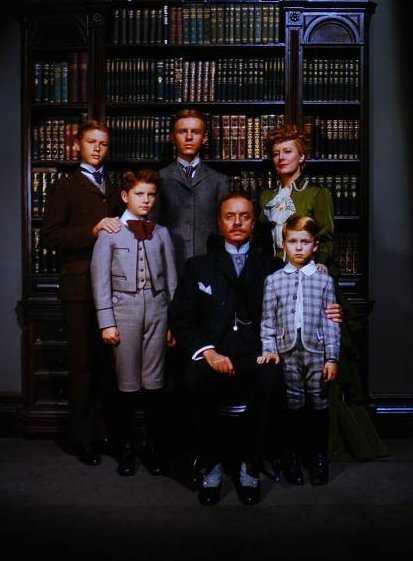
Life with Father (Michael Curtiz, 1947) "Oh, GAD!" Another one of those movies I've always had the opportunity to see but never did. A perennial for local television stations to have in their "libraries" for weekend programming (this was back in the day when local stations didn't fill their schedules with info-mercials), I had plenty of chances to catch this one on the tube, (and I would for fifteen minutes—tops—then move on) but I never did. My bad. This one needs to be taken in in one sitting, (preferably in a theater because the Technicolor is breath-takingly sharp), telephone off, and at full attention.
"I am the character of my household!" booms Clarence Shephard Day, as he's choosing the latest in a long line of maids, which he has chased out of his employ in the last few months, many of them in tears and some in hysterics. Truer words were never spoken. He is the titular patriarch of Life with Father, from the hit Broadway play,* based on the remembrances of Clarence Day, Jr. of turn-of-the-century living with a father-figure who paces slowly in his own grooved path. William Powell plays the role, one he actively petitioned for.
It's a charming film, full of easy irony about the mores and prejudices of the time, where male pomposity poses as dignity, and more separates people than unites them—easy excuses for keeping things nice and orderly on the surface, while underneath, they are broiling with chaos that is easily ignored and denied. Clarence Day, Sr. denies at the top of his lungs, and his monologues—against politics, taxes, unnecessary expenses, and organized religion (organized against him, it seems)—built individually in intensity and volume, are performances for an audience of one—himself. His barely suffering wife (played by Irene Dunne as if she were singing the entire role) has more influence over him than he is willing to admit, or recognize...or even remember. And his kid's are "mini-me's" of him, all boys, all carrot-tops, and as they age they morph further into miniature versions of The Old Man, down to his expletives and bluster.
Michael Curtiz directs formally and breezily, with his actors performing at top gear, and the director altering pace in editing and filling the frame with as much set decoration as it can hold.
The material doesn't need much else. It's strongly forced, comically subtle and has an undercurrent of mature content, that you just don't see in movies nowadays. Life with Father is from a far subtler era in which sub-texts flew over kid's heads, while the adults exchanged knowing glances and suppressed chuckles (that way you don't have to explain it to the youngsters with a simple "you'll understand some day").
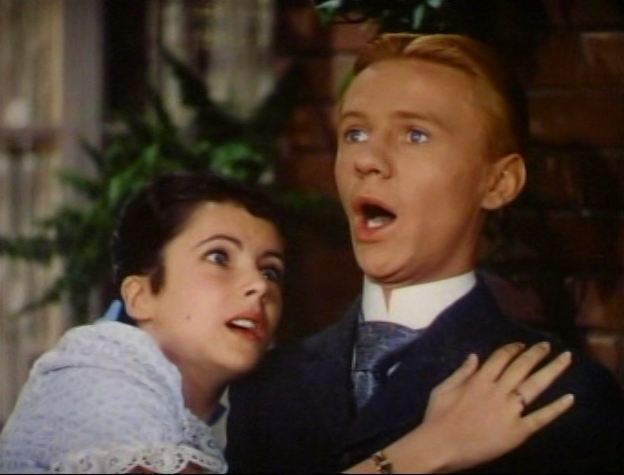
And the sub-text is sex. Clarence, Jr. is growing up, voice changed (but his violin playing still has noticeable cracks) and he's noticing girls—and when it's Elizabeth Taylor as a visiting friend's daughter, one can't help noticing. At the time of the film, it was still early in Taylor's career and her performance is breathy, needy and comes from the same type of ingenue training that produced Marilyn Monroe's early performances. Clarence wants to impress Taylor's Mary, but he can't do so in Dad's ill-fitting hand-me-down suits. The excuse is they're practical, but, as he says, "I can't do anything in Dad's clothes." But, the truth is he gets...uncomfortable...in Taylor's presence. It's not bluntly said, it's danced around, implied, suggested, but never spelled out (as would be the norm today). It's hilarious, charming, and pays off in some ironically comic laugh-lines throughout the film.
Yeah, they "don't make 'em like this anymore." More's the pity. Life with Father deserves its classic status—for some reason, it's not in the National Film Registry—because it's smart, pointed...and hilarious.
GAD!
* It still holds the record for the longest run of a non-musical stage-play.
Showing posts with label Elizabeth Taylor. Show all posts
Saturday, June 17, 2023
Tuesday, June 14, 2016
Suddenly, Last Summer
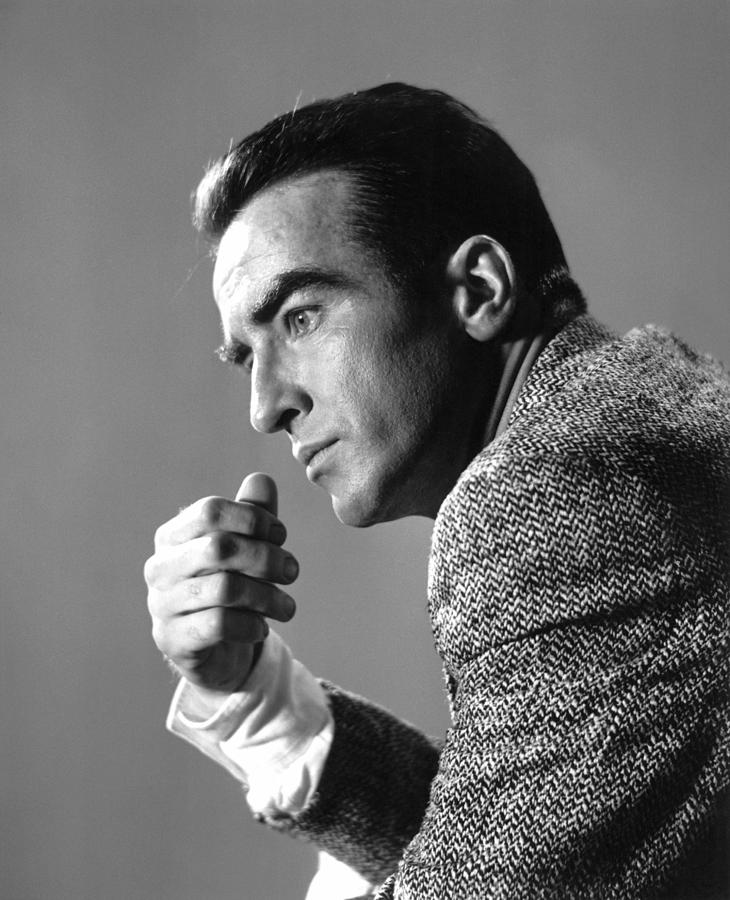
Suddenly, Last Summer (Joseph L. Mankiewicz, 1957) A tawdry gothic-noir that was so compromised by concessions to the moral powers-that-be that nobody associated with its production ended up liking it, not the original author of the play, Tennessee Williams, not his co-screenwriter Gore Vidal, nor the director Joe Mankiewicz. Pity, as its an example of how Mankiewicz could juice up material directorially in a truly unsettling way when given the chance. And he had a great cast in Katherine Hepburn, Montgomery Clift (even in the semi-drug-addled condition he was in), Elizabeth Taylor and Mercedes McCambridge.What's missing is the person everyone talks about—the late Sebastian Venable, (poet and narcissist) who died (suddenly) last summer, ostensibly of a heart attack, as the whispers state, but has nothing to do with the truth, which is damaging enough that his doting mother Violet (Hepburn) will do anything to keep it secret, even if it means lobotomizing her niece Catherine Holt (Taylor) who witnessed his death and has blanked it from her memory. Mother Violet entreats the local psychiatric hospital and its brilliant lobotomist Dr. Cukrowicz (Clift) to see if Catherine is a suitable case for treatment, with the promise of a large endowment if she can be "cured." "Cured" of the memory stuck in her head, and if not cured, silenced, whether institutionally or medically.
Except for Catherine. The play's third scene is the explanation in the drawing room scene if this were a detective novel, where Catherine, under the influence of sodium pentathol reveals all (from her point of view), and Mankiewicz goes to directorial town (his point of view) in a weird silent flashback that threatens to crowd out Taylor from the frame, and that veers wildly from realism to German expressionism to surrealism within the course of its run, containing some of the most bizarre imagery just outside the horror realm (or Salvadore Dali's dream sequence from Spellbound).
To tell you what it all means ruins the ending, except that the movie itself doesn't come right out and say anything, owing to the tenor of the times (meaning you couldn't be too explicit) and to the so-called community standards that this particular era of film-making was challenging. This was before ratings systems—G, PG-13, M, R, X and NC-17—but there was The Legion of Decency, over-run by the Catholic Church, that crossed itself, said five "Hail Mary's" and then banned your movie from being advertised. You couldn't talk about homosexuality, procurement, prostitution, drug use, pedophilia, and cannibalism except in closeted code, and the "Truth Serum" sequence obfuscates what's going on to the point of obtuseness. Williams wasn't entirely guilt-free of this; he was just as capable of pulling the shade over a naked light-bulb or turning pleurosis into "blue roses"—he made an art of it. But here, the mother-love perversity at the heart of so many of his plays runs on the hysterical side, and, try as he might, Mankiewicz can't make more of the empty book of poems than he can. All he can do is try and push Hepburn over the brink of sanity, after she's been doing wheelies near the edge that entire movie (Vivien Leigh nearly played the part; can you imagine?)
How far we have come since then—except, of course, for the cannibalism part (unless you were voted to the House of Representatives in 2010).
P.S. there's an excellent breakdown of the film, courtesy of The Last Drive-In, that did an excellent job of pulling screen-caps-two of which I cribbed above.
![]() |
| Liz Taylor glamour shot draped over the rail of an asylum |
Subscribe to:
Posts (Atom)